
For a quick, portable heat source that warms a room in minutes, the Pro Breeze 2000W Mini Ceramic Fan Heater is the one to buy. With over 7,000 reviews at 4.5 stars and a price tag under £30, it delivers reliable 2000W heat with oscillation and a built-in thermostat. It covers everything most people need, for less than the cost of a takeaway meal.
Fan heaters are the fastest way to heat a cold room. Plug one in, press a button, and you have warm air circulating within seconds. Below we’ve picked the eight best fan heaters available on Amazon UK right now, covering everything from budget desktop options to large-room tower heaters and smart WiFi models. We’ve also included practical guidance on running costs, safety, and efficiency, so you can choose the right heater and use it wisely.
Contents
- 1 Our Top Picks
- 2 8 Best Fan Heaters
- 2.1 1. Pro Breeze 2000W Mini Ceramic Fan Heater
- 2.2 2. Dreo 25 Inch Oscillating Tower Fan Heater
- 2.3 3. Dreo 1500W Compact Oscillating Ceramic Heater
- 2.4 4. ANSIO 2000W Ceramic PTC Fan Heater
- 2.5 5. Olsen & Smith 1800W Smart Ceramic Fan Heater
- 2.6 6. QEXREED 2000W PTC Fan Heater
- 2.7 7. Dimplex DXUC2BS 2000W Upright Ceramic Fan Heater
- 2.8 8. PELONIS 2000W Portable Silent Fan Heater
- 2.9 Key Takeaways
- 2.10 How Fan Heaters Work
- 2.11 Ceramic PTC vs Metal Element vs Halogen
- 2.12 Wattage, Room Sizing, and Running Costs
- 2.13 Controls and Thermostat
- 2.14 Things to Keep in Mind Before Buying
- 2.15 Types of Fan Heater
- 3 Fan Heater Buying Guide
- 4 Case Study: Heating a Draughty Victorian Terrace Home Office
- 5 Expert Insights From Our Heating Engineers About Fan Heaters
- 6 Frequently Asked Questions
- 6.1 Are fan heaters expensive to run?
- 6.2 Are fan heaters safe to leave on overnight?
- 6.3 What is the difference between a ceramic fan heater and a regular fan heater?
- 6.4 How efficient are fan heaters compared to other electric heaters?
- 6.5 Can I use a fan heater in a bathroom?
- 6.6 What size fan heater do I need for my room?
- 6.7 Is it cheaper to use a fan heater or central heating?
- 6.8 Do fan heaters dry out the air?
- 7 Summing Up
Our Top Picks
| Image | Name | |
|---|---|---|
| Pro Breeze 2000W Mini Ceramic Fan Heater | |
| Dreo 25 Inch Oscillating Tower Fan Heater | |
| Dreo 1500W Compact Oscillating Ceramic Heater | |
| ANSIO 2000W Ceramic PTC Fan Heater | |
| Olsen & Smith 1800W Smart Ceramic Fan Heater | |
| QEXREED 2000W PTC Fan Heater | |
| Dimplex DXUC2BS 2000W Upright Ceramic Fan Heater | |
| PELONIS 2000W Portable Silent Fan Heater |
8 Best Fan Heaters
1. Pro Breeze 2000W Mini Ceramic Fan Heater
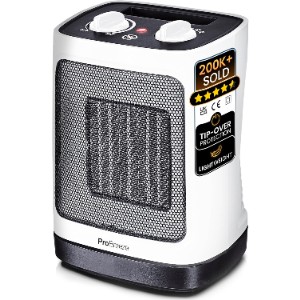
Over 7,000 UK buyers have reviewed this heater, and the verdict is consistently positive: it works, it’s reliable, and it’s a bargain. The Pro Breeze 2000W uses a PTC ceramic heating element that warms up quickly and cuts out automatically if it overheats. You get real heat fast, with a safety net built in.
There are two heat settings (1000W and 2000W), plus a cool-air fan-only mode, an adjustable thermostat, and 70° oscillation to spread heat across a room rather than just blasting one spot. It’s compact enough to sit on a desk or worktop, and the carry handle makes it easy to move between rooms.
The noise level is moderate. You’ll hear it, but nothing that would bother most people in a living room or kitchen. For a bedroom, the slightly louder units lower down the list might put some off, though many find it perfectly usable overnight.
At under £30, this is the fan heater most UK households should start with. It handles small and medium rooms comfortably, the build quality is solid for the price, and the review volume means any early faults would have shown up by now.
Features
- 2000W PTC ceramic heating element with two heat settings
- Cool-air fan-only mode for summer use
- 70° oscillation for wider heat distribution
- Adjustable thermostat with auto cut-off
- Tip-over and overheat protection
- Compact design with carry handle
- Outstanding value: under £30 with 7,000+ reviews
- PTC ceramic heats up faster than wire-element heaters
- Oscillation distributes warmth across the room
- Lightweight and easy to move around
- Audible fan noise (not the quietest option)
- Best suited to small and medium rooms
2. Dreo 25 Inch Oscillating Tower Fan Heater
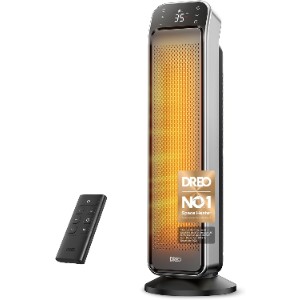
If you’re heating a living room or open-plan kitchen rather than a desk or bedroom corner, the Dreo 25 Inch tower heater is a serious upgrade. With 7,585 ratings at 4.5 stars and 70° oscillation, it covers a larger area than a compact desktop unit, and at just 25dB on its quietest setting, it’s remarkably silent for a fan heater.
The tower design means it stands free without taking up surface space. A remote control lets you adjust temperature, switch modes, and set the 1–12 hour timer from the sofa. Three heating modes and three fan speeds give you fine control over how much heat you want and how quickly.
Running cost is reasonable: it uses a ceramic element with ECO mode, so the thermostat cycles the element on and off rather than running flat-out continuously. The V0 flame-retardant casing, reinforced plug, and 45° tip-over protection make it a safe choice for households with children or pets.
Features
- 25 inch tower design with 70° oscillation
- 25dB ultra-quiet operation, suitable for bedrooms
- Remote control and 1–12 hour timer
- 3 heating modes, 3 fan speeds
- ECO mode with thermostat cycling
- V0 flame-retardant material, 45° tip-over protection, child lock
- Extremely quiet at 25dB, barely noticeable
- Covers large rooms effectively with 70° oscillation
- Remote control and timer for convenience
- 7,500+ reviews back up the quality
- Significantly pricier than compact options
- Larger footprint than desktop heaters
3. Dreo 1500W Compact Oscillating Ceramic Heater
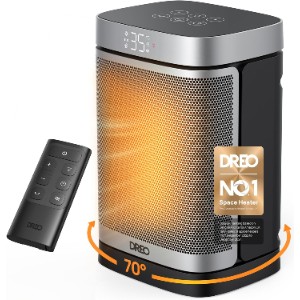
This is the sweet spot in Dreo’s fan heater range. At £39.99, it’s not the cheapest, but you get a remote control, a 1500W PTC ceramic element powered by a DC motor, 70° oscillation, and a 1–12 hour timer, all in a unit that’s compact enough for a desk or bedside table. The hidden carry handle is a nice touch.
The DC motor is worth calling out. Traditional fan heaters use AC motors with three blades; this uses a nine-blade DC motor that pushes significantly more air for the same power draw, which translates to faster heating and more consistent warmth across the room. Combine that with an electronic thermostat adjustable between 3°C and 35°C and you’ve got precise, efficient heat.
With 5,079 ratings at 4.5 stars, this is a thoroughly proven product. ECO mode keeps bills in check by cycling the heating element on and off rather than running continuously. Good all-round choice for a bedroom, home office, or smaller sitting room.
Features
- 1500W PTC ceramic with high-efficiency DC motor (9 blades)
- 70° oscillation with remote control
- Electronic thermostat: 3–35°C
- 1–12 hour timer with LED display
- ECO mode for energy-efficient cycling
- Overheat and tip-over protection
- DC motor heats faster than standard AC heaters
- Remote control and precise thermostat
- Compact but with oscillation and timer
- 5,000+ reviews confirm reliability
- 1500W rather than 2000W: slower in very cold rooms
- Slightly pricier than the basic options
- Remote control requires line of sight
4. ANSIO 2000W Ceramic PTC Fan Heater
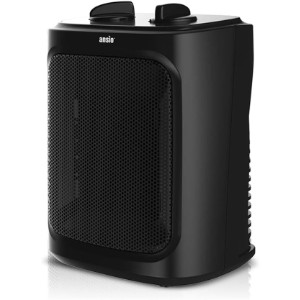
Under £20. Full 2000W output. 2,000+ reviews at 4.5 stars. If your main priority is getting a room warm without spending much, this is the pick.
The ANSIO is a no-frills fan heater with two heat settings (1000W and 2000W), an adjustable mechanical thermostat dial, tip-over and overheat protection, and a compact upright design. There’s no oscillation, no remote, no timer. What it does is provide straightforward heat from a proven PTC ceramic element, reliably, for years.
It’s noisier than the more expensive units, and the thermostat dial lacks the precision of a digital display. But for a cold utility room, workshop, or second bedroom that only needs occasional heating, paying under £20 for a solid heater is very hard to argue with. Keep expectations proportionate and you’ll be very happy with this one.
Features
- 2000W PTC ceramic element with two heat settings
- Mechanical adjustable thermostat
- Tip-over and overheat protection
- Compact upright design
- Cool-air fan mode
- Exceptional value: under £20
- Full 2000W output for fast heating
- Simple controls, nothing to go wrong
- No oscillation, timer, or remote
- Mechanical thermostat is less precise
- Fan noise is noticeable
5. Olsen & Smith 1800W Smart Ceramic Fan Heater
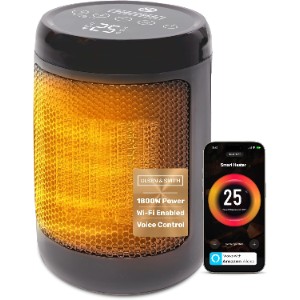
If you want smart home integration without paying over the odds, the Olsen & Smith 1800W is worth a look. WiFi-connected via app, compatible with Amazon Alexa and Google Assistant, and priced at £29.99, it’s one of the most affordable smart fan heaters on the market.
PTC ceramic element, two heat settings (900W and 1800W), adjustable thermostat, and a scheduling function via the app. You can set it to warm the room before you get out of bed, or switch it off remotely if you forget when leaving the house. For renters and those without smart thermostats, this fills a genuine gap.
The caveat is the review count. Just over 100 ratings compared to the thousands on the Pro Breeze or Dreo. The early signals are positive (4.6 stars), but this is a newer product and the track record is shorter. Worth the risk at this price if the smart features appeal.
Features
- 1800W PTC ceramic with WiFi/app control
- Compatible with Alexa and Google Home voice control
- Scheduling function via smartphone app
- Two heat settings plus fan-only mode
- Adjustable thermostat with overheat protection
- Smart/WiFi control at a budget-friendly price
- Alexa and Google Home compatible
- Scheduling makes it genuinely practical
- Fewer reviews than established picks
- 1800W rather than the full 2000W
- No oscillation
6. QEXREED 2000W PTC Fan Heater
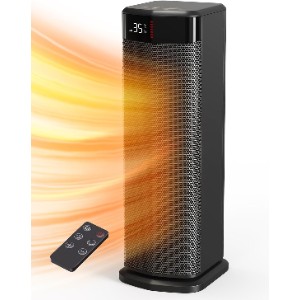
The QEXREED sits in the £50 bracket and punches above its weight on features: four heating modes, an LCD display, a 12-hour timer, adjustable thermostat, and a child lock. It’s a more feature-complete package than the Pro Breeze or ANSIO, aimed at people who want more control without going all the way to a smart heater.
PTC ceramic element delivers 2000W output, and the combination of modes lets you match heat output to the room and time of day. At 799 reviews and 4.5 stars it’s well-established enough to buy with confidence. The built-in handle makes it easy to carry between rooms.
Features
- 2000W PTC ceramic element with 4 heating modes
- LCD display with adjustable thermostat
- 12-hour programmable timer
- Child lock and overheat/tip-over protection
- Carry handle for portability
- LCD display and 12-hour timer, giving more control than budget picks
- Child lock is a useful safety addition
- Full 2000W output
- No oscillation or remote
- Pricier than the Pro Breeze for broadly similar heat output
- Not a smart/WiFi heater at this price point
7. Dimplex DXUC2BS 2000W Upright Ceramic Fan Heater
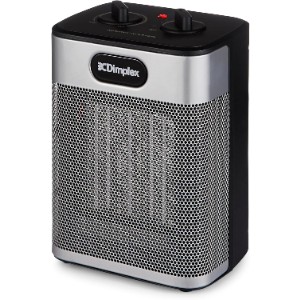
Dimplex is one of the most trusted names in UK electric heating, and this upright ceramic fan heater carries that reputation at an accessible £34. Three heat settings, fan-only mode for summer, adjustable thermostat, tip-over and overheat protection, everything you’d expect from a no-nonsense Dimplex product.
The upright form factor is worth noting: it stands vertically rather than sitting flat on a surface, which makes it a little more stable on uneven floors and gives it a smaller footprint on a desk or table. PTC ceramic technology heats quickly and self-regulates, reducing the risk of overheating.
Review volume is still building (31 ratings), so treat this as a brand-trust purchase rather than a crowd-validated one. Given Dimplex’s track record in the UK market, that’s a reasonable bet.
Features
- 2000W PTC ceramic element with 3 heat settings
- Fan-only cool mode for year-round use
- Upright compact design with adjustable thermostat
- Tip-over and overheat protection
- Trusted Dimplex brand with UK market heritage
- Reliable Dimplex brand quality
- Compact upright design saves desk space
- Fan-only mode extends its usefulness year-round
- Very few reviews as yet
- No timer, remote, or oscillation
- Slightly more expensive than the ANSIO for similar spec
8. PELONIS 2000W Portable Silent Fan Heater
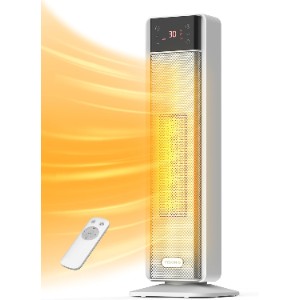
The most expensive pick on this list at £76.99, and the one that divides opinion most neatly. PELONIS has made a clear design choice here: quiet first, price second. The result is a 2000W heater that’s noticeably more hushed than a standard fan heater, making it a genuine option for light sleepers or those working from home in a quiet space.
With 196 ratings at 4.6 stars it’s performing well, and the build quality reflects the price. If the noise level of a standard fan heater is what’s putting you off the category, this is the answer. If you don’t mind a bit of background hum, most of the heaters above will do the same job for considerably less money.
Features
- 2000W energy-efficient silent fan heater
- Quiet operation for bedroom and office use
- Multiple heat settings with thermostat
- Overheat and tip-over protection
- Portable design with carry handle
- Significantly quieter than standard fan heaters
- 4.6 stars and strong early reviews
- Good choice for bedrooms and offices
- Expensive for a fan heater
- Modest review count compared to top picks
- Quieter alternatives exist at lower price points (Dreo 25″)
Key Takeaways
- Fan heaters work by blowing air across a heated element, producing fast, directional warmth within minutes. They are the quickest portable heaters to raise room temperature but are less suitable for sustained background heating because they consume more electricity than oil-filled or infrared alternatives at equivalent output
- Ceramic PTC (Positive Temperature Coefficient) elements are the standard in modern fan heaters. The element self-limits its temperature, making it inherently safer and more efficient than older metal wire elements. A 2kW ceramic fan heater at 27p/kWh costs approximately 54p per hour at full output; with thermostat cycling, typical running cost drops to 15 to 25p per hour
- Wattage determines heating speed, not energy efficiency. A 2kW fan heater and a 2kW oil-filled radiator consume identical electricity per hour. The fan heater heats the room faster; the oil-filled model retains warmth longer after switching off. For occasional rapid heating, fan heaters are the right choice; for sustained room heating, they are not the most economical option
- Safety features are non-negotiable: look for tip-over protection (cuts power if the unit falls) and overheat cutoff (cuts power if the element exceeds a safe temperature). Both are standard on quality models and required by UK safety regulations for portable electric heaters
- Noise varies significantly by design. A fan heater running at high speed is audible across a room. For bedrooms or quiet offices, look for models with a low-speed setting that reduces fan noise to a background hum, or choose an oil-filled or infrared alternative for silent operation
How Fan Heaters Work
A fan heater pulls cool room air in through a grille, passes it over a heated element, and blows the warmed air back into the room. The fan is what distinguishes them from convector heaters, which rely on natural convection rather than forced airflow. The fan accelerates heat distribution, warming a room significantly faster than passive heating methods. A 2kW fan heater can raise the temperature of a well-insulated 15m² room by 5°C in 10 to 15 minutes.
The trade-off is noise and electricity cost. The fan motor adds noise at all speeds, and because the element and fan run simultaneously, a fan heater at maximum output is never silent. For rooms where you need rapid heat for a defined period (getting dressed in a cold bathroom, warming a home office before starting work), this is a worthwhile trade. For overnight heating or background warmth in a living room, quieter and more efficient options are usually preferable.
Ceramic PTC vs Metal Element vs Halogen
Three heating element types appear in fan heaters sold in the UK. Ceramic PTC elements dominate the market because they self-regulate: as the ceramic heats up, its electrical resistance increases, automatically reducing current draw and preventing overheating. This makes PTC ceramic elements safer, more consistent in output, and less prone to burning dust particles that cause the characteristic smell of older metal-element heaters.
Metal wire or coil elements are found in older and budget fan heaters. They glow red-orange at operating temperature, produce slightly drier heat, and have no self-limiting function. They require more robust overheat protection and produce more of the burned-dust smell when first turned on in autumn. Halogen elements are used in some compact models; they heat up in seconds and produce both radiant and convective heat, but the visible orange glow can be distracting in bedrooms. For most buyers, a ceramic PTC model is the right default.
Wattage, Room Sizing, and Running Costs
Use 100W per m² as the starting rule for a well-insulated room with average ceiling height. A 12m² bedroom needs 1,200W; a 20m² living room needs 2,000W. For poorly insulated older properties, increase this by 20 to 30%.
| Room Size | Recommended Wattage | Cost per Hour (full output) | Cycling Cost per Hour |
|---|---|---|---|
| Small bedroom (10m²) | 1,000W | 27p | 10 to 15p |
| Standard bedroom (15m²) | 1,500W | 41p | 15 to 22p |
| Living room (20m²) | 2,000W | 54p | 20 to 30p |
| Large room (25m²) | 2,500W | 68p | 25 to 38p |
Running costs assume 27p/kWh. Cycling cost assumes a thermostat operating the element at 50 to 70% duty cycle. Fan heaters with good thermostats can be reasonably economical for short heating periods; the problem arises when left running continuously at full output without thermostatic control.
Controls and Thermostat
The most important feature after safety is a thermostat. A fan heater without a thermostat runs at full output until switched off, consuming maximum electricity regardless of whether the room has reached a comfortable temperature. A thermostat cycles the element off once the set temperature is reached and back on when the room cools, which can halve running costs compared to uncontrolled operation.
Digital thermostats with 1°C precision are standard on mid-range and premium models. Mechanical dial thermostats on budget models are less precise but still better than no thermostat. Programmable timers are valuable for a home office or studio that needs warming before arrival: set the heater to switch on 20 minutes before you enter.
Oscillation distributes heat more evenly across a room. Models with a 70 to 90° oscillation arc are more effective in larger spaces and avoid the uncomfortable experience of standing directly in the hot airflow. For a small bathroom or box room, fixed-direction is adequate.
Things to Keep in Mind Before Buying
Fan heaters are not suitable for bathrooms unless they carry the appropriate IP rating and bathroom zone certification. Standard fan heaters must not be used in Zone 1 or Zone 2 bathroom areas. Purpose-designed bathroom fan heaters with pull-cord switches are a separate product category.
Noise at high speed can be intrusive. Most fan heaters are louder than oil-filled radiators or panel heaters at equivalent heating output. If noise is a concern, read reviews specifically for noise at different speed settings, or choose a model with a low-speed option that reduces airflow and noise while still producing useful heat.
Types of Fan Heater
Compact personal fan heaters (750W to 1,500W) are small enough to sit on a desk or shelf, plug into a standard socket, and heat a personal zone. Best for offices, bedrooms, and small rooms. Price range £15 to £50.
Full-size portable fan heaters (2,000W to 3,000W) are freestanding units suitable for living rooms, workshops, and larger spaces. Most include oscillation, digital thermostat, and remote control at mid-range prices. Price range £30 to £100.
Ceramic tower fan heaters combine a fan heater with a tower fan format. They oscillate, distribute heat at a higher level than floor units, and work as cool fans in summer. Price range £50 to £150.
Bathroom fan heaters are IP-rated, pull-cord operated, and zone-certified for bathroom installation. Wall or ceiling-mounted, hardwired connection required. Price range £40 to £120.
Fan Heater Buying Guide
Key Takeaways
- Fan heaters deliver warmth in seconds and are ideal for quick heating needs or topping up existing heating
- 1,000W suits small rooms (up to 10m²), 1,500W for medium spaces (10-15m²), 2,000W+ for larger areas
- PTC ceramic models are safer and more efficient than conventional coil heaters, with better temperature self-regulation
- Running costs are higher per hour than oil-filled radiators, so use them for brief periods rather than all-day heating
- Noise is a real consideration. PTC ceramic models are quieter; conventional coils can be quite loud
- Modern fan heaters include thermostats, timers, cool modes, and overheat protection as standard
- Tower models distribute heat better for living spaces; compact models suit desks, bedrooms, and travel
- Safety features like tip-over switches and cool-touch casings are essential, especially in homes with children or pets
How Fan Heaters Work
A fan heater is elegantly simple. An electric heating element, either a wire coil or PTC ceramic panel, rapidly heats up. A fan then pushes air across this element and blows the warm air into your room. This two-step process delivers heat almost instantly, which is why fan heaters are unbeatable for warming a space in seconds.
The heating element draws electrical current and converts it to heat through resistance. Unlike oil-filled radiators or convector heaters, which take 15-20 minutes to reach full output, a fan heater produces noticeable warmth within 30 seconds. When you switch it off, the air cools quickly because there’s no thermal mass storing heat. This makes fan heaters brilliant for on-demand warmth but poor for maintaining warmth over hours.
Choosing the Right Wattage
Wattage determines how much heat output your heater can produce. Larger rooms need higher wattage, but oversizing wastes energy and money. Use this guide to match room size to the right output:
Up to 10m² | 1,000W | Home office, small bedroom, bathroom
- 15-25m²: 2,000W. Living room, kitchen, large bedroom
If your room is between sizes, pick the lower wattage and use the thermostat to maintain comfort. Higher wattage heaters also draw more power, which matters if your house has older electrics.
PTC Ceramic vs Conventional Coil
PTC ceramic elements are the modern standard. PTC stands for positive temperature coefficient, which means the element self-regulates its temperature. As it heats up, its electrical resistance increases automatically, preventing the element from overheating. The result is a safer heater that can’t burn out or pose a fire risk even if accidentally covered or blocked.
Conventional coil heaters use a metal wire that heats to a fixed, extremely high temperature. They’re cheaper to manufacture, so you’ll find them on budget models. The downside: they’re less safe (the coil can burn fabric if touched), less efficient (you can’t reduce heat without losing all output), and often noisier. For nearly all purposes, a PTC ceramic heater is the better choice. It costs a bit more upfront but runs more efficiently and lasts longer.
Running Costs
Fan heater running costs depend on wattage and how long you run it. Here’s what you’ll pay at typical UK electricity rates (around 27p per kilowatt-hour):
- 1,000W heater: approximately 27p per hour
- 1,500W heater: approximately 41p per hour
- 2,000W heater: approximately 54p per hour
- 3,000W heater: approximately 81p per hour
Running a 2,000W fan heater for two hours costs around £1.08. That’s fine for occasional use, but leaving it on all day soon becomes expensive. Oil-filled radiators cost slightly less per hour to run because they heat more gradually and efficiently, so they’re better for sustained heating. Use fan heaters for topping up warmth in the morning or evening, not for heating a room throughout the day.
Tower vs Compact Fan Heaters
Fan heaters come in two main shapes. Tower models are tall and slim, typically 60-80cm high and 25cm deep. They circulate heat more effectively because the fan sits higher and pushes warm air further into the room. They’re ideal for living rooms, kitchens, and larger bedrooms where you want the heat distributed across the entire space.
Compact models are squat and sturdy, usually 20-30cm high. They sit on desks, bedside tables, or windowsills, delivering direct heat to a localised area. Compact models are easier to move between rooms, take up less floorspace, and often include a carrying handle. They’re perfect for home offices, bedrooms where you don’t want the heater dominating the décor, and anyone who might need to relocate it frequently. The trade-off is less even heat distribution across larger rooms.
Smart Controls and Timers
Most modern fan heaters include useful controls and features. Look for these:
- Thermostat: Maintains a target temperature by automatically switching the heater on and off, saving energy
- Programmable timer: Set the heater to turn on or off at specific times, useful for warming rooms before you arrive home
- Eco or comfort mode: Reduces output to maintain the room at a lower temperature, cutting running costs
- Frost protection mode: Keeps the room above 5°C even when you’re away, preventing frozen pipes or damp
- Cool fan mode: Run the fan without the heater during summer for air circulation
- WiFi and app control: Control your heater from your phone, available on premium models
- Voice assistant compatibility: Some models work with Alexa or Google Home for hands-free control
Noise Levels
Fan heaters are inherently louder than oil-filled radiators or convectors because they have a spinning motor. If you’re planning to use one in a bedroom or quiet workspace, noise matters. PTC ceramic models are noticeably quieter than conventional coil heaters because the element doesn’t glow red-hot and the design is more refined. Budget models with cheap fans can be distracting; premium models often feature noise-dampening and slower fan speeds.
Check the decibel rating if it’s listed. Anything under 45dB is quiet enough for bedrooms; 45-55dB is tolerable for living areas; above 55dB can be disruptive. If noise is your priority, choose a compact PTC model on a low heat setting rather than a tower model on maximum output.
Safety Features
Any fan heater running on mains electricity deserves proper safety features. These are now standard on quality models:
- Tip-over cut-off switch: Automatically shuts off the heater if knocked over, preventing fire risk
- Overheat protection: Cuts power if the element gets too hot, essential with PTC ceramic models for extra safety
- Cool-touch casing: The exterior stays cool so you won’t burn yourself if you accidentally touch it while it’s running
- Thermal fuse: A one-time fuse that breaks if the heater overheats dangerously, sacrificing the heater to protect your home
Beyond the heater itself, follow these rules: keep it at least 1 metre away from flammable materials (curtains, papers, fabrics), never dry clothes on or over the heater, don’t leave it running unattended, and avoid using it in very damp rooms. Modern fan heaters are safe when used sensibly, but they’re not set-and-forget appliances.
Things to Keep in Mind Before Buying
Fan heaters are specialists at one job: delivering heat quickly. They’re brilliant for warming yourself at your desk on a cold morning or taking the chill out of a room for an hour. They’re less ideal if you’re looking to heat a bedroom through the night or warm a large open-plan space where you’re away from the heater’s direct output. For all-day heating or background warmth, an oil-filled radiator or convector heater will serve you better and cost less to run.
Noise is a genuine factor too. If you’re sensitive to sound or planning to use the heater while working or sleeping, a noisy model will frustrate you. Spend the extra on a quieter PTC model rather than being annoyed by constant fan noise. Similarly, a heater with a good thermostat and timer will use power more efficiently than one where you have to manually switch it on and off.
Finally, consider how you’ll use it seasonally. A dual-function heater with a cool fan mode adds summer value, letting you circulate air without heating. In the UK, that’s a useful feature even if you only use it occasionally. Look for a model with a carrying handle if you plan to move it between rooms, and check the power cord length so it reaches your preferred location without requiring an extension lead.
Case Study: Heating a Draughty Victorian Terrace Home Office
Background
A self-employed writer working from home in a Victorian terrace in the north of England struggled with a single draughty back bedroom used as an office. The central heating struggled to reach the room efficiently, and running it all day felt wasteful for one person in one room.
Project Overview
Rather than upgrading the central heating setup, the homeowner decided to supplement it with a portable fan heater, using it to quickly warm the room at the start of the working day and maintain a comfortable temperature during work hours only.
Implementation
A Dreo 1500W compact oscillating heater was placed on the desk beside the monitor. The thermostat was set to 19°C. The heater ran at full power for approximately 15 minutes each morning to bring the room up to temperature, then cycled at roughly 40% duty to maintain it through the day. ECO mode handled the cycling automatically. A timer was set to switch off the heater at the end of the working day.
Results
The office reached a comfortable working temperature within 15 minutes each morning. Running the heater for a typical 6-hour working day cost approximately £1.30 per day (accounting for thermostat cycling), significantly less than running the central heating for the whole house. The homeowner reported that the oscillating heat coverage made the room feel warmer than a fixed-direction heater of the same output had previously.
Expert Insights From Our Heating Engineers About Fan Heaters
One of our senior heating engineers with over 18 years of experience in UK domestic heating installations offered this perspective on fan heaters:
“The biggest mistake people make with fan heaters is treating them like a substitute for central heating in a cold room. They’re not designed for that. They’re designed for spot heating, getting a specific person or space warm quickly. If you use them that way, they’re cost-effective and convenient. If you try to use a 2000W fan heater to compensate for a poorly insulated room all day, you’ll spend more on electricity than you would fixing the draught or adding insulation.”
“On safety, the shift from nichrome wire to PTC ceramic has genuinely changed the risk profile of these heaters. The old wire-element heaters could reach surface temperatures that would ignite fabric if something fell against the grille. PTC elements plateau at a much safer temperature. That said, keep the 1-metre clearance rule regardless of the element type, it’s not just about the element getting hot, it’s about heat building up in enclosed or restricted spaces.”
“One thing worth understanding is the difference between a mechanical and electronic thermostat. A mechanical bimetallic strip thermostat (the type you turn with a dial) cycles quite crudely. A digital electronic thermostat maintains temperature much more precisely, which means less wasted heat. For anyone planning to use a fan heater regularly, it’s worth paying for a model with a proper digital thermostat and LED display rather than just a rotary dial.”
Frequently Asked Questions
Are fan heaters expensive to run?
At the current UK electricity rate of around 24p per kWh, a 2000W fan heater costs approximately 48p per hour at full power. In practice, the thermostat cycles the element on and off to maintain your set temperature, so actual running costs are typically 30–50% lower than the theoretical maximum. Using ECO mode and setting a reasonable thermostat temperature (rather than maximum) keeps bills manageable.
Are fan heaters safe to leave on overnight?
Modern fan heaters with tip-over protection and overheat cut-off are generally safe to leave running, but it’s good practice to use the timer function and set a shut-off time rather than leaving any heater on unattended all night. Keep 1 metre of clearance around the unit, ensure there’s nothing that could fall against the grille, and never cover the heater.
What is the difference between a ceramic fan heater and a regular fan heater?
A ceramic fan heater uses a PTC (Positive Temperature Coefficient) ceramic element that self-regulates its temperature, as it heats up, its resistance increases and power consumption naturally drops. This makes it safer and more consistent than older nichrome wire-element heaters, which don’t self-regulate and can reach much higher surface temperatures. Most fan heaters sold in the UK today are ceramic PTC models.
How efficient are fan heaters compared to other electric heaters?
All electric heaters convert electricity to heat at 100% efficiency. There’s no combustion, so no energy is wasted up a flue. Fan heaters have the advantage of distributing heat actively via forced air, which means the room feels warmer faster. For short bursts of targeted heating, they’re cost-effective. For sustained all-day room heating, panel heaters or storage heaters are usually more economical because they maintain background warmth without a continuously running motor.
Can I use a fan heater in a bathroom?
Only if the heater has a specific IP (Ingress Protection) rating suitable for use in damp environments, typically IP21 or higher for bathroom use. Standard fan heaters are not rated for bathroom use and must not be installed in or near a bath or shower. If you need supplementary heat in a bathroom, look for a heater specifically designed and rated for that environment.
What size fan heater do I need for my room?
A rough guide: allow approximately 100W per square metre for a well-insulated modern room. A small bedroom of 8–10m² is adequately served by a 1000W heater; a typical sitting room of 15–20m² benefits from a 2000W unit. For large open-plan spaces, a tower heater with oscillation distributes heat more evenly than a compact fixed-direction desktop heater of the same wattage.
Is it cheaper to use a fan heater or central heating?
It depends entirely on how many rooms you’re heating and for how long. For heating a single room for a short period, a few hours in an evening, a fan heater is usually cheaper than running the boiler for the whole house. If you need several rooms warm simultaneously, or need background heating throughout the day, central heating becomes more economical. Fan heaters work best as targeted supplementary heat, not as a whole-house heating solution.
Do fan heaters dry out the air?
Fan heaters do not add moisture to the air, and the warm air they produce has a lower relative humidity than the cold air coming in, so yes, they can make a room feel drier, particularly in a well-sealed space. This is rarely a significant problem in typical UK rooms, which tend to have some natural ventilation. If you notice dry eyes or throat in a heavily heated room, a small bowl of water near the heater or a compact humidifier alongside it will help.
Summing Up
For most households, the Pro Breeze 2000W Mini Ceramic Fan Heater is the obvious starting point: well-reviewed, affordable, and reliable enough to trust. If you’re heating a larger room and want proper silence and coverage, the Dreo 25 Inch Tower is the upgrade worth paying for. Budget buyers should go straight to the ANSIO 2000W at under £20, there’s no need to overthink it.
Whichever heater you choose, use the thermostat and timer features properly, keep clearance around the unit, and treat it as targeted supplementary heat rather than a full substitute for central heating. Do that and a fan heater will serve you well for years.
Updated