

Bathrooms are one of the hardest rooms to heat effectively in a typical UK home. The combination of moisture, tiles, and limited wall space means you can’t just grab any heater and hope for the best. The STIEBEL ELTRON CK 20 Trend LCD is our top pick for most UK bathrooms, delivering powerful, whisper-quiet heat with an LCD display and weekly timer that puts it in a class of its own. But there’s a heater for every bathroom type and budget on this list.
From traditional fan heaters and smart glass panels to quartz radiant models and electric towel rails, the eight options below cover every scenario. They’re all IP-rated for bathroom safety, all available on Amazon.co.uk right now, and chosen to give you a proper mix of price points and heating styles.
Our Top Picks
| Image | Name | |
|---|---|---|
| STIEBEL ELTRON CK 20 Trend LCD Electric Wall Heater | |
| Dimplex FX20V Wall Mounted Bathroom Fan Heater 2kW | |
| Devola Smart WiFi Glass Panel Heater 1500W | |
| Hyco Zephyr DF20 2kW Downflow Fan Heater | |
| Nedis Bathroom Heater 600/1200W | |
| Ex-Pro Wall Mounted Quartz Bathroom Heater 1200W | |
| DuraTherm Electric Heated Towel Rail 700×400mm | |
| Manissa Firenze Straight Electric Heated Towel Rail |
8 Best Bathroom Heaters
1. STIEBEL ELTRON CK 20 Trend LCD Electric Wall Heater
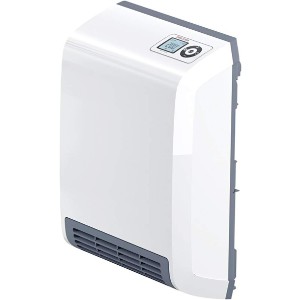
If you want the best bathroom heater money can reasonably buy, the STIEBEL ELTRON CK 20 Trend LCD is it. This German-engineered wall heater runs quieter than almost any competitor at this output, and that matters enormously in a bathroom where fan noise first thing in the morning can feel intrusive. The ceramic heating element reaches temperature quickly without the blast of a conventional fan heater, and once up to temperature the thermostat cycles so efficiently you barely notice it’s working.
The LCD display gives you precise temperature control down to 0.5°C, and the built-in weekly timer means you can programme your bathroom to be warm by the time you step out of bed each morning. That level of convenience is genuinely rare at this price point. STIEBEL ELTRON has been making electric heating equipment since 1924, and the build quality on the CK 20 reflects that heritage. The IP24 rating keeps it safe in bathroom environments where steam and splashing are inevitable.
At 2kW output it will warm a typical medium-sized UK bathroom in around 10 minutes. The step-down thermostat automatically drops to 1kW once your target temperature is reached, cutting running costs without any action needed from you. The pull-cord connection method means it can be positioned where you need it rather than where a power socket happens to be.
It costs more than the Dimplex alternatives below, but this is a heater you’ll be happy with for 15 years. The build quality, the quiet operation, and the precision controls justify every penny of the premium.
Features
- 2kW output with automatic step-down to 1kW
- IP24 rated for bathroom safety
- LCD digital display with precise thermostat control
- Built-in weekly timer
- Ceramic heating element for quiet, even heat
- Compact wall-mounted design
- Noticeably quieter than conventional fan heaters
- Excellent build quality from a trusted German brand
- Weekly timer adds real everyday convenience
- Precise thermostat keeps running costs in check
- Higher upfront cost than budget alternatives
- Requires professional hardwiring
2. Dimplex FX20V Wall Mounted Bathroom Fan Heater 2kW
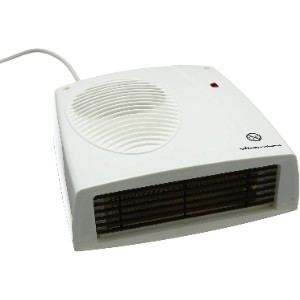
The Dimplex FX20V is the classic choice for UK bathroom heating, and there’s a very good reason it’s been a bestseller for years. It does exactly what you need a bathroom heater to do: mount on the wall, push heat downward into the room where you’re standing, and do it reliably without any fuss. Pull the cord and you’ve got 2kW of warmth within seconds. Pull it again and you’re back to 1kW for background warmth once the room is up to temperature.
The IP22 rating means it’s suitable for high-mounted positions outside the splash zones around your bath or shower. Dimplex has been manufacturing electric heating products in the UK for decades, and that experience shows in the FX20V’s reliability record. It’s the sort of heater that gets installed, then forgotten about because it just keeps working year after year.
No digital display, no app, no timer. If you want simple pull-cord convenience without any technology to go wrong, this is exactly what you’re after. At this price it’s also the easiest recommendation on this list for anyone on a tight budget who wants a proper bathroom heater from a proper UK brand.
Features
- 2kW output (1kW step-down available)
- IP22 rated for bathroom use
- Downflow design forces heat where you need it
- Pull-cord operation
- Compact wall-mounted unit
- Neon indicator light
- Trusted UK brand with decades of reliability
- Very competitive price point
- Simple pull-cord operation with no technology to fail
- Rapid heat output from a compact unit
- No timer or programmable controls
- IP22 limits positioning options in smaller bathrooms
3. Devola Smart WiFi Glass Panel Heater 1500W
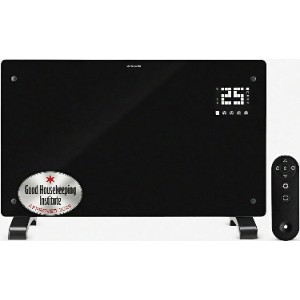
The Devola Smart WiFi Glass Panel is the pick if you want your bathroom heating connected to your smart home. It controls through the Tuya app and works with both Amazon Alexa and Google Assistant, so you can tell it to warm the bathroom while you’re still in bed. That sounds like a small thing until the first frost of the year, at which point it becomes the best feature on the list.
The glass panel design looks genuinely smart against bathroom tiles, and the ultra-slim profile takes up minimal wall space. IP24 protection covers it for all standard bathroom positions outside Zone 2. At 1500W it’s slightly less powerful than the 2kW fan heaters above, which makes it more suitable for medium-sized UK bathrooms up to about 15m². It operates silently, which is a real advantage if you have an en-suite next to a bedroom.
The 24-hour/7-day timer, multiple heating modes, and open window detection (which automatically pauses heating when a sudden temperature drop suggests a window’s been opened) make it one of the most capable heaters on this list. The main caveat is that it needs a 2.4GHz WiFi network, not 5GHz, and setup takes a few minutes through the app.
Features
- 1500W glass panel heater with WiFi connectivity
- IP24 rated for bathroom safety
- Works with Alexa and Google Assistant via Tuya app
- Multiple heating modes with 24/7 programmable timer
- Open window detection
- Silent operation
- Full smart home integration with voice control
- Sleek glass panel looks great in a modern bathroom
- Completely silent in operation
- Open window detection prevents energy waste
- 1500W may not be enough for larger bathrooms
- Requires 2.4GHz WiFi, not 5GHz
- App setup required to use smart features
4. Hyco Zephyr DF20 2kW Downflow Fan Heater
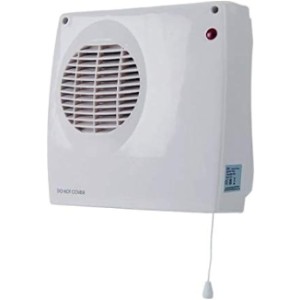
The Hyco Zephyr DF20 is a direct competitor to the Dimplex FX20V and, depending on what you prioritise, it can be the better buy. It delivers the same 2kW downflow fan heating through pull-cord operation, but the step-down thermostat is particularly well-regarded among electricians who specify bathroom heating regularly. The automatic temperature regulation switches the unit to 1kW once your set temperature is reached, meaning it doesn’t just blast on maximum until you pull the cord again.
Hyco is a specialist heating brand with strong trade credentials, and the Zephyr is used frequently in new-build and renovation projects across the UK. The IP22 rating places it in the same category as the Dimplex for positioning, so mount it high on the wall outside the immediate splash zone. Compact dimensions and a clean white finish mean it sits unobtrusively in most bathroom layouts.
Features
- 2kW output with step-down thermostat to 1kW
- IP22 rated
- Downflow design for rapid floor-level warming
- Pull-cord operation
- Suitable for bathroom and kitchen use
- Well-regarded by trade installers across the UK
- Step-down thermostat reduces energy waste
- Compact and unobtrusive design
- IP22 limits positioning options
- No timer or smart controls
- Very similar to the Dimplex FX20V without a clear price advantage
5. Nedis Bathroom Heater 600/1200W
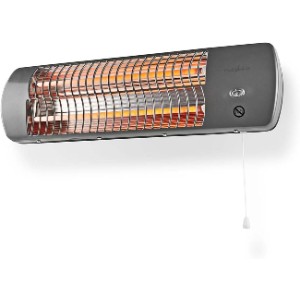
The Nedis is a different kind of bathroom heater, and that makes it useful for scenarios where the fan heaters above aren’t quite right. It uses radiant heating elements rather than a fan, warming people and surfaces directly through infrared-style radiation rather than heating the air. The result is immediate warmth when you’re standing in front of it, even in a cold, unheated room, and noticeably less draughty feel compared to forced air.
With 600W and 1200W settings it covers small to medium-sized en-suites comfortably. The IP24 rating means it can be positioned closer to your shower than IP22-rated fan heaters, which is useful in compact bathrooms where wall space is tight. It’s also completely silent, making it a good alternative for anyone who finds fan heater noise disruptive.
Features
- 600W and 1200W settings
- IP24 rated for bathroom safety
- Radiant heating for immediate warmth
- Silent operation
- Wall-mounted design
- Immediate radiant warmth with no delay
- Completely silent in use
- IP24 gives better positioning flexibility than IP22
- Less effective at warming the whole room than fan heaters
- 1200W maximum may feel underpowered in larger bathrooms
- No thermostat or timer control
6. Ex-Pro Wall Mounted Quartz Bathroom Heater 1200W
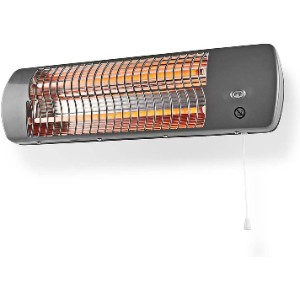
Quartz heaters are an interesting choice for bathrooms, and the Ex-Pro 1200W makes a good case for the technology. Quartz halogen elements produce heat almost instantly, faster than any other type on this list, and the radiated warmth feels noticeably different to fan heat. You’re warm the moment you switch it on rather than waiting for the room temperature to climb.
The IP44 rating is the standout specification here. Most bathroom heaters on this list are IP24, which restricts where you can position them. IP44 gives enhanced protection against water splashing from any direction, opening up more mounting options in your bathroom layout. It’s particularly useful if you’re working with a compact room where the heater needs to go closer to the shower than IP22 or IP24 models would allow.
Features
- 1200W quartz halogen heating elements
- IP44 rated for enhanced bathroom protection
- Instant heat output with no warm-up delay
- Wall-mounted design
- Multiple heat settings
- Instant heat output with zero warm-up time
- IP44 rating opens up more positioning options
- Targeted radiant warmth feels immediate
- Less effective at warming the whole room than fan heaters
- Quartz elements have a shorter lifespan than ceramic
- The glowing element can be too bright in a darkened bathroom
7. DuraTherm Electric Heated Towel Rail 700Ã400mm
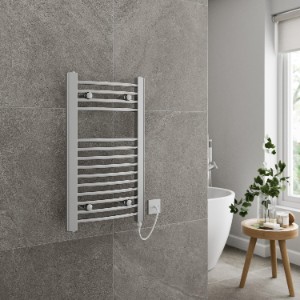
Heated towel rails don’t replace a proper bathroom heater, but they work brilliantly alongside one. The DuraTherm 700Ã400mm is a smart choice for anyone fitting out a new bathroom or undertaking a renovation. You get warm, dry towels every morning without the bulk of a separate towel heater, and the background warmth from the rail takes the edge off a cool bathroom even without additional heating.
The dual-fuel capability on this model is worth noting. It can run on the central heating circuit when your boiler is on, or switch to an electric element for use outside heating season without needing the boiler running. That flexibility makes it genuinely useful year-round. The chrome finish looks sharp against white tiles, and the 700Ã400mm footprint fits comfortably in a standard UK bathroom without dominating the wall.
If you’re choosing between this and the Manissa Firenze below, the DuraTherm wins on versatility. The dual-fuel option is genuinely useful, and the 700mm height gives you enough rail space for two large bath towels at once.
Features
- 700Ã400mm chrome heated towel rail
- Dual fuel capability (central heating or electric element)
- Standard UK plumbing connections
- Includes electric element for independent use
- BTU output provides useful background warmth
- Dual fuel works on central heating or electric
- Keeps towels warm and dry every day
- Looks great in modern and traditional bathroom settings
- Not a standalone heating solution for cold bathrooms
- Requires both a plumber and electrician for dual-fuel installation
8. Manissa Firenze Straight Electric Heated Towel Rail
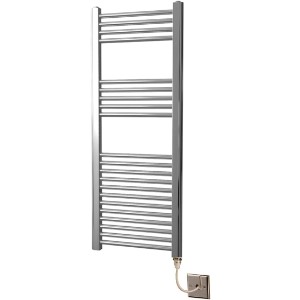
The Manissa Firenze is for those who want a straightforward electric towel rail without the dual-fuel complexity. It’s purely electric, which simplifies installation considerably. An electrician connects the element and you’re done. No plumber required. The straight-bar Firenze design suits both traditional and contemporary UK bathrooms, and the chrome finish holds up well to the inevitable soap splashes and steam exposure of daily bathroom use.
It won’t heat a cold bathroom on its own, but paired with one of the wall heaters above it completes the picture nicely. Warm towels ready when you step out of the shower, and residual background warmth from the rail during the day.
Features
- Classic straight bar design in chrome finish
- Electric-only operation (no plumbing required)
- Standard UK voltage compatible
- Firenze styling suits most bathroom décors
- No plumbing required, electrician-only installation
- Classic design works in most bathroom styles
- Not a substitute for a room heater in winter
- Electric-only means higher running costs than dual-fuel
- Less versatile than the DuraTherm above
Bathroom Heater Buying Guide
Key Takeaways
- Bathroom heaters must be IP-rated for water protection. IP24 is the minimum for most positions; IP44 is required in Zones 1 and 2.
- All UK bathroom electrical work must comply with BS 7671 (IET Wiring Regulations) and Part P of the Building Regulations. A qualified electrician is not optional.
- Use 100W per square metre as a starting guide for wattage. A 2kW heater suits a bathroom up to 20m².
- Fan heaters heat a cold bathroom fastest. Panel heaters and radiant models maintain temperature more efficiently once warm.
- A heated towel rail adds daily comfort and reduces condensation but should not be your only heat source in a cold UK bathroom.
- At 24p/kWh, a 2kW bathroom heater costs 48p per hour to run, or around £4.80 for ten hours of monthly use.
What Is a Bathroom Heater?
A bathroom heater is an electric heating appliance specifically designed and rated for use in the damp, steam-rich environment of a bathroom. The key difference between a bathroom heater and a standard room heater is the IP (Ingress Protection) rating, which tells you how well the unit is sealed against water penetration.
You cannot safely use a standard portable heater in a bathroom. UK electrical regulations are explicit on this point. Water and electricity are a lethal combination, and the safety ratings on dedicated bathroom heaters exist because they’ve been tested to withstand the conditions your bathroom creates every day. Never be tempted to use an extension lead to power a non-rated heater in a bathroom, even temporarily.
UK Bathroom Zones and IP Ratings Explained
This is the section most bathroom heater articles get wrong, and it matters more than almost any other decision you’ll make. UK bathroom electrical work is governed by BS 7671, the IET Wiring Regulations, which divides bathrooms into zones based on proximity to water sources.
Zone 0 is inside the bath or shower itself. Only specially designed equipment rated to IPX7 (waterproof to immersion) and operating at 12V or less is permitted here. No heaters belong in Zone 0.
Zone 1 extends directly above the bath or shower up to 2.25 metres from the floor. Equipment here must be rated to at least IP44. Most standard electric heaters are not suitable for Zone 1 installation.
Zone 2 extends 0.6 metres horizontally from the edge of the bath or shower, up to 2.25 metres high. IP44-rated equipment is required. Everything must be hardwired; no plug-in appliances are permitted anywhere in a bathroom under any circumstances.
Outside the zones covers anywhere more than 0.6 metres from the bath or shower edge, and anywhere above 2.25 metres regardless of horizontal position. This is where most bathroom heaters are installed. IP24 is the minimum recommendation for these positions, and it’s the rating you’ll find on most standard bathroom fan heaters.
In practice: a Dimplex FX20V (IP22) or Hyco Zephyr (IP22) should be mounted high on a wall, well clear of the bath or shower. The Ex-Pro quartz heater (IP44) gives you more positioning flexibility. The Devola glass panel (IP24) covers the vast majority of standard bathroom positions comfortably.
How Do Bathroom Heaters Work?
The types on this list use different heating technologies, each with distinct advantages for different bathroom situations.
Fan heaters use an electric element and a fan to blow warm air into the room. They heat up quickly and raise room temperature fast, which is what most people need from a bathroom heater. The noise of the fan is the main drawback. Downflow models like the Dimplex FX20V and Hyco Zephyr push heat downward to floor level, which is effective because cold air sinks and that’s where you’re standing.
Panel heaters and glass panels use convection with no moving parts. The STIEBEL ELTRON CK 20 uses a ceramic element that heats the surrounding air, which rises and circulates naturally. No fan means quieter operation, and they’re well-suited to bathrooms where noise is a concern. Heat-up time is slightly longer than a fan heater but not dramatically so.
Radiant and quartz heaters emit infrared radiation that warms people and surfaces directly, without heating the air first. The warmth is immediate, even in a cold room, but it’s directional: you benefit most when you’re broadly facing the heater. Good for instant targeted warmth; less effective at raising overall room temperature compared to fan heaters.
Heated towel rails heat a fluid that circulates through the rail. Their primary function is drying and warming towels, with secondary space heating as a bonus. Not standalone heating solutions, but they work very well as part of a complete bathroom heating setup.
Benefits of Using a Bathroom Heater
Beyond the obvious comfort of not stepping out of a shower into freezing air, a properly heated bathroom delivers several practical benefits that are especially relevant in older UK housing stock.
Condensation is dramatically reduced when a bathroom stays warmer. Cold surfaces cause water vapour to condense into droplets, which is the root cause of mould growth on grouting, silicone seals, and painted walls. A bathroom heater that runs for 30 minutes after your shower warms those surfaces enough to prevent condensation forming, and that makes a real difference to how long your decorating lasts.
Damp towels dry faster in a heated bathroom. If you’re not using a heated towel rail, the combination of warmth and improved air circulation from a fan heater significantly reduces drying time compared to a cold room. And for anyone with young children, a warm bathroom makes bath time genuinely less stressful.
Things to Keep in Mind Before Buying
Start with the IP rating, not the wattage. Work out where in your bathroom you can legally and safely mount a heater, check what IP rating that position requires, and then choose from heaters that meet that rating. Don’t pick a heater first and then try to make it fit.
All bathroom electrical appliances must be hardwired by a qualified electrician under Part P of the Building Regulations. There are no exceptions. Expect to pay £80 to £150 for a standard installation, and more if a new circuit needs running from your consumer unit.
On wattage: allow roughly 100W per square metre of floor space. A 2kW heater is appropriate for a bathroom up to 20m², but most UK bathrooms are 4 to 8m², meaning 1kW is often genuinely sufficient. Oversizing wastes money on the heater itself and on running costs.
For panel-style heaters, look for Lot 20 compliance. This is an energy efficiency regulation requiring smart thermostatic control, open window detection, and precise temperature management. Lot 20-compliant heaters use meaningfully less electricity in sustained use than non-compliant alternatives.
Types of Bathroom Heaters
Fan heaters are the fastest at heating a cold bathroom and ypically the most affordable. The trade-off is noise and, in some cases, the way they circulate steam and condensation around the room. They’re the most common choice in UK bathrooms precisely because they work quickly and reliably.
Panel heaters, including glass panel models like the Devola Smart, provide quieter, more even heat. They’re slower to reach full output but more comfortable to live with over time, and the smart features on mid-to-high-end models give you control options that fan heaters can’t match.
Radiant heaters, including quartz and infrared models, provide instant targeted warmth without heating the whole room. They’re suited to smaller bathrooms or situations where you want direct heat quickly rather than trying to raise the overall room temperature.
Heated towel rails occupy a slightly different category. They’re a fixture rather than a heater in the traditional sense, but the background warmth they provide is useful, and the practical benefit of warm, dry towels every day is hard to overstate once you’ve experienced it.
Case Study: Victorian Terrace Bathroom, West Yorkshire
Background
A family in a mid-terrace property in West Yorkshire had a bathroom that stayed cold throughout winter, with visible mould on the grouting and condensation running down the mirror after every shower. The existing central heating radiator was undersized and slow to respond, and the property’s solid wall construction made it harder to heat than a modern cavity wall build.
Project Overview
The goal was to improve morning comfort, reduce condensation, and deal with the mould problem without a full bathroom renovation. Budget was modest, and the work needed completing by an electrician in a single day.
Implementation
A STIEBEL ELTRON CK 20 Trend LCD was installed on the wall opposite the shower, positioned 2.2 metres up to keep it well outside Zone 2. A weekly timer was programmed to bring the bathroom to 20°C from 6:45am Monday to Friday and 7:30am at weekends. A DuraTherm heated towel rail replaced the existing undersized radiator, connected to both the central heating circuit and a separate electric element for summer use.
Results
Within three months, the mould on the grouting had not returned after treatment, and mirror condensation was reduced to a fraction of what it had been. The family reported that getting out of the shower in winter was no longer something they dreaded. Running costs for the STIEBEL heater over a typical winter month came to around £9, based on roughly 45 minutes of use per day on the weekly timer at 24p/kWh.
Expert Insights From Our Heating Engineers About Bathroom Heaters
One of our senior heating engineers with over 18 years of experience fitting electric heating in residential properties across the UK has a clear priority list for anyone buying a bathroom heater: “The first question I always ask is where it’s going. I’ve seen expensive heaters installed in the wrong zone, or with the wrong IP rating, and the homeowner has no idea until something goes wrong. Get the zone right first. Then get the IP rating. Then worry about the wattage and features.”
“On wattage, people consistently overbuy. I’ve fitted 2kW heaters in four-square-metre en-suites because that’s what the customer bought without asking. A 1kW or even 600W heater is more than enough for a small en-suite, and it’ll cost half as much to run. Match the power to the room, not to what feels reassuringly large on the box.”
“If you’re fitting anything with a fan, put it high on the wall. The fan forces air downward, which is good for warming floor level fast, but a low-mounted fan heater also distributes any steam from your shower more aggressively. High mounting keeps it well clear of Zone 2 in most standard UK bathroom layouts, which avoids IP rating complications and gives you more choice on models.”
Frequently Asked Questions
What IP rating does a bathroom heater need in the UK?
The minimum IP rating depends on where in your bathroom you’re mounting the heater. In Zone 2 (within 0.6 metres of the bath or shower edge, up to 2.25m high), you need at least IP44. In Zone 1 (directly above the bath or shower), IP44 is also the minimum, but most standard heaters are not suitable here at all. Outside both zones, IP24 is the minimum recommendation and covers most bathroom fan heaters and panel heaters. IP22 heaters like the Dimplex FX20V suit high-mounted positions well away from water sources, but IP24 gives you more flexibility on positioning.
Can I install a bathroom heater myself?
No. All electrical work in bathrooms must be carried out or certified by a qualified electrician under Part P of the UK Building Regulations. You cannot use an extension lead or standard plug socket in a bathroom. The heater must be hardwired. Attempting DIY bathroom electrical work risks electric shock and fire, invalidates your home insurance, and is not legal. A standard installation typically costs £80 to £150 for labour, plus the cost of the heater itself.
How much does a bathroom heater cost to run?
At 24p per kWh, a 2kW bathroom heater costs 48p per hour at full power. In practice, a good thermostat cycles the heater on and off to maintain your target temperature, so actual consumption is typically 40 to 60 per cent lower than the theoretical maximum. A heater running for one hour per day over a typical month will cost between £4.50 and £9.00 depending on thermostat settings and room size. A 1kW heater is half the running cost, which is why matching power to room size genuinely matters.
What size bathroom heater do I need?
The rule of thumb is 100W per square metre of floor space. A small en-suite of 3m² needs around 300W. A typical UK family bathroom of 6 to 8m² is well covered by 600W to 800W, though most people install 1kW or 2kW heaters for faster warm-up. Older properties with solid walls, stone floors, or poor insulation need more power than a modern well-insulated bathroom. When in doubt, go slightly larger rather than smaller.
Do bathroom heaters help with condensation and mould?
Yes, considerably. Condensation forms when warm, moisture-laden air meets cold surfaces. A heated bathroom means those surfaces stay warmer, so less condensation forms. Running your heater for 20 to 30 minutes after a shower, combined with an extractor fan, dramatically reduces the moisture that leads to mould on grouting and silicone. Fan heaters that circulate air actively improve this further. A heated towel rail also helps by keeping towels dry and providing residual background warmth throughout the day.
Is a fan heater or a panel heater better for a bathroom?
Fan heaters warm up a cold bathroom faster, which suits most UK households where the bathroom is only used for short periods. Panel heaters run more quietly, distribute heat more evenly, and are better for bathrooms used over longer periods or where noise is a concern, such as an en-suite next to a bedroom. For a typical morning routine of 15 to 20 minutes, a 2kW fan heater will heat the room more effectively. For a more relaxed soak where you want consistent background warmth without fan noise, a panel heater is the better choice.
Can I use a heated towel rail as my only bathroom heater?
In most UK bathrooms, a heated towel rail alone won’t provide enough warmth in winter. A standard 400W to 600W electric towel rail provides useful background warmth and keeps your towels dry, but it’s not designed to raise room temperature from cold in a reasonable time. In a small, well-insulated en-suite it might just about manage, but for a typical UK bathroom, particularly in an older property, you’ll want a dedicated wall heater alongside your towel rail. The combination of both is the ideal solution.
Summing Up
The STIEBEL ELTRON CK 20 Trend LCD is the one to buy if quality and quiet operation are your priorities. It’s the best all-round bathroom heater on this list: precise, powerful, and built to last. For a simpler, more affordable option from a trusted UK brand, the Dimplex FX20V has earned its reputation over many years and keeps on earning it. And if you want your bathroom heating connected to your smart home, the Devola Smart WiFi Glass Panel is the right call.
Whatever you choose, the IP rating and proper professional installation matter more than any feature on the spec sheet. Get those two things right and any heater on this list will serve your bathroom well for years.
Updated