
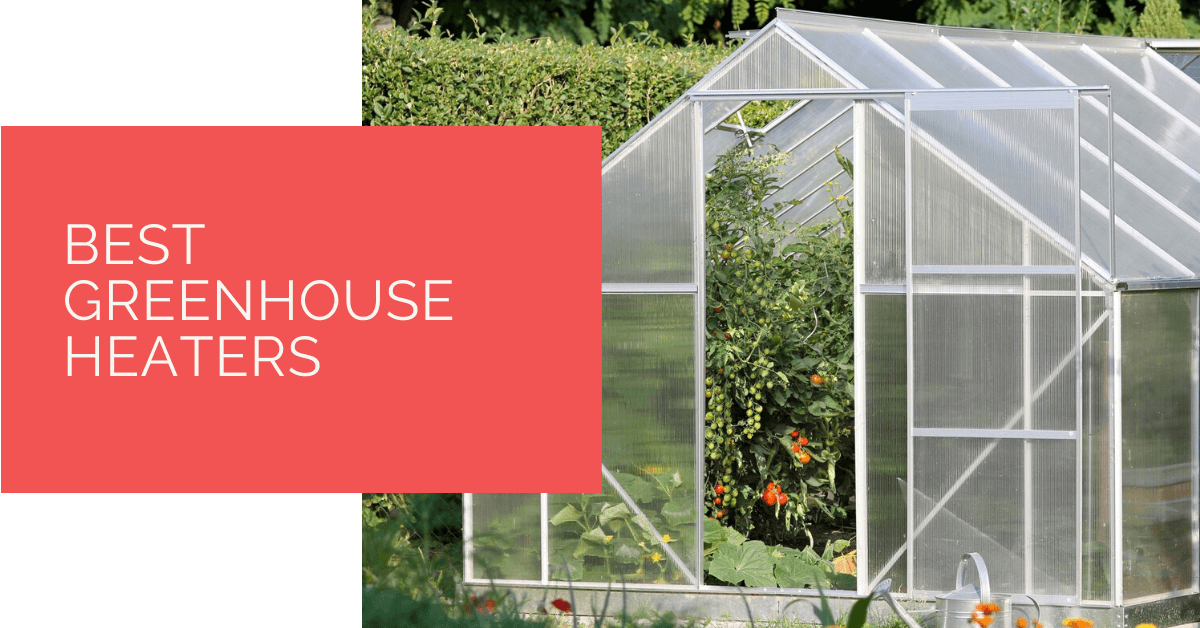
Keeping a greenhouse warm through a British winter takes more thought than most people expect. The temperature swings between a clear November night and a sunny January afternoon can be dramatic, and the wrong heater — or the wrong wattage — will either leave your plants frosted or run up an electricity bill that makes growing your own feel expensive. The AC Infinity THERMOFORGE T7 is the standout choice for gardeners who want precise control and energy efficiency, but we’ve included seven other options covering every budget and greenhouse size.
Below you’ll find our full reviews of eight of the best greenhouse heaters available on Amazon.co.uk right now, followed by a buying guide covering wattage, thermostat choice, and the key differences between tubular and fan heater designs.
Our Top Picks
Image | Name | |
|---|---|---|
| AC Infinity THERMOFORGE T7 Environmental Heater 1000W | |
| Bio Green Tropic Greenhouse Fan Heater 2000W | |
| Hydroponics 2kW Indoor Greenhouse Heater & Fan | |
| VIVOSUN AeroFlux Smart Grow Tent Heater 700W | |
| Greenhouse Heater Professional 2400W | |
| Mylek Tubular Heater 135W 1050mm | |
| Hylite Ecoheater Greenhouse & Shed Tube Heater 55W | |
| LightHouse 305mm 45W Eco Heat Greenhouse Heater |
8 Best Greenhouse Heaters
1. AC Infinity THERMOFORGE T7 Environmental Heater 1000W
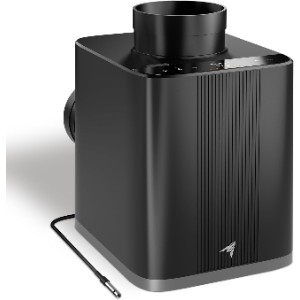
The THERMOFORGE T7 is the most sophisticated greenhouse heater on this list, and it shows from the moment you set it up. AC Infinity have built a genuinely useful VPD (Vapour Pressure Deficit) monitoring system into this unit, which tracks both temperature and humidity to give you a real picture of what your plants are experiencing rather than just what the air thermometer reads. For anyone growing seedlings, overwintering tender perennials, or running a year-round salad house, that extra layer of insight is genuinely valuable.
The 10-level PTC ceramic heating element runs cleanly and quietly, and the dual-duct design lets you direct warm air where it’s needed rather than just heating a spot near the heater. At 1000W it’s well suited to a medium-sized greenhouse — something in the 6×8ft to 8×10ft range — and the app control means you can check overnight temperatures from your phone without braving the cold. Scheduling works well: set it to pre-warm before dawn and the greenhouse is already at your target temperature by the time you arrive in the morning.
The price puts it firmly at the premium end of electric greenhouse heating, but if you’re serious about what you’re growing, the data it gives you pays back in fewer plant losses. This is the top pick for gardeners who treat their greenhouse as a growing environment rather than just a frost shelter.
Worth noting: the T7 is designed for enclosed spaces and works best when you seal draughts first. A poorly insulated greenhouse will push even a 1000W heater to its limits on a hard frost night.
Features
- 1000W PTC ceramic heating element with 10 heat levels
- VPD monitoring — tracks temperature and humidity simultaneously
- App control via AC Infinity smartphone app
- Dual-duct output for directional airflow
- Adaptive AI temperature management
- Suitable for grow tents, greenhouses, and enclosed rooms
- VPD monitoring gives real plant-environment data, not just air temp
- App control lets you check and adjust overnight temperatures remotely
- Quiet PTC element — no noisy fan cycling
- Dual-duct design distributes heat more evenly
- Premium price — significantly more than a basic fan heater
- 1000W may not be enough for large or poorly insulated greenhouses in hard frosts
2. Bio Green Tropic Greenhouse Heater & Fan 2000W
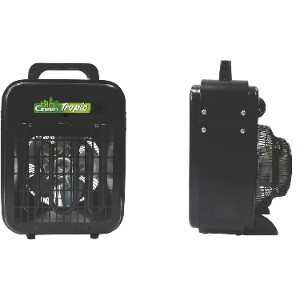
Bio Green are one of the few brands that specialise specifically in greenhouse heating rather than adapting general-purpose heaters for garden use. The Tropic reflects that: it’s built for the demands of a damp, condensation-prone environment, with an IPX4 water-resistance rating and a fan-plus-heater design that circulates warm air effectively rather than just pumping it out from one point.
The 2000W output is the right level for a standard UK aluminium-framed greenhouse in the 8×6ft to 10×8ft range, running comfortably on a frosty night without straining the wiring. The thermostat runs from 0°C to 60°C, which gives you genuine flexibility: set it low for frost protection, push it higher for propagation. Fan-only mode is useful for summer ventilation and for drying out a damp greenhouse in autumn without adding heat.
It’s not the cheapest option here, but for a dedicated greenhouse heater from a brand that understands the environment, it’s solid value. If your greenhouse is your main growing space and you want something purpose-built rather than a workaround, start here.
Features
- 2000W electric fan heater with IPX4 water resistance
- Adjustable manual thermostat 0°C to 60°C
- Fan-only mode for summer ventilation
- Designed specifically for greenhouse environments
- UK plug with integrated thermal protection
- Purpose-built for greenhouse use — not an adapted room heater
- IPX4 water resistance handles condensation and humidity
- Wide thermostat range (0–60°C) suits frost protection to propagation
- Fan-only mode useful year-round
- Higher price than generic fan heaters of similar wattage
- Manual thermostat only — no app control or scheduling
3. Hydroponics 2kW Indoor Greenhouse Heater & Fan Quiet
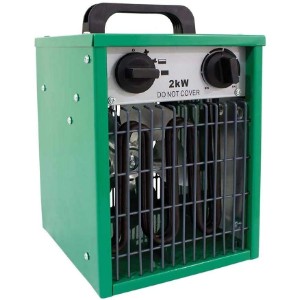
If you want a straightforward 2kW fan heater for a greenhouse or grow tent without paying premium-brand prices, this is the most popular budget option. The “Quiet UK” version runs noticeably more quietly than many competing units at this price point — still audible, but not the constant drone you get from some cheaper fan heaters.
With 2000W and a built-in adjustable thermostat, it will comfortably maintain frost-free temperatures in a standard 8×6ft greenhouse even on the coldest UK nights. The design is compact enough to sit on a shelf rather than taking floor space, and the thermostat dial is straightforward to set and doesn’t drift noticeably over time.
The trade-off versus the Bio Green above is build quality and the lack of a water-resistance rating — keep this away from direct drips or splash zones. But for a covered, reasonably dry greenhouse environment where you want 2kW of heat at a price that doesn’t sting, it does the job reliably.
Features
- 2000W fan heater with adjustable thermostat
- Compact design — shelf or floor mounting
- Quiet operation compared to budget competitors
- Thermal cut-out protection
- UK plug included
- Excellent value for 2kW of heating power
- Quieter than most budget fan heaters
- Compact and easy to position
- No water-resistance rating — avoid direct moisture exposure
- Basic thermostat dial only, no digital display or scheduling
- Fewer reviews than more established models
4. VIVOSUN AeroFlux Smart Grow Tent Heater 700W
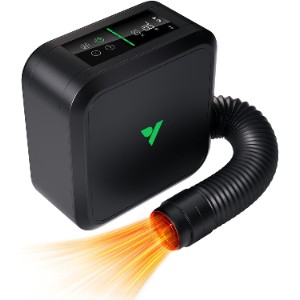
The AeroFlux sits between the THERMOFORGE T7 and a basic fan heater. At 700W it’s sized for smaller spaces — a compact greenhouse, a grow tent, or a well-insulated lean-to — and the smart features give you scheduling and temperature monitoring without paying AC Infinity prices. VIVOSUN are well established in the grow tent market and the AeroFlux shows that experience: the temperature sensor is accurate, the app is reliable, and the PTC element runs cleanly.
VPD monitoring is included, which is genuinely useful if you’re propagating or growing anything that cares about humidity as much as temperature. The extension hose attachment lets you direct warm air into specific areas of a grow tent rather than letting it diffuse randomly.
The 700W limit is the main constraint. In a hard UK winter, this will struggle to maintain growing temperatures (7°C minimum) in anything larger than a 6×4ft space. As a frost-protection heater with smart scheduling for a smaller greenhouse, though, it’s a strong option at a reasonable price point for what it does.
Features
- 700W PTC heater with smart app control
- VPD monitoring (temperature and humidity)
- Extension hose for directional airflow
- Overheat and tip-over protection
- Compatible with VIVOSUN app (iOS and Android)
- Smart scheduling and remote monitoring via app
- VPD monitoring included at this price point
- 224+ reviews with solid average rating
- Extension hose for targeted heat delivery
- 700W only — insufficient for larger or poorly insulated greenhouses
- Primarily designed for grow tents, not traditional glass/polycarbonate greenhouses
5. Greenhouse Heater Professional 2400W with Thermostat and Fan
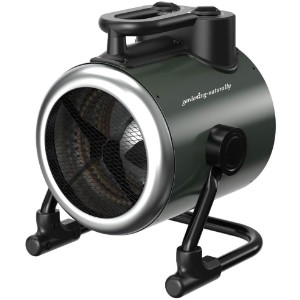
This is the pick for larger greenhouses. At 2400W it delivers meaningfully more heat than a standard 2kW unit — the difference matters when you’re trying to maintain 7°C inside a 10×12ft greenhouse while it’s below zero outside. The IP24 rating means it’s designed specifically for damp environments, and the thermostat is accurate enough to hold a set temperature without cycling too frequently.
The “Professional” branding is a bit of marketing, but the build quality does feel a step above generic imported fan heaters. For a greenhouse up to 24m² the manufacturer’s guide is reasonable — in a well-insulated polycarbonate structure, 2400W at frost protection settings is more than adequate. In an older single-glazed glass greenhouse with gaps, real-world performance will be lower.
Features
- 2400W electric fan heater with digital thermostat
- IP24 rated for damp greenhouse environments
- Suitable for greenhouses up to 24m²
- Fan-only mode for summer circulation
- UK plug with overheat protection
- 2400W output covers larger greenhouses more effectively than 2kW units
- IP24 rated — built for damp greenhouse conditions
- Digital thermostat for precise temperature control
- Relatively new to market — fewer long-term reviews than established brands
- Higher running cost than tubular heaters at equivalent frost-protection settings
6. Mylek Tubular Heater 135W 1050mm
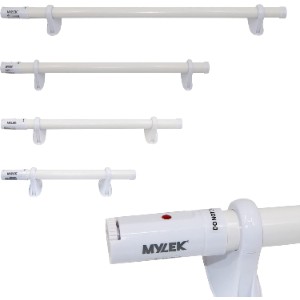
Tubular heaters are the traditional greenhouse heating solution, and for good reason. They run at low wattage continuously, provide gentle background warmth, and are far cheaper to run than a fan heater cycling on and off. The Mylek 135W at 1050mm is a well-made example of the format with a built-in thermostat — which matters, because a tubular heater without a thermostat will run at full output regardless of temperature, which wastes money and can overheat a small space on mild nights.
At 135W, this is sized for frost protection in a small-to-medium greenhouse. It won’t maintain growing temperatures on a hard frost night on its own, but paired with good insulation (bubble wrap lining is the classic) it will reliably keep the temperature above 0°C in a typical 6×8ft greenhouse throughout a British winter. The 1050mm length means it sits low along the base of the greenhouse where cold air settles, which is exactly where the heat is most needed.
Running costs at 135W are modest: at 24p/kWh, running overnight for 10 hours costs around 32p. Over a full winter month at that rate, you’re looking at roughly £10 — far less than a 2kW fan heater cycling through the same period.
Features
- 135W tubular heater, 1050mm length
- Built-in adjustable thermostat
- Mounting brackets included
- Low-energy continuous operation
- Suitable for greenhouse, garage, or conservatory use
- Very low running cost — 135W is far cheaper than a fan heater overnight
- Built-in thermostat prevents wasteful over-heating
- Silent operation — no fan noise
- Long 1050mm length distributes heat along the greenhouse base
- 135W only — not enough for maintaining growing temperatures in cold spells
- Slower to respond than a fan heater if temperatures drop sharply
7. Hylite Ecoheater Greenhouse & Shed Tube Heater with Thermostat 55W
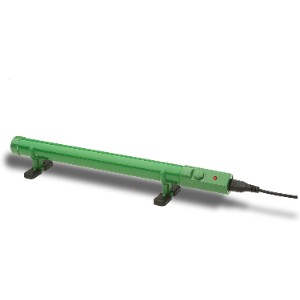
The most divisive pick on this list, depending on what you expect from it. At 55W, this is a frost-protection heater for small spaces — a cold frame, a mini greenhouse, a small shed — not a heater for a full-sized growing structure. Used correctly, it’s excellent. Over 500 Amazon reviewers have found it reliable, and the built-in thermostat means it genuinely responds to temperature changes rather than running flat out.
The 500mm length is compact, mounts neatly along a greenhouse base, and the running cost is negligible: 55W overnight for 10 hours at 24p/kWh costs about 13p. Over a full winter month that’s roughly £4 — less than a cup of coffee a week. For a small greenhouse where you just need to keep frost off hardy perennials and overwintering bulbs, this is an extremely cost-effective solution.
Features
- 55W tubular heater, 500mm length with built-in thermostat
- Designed for greenhouse, shed, and cold frame use
- Mounting brackets included
- 542+ reviews with solid rating
- Very low energy consumption
- Extremely low running costs — ideal for all-winter frost protection
- Built-in thermostat, well-reviewed by hundreds of buyers
- Compact size suits small greenhouses and sheds
- 55W is only appropriate for very small, well-insulated spaces
- Not a substitute for a proper heater in a full-sized greenhouse
- Won’t maintain growing temperatures — frost protection only
8. LightHouse 305mm 45W Eco Heat Greenhouse Heater
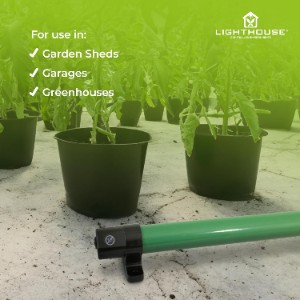
Plug it in, mount it at the base of the greenhouse, and forget about it. That’s the appeal of the LightHouse Eco Heat: simple, reliable, and cheap to run. Over 1,200 Amazon customers have bought this and found it does exactly what a budget tubular heater should — keeps the temperature just above freezing without running up a significant electricity bill.
At 45W it’s the lowest-wattage option on this list, which makes it the cheapest to run but also the most limited in scope. It’s suitable for a very small greenhouse, a cold frame, or as a supplementary heater alongside a more powerful unit in a larger structure. The 305mm length is short, so heat distribution is localised. Position it near the most vulnerable plants rather than expecting it to warm the whole space.
Features
- 45W tubular heater, 305mm length
- Eco heat design for minimal energy use
- Includes mounting brackets
- UK plug with straightforward installation
- 1,200+ customer reviews
- Lowest running cost on this list — 45W is negligible to operate
- 1,200+ reviews confirms it’s a proven, reliable product
- Very affordable purchase price
- 45W is only adequate for very small or very well-insulated spaces
- No thermostat — runs continuously unless manually switched off
- Short 305mm length limits heat distribution
Greenhouse Heater Buying Guide
Key Takeaways
- Match wattage to greenhouse volume, not floor area. A tall greenhouse holds more cold air than a low one of the same footprint. Allow 40–60W per cubic metre for frost protection, or 80–100W per cubic metre to maintain 7°C growing temperatures.
- A thermostat is not optional. Without one, any heater runs at full output regardless of temperature, wasting electricity on mild nights and dramatically increasing running costs.
- Tubular heaters are significantly cheaper to run than fan heaters for frost protection but respond more slowly to temperature drops. Fan heaters heat faster but cost more to operate continuously.
- Insulation does as much as the heater. A well-lined greenhouse (horticultural bubble wrap on the inside of the frame) can halve the required wattage compared to bare glass or polycarbonate.
- At 24p/kWh, running a 2kW fan heater for 8 hours overnight costs £3.84. Over a 5-month heating season at that rate, that’s £576 — a reminder that thermostat use and good insulation are not optional extras.
What Is a Greenhouse Heater?
A greenhouse heater is an electrical or gas-powered appliance designed to maintain minimum temperatures inside a greenhouse during cold weather. Unlike domestic heaters, greenhouse heaters typically need to operate in damp, condensation-heavy environments, often unattended for long periods overnight, and sometimes through power cuts or heating failures that could prove costly for plants.
The term covers a wide range of designs: low-wattage tubular heaters that run continuously at base level, fan heaters that cycle on and off to maintain a set temperature, smart heaters with app control and environmental monitoring, and gas-powered units for large structures where electricity is impractical. Most UK hobby gardeners use electric models for convenience and safety.
How Do Greenhouse Heaters Work?
Fan heaters use an electric element with a fan to rapidly circulate warm air through the greenhouse. They heat a space quickly, respond fast to temperature drops, and can cool as well as heat if fitted with a fan-only mode. The downside is energy use: a 2kW fan heater running several hours overnight uses meaningful amounts of electricity even with a thermostat.
Tubular heaters use a low-wattage heating element inside a metal tube that warms through radiant and convective heat. They run continuously at a low level rather than cycling on and off, which makes them very efficient for frost protection. They’re slower to respond to rapid temperature changes and can’t heat a cold space quickly, but for maintaining a steady minimum temperature they’re hard to beat on running costs.
Smart heaters combine PTC (Positive Temperature Coefficient) ceramic heating elements with sensors and Wi-Fi connectivity. The PTC element self-regulates: as it reaches operating temperature, its resistance increases and power draw drops, which provides some built-in efficiency. Add VPD monitoring and app scheduling and you get a heater that responds intelligently to the actual plant environment rather than just air temperature.
Benefits of Using a Greenhouse Heater
Frost is the primary threat to overwintering plants in a UK greenhouse. Even a single night at -3°C can kill off tender perennials, destroy stored dahlias and begonias, and crack terracotta pots. A small tubular heater running all winter costs very little but prevents losses that took a whole growing season to accumulate.
Extending the growing season is the other major benefit. An unheated greenhouse gives you perhaps six to eight weeks of additional growing time over the garden. A heated greenhouse running at 7°C minimum extends that to year-round growing for many crops — winter salads, microgreens, early tomato seedlings started in February rather than April. That’s a meaningful difference in what you can grow and when.
Condensation control is an underrated benefit. Cold surfaces in an unheated greenhouse cause moisture from the air to condense on leaves, frames, and pots, which promotes botrytis (grey mould) and other fungal diseases. A heater that keeps surfaces slightly warmer reduces condensation significantly, which means healthier plants and less chemical intervention.
Things to Keep in Mind Before Buying
Work out your required wattage before choosing a heater. Measure the internal volume of your greenhouse (length × width × height in metres) and multiply by 40–60W for frost protection or 80–100W for active growing temperatures. A typical 6×4ft greenhouse (approximately 1.8×1.2×2.1m = 4.5m³) needs roughly 200–270W for frost protection. Most people buy a 500W or 800W heater for a space that size, which gives a comfortable safety margin.
Insulation multiplies the effectiveness of any heater. Lining the inside of your greenhouse frame with horticultural bubble wrap before winter starts can cut heat loss by up to 50%, which either allows you to use a smaller heater or run a larger one for significantly less time.
Consider the power supply to your greenhouse. A 2kW heater needs a properly rated outdoor cable run from your house consumer unit — not an indoor extension lead run through a window. If you don’t have a dedicated supply, factor in the cost of having one installed. Alternatively, a low-wattage tubular heater like the Hylite 55W or LightHouse 45W can run safely from a standard outdoor socket or weatherproof extension lead.
Gas and paraffin heaters are an option for greenhouses without mains electricity, but they produce moisture as a byproduct of combustion, which increases humidity and the risk of fungal disease. They also require ventilation to prevent CO₂ build-up. For a mains-connected greenhouse, electric is almost always the better choice.
Types of Greenhouse Heaters
Tubular heaters are the traditional choice for frost protection. They run at low wattage (typically 40–240W depending on length), mount at the base of the greenhouse where cold air settles, and operate silently and continuously. With a thermostat, they’re among the most efficient options for keeping a greenhouse above freezing all winter. They won’t rapidly heat a cold space, and they’re not designed to maintain growing temperatures on a hard frost night — but for the classic British use case of “keeping the frost off the overwintering plants,” they’re difficult to beat.
Fan heaters are faster and more versatile. They can heat a large space quickly, maintain precise temperatures with a good thermostat, and often include a fan-only mode for summer ventilation. The trade-off is running cost: a 2kW fan heater uses significantly more electricity than a 135W tubular heater for the same overnight frost-protection job. If you’re using the greenhouse actively in winter — working in it, potting on, harvesting — a fan heater’s faster response and more even heat distribution justify the extra cost.
Smart heaters with app control and environmental monitoring sit at the top of the range. They suit gardeners who want precise data on their growing environment, the ability to adjust settings remotely, and scheduling that responds to forecast temperatures rather than running on a fixed timer. The AC Infinity THERMOFORGE T7 and VIVOSUN AeroFlux represent this category well.
Paraffin and gas heaters remain relevant for off-grid greenhouses or as backup heat during power cuts. They require more maintenance (refilling, cleaning wicks), produce moisture that increases disease risk, and need ventilation, but they provide reliable heat with no dependency on mains electricity.
Case Study: Heritage Greenhouse Renovation, North Yorkshire
Background
A keen vegetable grower in North Yorkshire had a Victorian-era lean-to greenhouse attached to a stone farmhouse. The structure was single-glazed with a draughty wooden frame and no existing heating beyond an old paraffin heater that was used sporadically. Plant losses over the previous two winters had been significant — dahlias, begonias, a collection of pelargoniums, and an early cucumber crop started in February that was wiped out in a late frost.
Project Overview
The goal was to reliably maintain a minimum of 5°C through the winter months without spending a fortune on running costs. The greenhouse measured approximately 3m × 2.5m × 2.5m (18.75m³), which at 60W per cubic metre suggested a minimum of around 1100W for active temperature maintenance.
Implementation
The frame was lined with horticultural bubble wrap before any heater was installed — a two-hour job that the grower estimated halved the effective heat loss. A Bio Green Tropic 2000W was installed on the back wall, positioned high to circulate warm air across the full length of the structure. A Mylek 135W tubular heater was added along the base on the coldest north-facing wall as supplementary overnight protection. A wireless thermometer with external sensor was placed among the plants to monitor actual temperatures rather than relying on the heater’s built-in sensor.
Results
The combination of insulation and heating maintained a minimum of 6–7°C through the entire winter, including a week in January with overnight lows of -8°C outside. The paraffin heater was kept as emergency backup but was not used. The following spring saw the strongest dahlia tuber survival the grower had experienced, all pelargoniums came through, and the February cucumber sowing succeeded for the first time. Estimated electricity cost for the heating season was £180, based on logged heater run times and 24p/kWh.
Expert Insights From Our Heating Engineers About Greenhouse Heaters
One of our senior heating engineers with over 22 years of experience in domestic and horticultural electrical installations has a clear view on where most people go wrong: “The wattage calculation is the easy part. What I see fail repeatedly is the power supply. People put a 2kW heater in their greenhouse on a 10-amp extension lead run across the garden from a kitchen socket. That’s a fire risk, it’ll trip the circuit, and in a hard frost that failure could cost them a whole year’s overwintering plants. If you’re running anything above a low-wattage tubular from a proper outdoor socket, get a sparky to put in a dedicated supply. It’s a few hundred pounds and it’s done properly.”
“On the insulation question — I can’t stress this enough to people buying heaters. If your greenhouse isn’t insulated, you could double the wattage and still struggle on the coldest nights. Bubble wrap lining takes an afternoon and costs almost nothing, and in my experience it has a bigger effect on overnight minimum temperatures than upgrading from a 1kW heater to a 2kW heater. Do the insulation first, then choose your heater.”
“Smart heaters are worth the money if you’re serious about what you’re growing. The VPD monitoring on units like the THERMOFORGE tells you things a basic thermometer doesn’t — specifically that your plants are experiencing higher humidity stress than the temperature alone suggests. I’ve seen gardeners spend a hundred pounds more on a VPD-capable unit and lose far fewer plants to botrytis and damping-off than they did with a cheaper heater set to the same temperature target. Data is worth something.”
Frequently Asked Questions
What size heater do I need for my greenhouse?
Work from your greenhouse volume, not just the floor area. Measure length × width × height in metres and multiply by 40–60W for basic frost protection (keeping it above 0°C), or 80–100W if you want to maintain growing temperatures (minimum 7°C for most tender plants). A typical 6×4ft greenhouse has an internal volume of roughly 4–5m³, meaning 200–300W is sufficient for frost protection with good insulation. Most growers buy a 500–800W heater for that size, which gives a comfortable safety margin on very cold nights.
How much does it cost to heat a greenhouse?
Running costs vary significantly depending on wattage, thermostat settings, and insulation. At 24p/kWh (the current UK average), a 2kW fan heater running for 8 hours overnight costs £3.84 — over a 5-month heating season that adds up to around £576 if it ran continuously, though a thermostat will cut actual run time substantially. A 135W tubular heater running the same 8-hour overnight period costs around 32p, or roughly £50 for a full heating season. Insulating the greenhouse with bubble wrap can reduce actual heater run time by 30–50%, which makes a real difference to the annual bill.
Is a tubular heater or fan heater better for a greenhouse?
It depends on your goals. Tubular heaters are cheaper to run, silent, and excellent for all-winter frost protection in a small-to-medium greenhouse. They respond slowly to rapid temperature drops, so they’re best used to maintain a gentle background warmth rather than bring a cold greenhouse up to temperature quickly. Fan heaters heat faster, distribute warmth more evenly, and suit larger greenhouses or active winter use where you’re working in the space. Many serious growers use both: a tubular heater for overnight base-level frost protection, and a fan heater for daytime growing temperatures.
Do I need a thermostat on a greenhouse heater?
Yes — not optional. A greenhouse heater without a thermostat runs at full power continuously regardless of outside temperature. In a mild UK winter, that means running at 2kW all night when 200W would have maintained your target temperature. Over a full heating season, the extra cost is substantial. Any heater you buy should either have a built-in thermostat or be connected to an external one. The Hylite, Mylek, and Bio Green Tropic all include thermostats. The LightHouse 45W does not — pair it with an external socket thermostat if you use it for extended winter heating.
Can I use a normal fan heater in a greenhouse?
Not safely for extended use. A standard household fan heater is not designed for the damp, condensation-heavy environment of a greenhouse. Moisture can damage the internal components, cause electrical faults, and create a fire or shock hazard. Greenhouse-rated fan heaters like the Bio Green Tropic (IPX4) or the Greenhouse Heater Professional 2400W (IP24) are built to handle the humidity. If you want to use a standard heater temporarily, keep it well away from any moisture source, never leave it unattended, and replace it with a proper greenhouse-rated unit as soon as possible.
What temperature should I keep my greenhouse at in winter?
It depends on what you’re growing. For overwintering hardy plants, bulbs, and dormant dahlias, 2–5°C is sufficient — just enough to keep hard frost away. For tender perennials and half-hardy plants like pelargoniums and fuchsias, a minimum of 5–7°C is typically recommended. For active growing (salads, herbs, overwintering young tomato plants), you’ll want to maintain at least 10°C. Each step up in minimum temperature requires meaningfully more heating power and higher running costs, so be realistic about what you’re growing and what temperature it actually needs.
How can I reduce greenhouse heating costs?
Insulation is the most effective step. Lining the interior of the greenhouse frame with horticultural bubble wrap before winter can halve heat loss and reduce heater run time significantly. Beyond that: use a thermostat and set it to the lowest temperature your plants actually need (not just a round number); consider a tubular heater rather than a fan heater for overnight frost protection; group vulnerable plants together in one area rather than trying to heat the whole greenhouse; and use fleece or cloches over the most tender plants as an additional layer of protection on the coldest nights.
Summing Up
The AC Infinity THERMOFORGE T7 is the top pick for anyone who wants genuine control over their growing environment — the VPD monitoring, app scheduling, and precise temperature management set it apart from everything else at any price. For a dedicated greenhouse heater from a brand that understands horticulture, the Bio Green Tropic is hard to argue with: IPX4 rated, well-specified, and built for the job. And if your priority is keeping frost off a smaller greenhouse at the lowest possible running cost, a Mylek Tubular 135W paired with good insulation will do it reliably for years.
Whatever you choose, fit a thermostat and insulate the greenhouse first. Those two steps will do more for plant survival than any upgrade in heater wattage.
Updated