
The Warmlite WL42013 Carbon Infrared Heater is the top pick on this list. Priced at just £44, it delivers instant warmth through a carbon fibre element that heats up in seconds, and its 70-degree oscillation spreads heat right around the room. Over 1,100 verified reviews and a 4.4-star rating on Amazon back it up.
That said, not every infrared heater suits every situation. If you’re heating a garden patio, looking for a smart panel you can control from your phone, or want a heater that retains warmth after it switches off, a different option will serve you better. Here’s our rundown of eight of the best infrared heaters available in the UK right now.
Our Top Picks
| Image | Name | |
|---|---|---|
| Warmlite WL42013 Carbon Infrared Heater | |
| Veito CH1800RE Carbon Infrared Heater | |
| Pro Breeze 2000W IP65 Outdoor Infrared Patio Heater | |
| Devola 2000W IP65 WiFi Infrared Patio Heater | |
| Könighaus 600W Smart WiFi Infrared Panel Heater | |
| Klarstein HeatPal Marble 1300W Infrared Heater | |
| Ecowelle 750W Far Infrared Wall Panel | |
| Infrared Desk Heater Panel 165W |
8 Best Infrared Heaters
1. Warmlite WL42013 Carbon Infrared Heater
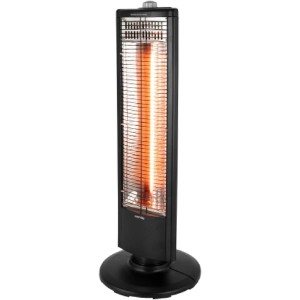
There’s a reason this is the UK’s best-selling carbon infrared heater. The Warmlite WL42013 heats up within seconds, not minutes, and its 70-degree automatic oscillation means you’re not just warming one patch of wall. Whether it’s sitting in the corner of a living room or a bedroom, it distributes radiant warmth across the whole space without effort.
Two heat settings give you a choice between 500W and 1000W, which is handy for mild evenings when you don’t want to run it at full power. The 500W mode is genuinely useful for taking the chill off a small room without overheating it. For a heater at this price, that kind of flexibility is welcome.
Weighing just 2.2kg with an integrated carry handle, it’s one of the easiest heaters to move between rooms. It won’t win any design awards, but the all-black casing is understated enough to work in most homes. Overheat protection cuts the power automatically if the unit gets too hot, which is reassuring in an unsupervised room.
With 1,196 reviews averaging 4.4 stars, the Warmlite WL42013 is the most trusted infrared heater in its price range. You get a standard one-year guarantee with an optional second year when you register online. For everyday home heating where you want something that just works straight out of the box, this is the one to buy.
Features
- Carbon fibre infrared heating element
- 500W and 1000W heat settings
- 70° automatic oscillation
- Lightweight at 2.2kg with carry handle
- Overheat protection with automatic cut-off
- 1 + 1 year guarantee (second year with online registration)
- Heats up in seconds with carbon fibre element
- Oscillation spreads heat across the whole room
- Exceptional value at £44
- Over 1,100 reviews confirm long-term reliability
- No thermostat, timer, or remote control
- 1000W maximum output limits it to smaller rooms
2. Veito CH1800RE Carbon Infrared Heater
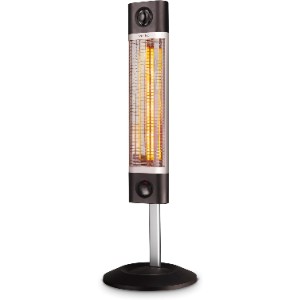
If you want more power, better controls, and a heater that looks the part in your home, the Veito CH1800RE steps up from the Warmlite in every key area. Running at up to 1800W with four adjustable power settings and a full remote control, it gives you proper control over your heating in a way that cheaper carbon towers simply can’t match.
The remote and push-button controls let you adjust output without leaving your seat, and automatic temperature control regulates itself once you’ve set your preferred level. The off-timer is a practical addition for bedrooms, letting you set it to run for an hour before switching off. Tip-over and overheat protection are both included as standard.
At 4.5 stars from 180 reviews, it earns its place as the premium pick. The silver finish gives it a more considered aesthetic than the budget models, and the freestanding base is stable enough that you won’t be concerned about pets or children knocking it over. At £159.99, it’s a meaningful step up from the Warmlite, but the combination of 1800W output, remote control, and auto temperature regulation justifies the cost for anyone heating a larger room.
Features
- 1800W carbon infrared output
- Four adjustable power settings
- Push-button and remote control operation
- Automatic temperature control
- Off-timer included
- Tip-over and overheat protection
- 1800W output heats larger rooms effectively
- Remote control for convenient adjustment
- Auto temperature regulation reduces running costs
- No WiFi or app control
- Significantly more expensive than the Warmlite
3. Pro Breeze 2000W IP65 Infrared Patio Heater
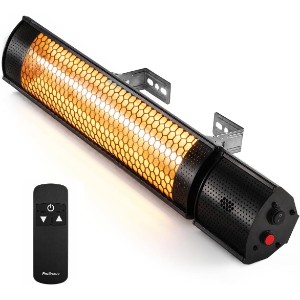
The best infrared heater for outdoor use. The Pro Breeze 2000W is IP65 rated, meaning it handles rain and humidity without complaint, and its two heat settings (1000W and 2000W) cover everything from mild evenings to properly cold nights. All the fixtures and fittings needed for wall or ceiling installation come in the box, which makes getting it up and running straightforward.
The remote control is a practical touch for a heater mounted above head height, and the broad halogen bar distributes warmth across a wider area than a narrow patio heater tube. At £67.67 with 307 reviews at 4.2 stars, it’s a competitive price for a weatherproof outdoor heater with a solid track record. Simple, reliable, and built for UK outdoor conditions.
Features
- 2000W halogen infrared output
- IP65 waterproof rating for outdoor use
- Wall and ceiling mounting (fixtures included)
- 1000W and 2000W heat settings
- Remote control included
- IP65 handles UK rain and winter conditions reliably
- Mounting hardware included for easy installation
- Affordable for a quality outdoor heater
- Bright orange halogen glow can be distracting at night
- No timer, WiFi, or smart control
- Fixed wall mount means it’s not portable
4. Devola 2000W IP65 WiFi Infrared Patio Heater
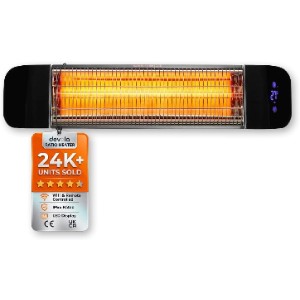
This is what the Pro Breeze looks like when you add a smart home upgrade. The Devola packs in WiFi connectivity, Alexa compatibility, a 24-hour programmable timer, and an LED display alongside its 2000W IP65-rated carbon lamp output. It uses a high-reflectivity aluminium mirror that pushes heat forwards rather than scattering it, making it noticeably efficient at warming the area directly in front.
Being able to schedule outdoor heating from your phone before you step outside is a genuine quality-of-life improvement, particularly in the winter when you want the patio warm by the time guests arrive. Built from weatherproof aluminium and IP65 rated for all-weather use, it’s a proper year-round installation. At £109.99 with 155 reviews at 4.3 stars, it costs more than the Pro Breeze but the smart controls are worth it if outdoor entertaining matters to you.
One thing to note: reliable WiFi signal outdoors is a requirement. If your garden has patchy coverage, you’ll want a WiFi extender before buying this.
Features
- 2000W carbon lamp infrared output
- IP65 waterproof aluminium construction
- WiFi app control and Alexa compatible
- 24-hour programmable timer
- LED display and remote control included
- 90% reflectivity aluminium mirror reflector
- WiFi and Alexa for proper smart home integration
- 24-hour timer ideal for scheduled outdoor entertaining
- Carbon lamp runs quieter and more efficiently than halogen
- Requires strong outdoor WiFi signal
- Pricier than non-smart outdoor options
5. Könighaus 600W Smart WiFi Infrared Panel Heater
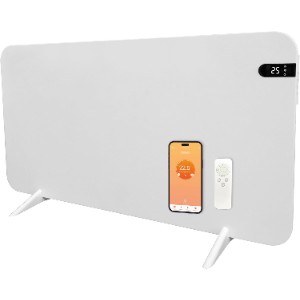
This is for people who want an infrared panel heater rather than a freestanding tower. The Könighaus 600W uses far infrared technology to warm surfaces and occupants directly rather than blowing hot air around the room. The IP44 rating makes it suitable for bathrooms and damp rooms as well as standard living spaces, and the built-in towel rail makes it a practical addition to an ensuite or bathroom where a conventional panel heater wouldn’t fit.
WiFi app control and a remote control give you flexible operation from anywhere in the house, and it works equally well wall-mounted or freestanding on its included stand feet. At £189 with 170 reviews at 4.2 stars, it’s not cheap for 600W of output. But the combination of far infrared heating, smart controls, IP44 protection, and built-in towel rail makes it a versatile option for rooms where a standard tower heater would look out of place.
Features
- 600W far infrared panel heater
- WiFi app and remote control
- IP44 waterproof rating (suitable for bathrooms)
- Wall-mounted or freestanding on included stand
- Built-in towel holder
- Double overheating protection
- IP44 rating makes it safe for bathrooms
- Far infrared gives gentle, even warmth without dry air
- Flexible installation as wall unit or freestanding
- 600W limits it to smaller rooms
- Expensive relative to output wattage
- Initial app setup takes some patience
6. Klarstein HeatPal Marble 1300W Infrared Heater
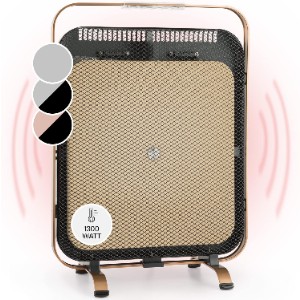
The Klarstein HeatPal Marble takes a different approach to infrared heating. Rather than relying purely on an element that goes cold the moment you switch off, it uses a marble stone panel that absorbs and retains heat during operation. The marble continues to radiate warmth for a period after the power cuts, which can meaningfully reduce total running time over an evening.
The slim aluminium frame with a top carry handle makes it genuinely portable, and the 1.8-metre cable gives you decent reach without rearranging furniture around sockets. At 1300W with a built-in thermostat and anti-frost protection, it has enough output for a medium-sized room, and the thermostat keeps temperatures stable without constant manual adjustment.
The 4.4-star rating is good, though the review count is lower than the other models here. It’s a niche product with a genuinely clever concept, and at £190.99 it’s not the cheapest route to 1300W of infrared. But if the idea of a heater that carries on warming a room after switching off appeals to you, this is the only mainstream option in the UK market that delivers it.
Features
- 1300W infrared with heat-retaining marble stone panel
- Built-in thermostat for automatic temperature regulation
- Anti-frost protection
- Slim aluminium frame with carry handle
- 1.8m power cord
- Portable freestanding design
- Marble retains heat after switching off, reducing run time
- Built-in thermostat prevents temperature fluctuations
- Genuinely portable with handle and long cord
- High price for a freestanding portable model
- No remote or smart controls
7. Ecowelle 750W Far Infrared Wall Panel
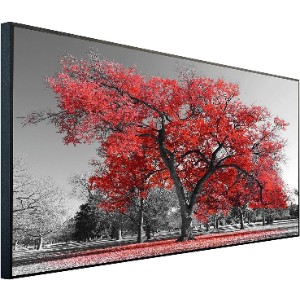
Made in Germany and designed for permanent wall or ceiling installation, the Ecowelle 750W is a flat far infrared heating panel in a different category to the freestanding heaters above. It mounts flush against a wall, runs silently, requires no maintenance, and uses far infrared waves to gently warm the people and objects in a room rather than heating the air. It’s the kind of heating most commonly found in Scandinavian homes and eco-builds.
At £189.95 for a 750W panel measuring 60x100cm, it’s an investment rather than an impulse buy. But it serves a fundamentally different purpose: a permanent, silent, maintenance-free heating installation rather than a portable appliance. Double-integrated overheating protection keeps it safe for extended unattended use, and 110 reviews at 4.2 stars from users who have it fitted to walls suggest it does exactly what’s claimed.
Features
- 750W far infrared heating panel
- 60x100cm, wall or ceiling mountable
- Made in Germany
- Double overheating protection
- Silent operation, no maintenance required
- Suitable for multiple rooms in combination
- Completely silent, no fan noise or moving parts
- German build quality, maintenance-free
- Far infrared provides deep, even warmth
- Permanent installation rules it out for renters
- 750W limits heating coverage in larger rooms
- No timer, thermostat, or smart controls at this price
8. Infrared Desk Heater Panel 165W
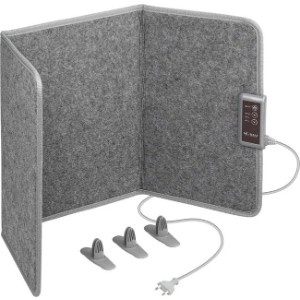
This is a very specific product for a very specific problem: cold feet at a desk. The 51x100cm foldable far infrared panel sits under or beside your desk, runs at just 165W, and directs gentle radiant warmth at the foot and leg area without heating the whole room. If you work from home in a cold office and don’t want to run a full heater for an eight-hour day, the energy saving compared to a 1000W tower heater is significant.
Three heat intensity settings let you adjust the output, and a three-hour auto-shutoff means you won’t come back from a meeting to find it still running. The tip-over switch cuts power if the panel falls. At £69.99 with a 4.3-star rating from 398 verified reviews, it’s a practical solution for a very common problem. Not a main room heater by any stretch, but comfortably the best product available for cold office desks.
Features
- 165W far infrared foldable panel
- 51x100cm footprint for desk or under-table use
- 3 heat intensity settings
- 3-hour auto-shutoff timer
- Tip-over protection switch
- 165W draw keeps running costs very low all day
- Auto-shutoff prevents wasted energy
- Ideal for desk use without heating a whole room
- Not suitable as a main room heater
- Delivery lead times longer than UK-stocked alternatives
Infrared Heater Buying Guide
Key Takeaways
- Carbon infrared heaters heat up in seconds and are the most popular type for home use in the UK
- Far infrared panels are silent, permanent wall installations that warm objects and occupants directly rather than heating the air
- For outdoor use, always choose a heater with at least IP44 rating (IP65 is strongly recommended for exposed UK garden areas)
- Wattage and room size: allow roughly 100W per square metre as a starting guide for a well-insulated room
- Running costs: at approximately 25p per kWh, a 1000W infrared heater costs around 25p per hour to run
- Unlike convection heaters, infrared doesn’t heat the air, so it remains effective even in draughty or poorly sealed rooms
What Is an Infrared Heater?
An infrared heater generates warmth through infrared radiation rather than hot air. Instead of warming the air in a room and relying on convection to carry that heat around, it emits infrared waves that travel directly to the people, furniture, and surfaces in the room and warm them there. The principle is the same as sunlight warming your skin on a cold day, even when the air temperature around you stays low.
The key difference from conventional heating is that you feel an infrared heater’s warmth almost immediately after switching it on, and the effect stops almost as soon as it’s switched off. There’s no residual warm air to cool down gradually, which is why infrared heaters feel significantly more responsive than oil-filled radiators or convection heaters.
How Do Infrared Heaters Work?
Infrared heaters convert electrical energy into infrared radiation. The heating element, whether a carbon fibre tube, halogen lamp, or far infrared panel, heats up and emits electromagnetic waves in the infrared spectrum. These waves pass through the air without warming it, then get absorbed by the solid objects they hit, including people, walls, floors, and furniture.
Different element types produce different wavelengths. Carbon infrared heaters use carbon fibre rods that emit near-infrared radiation and reach operating temperature in under two seconds. Halogen heaters use tungsten filaments inside a quartz tube and glow orange during operation. Far infrared panels use resistive elements inside a flat board to emit longer-wave radiation, which penetrates deeper into objects and produces a gentler, more diffuse warmth. Each type has its own strengths, which is why the market supports several distinct product categories.
Benefits of Using Infrared Heaters
Efficiency is the main argument for infrared heating. Because you’re warming the occupants of a room rather than the air, heat isn’t lost through gaps in doors, windows, or floorboards. In draughty Victorian terraces, conservatories, garages, and outbuildings where keeping warm air inside is difficult, this difference is very practical.
Silence is another advantage. There’s no fan, no air movement, and no circulation of dust. People with asthma or dust allergies often prefer infrared for this reason. Carbon and far infrared heaters produce no CO2, no combustion byproducts, and no fumes, making them safe for enclosed indoor spaces where gas heating isn’t an option.
Speed rounds out the main benefits. Carbon infrared elements reach full operating temperature in under two seconds. If you walk into a cold room and want warmth immediately rather than waiting for convection to work, infrared is the fastest option available in an electric heater.
Things to Keep in Mind Before Buying
Wattage matters more than most buyers realise. A 1000W infrared heater suits a small to medium room of roughly 10 to 15 square metres in a well-insulated property. For a standard UK living room of 20 to 25 square metres, you’ll want at least 1500W, ideally 2000W. Older properties with high ceilings, single glazing, or solid walls will need 20 to 30 per cent more capacity than these figures suggest.
Running costs are easy to calculate. At approximately 25p per kWh at current UK rates, a 1000W heater costs 25p per hour and a 2000W heater costs 50p. Over four hours of daily use for a winter season of four months, a 1000W model adds roughly £120 to your electricity bill and a 2000W model adds approximately £240.
Outdoor installation requires an IP rating. For a covered and sheltered outdoor area, IP44 is generally sufficient. For any exposed outdoor position in a UK garden or patio where the heater will face direct rain and wind, IP65 is the sensible minimum. This protects against jets of water rather than just splashes, which matters during a British winter.
Think about whether you need portable or fixed. Carbon towers are straightforward to move between rooms. Far infrared wall panels require drilling and occasionally hardwiring, though most can also be used freestanding in the short term. If you’re renting or move frequently, a portable model is the only practical option.
Types of Infrared Heaters
Carbon infrared heaters are the most popular type in UK homes. They use carbon fibre rods as the heating element, reaching operating temperature in under two seconds. The output is predominantly near-infrared radiation, providing strong, directional warmth. Most come in freestanding tower designs with oscillation, making them easy to position wherever you need heat. Carbon heaters are typically available from 600W to 2000W and represent the best balance of price, performance, and ease of use for most buyers.
Halogen infrared heaters use a tungsten filament inside a quartz tube, producing a vivid orange glow when operating. They’re generally cheaper to buy than carbon models and heat up quickly, but the brightness of the element makes them uncomfortable for indoor use in living rooms and bedrooms. They’re most commonly used outdoors as patio or garden heaters, where the glow is less of an issue and their IP-rated housings can handle the weather.
Far infrared panels are flat, wall-mounted units that emit longer-wave radiation. The warmth they produce feels gentler and more evenly distributed than carbon or halogen heaters. They run silently, require no maintenance, and can be left on for extended periods. The purchase price is higher, but far infrared panels are popular in eco-builds, converted outbuildings, and commercial spaces where a permanent and unobtrusive heating solution is needed.
Desk and under-table infrared panels are a niche category covering small, foldable far infrared panels designed for personal space heating at a desk. They’re not room heaters, but they’re effective at warming feet and legs during long desk sessions at very low wattage and minimal running cost.
Case Study: Heating a Draughty Victorian Living Room
Background
A homeowner in the East Midlands struggled to heat their Victorian terrace living room efficiently. The room measured approximately 20 square metres with original sash windows and solid stone walls, and conventional electric convection heaters took 30 to 40 minutes to make a noticeable difference. The household wanted faster, more reliable warmth without the cost of installing double glazing or a heat pump.
Project Overview
The core problem was that convection heating depends on warming the air in a room, which escapes quickly through Victorian windows, draughty floorboards, and gaps around skirting boards. Despite running two 2kW convection heaters during the winter months, the room never felt genuinely warm until the afternoon. Monthly electricity costs were running at around £180 in winter.
Implementation
On our recommendation, they replaced the main convection heater in the living room with a Veito CH1800RE carbon infrared heater, positioned to face the main seating area. A Warmlite WL42013 was added in the bedroom as a secondary unit. By directing infrared output at the furniture and occupants rather than the walls and windows, the room felt comfortable within two to three minutes of switching on, regardless of the air temperature.
Results
Monthly electricity costs fell to approximately £130 in the following winter, a saving of around £50 per month. The household reported running the heaters for noticeably shorter periods because they no longer needed to preheat an empty room. The Veito’s remote control was cited as a practical improvement over the old fan heater, allowing adjustment from the sofa without getting up. The combination of faster perceived warmth and lower running time was the key outcome.
Expert Insights From Our Heating Engineers About Infrared Heaters
One of our senior heating engineers with over 19 years of experience in domestic and commercial heating installations offered these observations on infrared heating in UK homes:
“The biggest misconception about infrared heating is that it’s somehow new or experimental. It’s actually the most fundamental form of heat transfer there is: direct radiation. Every open fire works on the same principle. What people often find surprising is how quickly they feel warm, even in rooms that are physically cold. The air temperature might still be 14 degrees, but if infrared is warming the person directly, they feel comfortable. That’s a completely different experience to waiting for convection to bring a room up to temperature.”
“For anyone considering a permanent far infrared wall panel, positioning matters enormously. The output is directional, and a panel needs clear line of sight to the areas where people sit. I’ve seen 750W panels installed behind sofas or partially obscured by curtains, and they’re essentially useless in those positions. A well-placed panel outperforms a poorly placed one of twice the wattage. Get the position right before you drill anything.”
“On running costs: infrared is efficient in the right context, but it’s still electric resistance heating, and electricity in the UK is expensive. The efficiency argument holds when you’re using infrared to warm one person in one spot rather than trying to bring a whole poorly insulated house up to temperature. Use it targeted and supplementary, and it’s genuinely cost-effective. Use it as a whole-house primary heat source, and your bills will reflect that.”
Frequently Asked Questions
Are infrared heaters expensive to run?
At current UK electricity rates of approximately 25p per kWh, a 1000W infrared heater costs around 25p per hour and a 2000W model costs 50p. Over four hours of daily use through a four-month winter, a 1000W heater adds roughly £120 to your electricity bill. Infrared is more cost-effective than convection in draughty or poorly insulated rooms because it heats people directly rather than warming air that quickly escapes.
Are infrared heaters safe to use indoors?
Yes. Carbon and far infrared heaters produce no fumes, CO2, or combustion byproducts, making them safe for enclosed indoor use including bedrooms, living rooms, and bathrooms (with an appropriate IP waterproof rating for the latter). Reputable models include overheat protection and tip-over switches as standard. As with any electric heater, keep flammable materials well clear of the unit and don’t block the element area.
Do infrared heaters heat a whole room?
They heat the occupants and objects in a room rather than the air. The air temperature may remain lower than with convection heating, but people feel warm because infrared waves warm them directly. Models with oscillation, such as the Warmlite WL42013, spread this effect across a wider area. If you need the air temperature in a room to rise significantly, a convection or oil-filled heater is a better tool.
What’s the difference between carbon and halogen infrared heaters?
Carbon infrared heaters use carbon fibre rods as the element. They heat up within two seconds and produce near-infrared radiation without any visible glow, making them comfortable for indoor home use. Halogen heaters use a tungsten filament in a quartz tube and produce a strong orange light during operation, which is uncomfortable in a bedroom or living room at night. Carbon models are preferred for indoor use; halogen heaters are more common in outdoor patio products where the bright glow is less of a concern.
What IP rating do I need for an outdoor infrared heater?
For a well-covered, sheltered outdoor area such as a pergola or lean-to, IP44 is generally adequate. For any exposed outdoor position in the UK where direct rain is likely, IP65 is the sensible minimum. IP65 protects against jets of water rather than just splashes, which matters through British winters. Both the Pro Breeze and Devola models reviewed above carry IP65 ratings and are built for year-round outdoor use.
Can I leave an infrared heater on overnight?
Not unsupervised. The heaters on this list include overheat protection and tip-over switches, but no freestanding electric heater should be left running unattended overnight. If you want extended or overnight heating, look for a model with a timer. The Veito CH1800RE includes an off-timer, and the Devola outdoor model has a 24-hour programmable timer. Set the timer to switch off after a fixed period rather than leaving it running indefinitely.
Are far infrared panels better than carbon tower heaters?
They serve different purposes rather than one being better than the other. Far infrared panels are permanent wall fixtures that run silently and provide gentle, even warmth over long periods. Carbon heaters are portable, start instantly, and cost far less to buy. For a room where aesthetics, silence, and long-term installation matter, a far infrared panel is the right choice. For flexible supplemental heating that moves between rooms, a carbon tower like the Warmlite WL42013 is more practical.
How many wattsdo I need for my room?
As a rough guide, allow around 100W per square metre for a well-insulated modern room. A 15m² bedroom suits a 1000W to 1500W heater. A 25m² living room benefits from at least 1500W to 2000W. Victorian or Edwardian properties with poor insulation, high ceilings, or single glazing may need 20 to 30 per cent more than these figures. Outdoor spaces are harder to calculate due to heat loss, so lean towards maximum output for any exposed patio or garden area.
Summing Up
The Warmlite WL42013 is the best infrared heater for most people. It’s affordable, highly rated, and delivers instant carbon infrared warmth with 70-degree oscillation for just £44. If you need more power or want remote control, the Veito CH1800RE steps up with 1800W and four heat settings at £159.99. For outdoor patio heating, the Pro Breeze 2000W IP65 covers you at £67.67, with the Devola 2000W WiFi adding smart home controls for £109.99. The Könighaus 600W suits bathrooms and smart panel installations, the Klarstein HeatPal Marble is the pick for heat retention, the Ecowelle 750W is the permanent wall panel option, and the Infrared Desk Panel solves cold office feet at minimal running cost.
Updated