
For most UK buyers, the Dreo 1500W Portable Ceramic Heater is the best table top heater to buy. It gives the strongest balance of practical warmth, safety-conscious design and everyday usability. A good table top heater should feel useful within minutes without taking over the desk, making the room noisy or becoming awkward to control. The best models are compact, stable and easy to turn down once the space feels comfortable.
Table top heaters are best for personal warmth at a desk or in a small room, not for replacing whole-house heating. The products below cover powerful ceramic heaters for small rooms, lower-wattage personal heaters and smarter options for home offices. Use the table to compare the basic fit first, then read the reviews for the practical differences that matter day to day.
Contents
- 1 Our Top Picks
- 2 6 Best Table Top Heaters
- 3 Table-Top Heater Buying Guide
- 4 Case Study: Choosing Safer Supplementary Heat
- 5 Expert Insights From Our Heating Engineers About Table Top Heaters
- 6 Frequently Asked Questions
- 7 Summing Up
Our Top Picks
| Image | Name | |
|---|---|---|
| Dreo 1500W Portable Ceramic Heater | |
| Olsen & Smith 1800W Smart Ceramic Heater | |
| BLACK+DECKER 1.8kW Ceramic Desk Heater | |
| Amazon Basics 1800W Ceramic Space Heater | |
| Ventox 500W Ceramic Plug-In Heater | |
| NETTA 2000W Ceramic Fan Heater |
6 Best Table Top Heaters
1. Dreo 1500W Portable Ceramic Heater
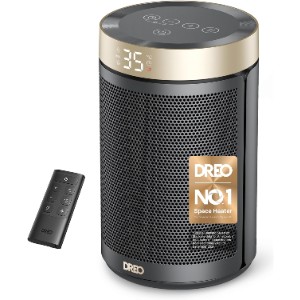
The Dreo 1500W Portable Ceramic Heater is the strongest all-round pick because it feels more polished than most small desk heaters. It has enough output for a small room, but it is still compact enough to sit near a workstation when used sensibly. The remote, thermostat and modes make it easier to use than a basic on/off heater. That matters because table top heaters are often used in short bursts while working, reading or warming up a chilly corner.
It is still a fan heater, so placement matters. Keep it on a stable surface, away from papers, curtains and soft furnishings, and do not treat it as an unattended background heater.
Dreo 1500W Portable Ceramic Heater makes most sense when you think of it as targeted warmth rather than a miniature central heating system. It can make a chilly desk or small room much more comfortable, but the result depends heavily on where it sits, how clear the airflow is and whether the output is sensible for the distance from you.
The practical limitation is the usual one with small fan heaters: they move warm air quickly, but they also make some noise and need clear space. If your desk is crowded with papers, cables or fabric storage, it is worth sorting the placement before relying on any portable heater.
Features
- 1500W ceramic heater
- Remote control
- Thermostat
- Multiple modes
- Portable compact body
- Overheat protection
- Strong all-round choice
- Good controls for daily use
- Compact but powerful
- Fan noise may be noticeable
- Too powerful for very close use on high
2. Olsen & Smith 1800W Smart Ceramic Heater
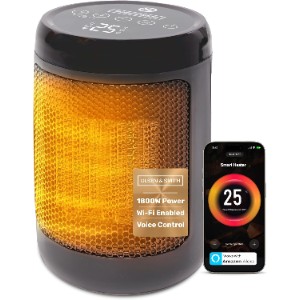
The Olsen & Smith Smart Ceramic Heater is the one to consider if you want app control rather than just a dial on the front. It suits home offices where you want the heater to come on before you sit down, or where voice control is useful.
The 1800W output is generous for a small heater, so it should be used with care in tight spaces. Smart controls are convenient, but they do not replace basic heater safety. If you like connected appliances, this adds useful flexibility. If you only want a simple blast of heat under a desk, a cheaper non-smart heater will be enough.
For regular desk use, controls matter more than they first appear. A timer, thermostat or lower heat setting can stop a compact heater from becoming too hot, too noisy or too expensive to run. That is especially useful if you tend to switch the heater on during work and forget about it for an hour.
Features
- 1800W ceramic output
- Wi-Fi app control
- Voice-control compatible
- Compact tabletop design
- Energy-saving modes
- Indoor use
- Smart controls
- Good output
- Useful for home offices
- More features than some users need
- Needs sensible placement
3. BLACK+DECKER 1.8kW Ceramic Desk Heater
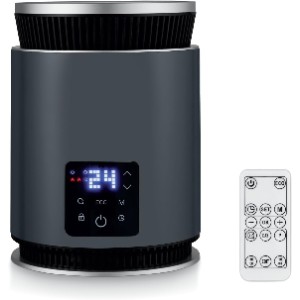
This BLACK+DECKER heater is a good option if you prefer a recognisable brand and want a compact unit with more than basic controls. The 360-degree heating format helps when the heater is placed centrally rather than pointed at one person. The timer and remote are useful touches for short sessions. It is the kind of heater that suits a small study, workshop desk or chilly corner where you want quick local warmth.
It is not the cheapest choice, and the round airflow style will not suit every setup. If you want directional heat under a desk, a front-facing model may feel more precise. The practical limitation is the usual one with small fan heaters: they move warm air quickly, but they also make some noise and need clear space. If your desk is crowded with papers, cables or fabric storage, it is worth sorting the placement before relying on any portable heater.
BLACK+DECKER 1.8kW Ceramic Desk Heater makes most sense when you think of it as targeted warmth rather than a miniature central heating system. It can make a chilly desk or small room much more comfortable, but the result depends heavily on where it sits, how clear the airflow is and whether the output is sensible for the distance from you.
Features
- 1.8kW ceramic heater
- 360-degree rapid heating
- Two heat settings
- 24-hour timer
- Remote control
- Compact grey body
- Recognisable brand
- Good for shared tabletop warmth
- Timer included
- Less directional than some heaters
- Premium over budget models
4. Amazon Basics 1800W Ceramic Space Heater
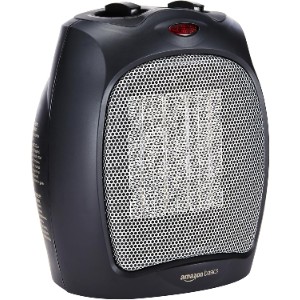
The Amazon Basics Ceramic Space Heater is a simple budget pick for users who do not need smart controls or a long feature list. It is best for occasional warmth in a small room, garage desk or spare workspace.
The appeal is simplicity. You get a compact heater with adjustable heat rather than apps, remotes or decorative modes.
The trade-off is that it feels basic. For frequent use in a home office, paying more for better controls may be worthwhile. This is a good category for matching the heater to the person rather than buying purely by wattage. Some users will prefer a gentler 500W personal heater, while others need 1500W or more to take the edge off a cold box room.
Features
- 1800W ceramic heater
- Adjustable thermostat
- Compact body
- Simple manual controls
- Portable design
- Affordable
- Easy to use
- Good occasional heater
- Basic controls
- No smart or timer features
5. Ventox 500W Ceramic Plug-In Heater
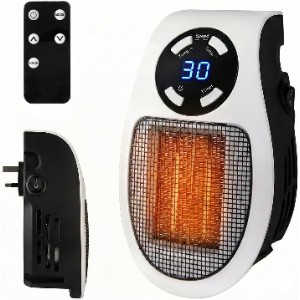
The Ventox 500W is much lower powered than the 1500W to 1800W heaters here, and that can be a good thing. It is better suited to close personal warmth where a full-size fan heater would be too aggressive. The remote, timer and thermostat are useful at this size, especially if the heater is used beside a desk or in a very small room.
Do not expect it to heat a large room. This is a personal heater first and a room heater second.
Ventox 500W Ceramic Plug-In Heater makes most sense when you think of it as targeted warmth rather than a miniature central heating system. It can make a chilly desk or small room much more comfortable, but the result depends heavily on where it sits, how clear the airflow is and whether the output is sensible for the distance from you.
Features
- 500W ceramic heater
- Plug-in design
- Remote control
- Adjustable thermostat
- 12-hour timer
- LED display
- Low wattage for personal use
- Compact
- Useful timer
- Limited room-heating ability
- Socket position matters
6. NETTA 2000W Ceramic Fan Heater
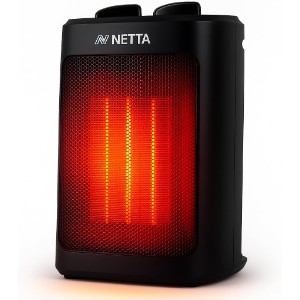
The NETTA 2000W heater is the more powerful option for small rooms where lower-wattage desk heaters feel too weak. It is better treated as a compact room heater than a close-up tabletop heater.
The three heat settings and thermostat give some flexibility, which helps if you want quick warm-up followed by lower running. Because it is powerful, it needs more care around placement and cable routing. It is not one to balance casually on a crowded desk.
For regular desk use, controls matter more than they first appear. A timer, thermostat or lower heat setting can stop a compact heater from becoming too hot, too noisy or too expensive to run. That is especially useful if you tend to switch the heater on during work and forget about it for an hour.
Features
- 2000W ceramic fan heater
- Three heat settings
- Adjustable thermostat
- Portable body
- Overheat protection
- Strong output
- Good value
- Flexible heat settings
- Can be too much for close desk use
- Fan heater noise
Table-Top Heater Buying Guide
Key Takeaways
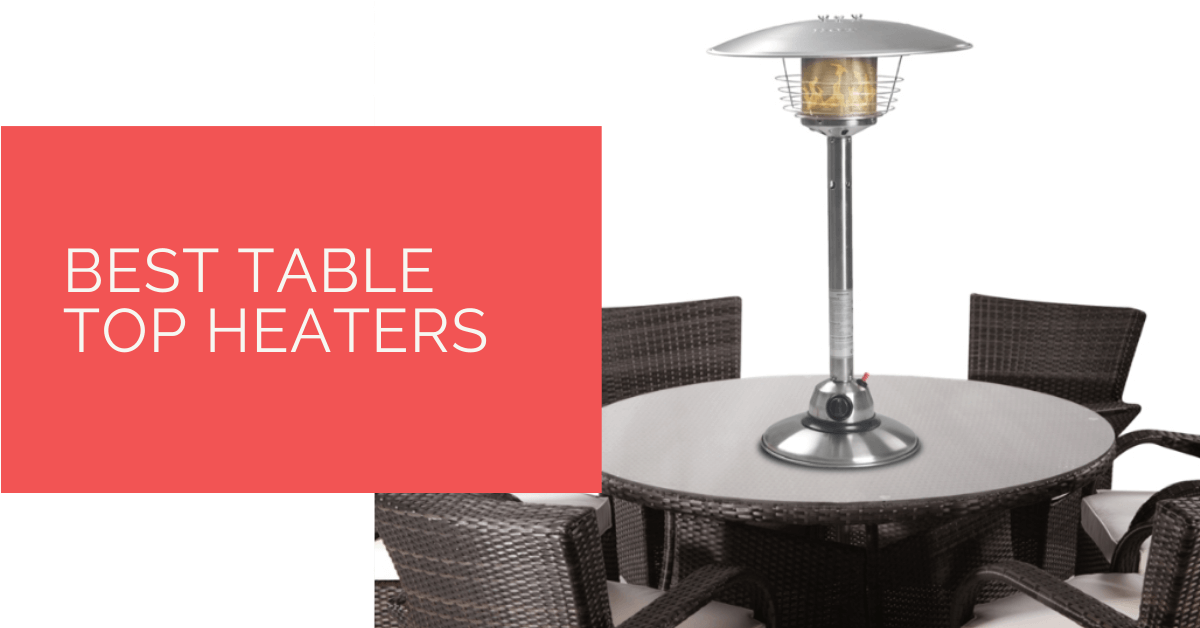
- Table-top heaters split into two entirely different product categories: outdoor patio heaters (electric infrared or gas, designed to sit on a garden table or surface) and indoor personal heaters (small electric devices for desks, offices, and bedrooms). They share a form factor but serve completely different purposes. Be clear which you need before buying
- Outdoor table-top patio heaters using electric infrared elements run at 1.5kW to 2.1kW and cost 41p to 57p per hour at 27p/kWh. Gas table-top heaters (butane or propane cartridges) produce 2kW to 4kW of heat for roughly 30 to 50p per hour and require no power outlet, making them the practical choice for gardens and balconies without an outdoor socket
- Bio-ethanol table-top heaters are a third option that some competitors overlook. They produce a real visible flame without any flue or gas supply, making them popular for outdoor dining tables where ambience matters as much as heat. Output is modest (1kW to 2kW) and fuel costs are high compared to gas, but the aesthetic appeal is significant
- Indoor personal table-top heaters (fan heaters, ceramic PTC heaters, mini panel heaters) are rated 400W to 2kW. The smallest desk heaters at 400W to 750W are designed to keep your immediate workspace warm rather than heat an entire room. They are spot heaters, not room heaters
- IP ratings matter for outdoor use. Any table-top heater used outdoors needs a minimum IP44 rating for covered outdoor areas. Most outdoor patio heaters meet this standard, but small personal indoor heaters used on a garden table during a summer party are not rated for outdoor use and will be damaged by dew or light rain
Outdoor Table-Top Patio Heaters: Electric vs Gas vs Bio-Ethanol
Electric infrared table-top heaters are the simplest option for outdoor use: plug into an outdoor socket, point at your seating area, done. They heat up in under a minute, can be repositioned easily, and require no fuel management. The limitation is that they need power, which rules them out for gardens without an outdoor socket. Output is lower than gas, making them better suited to small balconies and covered seating areas than large open terraces.
Gas table-top heaters run from butane or propane cartridges (typically 450g to 1kg) and produce more heat per unit than compact electric models. No power supply needed. The downside is cartridge management: carrying fuel, knowing when to swap cartridges, and disposing of empties. Most models are designed for outdoor use only, and all should be used in ventilated spaces. A full 450g cartridge typically provides 1 to 3 hours of use depending on output setting.
Bio-ethanol table-top heaters burn denatured alcohol in a small open trough or burner. The flame is real and visible, which makes them attractive for outdoor dining tables where a candle-like ambience is the goal. They require no power or gas cylinder. You pour liquid fuel into the burner. Running costs are substantially higher than gas (bio-ethanol costs £5 to £8 per litre, providing 2 to 3 hours of burn time), and heat output is modest. Think of them as heated centrepieces rather than serious heaters.
Indoor Personal Table-Top Heaters
Indoor desk and personal heaters are a different product entirely. These are compact electric devices designed to provide supplementary warmth in a specific zone: a desk, a reading chair, a bed’s footboard area. They range from 400W ceramic PTC heaters small enough to sit behind a laptop to 2kW fan heaters in a conventional table-top format.
The key advantage of a personal heater in an office or home working setup is targeting. Rather than heating an entire room you’re only occupying partially, you run the central heating at a lower setting and top up your immediate workspace with a small personal heater. For a 400W to 750W model at 27p/kWh, this costs 11 to 20p per hour, substantially cheaper than heating a room with a 2kW heater at 54p per hour.
Output, Coverage, and Running Costs
| Heater Type | Output | Effective Zone | Running Cost/hr | Fuel/Power |
|---|---|---|---|---|
| Electric infrared (outdoor) | 1,500–2,100W | 1.5–2m | 41–57p | Mains electric |
| Gas (butane/propane cartridge) | 2,000–4,000W | 1.5–2.5m | 30–50p | Gas cartridge |
| Bio-ethanol | 1,000–2,000W | 0.5–1m | £1.50–£3.00 | Bio-ethanol fuel |
| Personal electric (indoor) | 400–2,000W | Desk/spot | 11–54p | Mains electric |
Gas and bio-ethanol running costs use current UK cartridge/fuel prices. Electric costs assume 27p/kWh.
Things to Keep in Mind Before Buying
Outdoor table-top heaters in a garden setting need to be stored when not in use. Unlike wall-mounted or freestanding patio heaters, table-top models are small enough to store in a shed or garage, which significantly extends their lifespan. Cover or store after each use to prevent moisture damage to elements and components.
For indoor personal heaters, overheat cut-off and tip-over protection are non-negotiable safety features. Both are standard on all reputable models, but worth confirming in the product specification for very cheap imports. A small heater running for hours on a desk needs both features as a basic safety minimum.
Types of Table-Top Heater
Electric infrared table-top patio heaters suit covered outdoor areas and small balconies. IP-rated, directional heat, requires outdoor socket. Output 1.5kW to 2.1kW. Price range £40 to £150.
Gas cartridge table-top heaters need no power supply and produce strong heat output. Suitable for gardens and outdoor dining where sockets aren’t available. Price range £30 to £100.
Bio-ethanol table-top heaters produce a real open flame and are primarily decorative with supplementary warmth. Higher fuel costs. Price range £25 to £150.
Personal ceramic/PTC desk heaters are indoor devices for targeted workplace warmth. Compact, quiet, energy-efficient. 400W to 1,500W. Price range £15 to £60.
Mini fan heaters are the smallest and cheapest indoor table-top heaters: 600W to 2kW, audible fan noise, fast warm-up. Price range £15 to £50.
Case Study: Choosing Safer Supplementary Heat
Background
A homeowner wanted extra heat in a space that was cold at certain times of day, but did not want to run the main heating system for the whole house.
Project Overview
The goal was not simply to buy the highest-wattage heater. They checked the room size, power supply, ventilation, cable route, clearance around furniture and how long the heater would realistically run.
Implementation
They chose a heater matched to the actual task and set simple rules for use: clear space around the heater, no unattended running and no use near fabrics, clutter or blocked airflow.
Results
The space became more comfortable without relying on an oversized heater or creating avoidable safety risks. The biggest improvement came from choosing the right heater type for the job.
Expert Insights From Our Heating Engineers About Table Top Heaters
“Portable and supplementary heaters are useful when they are chosen for the right space. The problems usually start when people ask a small heater to do a big heater’s job, or use a powerful heater too close to furniture and fabrics.”
“One of our senior heating engineers with over 15 years of experience recommends checking wattage, clearances, controls and the intended use before buying. The safest heater is the one that suits the room and is easy to use correctly every time.”
“For any heater, do not ignore the manual. Tip-over switches, thermostats and overheat protection are helpful backups, not permission to place the heater badly or leave it running unattended.”
Frequently Asked Questions
Are table top heaters safe?
They can be safe when used carefully on a stable surface with clear space around them. The risk comes from placing them near paper, fabric, curtains, bedding or clutter. Look for overheat and tip-over protection, but still switch the heater off when leaving the room.
Can a table top heater warm a whole room?
Some higher-output models can warm a small room, but many table top heaters are better for personal warmth. If the room is large, draughty or poorly insulated, a small heater may feel disappointing. Match wattage to the room rather than assuming all compact heaters perform the same.
Are low-wattage desk heaters cheaper to run?
Yes, a 500W heater uses far less electricity than a 2000W heater at full power. The trade-off is output. Low-wattage models are best when you sit close to them, while higher-powered heaters are better for warming more air in the room.
Can I use a table top heater under a desk?
Only if the heater is designed and positioned safely, with plenty of clearance from legs, cables, bags and furniture. Never block the air inlet or outlet. A heater under a crowded desk can overheat or blow directly onto materials that should not get hot.
Is ceramic better for a small heater?
Ceramic heaters are popular because they heat quickly and work well in compact fan-heater designs. They are not automatically cheaper to run than other electric heaters, because electricity-to-heat efficiency is broadly similar, but they are convenient for fast local warmth.
Should I buy a smart table top heater?
Smart controls are useful if you want scheduling, app control or voice control in a home office. They are less important for occasional use. Safety still matters, so do not use smart control as a reason to leave a portable heater running unattended.
Summing Up
The Dreo 1500W Portable Ceramic Heater is the best table top heater for most people because it gives the most sensible balance of warmth, control and value. It is the model we would start with before comparing the more specialist options in the list, especially if you want a dependable recommendation rather than simply the highest wattage on the page.
The right choice still depends on the space. Check output, clearances, safety features, running cost and how the heater will actually be used before ordering. A heater that fits the task will feel better, run more sensibly and be easier to use safely than one chosen purely by headline wattage. That is the thread running through all the picks here: choose the heater for the situation, not just the spec sheet.
Updated