
If you want cleaner air at home without overthinking it, the LEVOIT Core 200S is the one to buy. It covers up to 64m², runs at a whisper-quiet 23 dB in sleep mode, connects to Alexa and the VeSync app, and has amassed over 39,000 reviews on Amazon. For the vast majority of UK homes, it does everything you need at a price that doesn’t hurt.
That said, the right air purifier depends heavily on your room size, noise tolerance, and whether you’re dealing with specific issues like pet dander, allergies, or persistent cooking smells. We’ve tested and reviewed eight of the best currently available on Amazon.co.uk, from compact desktop units to whole-home powerhouses.
Contents
- 1 Our Top Picks
- 2 8 Best Air Purifiers
- 2.1 1. LEVOIT Core Mini Air Purifier
- 2.2 2. MOOKA H13 HEPA Air Purifier
- 2.3 3. LEVOIT Core 200S Smart Air Purifier
- 2.4 4. Philips Air Purifier 600 Series
- 2.5 5. COWAY Airmega 150 Air Purifier
- 2.6 6. WINIX 5500-2 Air Purifier
- 2.7 7. EVA Alto Four Air Purifier
- 2.8 8. LEVOIT 400S Air Purifier for Large Rooms
- 2.9 Key Takeaways
- 2.10 How to Size an Air Purifier: CADR and Air Changes Per Hour
- 2.11 Filter Types: What Each One Does
- 2.12 Filter Replacement Costs: The Real Ownership Cost
- 2.13 Placement for Maximum Effectiveness
- 2.14 Things to Keep in Mind Before Buying
- 2.15 Types of Air Purifier
- 3 Case Study: Clearing the Air in a Victorian Terrace
- 4 Expert Insights From Our Heating Engineers About Air Purifiers
- 5 Frequently Asked Questions
- 5.1 Do air purifiers actually work?
- 5.2 How long should I run my air purifier each day?
- 5.3 Where should I place an air purifier?
- 5.4 How often do I need to replace the filter?
- 5.5 Can an air purifier help with hay fever?
- 5.6 Will an air purifier remove cooking smells?
- 5.7 What does CADR mean, and why does it matter?
- 5.8 Is it worth spending more on a smart air purifier?
- 6 Summing Up
Our Top Picks
| Image | Name | |
|---|---|---|
| LEVOIT Core Mini Air Purifier | |
| MOOKA H13 HEPA Air Purifier | |
| LEVOIT Core 200S Smart Air Purifier | |
| Philips Air Purifier 600 Series | |
| COWAY Airmega 150 Air Purifier | |
| WINIX 5500-2 Air Purifier | |
| EVA Alto Four Air Purifier | |
| LEVOIT 400S Air Purifier for Large Rooms |
8 Best Air Purifiers
1. LEVOIT Core Mini Air Purifier
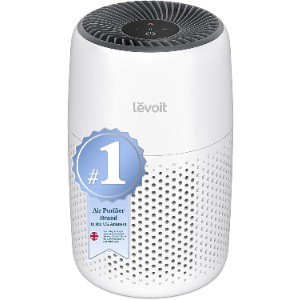
The Core Mini is LEVOIT’s entry-level desktop unit, and it’s a genuinely solid little machine. It’s designed for smaller spaces: bedrooms, home offices, and studies, covering up to around 34m². At just 7W it costs almost nothing to run, and the 25 dB noise level on its lowest setting means you’ll barely know it’s on.
Three fan speeds give you control, and there’s a handy fragrance sponge built into the base so you can add a few drops of essential oil if you like. The 360° VortexAir 3.0 technology pulls air in from all sides, which helps in smaller rooms where placement is awkward. It won’t transform a large living room, but as a bedroom companion it does the job well.
With over 4,200 Amazon reviews at 4.4 stars, it’s a proven performer at the budget end. The only real gripe is that it’s not app-enabled. No scheduling, no remote control. If you want smart features, you’ll need to step up to the Core 200S.
Features
- Room coverage: up to 34m²
- Noise level: 25 dB (low speed)
- Power: 7W
- 3-stage HEPA filtration with fragrance sponge
- 360° VortexAir 3.0 technology
- 3 fan speeds, touch controls
- Very low running costs at just 7W
- Compact enough for a desk or bedside table
- Fragrance sponge is a nice touch for bedrooms
- No app or smart controls
- Only suitable for smaller rooms up to 34m²
- No air quality indicator
2. MOOKA H13 HEPA Air Purifier
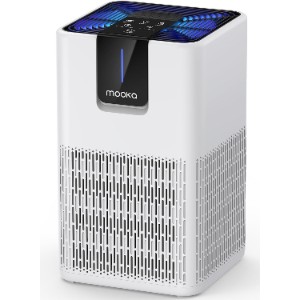
The most striking thing about the MOOKA is the noise rating: 15 dB in sleep mode. That’s effectively inaudible, quieter than a whispered conversation and among the lowest figures you’ll find in this price bracket. If noise is your main concern, this is where to start looking.
Despite its budget price, it claims coverage up to 116m² which would make it the largest-room option at this price point if accurate. The H13 HEPA filter is a genuine step up from standard HEPA, catching particles down to 0.3 microns. There’s also an aromatherapy function and a night light, which makes it well-suited to kids’ rooms.
A word of caution: this is a relatively new listing with around 200 reviews at the time of writing, so the long-term reliability picture isn’t fully established. The specs are impressive for the money, but it’s worth keeping your expectations calibrated accordingly.
Features
- Room coverage: up to 116m²
- Noise level: 15 dB (sleep mode)
- H13 HEPA 3-layer filtration
- Aromatherapy function and night light
- Touch controls, sleep mode
- White finish
- Extraordinary 15 dB sleep mode: effectively silent
- H13 HEPA catches finer particles than standard HEPA
- Relatively new product with fewer reviews than rivals
- Long-term reliability not yet proven
- No smart or app connectivity
3. LEVOIT Core 200S Smart Air Purifier
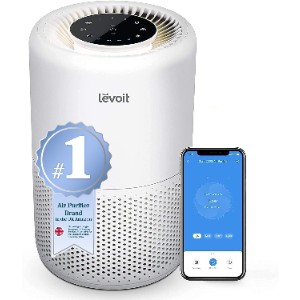
This is the one we’d recommend to most people. The Core 200S covers up to 64m², runs at 23 dB in sleep mode, and connects to both Alexa and the VeSync app so you can control it from your phone, set schedules, and check filter life without getting up. With over 39,000 Amazon reviews at 4.6 stars, the track record is about as solid as it gets in this category.
It’s specifically well-suited to pet owners and allergy sufferers. The 360° design pulls air in from all sides, and the HEPA filter traps 99.97% of particles at 0.3 microns: pollen, dust mites, pet dander, mould spores. The sleep mode dims the display and drops to near-silence, which makes it genuinely viable in a bedroom without being a distraction.
At £79.98 it sits in a sweet spot. You get smart features you’d otherwise pay considerably more for, decent room coverage for an average-sized bedroom or living room, and a brand with a proven support record. The only real trade-off is that coverage tops out at 64m², so if you have a large open-plan space you’ll want to look at the 400S further down the list.
Features
- Room coverage: up to 64m²
- Noise level: 23 dB (sleep mode)
- Power: 26W
- Alexa and VeSync app control
- 360° air intake design
- 3-stage HEPA filtration (99.97% at 0.3 microns)
- Sleep mode with dimmed display and night light
- Timer function
- 39,000+ Amazon reviews at 4.6 stars, exceptionally well proven
- Full Alexa and app control with scheduling
- Ultra-quiet 23 dB sleep mode
- Great value for money with smart features at under £80
- Coverage limited to 64m², not ideal for large open-plan rooms
- No built-in air quality sensor
4. Philips Air Purifier 600 Series
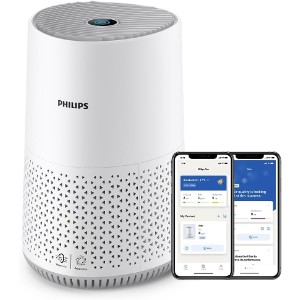
Philips is one of the most trusted names in home electronics, and the 600 Series brings that pedigree to air purification at a reasonable price. It covers up to 44m², uses a genuine HEPA filter that removes 99.97% of pollutants, and has a smart aerosense sensor that automatically adjusts fan speed based on real-time air quality. The Air+ app gives you remote control and air quality tracking.
At just 12W on its most efficient setting, running costs are minimal. The design is clean and unobtrusive, and at £79.99 it competes directly with the LEVOIT Core 200S. The key differentiator is the smart sensor. Philips detects air quality changes automatically and responds, whereas the LEVOIT requires manual input or app scheduling.
The honest caveat is the noise figure. At maximum speed the 600 Series can reach 49 dB, which is noticeably louder than most rivals on this list. It’s fine during the day, but if you’re a light sleeper you’ll want to use the lower settings at night.
Features
- Room coverage: up to 44m²
- Power: 12W (efficient setting)
- Automatic aerosense air quality sensor
- HEPA filter (99.97% particle removal)
- Air+ app control (Android and iOS)
- Model: AC0651/10
- Trusted Philips brand with solid after-sales support
- Automatic smart sensor adjusts fan speed without manual input
- Very energy-efficient at 12W
- Can reach 49 dB at maximum speed, louder than rivals
- Smaller coverage area (44m²) than similarly priced alternatives
- Fewer Amazon reviews than the top LEVOIT models
5. COWAY Airmega 150 Air Purifier
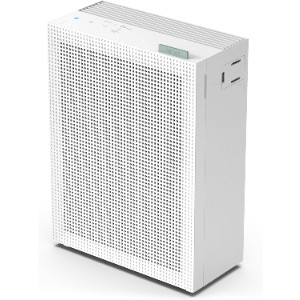
COWAY is a South Korean brand that’s been making air purifiers for over two decades, and the Airmega 150 shows exactly why they’ve built a loyal following. It holds both ECARF (European Centre for Allergy Research Foundation) and Quiet Mark certifications. These are two independent endorsements that genuinely mean something for allergy sufferers and noise-sensitive households.
Coverage runs to 73m², the GreenHEPA filter catches particles down to 0.01 microns, and the sleep mode operates at just 20 dB. The washable pre-filter is a practical touch. Pull it out, rinse it under the tap, and put it back rather than replacing it every few months. Running costs are low at 35W.
At £149.98 it asks you to spend notably more than the LEVOIT Core 200S, but those certifications aren’t just marketing. If allergy management is a priority (hay fever, asthma, pet allergies), the independent validation is worth the premium.
Features
- Room coverage: up to 73m²
- Noise level: 20 dB (sleep mode)
- Power: 35W
- ECARF and Quiet Mark certified
- GreenHEPA filter (particles down to 0.01 microns)
- Washable, pull-out pre-filter
- Touch controls
- ECARF and Quiet Mark certified, with independently verified performance
- 20 dB sleep mode is impressively quiet
- Washable pre-filter reduces ongoing running costs
- Significantly more expensive than mid-range alternatives
- No smart app or voice control
- Fewer Amazon reviews than the WINIX and LEVOIT models
6. WINIX 5500-2 Air Purifier
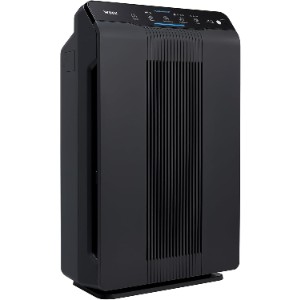
Ask someone who takes indoor air quality seriously which brand they’d recommend, and WINIX comes up repeatedly. The 5500-2 has over 27,000 Amazon reviews at 4.6 stars, covers up to 99m², and combines a True HEPA filter with an activated carbon filter to tackle both particles and odours in a way that HEPA-only units simply can’t match. That combination makes it particularly effective in kitchens, homes with smokers, or anywhere persistent smells are an issue.
The smart sensor reads air quality in real time and adjusts automatically, and there’s a sleep mode that drops fan speed and dims the display. CADR is rated at 390m³/h, one of the highest figures on this list, which means it can turn over the air in a large room multiple times an hour. At 27.8 dB it’s not quite as silent as some rivals, but at 99m² coverage you’re getting serious performance.
At £159 it competes with the COWAY and EVA Alto, but the combination of coverage area, verified HEPA and carbon filtration, and a review count that few products at this price can match makes it the standout all-rounder in the premium tier.
Features
- Room coverage: up to 99m²
- CADR: 390m³/h
- Noise level: 27.8 dB
- Power: 70W
- True HEPA + activated carbon filtration
- Smart air quality sensor with auto mode
- Sleep mode with display dimming
- Remote control included
- HEPA and carbon filters tackle particles AND odours simultaneously
- Exceptional 27,000+ reviews: one of the most proven models available
- CADR 390m³/h, genuinely high performance for large rooms
- Remote control is a convenient bonus
- Slightly louder than some competitors at 27.8 dB
- Higher 70W power draw than most rivals
7. EVA Alto Four Air Purifier
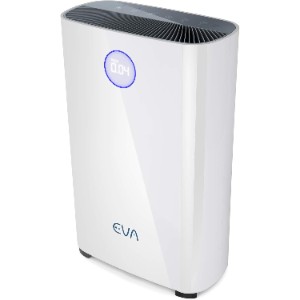
The EVA Alto four is a British-designed air purifier built around one headline claim: 17 dB. That’s not just quiet. It’s astonishing. Normal breathing registers around 10 dB. At 17 dB, the Alto four is virtually undetectable in a quiet room, which makes it a compelling option for light sleepers, young children’s bedrooms, or anyone who’s sent every other air purifier back because they found the noise unbearable.
Beyond the noise spec, it’s a well-specified unit. True HEPA filtration at 99.97%, a 3-stage system including an active carbon filter, 55m² coverage, and a light sensor that puts it into sleep mode automatically when the room goes dark. The two-year filter supply included in the box is a genuine saving, as filter replacements are often an overlooked running cost.
The main caveat: it’s a newer product with a smaller review base than the WINIX or LEVOIT models. The spec sheet is impressive and the reviews are positive, but it hasn’t yet amassed the long-term feedback that would make it a completely safe recommendation. If silence is non-negotiable, it earns its place. Otherwise, the WINIX offers more proven credentials at a similar price.
Features
- Room coverage: up to 55m²
- Noise level: 17 dB (sleep mode)
- Power: 34W
- True HEPA 99.97% + active carbon 3-stage filtration
- Light sensor for automatic sleep mode
- Child lock
- Two-year filter supply included
- Touch controls
- 17 dB is extraordinary: effectively inaudible during sleep
- Two-year filter supply included reduces ongoing costs
- Light sensor automatically activates sleep mode at night
- Newer product with a smaller review base than rivals
- 55m² coverage is modest for the price
- No app or smart connectivity
8. LEVOIT 400S Air Purifier for Large Rooms
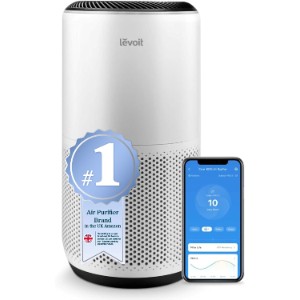
The 400S is LEVOIT’s large-room flagship, and the numbers back up the premium: 166m² coverage, a CADR of 400m³/h, and a PM2.5 laser sensor that gives you real-time air quality readings down to fine particulate level. It works with Alexa and the VeSync app, has an auto mode that responds to the sensor data, and at 24 dB in quiet mode it’s impressively unobtrusive for a unit this powerful.
With over 39,000 Amazon reviews at 4.6 stars it shares the same exceptional track record as the Core 200S but in a completely different class of performance. If you have a large open-plan kitchen and living area, a big conservatory, or a home office that bleeds into other rooms, this is the unit that will actually keep up. At 24W it’s also notably power-efficient given the output, cheaper to run than the WINIX despite moving considerably more air.
The price, just under £176, reflects what it is. You’re not paying a premium for the brand name; you’re paying for genuine large-room capability with a smart sensor and Alexa control. For most UK homes it’s more than you need. But if you genuinely have the space, it’s the best option on this list.
Features
- Room coverage: up to 166m²
- CADR: 400m³/h
- Noise level: 24 dB (quiet mode)
- Power: 24W
- PM2.5 laser air quality sensor
- Alexa and VeSync app control
- 3-stage HEPA filtration (99.97% at 0.3 microns)
- Auto mode, sleep mode, display off function
- 166m² coverage handles even the largest open-plan UK homes
- CADR 400m³/h, top-tier air throughput on this list
- PM2.5 laser sensor provides real-time air quality data
- Only 24W, energy-efficient for the performance level
- Overkill for most standard-sized UK rooms
- Most expensive unit on this list
Key Takeaways
- Air purifiers only work on airborne particles: dust, pollen, pet dander, mould spores, smoke, and some bacteria. They don’t remove volatile organic compounds (VOCs) or odours unless the unit also contains an activated carbon filter
- CADR (Clean Air Delivery Rate) is the most reliable way to size a purifier to a room. Take the room’s floor area in square feet and multiply by 0.67 to get the minimum CADR you need. A 150 sq ft room (roughly 14m²) needs a CADR of at least 100
- True HEPA filters capture 99.97% of particles 0.3 microns and larger. “HEPA-style” or “HEPA-like” filters are not the same thing. They’re a marketing term with no standardised performance requirement
- Air changes per hour (ACH) measures how many times per hour the unit filters the entire volume of room air. For allergy sufferers, 4 to 5 ACH is the recommended target. Most sizing guides are based on 2 ACH, which is the minimum for meaningful air quality improvement
- Activated carbon filters are essential if your concern is cooking smells, pet odours, VOCs from new furniture, or cigarette smoke. HEPA alone does not address odours or gases
- Filter replacement is a recurring cost that significantly affects the total ownership cost. HEPA filters typically last 6 to 12 months; carbon pre-filters 3 to 6 months. Budget £30 to £80 per year in filter costs depending on model
- Placement matters as much as specification. A purifier in a corner with restricted airflow cleans less air than a lower-spec model in a well-ventilated central position
How to Size an Air Purifier: CADR and Air Changes Per Hour
CADR (Clean Air Delivery Rate) is a measurement developed by the Association of Home Appliance Manufacturers and gives you a standardised way to compare purifiers. It measures the volume of clean air a unit delivers per minute at its highest fan speed, tested separately for dust, smoke, and pollen. The figure is expressed in cubic feet per minute (CFM) or cubic metres per hour (m³/h) depending on the brand.
The quick sizing rule: the CADR in CFM should be at least two-thirds of the room’s floor area in square feet. For metric users, the room area in m² multiplied by 4 gives you a rough minimum m³/h CADR:
| Room Size | Min CADR (m³/h) | Target ACH | Use Case |
|---|---|---|---|
| Up to 12m² | 50 to 80 | 4 to 5 | Small bedroom, home office |
| 12 to 20m² | 80 to 150 | 4 to 5 | Standard bedroom, lounge |
| 20 to 35m² | 150 to 250 | 3 to 4 | Living room, open-plan kitchen |
| 35m² and above | 250+ | 2 to 3 | Large open-plan space |
Air changes per hour (ACH) is the more meaningful figure for allergy sufferers. It measures how many complete room air cycles the unit achieves per hour. To calculate: divide the unit’s CADR (in m³/h) by the room volume (floor area in m² multiplied by ceiling height in metres). A 150 m³/h CADR purifier in a 30m³ room delivers 5 ACH, which is an excellent result. The same unit in a 75m³ room delivers only 2 ACH, which is adequate but not optimal for hayfever or asthma conditions.
For allergy and asthma management, 4 to 5 ACH in the bedroom where you spend 8 hours a night will produce a more noticeable health benefit than higher coverage in a large living room. Size for the bedroom first.
Filter Types: What Each One Does
Most air purifiers combine several filter layers. Understanding what each layer does helps you assess whether a particular model addresses your specific concern:
Pre-filter: A coarse mesh that captures larger particles like hair, large dust, and pet fur. Extends the life of the HEPA filter by preventing it from clogging with material it could handle itself. Most pre-filters are washable and reusable.
True HEPA filter: Captures 99.97% of particles 0.3 microns and larger, which includes most pollen, dust mite allergens, mould spores, smoke particles, and bacteria. The 0.3-micron specification is deliberate: it’s the hardest particle size to capture (larger particles are captured by impaction and interception; smaller ones by diffusion). A True HEPA filter is effective against both larger and smaller particles as a result.
Activated carbon filter: Adsorbs gases, VOCs, and odour molecules. Essential for smoke, cooking smells, pet odours, off-gassing from new furniture or paint, and chemical smells. Has no effect on airborne particles. Carbon filters become saturated over time and must be replaced; they cannot be regenerated by washing.
UV-C light: Used in some units to kill bacteria and viruses. Effectiveness depends on dwell time: the longer air is exposed to UV-C radiation, the more pathogens are neutralised. In most portable consumer units, airflow speed limits exposure time, so UV-C is a supplementary rather than primary disinfection method. Not a substitute for HEPA filtration.
Ionisers: Emit negative ions that cause particles to clump and fall to surfaces rather than remaining airborne. Can produce trace ozone as a by-product. Not recommended for people with respiratory conditions, as ionisers may temporarily reduce airborne particle counts while depositing contaminants on floors and furniture where they can be disturbed later.
Filter Replacement Costs: The Real Ownership Cost
Replacement filters are where manufacturers make their margin, and it’s worth researching before committing to a model. Annual filter costs vary considerably:
- Budget models (£50 to £100 purchase price): Replacement filters often cost £15 to £30 per year, but generic alternatives are rarely available. Proprietary filter shapes lock you into manufacturer pricing
- Mid-range models (£100 to £200): Typically £25 to £50 per year for a combined HEPA and carbon replacement. Some models have separate replaceable components, which is cheaper than replacing a combined filter unit
- Premium models (£200+): Replacement filters can cost £40 to £80 per year, though higher-end units often have longer filter life and better monitoring of actual filter condition rather than running on a fixed time schedule
Always check filter availability for any model you’re considering. Some discontinued models become unusable when filter stocks run out. Brands with widely available generic alternatives (or washable pre-filters plus standard HEPA sizes) have lower long-term running costs.
Placement for Maximum Effectiveness
An air purifier’s position significantly affects how much of the room’s air it actually cleans. The key principles:
Place the unit where airflow is unrestricted on all intake and outlet sides. Most units draw air from the sides or bottom and expel clean air from the top or front. Positioning against a wall, in a corner, or behind furniture restricts intake and reduces effective CADR by 20 to 40%. Central floor placement, or near a frequently used area (a bed, a desk, a sofa), delivers the best results.
Don’t place the unit directly next to a major pollution source if avoidable. A purifier next to a kitchen hob trying to capture cooking fumes is working harder than the same unit positioned to clean already-circulating room air. For cooking odours, an extractor hood that vents outside is always more effective than a purifier circulating air that’s already contaminated.
For bedrooms, place the unit on the side of the bed you sleep on if space allows, and run it on a low fan setting throughout the night. The quieter the unit, the higher the fan speed you can sustain without disrupting sleep. Many people start purifiers on high for an hour before bed to reduce particle counts quickly, then drop to low speed for the night.
Things to Keep in Mind Before Buying
Air purifiers don’t solve damp, mould, or ventilation problems. A mouldy bathroom or poorly ventilated kitchen needs extraction at source, not a purifier in the adjacent room recycling spore-laden air. Similarly, if someone in the household smokes indoors, the purifier will reduce airborne particles and odours to some extent, but it’s managing a symptom rather than addressing the source.
Don’t expect instant results. An air purifier running in a room for the first time will take 30 minutes to an hour to meaningfully reduce particle counts, depending on room size and CADR. In a well-sealed bedroom run overnight, the difference in morning air quality is noticeable after a few nights. The benefits accumulate with consistent use rather than being immediately obvious.
If your main concern is hayfever, close windows during high pollen periods and run the purifier continuously, as opening windows while the purifier is running defeats the purpose. If your concern is dust mites, pairing the purifier with regular vacuuming with a HEPA-filtered hoover and dust mite-resistant bedding will produce a much greater benefit than the purifier alone.
Types of Air Purifier
HEPA-only units are the simplest and most reliable design. A fan draws room air through a True HEPA filter. No ioniser, no UV, no carbon layer. Best for dust and allergen control in clean-air environments where odours aren’t a concern. Maintenance is predictable: replace the HEPA filter annually and wash the pre-filter monthly.
HEPA plus carbon units are the most versatile all-round choice for UK homes. The carbon layer handles cooking smells, pet odours, and VOCs; the HEPA layer handles particles. The carbon filter degrades faster than the HEPA, so check whether these are replaceable separately, which is cheaper.
Smart air purifiers include air quality sensors (often PM2.5 particle counters and sometimes VOC sensors) that automatically adjust fan speed in response to detected pollution. They run quietly when air quality is good and ramp up when needed. Some connect to apps for monitoring and scheduling. Useful for high-use areas like living rooms where air quality fluctuates throughout the day.
Tower and floor-standing units move larger volumes of air and suit bigger rooms. Compact desktop or bedside units are better suited to bedrooms and offices where placement close to the user maximises the benefit. For the bedroom, size the unit for the room volume and prioritise low noise output over maximum CADR.
Case Study: Clearing the Air in a Victorian Terrace
Background
A homeowner in south Manchester had been struggling with persistent allergy symptoms throughout spring and summer for several years. With two cats in a Victorian terraced house (single-glazed windows, minimal mechanical ventilaventilation, and a small back garden) meant the combination of pet dander, outdoor pollen, and general dust accumulation was causing year-round discomfort rather than purely seasonal symptoms.
Project Overview
After trying an anti-allergy mattress cover and HEPA vacuum cleaner with limited improvement, they decided to add an air purifier to the main bedroom and living room, the two spaces where they spent the most time. Budget was around £300 for both units combined.
Implementation
A LEVOIT Core 200S was placed in the bedroom, running on sleep mode overnight at 23 dB, and a WINIX 5500-2 in the open-plan kitchen and living room, where cooking smells and the cats’ main territory created both particulate and odour challenges. Both were placed centrally in their respective rooms rather than pushed against walls, which the manuals note improves air circulation efficiency.
Results
Within the first week there was a noticeable reduction in visible dust settling on furniture. Over the following month, the homeowner reported significantly reduced morning congestion and a reduction in antihistamine use during the peak pollen period. The carbon filter in the WINIX made a clear difference to cooking smells. The living room no longer carried the previous evening’s dinner the next morning. Total spend was £238.98 for both units, comfortably within budget.
Expert Insights From Our Heating Engineers About Air Purifiers
One of our senior heating engineers with over 18 years of experience in domestic HVAC and indoor air quality work offers this perspective on choosing and placing air purifiers effectively.
“The single most common mistake I see is people buying a unit based on price and then placing it in a corner against a wall. Air purifiers need clear space on all sides to pull in and discharge air effectively. A unit rated for 60m² will perform like a 30m² unit if it’s hemmed in. Put it centrally in the room if you can, or at least give it 30cm clearance on all sides. That one change makes more difference than most people realise.”
“On filter type: if you have pets or a smoker in the house, don’t buy a HEPA-only unit. You’ll filter the particles but the odours will remain, and people often conclude the purifier isn’t working when actually it’s just doing a different job to what they wanted. The WINIX-type combination of HEPA and activated carbon is what you need. For allergies in a pet-free non-smoking household, HEPA alone is fine. Know what problem you’re solving before you buy.”
“Running costs are worth calculating properly. At current UK electricity rates, a 70W unit running 24 hours uses around £1.20 of electricity per day at 24p/kWh, which is £438 per year on its highest setting. Obviously you won’t run it on max all the time, but in auto mode a larger unit will still use more than a smaller one. A 7W compact unit like the LEVOIT Core Mini costs pennies to run continuously. Size appropriately for your actual room, not aspirationally.”
Frequently Asked Questions
Do air purifiers actually work?
Yes, HEPA air purifiers are well-supported by evidence for reducing airborne particles including pollen, dust mite allergens, pet dander, and mould spores. Their effectiveness depends on matching the unit to the room size, running it consistently rather than occasionally, and replacing filters on schedule. They won’t eliminate all allergens, particularly those that have already settled on surfaces, but they measurably reduce airborne concentrations over time.
How long should I run my air purifier each day?
Continuously, ideally. Air purifiers are most effective when they’re running consistently rather than for short bursts. Modern units are energy-efficient enough, particularly the smaller LEVOIT models, so running them 24 hours costs very little. At minimum, run your purifier whenever you’re in the room and for a few hours before you sleep.
Where should I place an air purifier?
Central placement with at least 30cm clearance on all sides is ideal. Avoid corners, tight shelving, and positions directly against walls. If you can only place it against a wall, choose a unit with a top-discharge design so the clean air outlet isn’t obstructed. For bedrooms, place it away from the bed but on the same side of the room as where you sleep. You want clean air circulating where you breathe, not across the room.
How often do I need to replace the filter?
Most HEPA filters need replacing every 6 to 12 months depending on usage and air quality in your home. Homes with pets, smokers, or high outdoor pollution levels will need more frequent changes. Most modern purifiers have a filter replacement indicator. Don’t ignore it. A clogged filter doesn’t just reduce performance; it can strain the motor and increase energy consumption.
Can an air purifier help with hay fever?
Yes, noticeably so. HEPA filters catch pollen particles effectively, and running a purifier in your bedroom overnight during hay fever season can significantly reduce morning symptoms. Close windows while the purifier is running. There’s no point filtering indoor air if you’re simultaneously letting fresh pollen in from outside. The COWAY Airmega 150 is specifically ECARF curtified for allergy sufferers if you want independent validation.
Will an air purifier remove cooking smells?
Only if it has an activated carbon filter layer. HEPA filters are designed for particles. They don’t adsorb gases or volatile organic compounds. Carbon-equipped units like the WINIX 5500-2 are genuinely effective at cooking smells, smoke, and chemical odours. A HEPA-only unit in a kitchen will clean the air of particles but leave the smells largely untouched.
What does CADR mean, and why does it matter?
CADR stands for Clean Air Delivery Rate, measured in cubic metres per hour (m³/h). It tells you how much clean air the unit delivers, and it’s a more reliable performance metric than the coverage area figure, which manufacturers calculate differently. To work out if a unit is powerful enough, multiply your room’s floor area by ceiling height to get the volume, then check whether the CADR will deliver at least two to three complete air changes per hour. The LEVOIT 400S at CADR 400m³/h and the WINIX at CADR 390m³/h are the strongest performers on this list.
Is it worth spending more on a smart air purifier?
If you’re likely to use the features, yes. The main benefit isn’t convenience. It’s the auto mode that responds to a real-time air quality sensor. Units like the LEVOIT Core 200S and 400S detect when air quality drops (cooking, opening windows, cleaning) and ramp up automatically without you having to think about it. That reactive behaviour tends to be more effective than fixed schedules. If you’ll never use an app and just want to plug it in and leave it on, the extra cost isn’t necessary.
Summing Up
For most UK homes, the LEVOIT Core 200S is the best all-round choice. It covers up to 64m², runs quietly enough for overnight bedroom use, connects to Alexa and the VeSync app, and has the review volume to back up everything it promises. At £79.98, nothing else on this list gives you smart features, proven performance, and quiet operation at that price.
If you need coverage for a large open-plan space, step up to the LEVOIT 400S. For allergy certification, the COWAY Airmega 150. For odour removal in kitchens or homes with smokers, with its carbon filter combination. And if silence is the absolute priority, the EVA Alto four’s 17 dB rting is genuinely in a class of its own.
Updated