
A ground source heat pump can be one of the most efficient ways to heat a home, but it is also one of the most site-dependent. The heat pump itself is only half the story. The buried ground loop, the land or boreholes, the heating emitters, the hot-water cylinder and the quality of the design all decide whether the system performs well.
In simple terms, a ground source heat pump collects low-temperature heat from the ground, upgrades it using electricity, and sends that heat into your home for radiators, underfloor heating and hot water. The ground is not hot in the way a boiler flame is hot. It is simply more stable than winter air, which can help the heat pump operate efficiently across the heating season.
This guide explains how ground source heat pumps work, the difference between horizontal trenches and boreholes, what installation involves, what costs and grants to consider, and how to decide whether ground source is the right route for your property.
Contents
- 1 Key Takeaways
- 2 How Ground Source Heat Pumps Work
- 3 The Three Main Parts of the System
- 4 Horizontal Trenches, Boreholes and Water Loops
- 5 Is Your Property Suitable?
- 6 Installation Process and Disruption
- 7 Costs, Grants and Running Costs
- 8 Efficiency, COP and SCOP
- 9 Radiators, Underfloor Heating and Hot Water
- 10 Ground Source vs Air Source Heat Pumps
- 11 Pros and Cons of Ground Source Heat Pumps
- 12 Maintenance and Lifespan
- 13 Case Study: Assessing Ground Source Heating for a Rural Home
- 14 Expert Insights From Our Heating Engineers
- 15 Frequently Asked Questions
- 15.1 How Does a Ground Source Heat Pump Work in Simple Terms?
- 15.2 How Deep Do Ground Source Heat Pump Pipes Need to Be?
- 15.3 How Much Land Do You Need for a Ground Source Heat Pump?
- 15.4 Are Ground Source Heat Pumps Cheaper to Run Than Air Source Heat Pumps?
- 15.5 Can Ground Source Heat Pumps Work With Radiators?
- 15.6 How Disruptive Is Ground Source Heat Pump Installation?
- 15.7 How Long Do Ground Source Heat Pumps Last?
- 15.8 Do Ground Source Heat Pumps Qualify for Grants?
- 15.9 Are Ground Source Heat Pumps Worth It?
- 16 Summing Up
Key Takeaways
- Ground source heat pumps collect heat from the ground through buried pipework or boreholes, then upgrade it using a refrigeration cycle.
- The main system parts are the ground array, the heat pump unit and the home’s heat distribution system.
- Horizontal trenches need suitable land. Boreholes use less surface area but cost more and need specialist drilling access.
- Ground source can be very efficient, but only when the ground loop, heat pump, radiators or underfloor heating and controls are designed together.
- The installation is usually more disruptive and expensive than an air source heat pump because of excavation or drilling.
- Existing radiators can sometimes be used, but they must provide enough heat at lower flow temperatures.
- The Boiler Upgrade Scheme may provide grant support for eligible ground source heat pump installations in England and Wales.
How Ground Source Heat Pumps Work
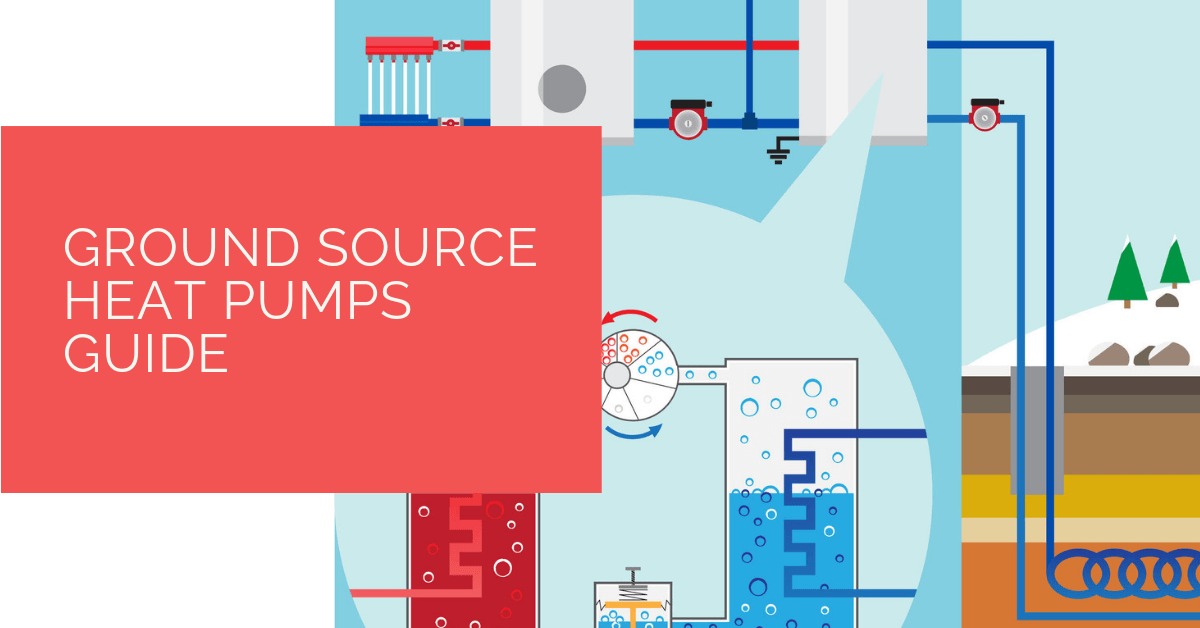
A ground source heat pump works by moving heat rather than creating it by burning fuel. Pipes buried in the ground contain a fluid, usually a mixture of water and antifreeze. As this fluid circulates, it absorbs low-grade heat from the surrounding ground.
The warmed fluid returns to the heat pump, where a heat exchanger transfers that energy into a refrigerant circuit. The refrigerant evaporates at a low temperature, is compressed to raise its temperature, and then releases heat into the home’s heating system through another heat exchanger.
That heat can be used for underfloor heating, radiators, fan convectors and domestic hot water. The process sounds technical, but the principle is straightforward: collect low-temperature heat from the ground, concentrate it, and deliver it into the home at a useful temperature.
The Three Main Parts of the System
A ground source heat pump installation has three main parts, and all three need to work together.
The Ground Array
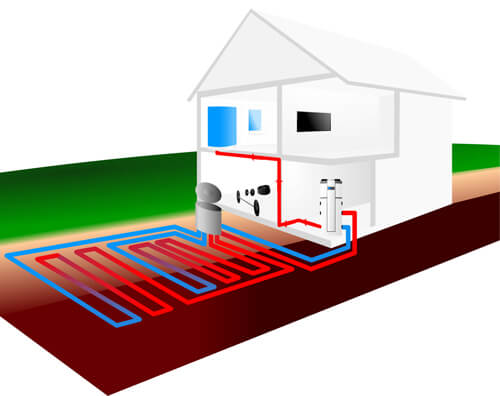
The ground array is the buried pipework that collects heat. It may be laid in horizontal trenches, installed in vertical boreholes, or placed in a suitable body of water. The size of the ground array depends on the property’s heat demand, soil or ground conditions, available space and the design temperatures.
The Heat Pump Unit
The heat pump unit usually sits inside the property, garage, utility room or plant space. It contains the compressor, heat exchangers, controls and pumps that move heat from the ground circuit into the heating system.
The Heat Distribution System
The distribution system is what delivers heat around the home. This might be underfloor heating, radiators, fan convectors or a mix of emitters. The lower the flow temperature the home can use while staying warm, the more efficiently the heat pump can usually run.
Horizontal Trenches, Boreholes and Water Loops
The ground array is the part that most affects cost, disruption and suitability. There are three broad options.
Horizontal Ground Loops
Horizontal loops are buried in trenches, usually across a garden or field. They are often cheaper than boreholes because they avoid specialist drilling, but they need enough land and access for excavation equipment.
The land above the loop usually needs to remain suitable for heat recovery. It should not be heavily built over, and the reinstatement plan matters. A finished landscaped garden is more disruptive to dig up than a plot already being renovated.
Vertical Boreholes
Boreholes use vertical drilled holes rather than wide trenches. They are useful where surface land is limited, but they are usually more expensive because drilling requires specialist equipment and suitable access.
The borehole depth and number are design decisions. They depend on heat demand, geology and how much heat can be extracted sustainably. This is not something to estimate from house size alone.
Water-Source Loops
Some systems use a pond, lake or other suitable body of water as the heat source. This can work well where the site is appropriate, but it is more specialist and depends on water depth, permissions, access and environmental considerations.
| Ground Array Type | Best Suited To | Main Limitation |
|---|---|---|
| Horizontal Trenches | Homes with enough land and good excavation access | Needs suitable ground area and reinstatement |
| Vertical Boreholes | Homes with less land but higher installation budget | Specialist drilling cost and access requirements |
| Water Loops | Properties with a suitable pond or lake | Site-specific permissions and environmental checks |
Is Your Property Suitable?
Ground source heat pumps suit some homes extremely well and others poorly. The strongest candidates usually have land, long-term ownership plans, a good space for plant equipment and a heating system that can work at lower flow temperatures.
A large rural property, self-build, major renovation or home with a sizeable garden may be a good candidate. A small urban terrace with limited outdoor space may find an air source heat pump more realistic. A flat will usually be difficult unless it is part of a larger shared system.
Insulation matters too. A poorly insulated home loses more heat, which means a larger system, more ground array, higher running demand and potentially more radiator upgrades. Improving insulation before sizing the system can reduce cost and improve comfort.
Installation Process and Disruption
Ground source installation is more disruptive than fitting a standard boiler or many air source heat pumps because the heat collector has to be installed in the ground. The exact process depends on whether you choose trenches or boreholes.
For a horizontal system, the installer will usually survey the site, excavate trenches, lay pipework, connect the ground array to the manifold and heat pump, pressure-test the circuit, backfill the trenches and reinstate the ground. Weather, soil, access and landscaping all affect the experience.
For boreholes, the work involves drilling equipment, borehole loops, grouting, header pipework, manifold connections and plant-room installation. Boreholes reduce the surface area needed, but they do not remove disruption. Access for drilling equipment is a major practical question.
Inside the home, you may also need a hot-water cylinder, upgraded radiators, underfloor heating manifolds, new controls, electrical work or pipework changes. A good quote should explain all enabling works, not just the heat pump unit.
Costs, Grants and Running Costs
Ground source heat pumps usually cost more to install than air source heat pumps because of the groundworks or boreholes. The heat pump unit, ground array, labour, plant space, cylinder, heating emitter upgrades, controls, electrical work and reinstatement all affect the final figure.
It is better to treat published cost ranges as rough context rather than promises. A simple horizontal trench installation on a suitable plot is very different from boreholes on a restricted site. The only useful cost is a design-led quote based on your home’s heat loss and ground conditions.
Running costs depend on seasonal efficiency and electricity tariff. A well-designed ground source system can deliver several units of heat for each unit of electricity it uses, but poor design can weaken that advantage. Flow temperature is especially important. If the system has to run too hot to satisfy undersized radiators, efficiency falls.
For eligible installations in England and Wales, the Boiler Upgrade Scheme can help with upfront cost. The standard grant is £7,500 towards ground source heat pumps. Homes currently on heating oil or LPG qualify for a higher grant of £9,000 from July 2026, reflecting the greater savings from switching off a more expensive fuel. Check eligibility before making budget decisions, because grant rules and installer requirements matter.
Efficiency, COP and SCOP
Heat pump efficiency is often described using COP, or coefficient of performance. A COP of 4 means the heat pump delivers four units of heat for every unit of electricity used under a particular test condition.
For real homes, seasonal performance is more useful than a single COP figure. SCOP, or seasonal coefficient of performance, looks across a wider range of operating conditions. It gives a better sense of how the system may perform over the heating season.
Ground source systems often perform well because the ground temperature is more stable than outdoor air. That does not guarantee strong performance by itself. The ground array must be correctly sized, the heat pump must be commissioned properly, and the heating emitters must allow sensible flow temperatures.
Radiators, Underfloor Heating and Hot Water
Ground source heat pumps work well with underfloor heating because underfloor systems can deliver comfort at low water temperatures. That helps efficiency. However, underfloor heating is not the only option.
Radiators can work with ground source heat pumps if they are sized correctly. Existing radiators may be suitable in some rooms, especially after insulation improvements. Other rooms may need larger radiators, extra panels, fan convectors or a lower heat loss before the system can run efficiently.
Hot water normally requires a compatible cylinder. If you currently have a combi boiler, this is a major practical change because you may need space for stored hot water. Cylinder size should be based on real household demand, not a generic assumption. Our radiator sizing guide explains why lower flow temperatures change emitter output.
Ground Source vs Air Source Heat Pumps
Ground source and air source heat pumps both move heat using electricity, but they collect heat from different places. Air source heat pumps collect heat from outdoor air. Ground source systems collect heat from the ground through buried pipework.
Ground source systems can offer strong, stable efficiency and quieter outdoor operation because there is no large outdoor fan unit. They can also have long-lasting ground arrays. The trade-off is higher upfront cost, more design work and more disruption during installation.
Air source heat pumps are usually easier and cheaper to install, especially in typical homes with limited land. They are often the more practical choice when groundworks are not realistic. Ground source becomes more compelling where the property has land, high heat demand, a long-term ownership horizon or a renovation schedule that makes groundworks easier to absorb. Our air source heat pump guide explains that alternative in more detail.
Pros and Cons of Ground Source Heat Pumps
Pros
- High potential seasonal efficiency when designed well.
- Stable heat source compared with winter air temperatures.
- No large outdoor fan unit.
- Can provide space heating and hot water.
- Long-lasting ground arrays when installed correctly.
- Low-carbon heating when paired with a decarbonising electricity grid.
Cons
- Higher upfront cost than many alternatives.
- Trenching or drilling can be disruptive.
- Needs suitable land, borehole access or a specialist water-source option.
- Requires careful design of radiators, underfloor heating, cylinder and controls.
- Not usually the easiest choice for small urban plots or flats.
- Poor design is hard to correct after the ground array is installed.
Maintenance and Lifespan
Ground source heat pumps are often described as low maintenance, and that is broadly fair compared with combustion heating. There is no fuel delivery, flue or burner. Even so, low maintenance does not mean no maintenance.
The heat pump unit, pumps, pressure, antifreeze concentration, filters, controls and electrical components should be checked according to the manufacturer and installer guidance. The ground array is designed to last for decades, but it depends on correct installation, pressure testing and protection during any future landscaping or building work.
Keep clear records of the ground loop layout. That matters if you later build an extension, install drainage, plant trees or carry out garden works. The buried pipework is an asset, but only if future work avoids damaging it.
Case Study: Assessing Ground Source Heating for a Rural Home
Background
A homeowner with a large rural property wanted to move away from oil heating and had enough land to consider horizontal ground loops. The house had high heat demand, but the plot gave options that many urban homes would not have.
Assessment
The first question was not which heat pump model to buy. It was whether the land could support the ground array without drainage problems, damage to mature planting or excessive reinstatement cost. Horizontal trenches were compared with boreholes, including access, soil conditions and long-term serviceability.
Decision
The heating design also looked at radiators and hot water. Several radiators were upgraded so the system could run at lower flow temperatures, and the cylinder was sized around real household use. Because landscaping work was already planned, the trenching disruption was easier to absorb.
Result
The project made sense because the property had land, long-term ownership and enough heat demand for the efficiency benefit to matter. The lesson is that ground source heat pumps can be excellent, but the groundworks and building design must justify the extra upfront cost.
Expert Insights From Our Heating Engineers
One of our senior heating engineers with over 18 years of experience says ground source heat pumps reward careful design more than almost any domestic heating system.
“The buried loop is the part you really do not want to undersize. You can adjust controls later and you can change radiators later, but correcting a poor ground array is much harder. The design has to treat the ground, heat pump, cylinder and emitters as one system.”
He also advises homeowners to ask about reinstatement. “People focus on the heat pump unit, but the garden, driveway or field work can be the part they feel most. A good installer should talk through access, spoil, drainage, reinstatement and future protection of the ground loop.”
Frequently Asked Questions
How Does a Ground Source Heat Pump Work in Simple Terms?
It circulates fluid through buried pipes, collects low-temperature heat from the ground, then uses a heat pump to raise that heat to a useful temperature for the home. The heat can then be used for radiators, underfloor heating and hot water.
How Deep Do Ground Source Heat Pump Pipes Need to Be?
Horizontal ground loops are usually buried in trenches below the surface, while boreholes go much deeper and need specialist drilling. The exact depth depends on ground conditions, system size, heat demand and design. It should be specified by a competent designer, not guessed from garden size.
How Much Land Do You Need for a Ground Source Heat Pump?
It depends on the property’s heat demand and ground conditions. A small, well-insulated home needs less collector area than a large, poorly insulated home. If land is limited, boreholes may be possible, but they usually increase installation cost and need specialist access.
Are Ground Source Heat Pumps Cheaper to Run Than Air Source Heat Pumps?
They can be, because ground temperatures are more stable than winter air temperatures. However, the higher installation cost means the best-value option is not automatic. Compare total installed cost, expected seasonal efficiency, maintenance, available space and how long you plan to stay in the property.
Can Ground Source Heat Pumps Work With Radiators?
Yes, but the radiators must deliver enough heat at the lower water temperatures the heat pump is designed to use. Some existing radiators may be suitable, while others may need to be larger or replaced with fan convectors or underfloor heating.
How Disruptive Is Ground Source Heat Pump Installation?
It can be quite disruptive because trenches or boreholes are needed for the ground array. Horizontal systems involve excavation across suitable land, while boreholes need drilling equipment. The indoor work may also include a cylinder, controls, pipework and radiator upgrades.
How Long Do Ground Source Heat Pumps Last?
The indoor heat pump unit may last around 15 to 25 years depending on product quality, usage and maintenance. The buried ground array can last much longer when installed correctly. Keep records of the loop location so future groundworks do not damage it.
Do Ground Source Heat Pumps Qualify for Grants?
Eligible ground source heat pump installations in England and Wales may qualify for the Boiler Upgrade Scheme. The standard grant is £7,500, rising to £9,000 for homes currently on heating oil or LPG (from July 2026). The application is installer-led, so check eligibility before committing.
Are Ground Source Heat Pumps Worth It?
They can be worth it for suitable homes, especially properties with land, high heat demand, long-term ownership plans or renovation work that makes groundworks easier. They are less convincing where land is limited, upfront budget is tight or an air source heat pump would meet the same need with far less disruption.
Summing Up
A ground source heat pump is not just a boiler replacement with buried pipes. It is a whole heating system built around the ground array, the heat pump unit, the emitters, the hot-water cylinder and the controls. When those parts are designed together, ground source can be efficient, quiet and durable.
The trade-off is upfront cost and disruption. If your property has suitable land, good access and a long-term plan, ground source may be one of the strongest low-carbon heating options available. If space or budget is limited, an air source heat pump may be the more practical route.
Updated