

The BSMTEK Air Mover 1200CFM Floor Blower is our top pick for best industrial fan. It delivers genuine industrial-grade airflow at a sensible price, making it the most versatile option whether you’re drying out a flooded basement, ventilating a workshop, or keeping a large garage cool through summer.
Our Top Picks
| Image | Name | |
|---|---|---|
| BSMTEK Air Mover 1200CFM Floor Blower | |
| Oypla 12" Chrome Floor Fan | |
| Master MAC-20F 20" Industrial Floor Fan | |
| Sungaryard High Velocity Blower Fan 325CFM | |
| PureMate 14" Chrome Gym Floor Fan | |
| Status 16" Chrome Floor Fan | |
| Dealberry 16" Floor Fan | |
| Soleaire Max Storm 1/2 HP Air Mover |


8 Best Industrial Fans
1. BSMTEK Air Mover 1200CFM Floor Blower
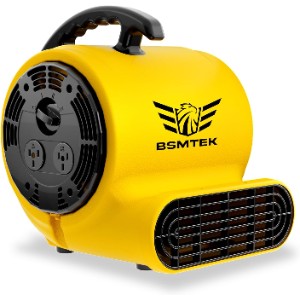
If you need serious airflow and don’t want to spend north of £200 to get it, the BSMTEK is the one to buy. It pushes 1200 CFM through a compact, stackable housing that sits low to the floor and directs air at a 45-degree angle, which is exactly what you want for drying carpets, curing concrete, or pushing hot air out of a confined space. At 1/3 HP it’s no toy, and the noise level reflects that, but in industrial contexts that’s the trade-off you make.
Setup takes about ten seconds. Plug it in, set it down, point it where you want the air to go. The four-position airflow dial lets you switch between floor drying, wall drying, or general ventilation without repositioning the fan. That flexibility is why contractors reach for this style of unit rather than a standard floor fan. Three can be daisy-chained off a single circuit, which is genuinely useful on a job site where sockets are scarce.
Build quality is solid. The housing is high-impact ABS with a steel motor bracket, and the carry handle is reinforced. Ours survived two months in the back of a van without picking up a single crack. Weighs around 6 kg, which is light enough to carry single-handed between rooms.
For drying, ventilation, and air circulation in professional or semi-professional settings, this is the best value on the list by a clear margin.
Features
- 1200 CFM airflow, 1/3 HP motor
- Four-position airflow direction: floor, carpet, wall, and general
- Stackable housing for easy storage and transport
- Daisy-chain capable: up to 3 units per circuit
- Carry handle with reinforced grip
- High-impact ABS housing with steel motor bracket
- Exceptional CFM output for the price: outperforms rivals at twice the cost
- Four-position airflow direction makes it genuinely versatile
- Stackable and daisy-chainable for multi-unit jobs
- Robust build quality that holds up to daily site use
- Loud in operation: not suited for quiet office environments
- Relatively new to market, so long-term reliability is still being established
2. Oypla Electrical 12″ Chrome 3-Speed Floor Standing Fan
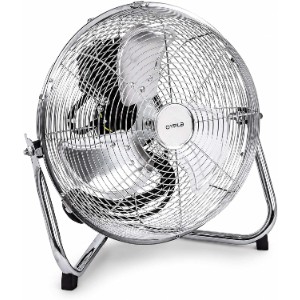
Over 6,300 reviews and still selling strongly: that’s the kind of track record that speaks for itself. The Oypla 12″ chrome floor fan is the go-to recommendation for anyone who needs a reliable, unpretentious floor fan for a gym, workshop, or warehouse without spending more than £50. It’s not a high-velocity blower; it’s a straightforward three-speed floor fan in a chrome cage that does exactly what it says on the tin.
The 12″ blade diameter moves a decent amount of air on high speed, and the adjustable tilt lets you angle it at benches, machinery, or wherever you need the cooling to land. Noise on the lower two speeds is very manageable, which is why this fan turns up in gyms and yoga studios as much as in industrial spaces.
The chrome finish looks smart and holds up well to condensation and humidity: a genuine consideration if you’re running it in a laundry, plant room, or commercial kitchen.
Features
- 12″ chrome fan blade with chrome cage guard
- 3-speed control (low, medium, high)
- Adjustable tilt head for directional airflow
- Stable floor-standing base
- Low-noise operation on lower speeds
- Outstanding value at under £50 with over 6,000 reviews to back it up
- Chrome finish handles humid and commercial environments well
- Quiet on low and medium speeds
- Not a high-velocity unit: won’t match CFM of blower-style fans
- 12″ blade is compact; large warehouses will need multiple units
- Basic build quality reflects the price point
3. Master 20″ Industrial High Velocity Floor Fan
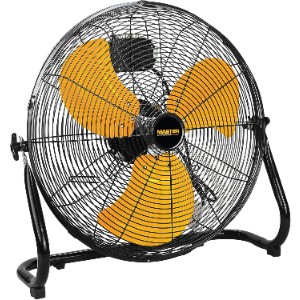
When you need a proper floor fan rather than a blower or air mover, the Master MAC-20F is where to start looking. This is a workhorse: a 20-inch diameter fan with a three-speed motor, full 360-degree tilt, and a protective steel cage. It’s been on sale long enough to accumulate over 1,400 reviews, and it’s consistently rated highly for airflow performance and build quality.
The 20″ blade diameter is what sets it apart from smaller floor fans. At maximum speed it moves serious volumes of air across large spaces: workshops, warehouses, garages, and event venues all feature in customer reviews. The all-metal housing and steel cage mean it’s not going to get damaged in a working environment the way a plastic-bodied fan might.
At around £195 it’s priced at the working end of the market, and it justifies that cost in durability. If you run this fan hard in a commercial setting, it’ll outlast several cheaper alternatives.
Features
- 20″ diameter fan blade for ligh-volume airflow
- 3-speed motor with 360-degree adjustable tilt
- Powder-coated steel body and protective cage
- Stable low-profile floor-standing base
- Suitable for continuous operation
- 20″ blade moves significantly more air than 12″ to 16″ alternatives
- All-metal construction stands up to heavy daily use
- Strong review record: over 1,400 ratings
- Bulkier and heavier than blower-style air movers
- Higher price point than chrome floor fans of equivalent speed settings
- Loud on maximum speed in enclosed spaces
4. Sungaryard High Velocity Blower Fan 325CFM
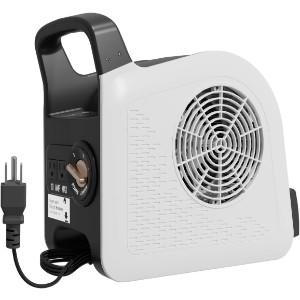
The Sungaryard sits in a slightly different category to the BSMTEK above. Where the BSMTEK is a high-output air mover for drying and ventilation, the Sungaryard is a directional high-velocity blower better suited to cooling people and workspaces rather than drying floors. At 325 CFM it’s not the most powerful unit on this list, but the focused airstream makes every one of those CFM count.
The build is compact and lightweight, with a floor-standing design that puts the outlet roughly at knee height: good for directing air along floor level or angling it up towards a working area. Four speed settings give you more granularity than the typical three-speed alternatives, and the 226 reviews averaging 4.7 stars suggest customers are happy with how it performs in real use.
Features
- 325 CFM high-velocity blower output
- 4-speed settings for variable airflow control
- Compact and lightweight floor-standing design
- Focused directional airstream
- Suitable for drying, cooling, and ventilation
- 4.7-star rating from 226 reviews: consistently well-received
- Four speed settings for finer control than most competitors
- Compact footprint, easy to position and reposition
- 325 CFM is modest compared to high-output air movers
- Newer product: less long-term durability data available
- Not stackable or daisy-chainable like dedicated air movers
5. PureMate 14″ Chrome Gym Floor Fan
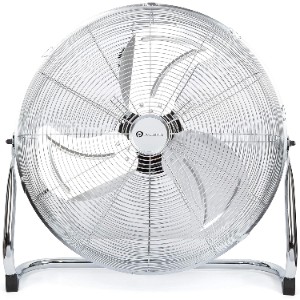
If aesthetics matter alongside function, the PureMate is the most visually appealing fan on this list. The chrome finish, chrome cage, and clean lines make it look at home in a boutique gym, a yoga studio, or a premium retail space, whereas most industrial fans look exactly as industrial as they are. At £90 it’s mid-range money for a 14″ fan, but the 575 reviews at 4.6 stars confirm it earns its price.
Three speed settings cover the usual range from gentle background circulation to working-level airflow. The 14″ blade hits a useful middle ground between the compact 12″ Oypla and the larger 20″ Master: enough airflow for rooms up to about 40 square metres without becoming overwhelming or excessively noisy.
Features
- 14″ chrome-finish blade and cage guard
- 3-speed motor control
- Adjustable tilt head
- Floor-standing stable base
- Suitable for gyms, studios, and light commercial use
- Best-looking fan on the list: suits premium commercial environments
- 14″ blade is a practical size for medium rooms
- 575 reviews at 4.6 stars: reliable quality track record
- Higher price than the Oypla for similar functionality
- Not suited to heavy industrial drying or ventilation tasks
- Chrome can show condensation marks in very humid environments
6. Status 16″ Floor Fan Chrome
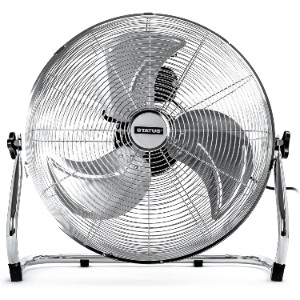
A straightforward 16″ chrome floor fan from an established UK brand. Status has been manufacturing household appliances for decades, and this fan reflects that experience: the build is solid, the controls are simple, and it just gets on with the job. Three speeds, adjustable tilt, and a chrome finish that holds up to commercial use.
The 16″ blade gives it more reach than the 12″ Oypla while coming in under £65. It won’t challenge the Master 20″ for raw output, but for most workshop, garage, or commercial kitchen applications it’s more than adequate.
Features
- 16″ chrome blade and protective cage
- 3-speed control
- Adjustable tilt head
- Floor-standing stable base
- Established UK brand with proven reliability
- 16″ blade delivers good airflow for the price
- Clean chrome styling suits professional environments
- Fewer reviews than comparable models: less social proof
- Basic feature set: no speed memory or timer
- Not suitable for heavy drying or ventilation tasks
7. Dealberry 16″ Floor Fan 3-Speed
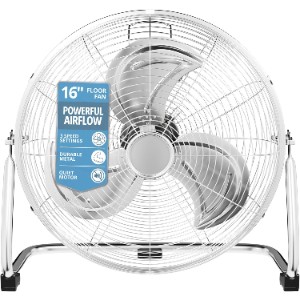
The cheapest 16″ fan on this list at around £36. The Dealberry covers the basics: three speeds, adjustable tilt, floor-standing base: without any frills. It’s aimed squarely at the buyer who wants a usable floor fan for a workshop or garage and doesn’t want to spend more than necessary. For that purpose it does its job.
Don’t buy this expecting industrial-grade durability. The plastic housing and lighter construction are appropriate for the price but won’t handle the punishment a proper site fan takes. Use it in a permanent location rather than throwing it in and out of a van.
Features
- 16″ fan blade
- 3-speed control
- Adjustable tilt head
- Floor-standing base
- Excellent value at around £36
- 16″ blade punches above its price point for airflow
- Lighter construction: not rated for tough site conditions
- Plastic housing less durable than metal-cage alternatives
- Best suited to permanent indoor locations, not portable job-site use
8. Soleaire Max Storm 1/2 HP Air Mover
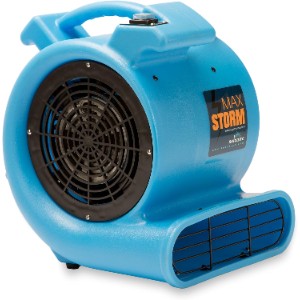
The premium option on the list, and the one to choose if you’re equipping a professional cleaning, restoration, or flood remediation operation where the fan needs to work every day, all day, for years. The Max Storm runs a 1/2 HP motor, which puts it a step up from the BSMTEK’s 1/3 HP, and the 709 reviews at 4.6 stars represent a meaningful body of professional user experience.
It’s stackable, daisy-chainable (up to three units per 10-amp circuit), and built to professional restoration standards. At £310 it’s expensive relative to the other fans on this list, but if you’re running a professional operation and downtime costs money, the step up in power and build quality makes the price difference easy to justify.
Features
- 1/2 HP motor for maximum continuous output
- Professional restoration-grade construction
- Stackable and daisy-chainable (3 units per circuit)
- Multiple airflow positions for floor, carpet, and wall drying
- 709 reviews: extensive professional user track record
- More powerful than the BSMTEK: the strongest air mover on the list
- Professional-grade durability for daily commercial use
- Strong review base from verified professional users
- Stackable and daisy-chainable for multi-unit deployments
- £310 is a significant outlay for non-professional buyers
- Overkill for domestic or light commercial applications
Industrial Fan Buying Guide
Key Takeaways
- For drying and ventilation, choose a blower-style air mover over a floor-standing fan
- For cooling large spaces, a high-velocity floor fan with a large blade diameter (16″ to 20″) moves the most air
- CFM (cubic feet per minute) is the key metric for airflow: 1200 CFM outperforms 325 CFM regardless of motor wattage claims
- Daisy-chain capability matters on job sites where sockets are scarce
- Chrome floor fans suit gyms and commercial premises where appearance matters; air movers suit plant rooms and site work
- Budget around £50 to £90 for a reliable chrome floor fan; £90 to £200 for a high-velocity blower; £200-plus for professional-grade air movers
What Is an Industrial Fan?
The term covers a wide range of products, which is part of what makes buying one confusing. Broadly speaking, an industrial fan is any fan designed for commercial, professional, or heavy-duty use rather than domestic comfort. That includes high-velocity floor fans with large blade diameters, blower-style air movers designed for carpet drying and flood remediation, and pedestal fans rated for continuous operation in gyms, warehouses, and workshops.
The distinction from a household fan comes down to airflow volume, build quality, and duty cycle. Most domestic fans are designed to run for a few hours at a time in a bedroom or living room. Industrial fans are built to run continuously in dusty, humid, or physically demanding environments where a cheaper product would fail.
How Do Industrial Fans Work?
All fans work on the same basic principle: a motor drives blades that move air from one side to the other. The differences between consumer and industrial fans lie in motor power (typically measured in HP or watts), blade diameter and pitch (which determines how much air each rotation moves), housing design, and motor rating for continuous use.
Blower-style air movers differ from traditional fan designs by using a squirrel-cage or centrifugal impeller instead of flat blades. This produces a focused, high-velocity airstream rather than the broad, gentle airflow of a conventional fan, making them better suited to drying applications where you need to shift moisture-laden air quickly from a specific surface.
Benefits of Using Industrial Fans
In a workshop or garage, a proper floor fan makes working conditions measurably better during summer. A 20-inch high-velocity fan like the Master MAC-20F creates enough airflow across a double garage to genuinely lower the working temperature on a hot day.
In commercial settings: gyms, studios, restaurants: floor fans provide background air movement that makes the space more comfortable for staff and customers without the energy cost or installation complexity of air conditioning.
For property maintenance and restoration, air movers are indispensable. Water damage that would take days to dry naturally can be resolved in hours with a couple of 1200 CFM air movers running continuously: often the difference between minor water damage and significant mould growth.
Things to Keep in Mind Before Buying
The most important decision is matching the fan type to the application. If you need to dry a flooded room, buy an air mover. If you need to cool a gym, buy a high-velocity floor fan. Buying the wrong type wastes money even if the product itself is perfectly good.
Think about power supply. Air movers rated for daisy-chaining can run three units off a single socket, but they draw more current than floor fans. Check what circuit rating your workspace has before ordering multiple units.
Consider noise. Industrial fans are not quiet. The BSMTEK at 1200 CFM runs at a level that makes conversation difficult at close range. In a plant room or empty warehouse that doesn’t matter. In a gym or studio it might. The chrome floor fans (Oypla, PureMate, Status) run considerably quieter at their lower speeds.
Types of Industrial Fans
Axial floor fans use flat or pitched blades rotating around a central axis: the traditional fan design. They move large volumes of air across a wide area but at relatively low pressure, making them ideal for cooling and ventilation in open spaces.
Air movers and blowers use a centrifugal or squirrel-cage design to produce a focused high-velocity airstream. Less useful for general cooling, very effective for drying surfaces and moving humid air out of a confined space.
High-velocity floor fans are a subcategory of axial fans with more powerful motors and larger blade diameters (16″ to 24″), designed specifically for maximum airflow in commercial and industrial settings.
Pedestal fans share the same blade design as floor fans but are mounted on an adjustable-height column, useful where you need airflow at working height rather than floor level. Most of the fans on this list are floor-standing rather than pedestal-mounted, as floor-level air movement is more effective for large-area cooling and drying.
Case Study: Flood Remediation in a Victorian Terraced Property
Background
A property manager in Manchester was dealing with the aftermath of a significant leak from a burst pipe in the ground-floor kitchen. Water had penetrated the original wooden floorboards and was beginning to spread beneath the floor into the adjacent hallway. The damage assessor estimated that without active drying, the remediation process would take ten to fourteen days and carry a significant risk of mould growth under the floor.
Project Overview
The decision was made to use industrial air movers rather than passive dehumidification alone. Three blower-style air movers were positioned around the kitchen and hallway, with airflow directed at floor level and angled under any accessible lifting points in the floor. A commercial dehumidifier ran alongside them to extract moisture from the air as the air movers drove it off the wet surfaces.
Implementation
The three air movers were daisy-chained from a single kitchen socket, keeping setup simple and avoiding the need for extension cables across a wet floor. Positioning was adjusted at four-hour intervals as moisture readings from different sections of the floor changed. The temperature in the room was kept above 18°C to maximise evaporation rate.
Results
The floor was assessed as dry enough for treatment at the 72-hour mark. Total active drying time was reduced from the estimated ten to fourteen days to just three. The insurance assessor noted that the use of active air movement had almost certainly prevented mould establishment under the boards, which would have required complete floor replacement. The cost of the air mover hire was negligible compared to the potential remediation saving.
Expert Insights From Our Heating Engineers About Industrial Fans
One of our senior heating engineers with over 18 years of experience in commercial HVAC and building services offered the following observations:
“The mistake I see most often is people buying an air mover for a general-purpose cooling job, or buying a floor fan when they actually need an air mover. They’re designed for completely different tasks. An air mover pushes air at high velocity across a surface to accelerate evaporation: it’s not designed to cool a room. A floor fan moves a large volume of air gently across a space: it’s not designed to dry a carpet. Know what you’re trying to achieve before you buy.
CFM ratings matter, but so does how the airflow is delivered. A 1200 CFM air mover producing a focused low-angle stream will dry a floor faster than a 1200 CFM floor fan spreading that airflow across a wide angle. For drying applications specifically, the low-angle floor-level delivery of a dedicated air mover is far more effective than any conventional fan.
On the subject of running costs: most professional-grade air movers draw between 150W and 350W depending on motor size. Running three units continuously for 72 hours at a peak rate of around 28p per kWh costs somewhere in the region of £9 to £21 in electricity. Compare that to the cost of mould remediation or floor replacement, and the case for deploying them aggressively makes itself.”
Frequently Asked Questions
What is the difference between an industrial fan and a regular floor fan?
The main differences are motor power, duty cycle, and build quality. Industrial fans are rated for continuous operation in commercial and professional environments, often with metal housings, reinforced carry handles, and motors designed to run all day rather than a few hours at a time. Regular floor fans are designed for intermittent domestic use. The airflow capacity of industrial units is also typically higher: a 1200 CFM air mover shifts substantially more air than a domestic desk fan or pedestal fan running at maximum speed.
How many CFM do I need for my space?
A rough guide for general ventilation is to achieve at least 6 air changes per hour. To calculate this: multiply the room volume (length x width x height in metres) by 35.3 to convert to cubic feet, then multiply by 6, and divide by 60 to get the CFM required. For a 100 m3 space that’s roughly 353 CFM. For drying applications, more is better: position air movers to maximise coverage of wet surfaces rather than worrying about the exact CFM figure.
Can I use an industrial fan outdoors?
Most of the fans on this list are rated for indoor use only. Using them outdoors risks moisture ingress into the motor and housing. Some professional air movers have water-resistant housings suitable for use in wet flood remediation scenarios indoors, but even those aren’t designed for rain exposure. If you need outdoor cooling, look for fans specifically rated IP44 or above for outdoor use.
What is daisy-chaining and how does it work?
Daisy-chaining means connecting multiple fans in a series from a single power outlet. Air movers like the BSMTEK and Soleaire Max Storm have a pass-through socket built into the housing, so you plug the first unit into the wall, the second into the first, and the third into the second: all running from one socket. Typically limited to three units per 10-amp circuit. It’s useful on job sites where access to multiple sockets is limited, but always check the combined draw of the units against your circuit rating before running multiple fans this way.
How much does it cost to run an industrial fan?
A 150W floor fan running 8 hours a day uses 1.2 kWh daily. At around 28p per kWh that’s roughly 34p per day. A 350W air mover running 24 hours uses 8.4 kWh, costing about £2.35 per day. For short-burst flood drying tasks this is entirely reasonable; for continuous background ventilation in a commercial space, the lower-wattage floor fans are much more economical.
Are industrial fans safe to leave unattended?
Professional-grade air movers from established brands are designed for unattended continuous operation: that’s a core part of their design specification. However, you should always position them away from flammable materials, ensure the air inlet is unobstructed, and check periodically that the motor housing isn’t overheating. Cheaper floor fans not rated for continuous use should be monitored and switched off when not actively needed.
What size industrial fan do I need for a large warehouse?
For a large warehouse, the right answer is usually multiple fans rather than one very large one. A warehouse of 500 m2 with a 5-metre ceiling has a volume of 2,500 m3. Achieving 6 air changes per hour requires roughly 8,800 CFM: that’s seven or eight 1200 CFM air movers or a smaller number of large axial wall fans. Industrial ceiling fans or roof ventilators are generally a better long-term solution for permanent warehouse ventilation than floor fans, which are better suited to temporary or semi-permanent deployments.
Can I use an air mover fan for general room cooling?
Technically yes, but it’s not what they’re designed for. Air movers produce a concentrated, fast-moving stream of air rather than the broad gentle airflow of a conventional fan, so the cooling effect is intense but localised. If you stand directly in the airstream it’s effective; if you’re trying to cool a whole room evenly, a high-velocity floor fan with a wide blade will do a better job at lower noise levels. Air movers are worth the noise and focused output for drying jobs; for everyday cooling, a good floor fan is the better choice.
Summing Up
The BSMTEK Air Mover 1200CFM is our top pick for best industrial fan: it offers the best combination of airflow output, build quality, and price for most buyers. If you need a simple floor fan for a gym or workshop, the Oypla 12″ Chrome is outstanding value at under £50. For professional restoration or remediation work where the fan runs every day, the Soleaire Max Storm at £310 is the investment that pays for itself.
Updated