

Our blog is reader-supported. When you buy through links on our site, we may earn an affiliate commission. Thank you for your support!
Electric radiators have moved a long way from the storage heaters and basic panel heaters of the 1980s. The best models now combine accurate digital thermostats, Wi-Fi scheduling, and slim modern profiles that look more like a design feature than a heating appliance. The Devola Wifi Enabled Smart Electric Glass Panel Heater 2000W is our top pick, it won the Good Housekeeping Institute approval in 2025 and is the most reviewed smart electric radiator on Amazon UK.
We’ve reviewed the best electric radiators available on Amazon UK right now, from budget eco panel heaters to Wi-Fi connected glass panel models, so you can find the right fit for your home.
Our Top Picks
| Image | Name | |
|---|---|---|
| Devola Wifi Smart Electric Glass Panel Heater 2000W | |
| Dimplex ECR20Tie 2kW Portable Eco Radiator | |
| Devola Wifi Smart Electric Panel Heater 2000W Wall Mounted | |
| Devola DVNDM24 2400W Eco Electric Panel Heater | |
| Devola DVNDM10 1000W Eco Electric Panel Heater |
5 Best Electric Radiators
1. Devola Wifi Smart Electric Glass Panel Heater 2000W
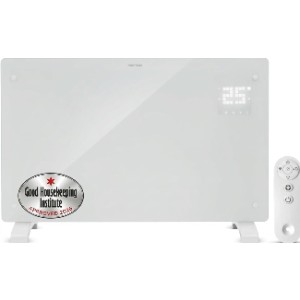
This is the electric radiator that UK heating professionals and consumer press keep coming back to. The Good Housekeeping Institute approved it in 2025, and 1,295 verified buyers have kept the rating at 4.3 stars across what is now the most comprehensively reviewed smart electric heater in this category on Amazon UK. That’s a meaningful signal in a category that has seen a lot of short-lived entrants.
The Wi-Fi connectivity integrates with the Devola app and works with Alexa, practical rather than gimmicky. You can set weekly schedules, control temperature from your phone when you’re away, and use open-window detection that pauses heating automatically when it senses a rapid temperature drop. At 2,000W with IP24 splash-proof rating, it’s suitable for both living rooms and bathrooms.
The glass panel design is a genuine aesthetic upgrade over the plastic alternatives. In a kitchen or modern bedroom, it looks intentional rather than functional. The integral precision thermostat is accurate to within half a degree, which matters for actual energy efficiency, an inaccurate thermostat that overshoots wastes more energy than the schedule savings can recover.
At £119.99, it’s the mid-range option on this list. For any room that will be heated on a regular daily schedule, the scheduling capability pays back the price premium quickly.
Features
- 2,000W output with Wi-Fi and app control
- Good Housekeeping Institute 2025 approved
- Alexa compatible, smart home integration
- IP24 rated, suitable for bathroom use
- Open window detection
- Precision thermostat accurate to 0.5°C
- Wall mountable or freestanding with bracket
- Most reviewed smart electric radiator on Amazon UK
- Good Housekeeping 2025 approval
- Wi-Fi, Alexa, open window detection
- IP24 rated for bathroom use
- 5GHz Wi-Fi networks need splitting to 2.4GHz for connection
- Glass panel requires careful cleaning
2. Dimplex ECR20Tie 2kW Portable Eco Radiator
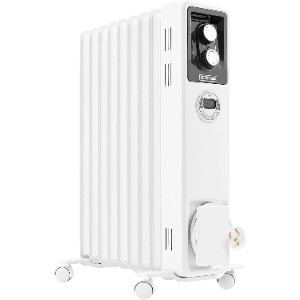
The Dimplex ECR20Tie has the highest rating on this list, 4.6 stars from 364 verified buyers, and comes from a brand with over 70 years in UK electric heating. While the Devola dominates on smart features, the Dimplex wins on thermal performance and near-silent operation.
This is an oil-free column radiator, which distinguishes it from the glass panel heaters elsewhere on this list. The column format heats up faster than oil-filled equivalents and continues to radiate warmth after switch-off, but without the weight and slow start-up of traditional oil-filled designs. Dimplex’s thermal compound technology stores and releases heat efficiently.
At £98.89 with wheels for easy room-to-room movement, it’s the most portable option here. No Wi-Fi, no app, it has a manual thermostat and runs on a standard plug. For a spare bedroom, a garage workshop, or any room where you want effective heating without complexity, it’s the straightforward professional choice. The Dimplex name alone carries significant reliability confidence in the UK heating market.
Features
- 2,000W oil-free column design
- Near-silent operation
- Thermal compound stores and releases heat
- Portable, wheels included
- Standard plug, no installation required
- Adjustable thermostat
- Highest-rated product on this list (4.6 stars)
- Dimplex brand, 70+ years UK reliability
- Near-silent operation
- No installation, plug-in and go
- No Wi-Fi or smart controls
- Manual thermostat only
3. Devola Wifi Smart Electric Glass Panel Heater 2000W, Wall Mounted
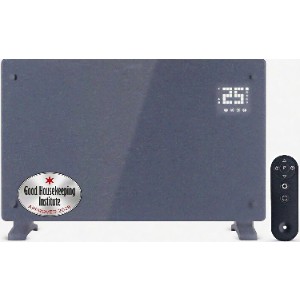
This is the permanently wall-mounted version of the top-pick Devola, same Good Housekeeping approval, same 1,295 reviews at 4.3 stars, same 2,000W output and Wi-Fi capability, but designed for fixed installation rather than freestanding use.
The wall-mounted format is worth the £15 premium over the standard model if you want a cleaner finish. No visible brackets, no unit that can be knocked or moved accidentally, and a sleeker installation that integrates with the room rather than sitting in front of it. Installation requires a qualified electrician for hardwired connection to a fused spur, the same work required for any fixed electric heater.
For a primary bedroom, a living room, or any space where the electric radiator will be in permanent use, wall mounting is the right approach. It commits the unit to the room but removes the visual clutter of a freestanding appliance.
Features
- 2,000W wall-mounted configuration
- Wi-Fi and Alexa compatible
- Good Housekeeping Institute 2025 approved
- IP24 splash-proof rating
- Open window detection
- Hardwired installation, professional fitting recommended
- Cleaner wall-mounted installation
- Same smart features as the top pick
- Good Housekeeping 2025 approved
- Permanent fixture, more secure than freestanding
- Requires electrician for hardwired installation
- £15 premium over freestanding version
4. Devola DVNDM24 2400W Eco Electric Panel Heater
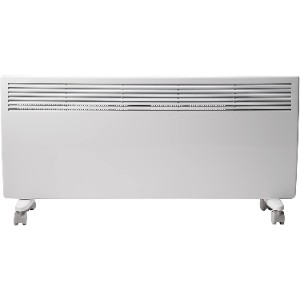
If you want more wattage than the standard 2,000W models, either because you have a larger room or because your property has significant heat loss, the Devola 2400W Eco is worth considering. At £84.45 it’s the most affordable option here, and the 2,400W output gives it a meaningful advantage over the 2,000W units for larger spaces.
The trade-off is that this is a no-Wi-Fi model. You get an adjustable thermostat and the standard panel heater form factor, but no app control or scheduling. For a room that’s used at predictable times and where manual control is acceptable, this is a practical budget choice.
The 3.9-star rating from 294 reviews is the lowest on this list and reflects the limitations of a budget model, some buyers report the thermostat being less precise than the premium Devola Wifi units. For occasional use in a room that doesn’t need scheduling, it performs adequately. For daily primary room heating, the step up to the Wifi model is worth the extra cost.
Features
- 2,400W, highest output on this list
- Adjustable thermostat with multiple heat settings
- Eco mode for efficient temperature maintenance
- Overheat protection
- Suitable for wall mounting or freestanding
- Highest wattage, best for larger rooms
- Most affordable on this list at £84.45
- Eco mode for energy efficiency
- No Wi-Fi or smart features
- Lower rating (3.9 stars) than premium models
- Less precise thermostat than Wifi models
5. Devola DVNDM10 1000W Eco Electric Panel Heater
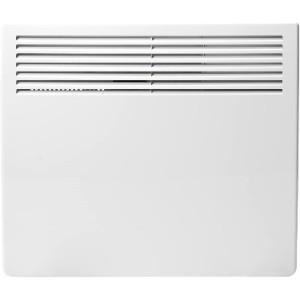
The 1,000W version is the right choice when a larger unit would overheat the space. Small bedrooms, box rooms, home offices, and bathrooms often need less than 2,000W, and running a 2,000W unit on its lowest setting all day is less efficient than a correctly sized 1,000W unit cycling naturally at a higher duty cycle.
At £69.99 with 186 reviews at 4.4 stars, it’s the best-rated eco model on this list and the most economical option for smaller rooms. The eco mode functions effectively, maintaining target temperature more consistently than basic on/off cycling. For a home office used during work hours with predictable temperature requirements, this is a sensible fit.
It doesn’t have Wi-Fi, but the thermostat and eco mode provide enough control for most small-room applications where scheduling isn’t a priority.
Features
- 1,000W output, suited for smaller rooms up to 10–12m²
- Eco mode for efficient temperature maintenance
- Adjustable thermostat
- Slim wall-mounted profile
- Overheat protection
- 4.4-star rating, best eco model on this list
- Correctly sized for small rooms
- Most economical option at £69.99
- No Wi-Fi or scheduling
- 1,000W only, not suitable for larger rooms
Electric Radiators Buying Guide
Key Takeaways
- Dry thermal technology heats fastest and is most energy efficient; ceramic and oil-filled options retain heat longer but take time to warm up
- Calculate your room’s heat output in watts using the 10W per cubic metre rule as a starting point, then adjust for insulation quality and climate
- Thermostatic controls are essential for reducing running costs — precision control can cut energy use by up to 30% compared to basic models
- Panel radiators suit most UK homes; storage heaters are ideal if you’re on Economy 7; infrared suits poorly insulated spaces or spot-heating scenarios
- Check the IP rating for bathrooms and wet rooms — IP44 minimum is required for zone 1 installations; IP65 for splash-prone areas
- Running costs vary from 8.6p to 36p per hour at current 27.7p/kWh — your actual spend depends on thermostat accuracy and usage patterns
- Installation is DIY-friendly for plug-in models; hardwired units need a qualified electrician and proper circuit provision
- Smart controls and app-based heating schedules let you optimise by room and time of day, making it worth paying extra for higher-spec models
Panel Heaters vs. Storage Heaters vs. Infrared: Which Type Is Right for You?
The type of electric radiator you choose affects how quickly it heats, how long it holds warmth, and ultimately what you’ll spend on electricity. Understanding these differences is crucial to getting the right product for your space.
Dry thermal panel radiators contain metal heating elements and are the fastest to warm up — you’ll feel heat in minutes. They’re also the quickest to cool down, which means your thermostat can respond immediately when the room reaches your target temperature. This responsiveness is why dry thermal models are exceptionally energy efficient. They work brilliantly in rooms you use during the day and can switch off at night without wasting power. Most modern electric radiators sold in the UK use this technology.
Ceramic and stone-core radiators are slower to heat but excellent at retaining warmth. The dense ceramic core continues releasing heat even after the element switches off, making them good for bedrooms or rooms you occupy for long stretches. If you’re away during the day, however, the lingering heat means the radiator carries on warming the room even when you don’t want it to, which costs money. Best suited to consistently occupied spaces or supplementary heating in well-insulated rooms.
Oil-filled radiators are the traditional column-style heaters you may remember. They’re popular because they look elegant and offer excellent heat retention, but they’re substantially slower to warm a room than dry thermal models. The trade-off is smooth, radiant heat and a warm surface you can safely touch around children. If you prioritise aesthetics and don’t mind the slower warm-up time, oil-filled remains a solid choice. Many premium brands still use this design.
Infrared heaters are a different technology altogether — instead of heating the air, they emit far-infrared radiation that warms objects and people directly, rather like sunlight. This means you feel comfortable at a lower air temperature, potentially cutting running costs. Infrared suits spot-heating scenarios (a home office, kitchen area) or homes with high ceilings and poor insulation where traditional radiators struggle. They’re not ideal as your primary heating for a conventional house with standard ceilings.
For most UK homes, dry thermal panel radiators offer the best balance of rapid response, energy efficiency, and affordability. They’re what the majority of new builds and renovations use.
How to Calculate the Wattage You Need for Your Room
Putting a 500W radiator in a large bedroom or a 2000W unit in a small bathroom wastes money and fails to heat properly. Calculating the right wattage is straightforward and takes five minutes.
The basic formula: room volume (cubic metres) multiplied by 10W equals your baseline wattage requirement. To find room volume, multiply length by width by height. A room that’s 4m long, 3m wide, and 2.5m high has a volume of 30 cubic metres. Multiply by 10W and you need 300W as a minimum.
However, that rule assumes average UK insulation. Adjust upwards or downwards based on your situation. A room with single-glazed windows, uninsulated walls, or a north-facing aspect in Scotland needs 15W–20W per cubic metre. A well-insulated modern flat with double glazing and draught-proofing might only need 8W–10W per cubic metre. Room height also matters: kitchens and bathrooms, which generate steam and moisture, need extra heat to maintain comfort.
A practical shortcut: look at the radiator wattage your gas central heating installer would have specified for that room. Electric radiators with the same BTU output (1kW equals roughly 3412 BTU) will perform similarly, though electric tends to feel more responsive because there’s no lag in water temperature climbing through pipework.
Don’t oversise just for safety. A radiator that’s too powerful will overshoot your target temperature, switching on and off constantly, which actually increases running costs and wears out the thermostat. Undersizing is better than oversizing — you can always add a second radiator later for a few pounds if needed.
Thermostatic Controls: Why Precision Matters for Your Bills
A basic on-off switch on an electric radiator will keep you warm, but it won’t keep your bills under control. Modern thermostatic radiators are where you save real money — they can reduce energy consumption by up to 30% compared to non-thermostat models.
Mechanical thermostats sense room temperature and dial the heating element up or down automatically. They’re reliable, need no batteries, and are standard on all decent modern radiators. Set your target temperature (usually 16–22°C) and the radiator maintains it with minimal user intervention.
Digital thermostats add precision and flexibility. They display the current room temperature on an LED screen, let you set the exact target to 0.5°C accuracy, and some include a 24-hour timer so you can programme heating to switch on before you wake up and off before you leave for work. This is where the energy savings happen: heating only when you’re present, only to the temperature you actually want.
Smart / WiFi-enabled radiators can be controlled from your phone, include geolocation (heating starts before you arrive home), and many have open-window detection (the radiator senses a sudden temperature drop and shuts off to avoid waste). If you own multiple radiators, smart controls let you heat only the rooms in use, which is far more efficient than whole-house heating. Yes, they cost more upfront — typically £150–300 per unit compared to £60–150 for basic models — but over three years the energy savings often justify the investment.
Whatever thermostat type you choose, avoid cheap radiators with poorly calibrated sensors. A thermostat that thinks 19°C is 22°C will overshoot, waste energy, and leave you swearing at your heating bill.
IP Ratings for Bathrooms and Wet Rooms: Which Are Zone-Safe?
If you’re fitting an electric radiator in a bathroom, en-suite, or wet room, you must check the IP (Ingress Protection) rating. This two-digit code tells you how well the radiator resists moisture, and Building Regulations specify minimums for different bathroom zones.
The first digit rates protection against solids (dust, fingers) on a scale of 0–6. The second rates protection against liquids (spray, immersion) on a scale of 0–9. For bathrooms, the liquid rating is what matters.
IP21: Basic protection against overhead drips. Suitable for open kitchens and utility rooms away from direct spray. Not acceptable for bathrooms under UK Building Regs.
IP44: Protected against splashing from all directions. Meets Building Regs for bathroom zone 1 (outside the shower/tub enclosure). This is the minimum you’ll see on purpose-designed bathroom radiators. Most modern panel radiators advertise IP44.
IP65: Protected against low-pressure jets from all directions. Suitable for zone 2 (near the bath edge or shower enclosure) and commercial kitchens. More expensive than IP44 but future-proofs if you remodel the bathroom layout.
The practical rule: if the radiator is more than 60cm from the edge of a bath or shower enclosure, IP44 is fine. Within 60cm, use IP65. Directly inside a shower enclosure, you’re better off with a bathroom fan heater (which is purpose-designed for that environment) rather than a wall-mounted radiator.
Always ask the supplier for the IP rating before buying. Budget models from unknown brands sometimes skimp on weatherproofing — a £40 saving isn’t worth a damp short circuit.
Economy 7 and Off-Peak Tariffs: Does Your Radiator Fit Your Electricity Plan?
If you’re on Economy 7 or another off-peak tariff (cheaper electricity between 22:00 and 07:00, for example), electric radiators can be exceptionally cost-effective — provided you choose the right type.
Dry thermal panel radiators don’t store heat: they warm the room only while they’re switched on. If you’re on Economy 7, running a 2000W panel radiator during the cheap hours will heat your home, but by the time you wake up at 7:00 the radiator is cold again. You’d then need additional heating during peak-rate hours, defeating the point. Panel radiators work best on standard 24-hour tariffs or if you layer them with storage heaters.
Storage radiators and heat-bank systems are designed for Economy 7. They charge up overnight on cheap rate, storing thermal energy in dense ceramic or concrete cores, then release it gradually throughout the day. A well-sized storage heater can heat a room for 16+ hours on a single charge. Running costs can be as low as 8–12p per hour compared to 25–35p for daytime electric heating. However, storage heaters are heavy, need careful sizing (if you charge too much you overheat the room; too little and you’re cold by afternoon), and offer less flexibility than panel radiators. They’re ideal if your usage pattern is predictable.
If you’re on a standard 24-hour tariff or a flexible time-of-use plan, dry thermal panel radiators with thermostatic control are your best bet. They respond instantly, waste no energy on heat loss through the day, and the precise thermostat makes sure you’re not overheating rooms you’ve left.
Before choosing a radiator type, check your electricity tariff with your supplier and ask them for the peak and off-peak rates. The difference will tell you whether storage heating is financially worth it in your situation.
Wall-Mounted vs. Freestanding Installation: What Suits Your Situation
Electric radiators come in two main forms: wall-mounted (the majority) and freestanding (usually on wheels or legs). Choosing the right form depends on your space, room use, and whether you’re renting or own your home.
Wall-mounted radiators are the standard. They save floor space, look neat, and are permanent fixtures. Installation is straightforward for plug-in models (just mount on the wall and plug in) but requires a qualified electrician for hardwired units (which need a 16A or 20A circuit breaker and proper wiring). Wall mounting is favoured for living rooms, bedrooms, and bathrooms because it keeps the room uncluttered. One downside: if you redecorated or move house, you’ll have to patch the wall holes.
Freestanding radiators on castors or legs offer flexibility. Plug one in wherever you need it — no installation costs, no landlord permission needed. They’re brilliant for rented properties, temporary heating in a conservatory or garage, or supplementing other heating in a cold room. The trade-off is they consume floor space and need to sit away from furniture and curtains (a fire safety requirement). Most freestanding models are oil-filled or portable panel radiators rated at 2000W, making them quite powerful but also heavyweight to move around.
Hardwired vs. plug-in: Plug-in radiators are limited to 2.4kW (the maximum a standard 13A socket can safely handle continuously). If you need more than 2.4kW of heating in one room, you’ll need a hardwired radiator on its own circuit. A kitchen or large hall might need 3–4kW. Hardwired installation costs £150–300 in labour, but gives you more heating capacity and a permanent, neater installation. Most new-build homes and renovations use hardwired electric radiators for that reason.
If you’re a homeowner staying in the property, wall-mounted hardwired is the best long-term choice. If you’re renting or expect to move in 2–3 years, go freestanding and plug-in.
Running Costs: What to Expect at 27.7p/kWh
At the current UK average of 27.7p per kilowatt-hour, running costs are higher than gas heating but very transparent — you know exactly what you’re spending. Here’s what actual bills look like.
A 2000W radiator running for one hour costs 2kW × £0.277 = 55.4p. Run it for 8 hours a day and you’re paying £4.43 per day or roughly £132 per month. Sounds expensive, but remember: that’s with the thermostat at full power the entire time, which never happens in practice.
Real-world costs are lower because:
- The thermostat cycles the heating on and off to maintain your target temperature. A well-insulated room needs power only 30–40% of the time once it reaches 21°C
- Modern radiators with digital thermostats cut energy use by 25–30% compared to the peak wattage figure
- If you lower the thermostat by 1°C (say from 21°C to 20°C), heating demand drops roughly 10%
- Rooms you heat only part-time (a guest bedroom, hallway) use far less than the full monthly bill suggests
Realistic budget example: A 3-bedroom home with central zone heating (hallway, kitchen, main bedroom and living room) using 2000W radiators in each, running 12 hours a day with an average thermostat cycling of 35%, costs roughly: 3 radiators × 2kW × 35% duty cycle × 12 hours × £0.277 = £87 per month, or about £1,040 per year. That’s for year-round heating plus some hot water if using an electric boiler. Adding additional radiators, running them 16 hours a day, or heating poorly insulated rooms will increase that proportionally.
To cut costs further, programme your heating to turn off one hour before you leave home and start 30 minutes before you arrive. On smart radiators, this automation happens automatically via geolocation. Over a year, that routine alone can save 15–20% on bills.
Energy Efficiency Ratings and Performance Characteristics
All electric radiators are 100% electrically efficient — they convert every joule of electricity into heat. There’s no loss like you’d get with a boiler’s combustion process. However, radiators still vary in real-world performance because of how they deliver that heat and how well they maintain warmth.
Responsiveness: Dry thermal and panel radiators respond within 2–5 minutes, reaching full temperature within 10–15 minutes. Ceramic and oil-filled models take 30–50 minutes to warm fully. If you’re heating an office you use 9–5, dry thermal is more efficient because you’re not wasting energy bringing a storage heater to temperature at 08:45 when you won’t be there long. If you’re heating a bedroom all night, response time barely matters.
Heat distribution: Traditional column radiators (oil-filled) emit heat as a gentle convection flow — air warms, rises, and circulates. Modern panel radiators combine convection with radiant heat, which feels more immediate in a room. Infrared heaters emit pure radiant heat, warming people and objects rather than just air. For comfort at the same air temperature, radiant heat “feels” warmer, so infrared users often set thermostats lower.
Standby losses: Premium radiators from brands like Rointe, Hubbard, and Dreo include smart standby modes that drop power consumption to under 1W when the heating target is met. Budget models may draw 5–10W continuously, adding £15–30 per year to your bill. Not huge, but worth checking the spec sheet.
Don’t be swayed by “energy saving” marketing claims that suggest one radiator is dramatically more efficient than another at the same wattage. The real efficiency gains come from thermostat accuracy, not the radiator itself. A £80 radiator with a good thermostat will outperform a £300 radiator with a duff thermostat.
Quick Decision Guide: Which Radiator Suits Your Needs?
| If You Want… | Choose… | Key Reason |
|---|---|---|
| Fast response and lowest running costs | Dry thermal panel radiator with digital thermostat | Reaches full heat in 10–15 minutes; thermostat cycles quickly, saving 25–30% on energy |
| All-day consistent warmth, less thermostat cycling | Ceramic or oil-filled radiator | Retains heat for hours; ideal for rooms occupied all day or overnight heating |
| Economy 7 or off-peak tariff | Storage heater or heat-bank system | Charges overnight on cheap rate; releases heat throughout the day, cutting costs to 8–12p/hour |
| Rented flat or temporary heating | Plug-in freestanding radiator (2000W max) | No installation, no landlord permission needed; move it when you leave |
| Poorly insulated room or spot heating | Infrared heater or over-sized panel radiator | Infrared warms objects directly; large radiator compensates for heat loss through walls and windows |
| Bathroom or wet room | IP44 or IP65 panel radiator with thermostat | Meets Building Regs; dual-purpose as both heating and towel rail in many models |
Warranty, Brand Reliability, and Buying Tips
Electric radiators rarely fail, but when they do (a failed heating element or thermostat) you want to know you’re covered. Most decent brands offer 2–5 year warranties, which is reasonable given that an electric radiator should last 15–20 years with no moving parts to wear out.
Established UK brands like Stelrad, Runtal, and Hubbard have strong service networks and spare parts availability. European brands like Rointe (Spain) and Dreo (China) offer excellent smart features and often better prices, though getting repairs may take longer if stock isn’t held locally. Budget brands from Amazon or eBay occasionally fail within the first year, and you may struggle to claim warranty.
Always check the thermostat is user-replaceable. A radiator is worthless if its thermostat dies after the warranty and you can’t swap it for a new one. Better radiators (anything above £150) use industry-standard thermostats that any heating engineer can replace for £30–50. Budget models may solder the thermostat to the circuit board, making it impossible to repair.
Where to buy: specialist online retailers like Electric Radiators Direct, Hubbard Direct, and Rointe UK typically stock newer models with better specs and faster delivery than high-street DIY shops. Compare wattage, thermostat type, and warranty before clicking buy.
Case Study: Heating a Victorian Home Office Extension
Background
A freelance consultant working from a rear extension to a Victorian terraced house in Leeds had a home office of approximately 14m² that wasn’t served by the central heating system. The extension had solid walls on two sides, French doors on one side, and a flat roof. Heat loss was significant and the room was unusable for comfortable work from October to April.
Project Overview
The office needed primary room heating, not supplementary warmth but a system capable of bringing the room from 10°C to 20°C in a reasonable time and maintaining it through a work day. The brief was also for scheduling: the heater needed to come on automatically before the working day started.
Implementation
A Devola Wifi 2000W was wall-mounted on the internal wall, connected to a fused spur installed by an electrician. The unit was added to the Devola app with a weekly schedule set to activate at 07:30 on weekdays. The app’s geofencing feature was also enabled so the heater switched off automatically when the consultant left the property.
Results
The office reliably reached 20°C by 08:00 from a typical winter overnight temperature of around 10°C. The precise thermostat maintained temperature within 0.5°C throughout the working day. Electricity costs for heating the room were estimated at approximately £1.20 to £1.80 per working day during winter, significantly less than the cost of running the whole-house gas boiler to reach the extension. The open window detection automatically paused heating when the French doors were opened on warmer days.
Expert Insights From Our Heating Engineers About Electric Radiators
One of our senior heating engineers with over 15 years of experience in domestic heating systems, including electric heating installations, shared the following.
“The biggest change in electric heating over the past five years is thermostat accuracy and scheduling. The old electric heaters had thermostats that were basically a rough guide. The modern units, especially the smart ones, are genuinely precise. That precision matters for running costs in a way that’s underappreciated.
Devola has been the standout brand in the mainstream market. The Good Housekeeping approval reflects genuine product quality, not just marketing. I’ve recommended them to clients consistently for the past two years.
The one thing I’d always tell someone considering electric heating: calculate the room’s actual heat requirement first. I see underspecification all the time, someone buys a 1,000W heater for a 20m² room because it’s cheaper, then wonders why the room never gets warm. Match the wattage to the room, add smart controls if it’s going to be used on a schedule, and you’ll have a heating solution that works properly and costs what you’d expect.”
Frequently Asked Questions
Are electric radiators cheaper to run than central heating?
For heating a single room, electric radiators can be more economical than running the whole central heating system to heat every room in the house. For whole-house heating, gas central heating is approximately four times cheaper per unit of heat. The economic case for electric radiators is in individual room heating on demand, not as a replacement for whole-house gas central heating. If you want to heat your entire home electrically, a heat pump is a far more cost-efficient option than direct electric radiators.
Do electric radiators use a lot of electricity?
A 2,000W electric radiator costs approximately 48p per hour at full power (at 24p per kWh). In practice, a precision thermostat cycles the heating element on and off to maintain your target temperature, so actual consumption during a heating session is typically 30 to 50% of the nameplate wattage. A smart electric radiator with accurate scheduling that runs for 6 hours on a working day might cost £1.40 to £1.80 per day, comparable to running a small electric shower briefly.
Can electric radiators be used as primary heating?
Yes, electric radiators can serve as primary heating in rooms without central heating access, garden offices, extensions, converted outbuildings, and rooms that central heating doesn’t reach effectively. In properties without gas connections, electric radiators are a viable primary heating solution for individual rooms. For whole-house primary heating without gas, a heat pump is significantly more cost-efficient. Direct electric heating at 24p per kWh for an entire house would result in very high energy bills.
What is the difference between an electric radiator and a panel heater?
The terms are often used interchangeably in the consumer market. Technically, a panel heater uses a resistance element behind a flat panel with convection as the main heat transfer mechanism. An electric radiator may also include a thermal mass (oil, ceramic, or thermal compound) that stores heat and continues to radiate after the element cycles off. The practical difference in most home applications is small, both heat a room effectively when correctly sized. The distinction matters more for energy efficiency in rooms that need sustained heating over long periods.
Do I need a Wi-Fi electric radiator?
Wi-Fi is worth paying for if you use the radiator on a predictable daily schedule and want to pre-heat rooms before you arrive, adjust temperature remotely, or integrate heating into a smart home routine. The scheduling capability of models like the Devola Wifi genuinely reduces energy waste, heating only when and to the precise temperature needed. If the room is used occasionally and manually, a basic model without Wi-Fi at a lower price point is a reasonable choice.
Summing Up
For most buyers wanting a smart, reliable electric radiator, the Devola Wifi 2000W Glass Panel Heater is the pick. The Good Housekeeping approval, precise thermostat, scheduling capability, and 1,295 verified reviews make it the benchmark in this category at £119.99.
If you want Dimplex’s established reliability without smart features, the Dimplex ECR20Tie at £98.89 delivers the highest average rating on this list with its oil-free column design. For permanently wall-mounted installation, the Devola wall-mounted version at £134.90 offers the same smart features in a cleaner fixed format.
For smaller rooms or tighter budgets, the Devola 1,000W at £69.99 and the Devola 2,400W Eco at £84.45 complete a range that covers most domestic electric heating requirements.
Updated