
Modern air source heat pumps are usually quieter than many people expect, but they are not silent. The outdoor unit contains a fan and compressor, so placement, model choice, distance and mounting quality all affect how noticeable it is.
Heat pump noise is usually manageable, but it deserves a precise answer because the outdoor unit runs near homes, gardens and neighbours. The number on a datasheet is only part of the story; siting, distance, walls, windows and night-time operation all affect what people actually hear.
Key Takeaways
- Many modern air source heat pumps are around 40 to 60 dB at one metre, depending on model and operating conditions.
- Sound falls with distance, so placement can make a large difference.
- Normal sound is usually a fan whoosh and compressor hum, not a loud mechanical clatter.
- Cold weather, high demand and defrost cycles can briefly change the sound.
- Correct installation and MCS noise considerations are essential in close-built homes.
Typical Noise Levels
Many modern units sit around 40 to 60 dB at one metre, depending on model and output. At distance, the perceived sound drops significantly.
What The Noise Sounds Like
Most units produce a steady fan whoosh and low compressor hum. During cold weather, defrost or high demand may briefly change the sound.
Why Placement Matters
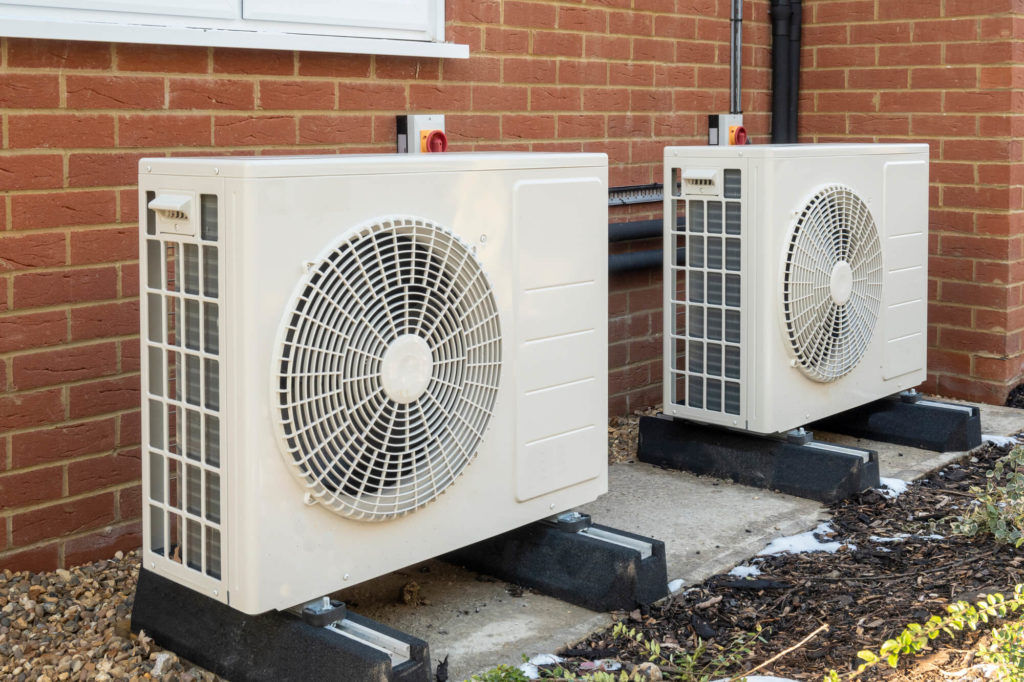
Avoid bedroom windows, tight corners, hard reflective surfaces and shared boundaries where possible. Anti-vibration mounting and good airflow reduce nuisance.
Planning And Neighbours
Permitted development rules include noise considerations. MCS guidance and installer calculations matter, especially in terraces or dense sites.

For the installation context, see how heat pumps are installed.
Noise Comparison Table
| Sound | Approximate Level | How It Compares |
|---|---|---|
| Quiet bedroom | 30 dB | Very quiet background |
| Fridge hum | 40 dB | Similar to a quiet heat pump at distance |
| Modern heat pump at 1 metre | 40-60 dB | Model and operating condition dependent |
| Normal conversation | 60 dB | Often louder than a well-sited unit |
These figures are only useful if they are treated as a guide rather than a promise. A 45 dB heat pump in an open garden may be barely noticed, while the same unit in a narrow alley between two houses can seem much more intrusive because hard surfaces reflect sound. Night-time background noise also matters. A low hum that disappears during the day can stand out at 2am when roads, gardens and neighbouring homes are quiet.
The UK government has reviewed heat pump noise emissions and planning rules, and noise remains part of the permitted development conversation for air source systems. If your property has close boundaries, upstairs bedroom windows near the proposed unit or several hard reflective surfaces, it is worth reading the official air source heat pump noise emissions guidance and asking the installer to explain how the calculation applies to your home.
Why Datasheet Noise Can Be Confusing
Manufacturers may quote sound power or sound pressure. They are not the same measurement. Sound pressure changes with distance and surroundings, while sound power describes the source. This is why two figures for the same machine can look contradictory.
A good installer should understand which figure is being used for planning and neighbour assessments. Homeowners should not have to decode acoustic jargon alone.
What Makes A Heat Pump Sound Louder
Hard walls, narrow side passages, corners, poor mounting and blocked airflow can all make sound more noticeable. So can asking the system to recover from large temperature setbacks, because the compressor and fan may work harder.
Maintenance matters too. Leaves, debris, loose panels or failing bearings can change a gentle hum into an irritating noise. A sudden change in sound should be investigated.
Normal Heat Pump Sounds Vs Warning Noises
A normal air source heat pump should sound fairly steady. You may hear a fan, a low compressor note, air movement through the outdoor coil and occasional changes during defrost. Those changes are not automatically a fault, especially in cold damp weather when frost forms on the coil and the system briefly reverses operation to clear it.
What is less normal is a harsh grinding sound, repeated rattling, metallic vibration, loud buzzing, scraping, or a sudden change from a soft hum to a much rougher mechanical noise. Those symptoms can point to loose casing panels, failing fan bearings, debris touching the fan, vibration through the mounting base or a service issue. If the sound has changed rather than simply become more noticeable because of cold weather, arrange a maintenance check.
How Distance Changes What You Hear
Sound reduces as distance increases, so moving a unit even a few metres can make a noticeable difference. The drop is not perfectly predictable in a real garden because walls, fences, hard paving and corners all change how sound travels, but the principle is simple: distance, soft boundaries and open airflow help.
This is why a low-noise model is only one part of the decision. A quiet heat pump pressed into a tight reflective space may perform worse acoustically than a slightly louder unit with better siting. Ask the installer where the fan will face, how far the unit is from neighbouring windows, whether anti-vibration feet are included, and whether the base will transmit vibration into the building.
Questions To Ask The Installer
Ask for the model’s sound data, the proposed unit location, the distance to bedrooms and boundaries, and whether the installation meets MCS noise requirements. Ask what mounting will be used and whether nearby walls could reflect sound.
If your home is terraced, has a narrow side passage or sits close to neighbours, noise planning deserves extra attention. A good installer will not dismiss the concern; they will show how the location and specification manage it.
A Practical Noise Checklist Before You Commit
- Check the proposed location against your bedroom windows, neighbour windows and shared boundaries.
- Ask whether the quoted figure is sound power or sound pressure, and at what distance it is measured.
- Look for hard surfaces that could reflect sound back towards a window or sitting area.
- Ask whether the unit will sit on a stable base with anti-vibration measures.
- Confirm that airflow is not restricted by fences, walls, bins, planting or storage.
- Ask what happens if the noise assessment fails for the preferred position.
If the installer cannot answer those questions clearly, pause before accepting the design. Noise problems are much easier to avoid during survey and design than to fix after refrigerant pipework, electrics and drainage have already been installed.
Does A Quieter Model Always Solve The Problem?
A quieter model helps, but it is not a substitute for good design. The quietest unit on paper can still disappoint if it is boxed into a corner, mounted on a resonant surface or placed directly outside a bedroom. Conversely, a mainstream unit with sensible output, good modulation and generous distance from sensitive rooms may be perfectly acceptable.
Noise should therefore be part of the whole heat pump design, alongside heat loss, radiator sizing, flow temperature and hot-water demand. If the system is undersized or poorly controlled, it may work harder for longer, which can make sound more noticeable even if the product itself is not unusually loud.
When Noise Concerns Are Most Important
Noise deserves the most care where homes are close together, the outdoor unit would sit near a bedroom window, or the only available location is a narrow side passage. These are not reasons to reject a heat pump automatically, but they are reasons to choose the model and location carefully and to ask for the noise assessment before installation.
Case Study: Avoiding A Boundary Noise Problem
Background
A homeowner wanted the outdoor unit in a narrow passage beside a neighbour’s bedroom wall because it was visually discreet.
What Changed
The installer modelled a different position with better airflow, less reflection and more distance from the boundary.
Result
The final installation was less visually hidden but much less likely to create night-time noise concerns.
Expert Insights From Our Heating Engineers
One of our senior heating engineers with over 20 years of experience says heat pump noise complaints are usually about siting rather than the technology itself. A quiet unit in a poor location can be more intrusive than a slightly louder model positioned carefully.
He recommends asking for the noise assessment before installation, especially in terraces, small gardens and homes with close neighbours. The best time to solve a noise issue is before the base is poured and pipework is run.
He also warns against choosing a heat pump on sound level alone. A low-noise unit still has to be correctly sized and suitable for the property. For wider system design context, our guide to what size heat pump you need explains why output and property heat loss matter.
Frequently Asked Questions
Are Air Source Heat Pumps Noisy?
They make some noise, but modern units are usually far quieter than the reputation suggests. A properly sited unit often sounds like a steady fan and compressor hum. Poor placement, reflective walls or faults can make the sound more noticeable.
How Many Decibels Is An Air Source Heat Pump?
Many modern air source heat pumps are quoted around 40 to 60 dB depending on model, measurement type and operating condition. Always check whether the figure is sound power or sound pressure, because they are not the same.
Can Neighbours Hear A Heat Pump?
They might if the unit is close to a boundary, installed in a narrow side passage, aimed towards a bedroom window or mounted poorly. A good installer should consider distance, barriers, reflective surfaces and MCS noise requirements.
Does A Heat Pump Get Louder In Winter?
It can be more noticeable in winter because the unit may run for longer and work harder. Defrost cycles can briefly change the sound. A short change in tone is normal; harsh or sudden mechanical noise is not.
Where Should An Air Source Heat Pump Be Placed To Reduce Noise?
Choose a position with good airflow, service access and sensible distance from bedrooms and neighbours. Avoid tight corners, hard reflective walls and flimsy mounts. The quietest model can still annoy people if placed badly.
Can Heat Pump Noise Be Reduced After Installation?
Sometimes. Anti-vibration mounts, clearing airflow restrictions, maintenance, control adjustments or minor siting changes can help. If the unit is fundamentally too close to a sensitive window or boundary, options may be more limited.
Are Ground Source Heat Pumps Quieter?
Usually, yes outside the home, because there is no outdoor fan unit. There may still be indoor plant noise from pumps and cylinders, but it is normally easier to manage than an external air source unit.
Do Planning Rules Cover Heat Pump Noise?
Yes. Permitted development and MCS requirements include noise considerations. This is especially important for terraces, flats, small gardens and homes close to neighbouring bedrooms.
Summing Up
Air source heat pumps are not silent, but a modern unit should not be a serious nuisance when it is correctly specified, positioned and maintained. Most concerns come down to the details: the model’s sound data, the distance to sensitive windows, the surrounding surfaces, the mounting base and whether the installer has properly considered neighbours.
If noise is your main worry, do not rely on a single decibel figure in a brochure. Ask for the proposed location, the noise assessment, the mounting method and the reasons behind the choice of unit. A well-planned installation should give you low-carbon heating without turning the garden or boundary into an avoidable source of irritation.
Updated