

Diesel air heaters are the heating solution of choice for campervan owners, narrowboat users, and anyone who needs reliable warmth in a space that’s off-grid or disconnected from mains gas. They run on 12V from a leisure battery, burn diesel at a fraction of the rate of a petrol generator, and can keep a van or cabin warm all night on less than half a litre of fuel. Unlike propane heaters, they push all combustion gases outside and produce dry heat, which means no moisture build-up on the windows.
The Triclicks 5KW Diesel Air Heater Kit is our top pick. It’s the right output for most mid-size campervans, comes with everything needed for a straightforward installation, and has built up one of the strongest track records among UK van lifers. Read on for the full shortlist plus a practical buying guide covering sizing, running costs, safety, and the honest case for and against budget Chinese models.
Our Top Picks
| Image | Name | |
|---|---|---|
| Triclicks 5KW Diesel Air Heater | |
| Triclicks 8KW Diesel Air Heater + Fuel Tank | |
| Sunster 8KW Diesel Heater AC/DC | |
| 8KW Portable Diesel Heater | |
| 5KW All-in-One Diesel Air Heater | |
| HTB1 8KW Diesel Heater with Bluetooth App | |
| LF Bros 5KW Diesel Air Heater | |
| 8KW 240V Mains Powered Diesel Heater |
8 Best Diesel Heaters
1. Triclicks 5KW Diesel Air Heater Kit
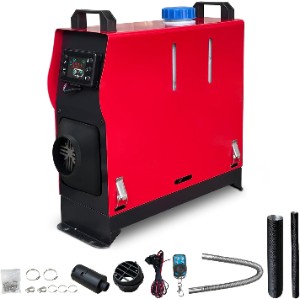
If you want one diesel heater recommendation and don’t want to overthink it, this is the one. The Triclicks 5KW has become one of the most popular diesel air heaters on Amazon UK for good reason: it works reliably, it comes with a comprehensive installation kit, and it’s priced well under £70. Van lifers across the UK and Europe have been running these through cold seasons, some reporting three or four years of trouble-free use. At 5KW it’s well matched to mid-size campervans, Transit, Sprinter, Renault Master, where it can raise the temperature from near-freezing to comfortable within ten or fifteen minutes.
The unit runs on 12V DC from a leisure battery and draws around 10A during the start-up cycle before dropping to under 1A once the glow plug cuts out. In practical terms that means the running draw is negligible for most leisure battery setups. Fuel consumption on the mid setting sits at around 0.2–0.25 litres per hour, which works out at roughly 30–38p per hour at current diesel prices. The LCD digital controller is clear and easy to read, and the included remote lets you adjust the heat setting without getting out of your sleeping bag.
The kit includes the heater unit, silencer, exhaust pipe, fuel pick-up lines, mounting hardware, and a 10-litre fuel tank, meaning you can run it from a standalone tank or plumb it into your vehicle’s diesel tank. Instructions lean towards the brief side, as is typical of this type of budget heater, but there’s a substantial online community of UK users who have documented their installs in detail. It’s not a Webasto. The components are lighter, the fuel pump makes a ticking sound during operation, and there’s no manufacturer warranty to fall back on if it fails after two years. But for the price, the performance-to-cost ratio is hard to argue with.
If your van is on the larger end, or you’re running the heater in very cold conditions (below -15°C regularly), step up to an 8KW model instead. But for three-season use in the UK and most of Europe, the 5KW is the one to buy.
Features
- 5KW heat output, suits mid-size vans and campervans
- 12V DC operation, connects to leisure battery
- LCD digital controller with remote control included
- Silencer included to reduce pump noise
- 10-litre standalone fuel tank included
- Full installation kit: exhaust pipes, fuel lines, mounting hardware
- Fuel consumption: 0.12–0.52 litres per hour (low to full output)
- One of the most popular and well-documented budget diesel heaters in the UK
- Complete kit with all installation hardware included
- Very low running draw once start-up cycle completes
- 10-litre standalone tank means no need to tap into vehicle fuel system
- Fuel pump makes a ticking noise during operation
- No manufacturer warranty
2. Triclicks 8KW Diesel Heater with 10L Fuel Tank
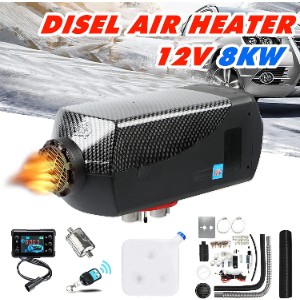
The larger sibling to the 5KW model above, this 8KW version is aimed at bigger campervans, motorhomes, and anyone who plans to use their heater in genuinely cold conditions, extended winter trips, high-altitude travel, or a large Sprinter conversion. The extra output means the heater can push the van to temperature faster on the coldest mornings, and at lower settings the fuel consumption is similar to the 5KW model running harder. If you’re on the fence about which size you need, 8KW gives you more headroom.
Like the 5KW version, this comes with a 10-litre standalone tank and the full installation kit. The controls and display are near-identical, and the operating noise is comparable. The key difference is the higher power draw on start-up, budget around 12–15A for the first minute, so make sure your leisure battery has adequate capacity before buying. At 174 reviews it’s one of the better-reviewed diesel heaters on Amazon UK, which is a reasonable indicator of reliability given the return rate sensitivity of this product category.
Worth noting: all else being equal, the 8KW unit running at 40% output will be quieter and more fuel-efficient in a smaller space than a 5KW unit working at full blast. If you have a large van or expect your van to be cold when you return to it (i.e. you want a quick blast of heat rather than low-and-slow overnight warming), 8KW is the more practical choice.
Features
- 8KW heat output, suits large vans, motorhomes, and cold climates
- 12V DC operation
- LCD controller with remote control
- 10-litre standalone fuel tank and full installation kit included
- Fuel consumption: 0.15–0.6 litres per hour
- Silencer included
- More headroom for cold-weather use and larger spaces
- Well-reviewed with a strong UK buyer track record
- 10-litre tank included, easy standalone installation
- Higher start-up current draw, needs a decent leisure battery
- 8KW is unnecessary for smaller vans, where it will short-cycle
- Same ticking fuel pump noise as all budget heaters in this class
3. Sunster 8KW Dual-Power Diesel Heater (12V/240V)
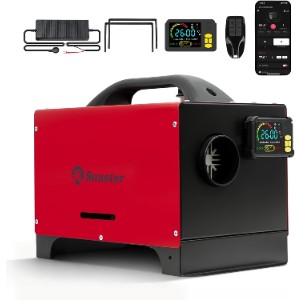
The standout feature here is the AC/DC dual power input: this heater can run from a 12V leisure battery or plug straight into a 240V mains supply. That flexibility makes it genuinely useful in two distinct scenarios. On site with electric hookup, you can run the heater from the campsite supply without touching your leisure battery. Off-grid, you switch to 12V and carry on as normal. For someone who splits their time between EHU pitches and wild camping, this is a meaningful practical advantage over a 12V-only model.
At 8KW it’s well sized for larger campervans and the output sits above what most mid-range 12V heaters offer. The controls are standard LCD with remote, and the kit includes the usual silencer and installation hardware. The 99-review count is lower than the Triclicks models, so there’s a shorter track record to draw on, but the ratings are consistent and the AC/DC capability is rare enough at this price point to justify the premium.
One thing to be aware of: when running on 240V, this heater still combusts diesel and vents exhaust outside, so the safety requirements are identical to 12V operation. It doesn’t become an “appliance” in the mains-safe sense, you still need proper exhaust routing and CO detection. It’s a more convenient power source, not a change in the fundamental technology.
Features
- 8KW heat output
- Dual power: 12V DC or 240V AC mains
- LCD controller with remote
- Silencer and full installation kit included
- Suits campervans with electric hookup or off-grid use
- Unique AC/DC dual power, works with or without hookup
- Saves leisure battery when mains is available
- 8KW output suits large vans and cold climates
- Fewer reviews than equivalent Triclicks models
- 240V mode still requires proper diesel exhaust installation
4. 8KW Portable Diesel Air Heater with Carry Handle
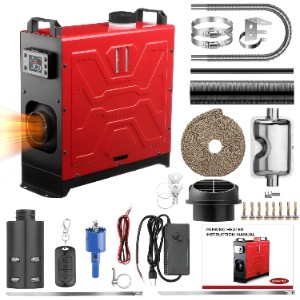
With 177 reviews and a solid 4.4-star average, this portable 8KW heater has built up a genuine track record despite being a more recent listing. The design prioritises ease of movement: the built-in carry handle and self-contained fuel tank mean you can pick this up and use it in the van, the boat, the garage, or the workshop without any permanent installation. That portability also makes it a good choice if you’re hiring out a van or vehicle and don’t want a heater permanently plumbed in.
The trade-off for portability is the standalone tank capacity. You’ll need to refuel more frequently than a plumbed-in setup, and the unit is larger and heavier than a wall-mounted kit heater. For regular overnight van use where you’ve already got a fixed diesel line, a plumbed kit heater is the more practical long-term choice. But if you want something you can take out of the van and use elsewhere, or you want to avoid any installation work, this does the job well.
Features
- 8KW heat output
- 12V DC operation with integrated fuel tank
- Carry handle for portable use between locations
- LCD controller and remote included
- No fixed installation required
- No permanent installation, fully portable
- Strong review count for a newer listing
- Good for multi-location use: van, boat, garage
- Standalone tank needs more frequent refilling
- Bulkier than a fixed kit heater
- Not ideal for long-term daily use vs plumbed alternatives
5. 5KW All-in-One Diesel Air Heater
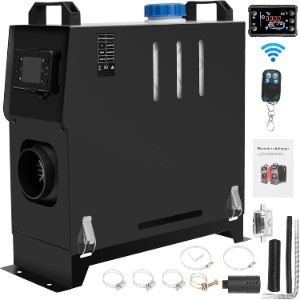
The all-in-one format puts the fuel tank, heater unit, and controls in a single compact assembly. There’s no separate tank to mount, no fuel lines to route through bulkheads, and no installation beyond connecting the 12V power leads and routing the exhaust outside. For someone who wants occasional heating without committing to a full fixed installation, this is the simplest entry point. It works well for a small van, a day van, or as a backup heater in a motorhome.
At 5KW and £62, it’s the most budget-friendly all-in-one option on the list. The review count of 36 is lower than the top picks, so you’re taking slightly more on faith. It works as described for most buyers, but it’s worth acknowledging there’s less community support available if something goes wrong, compared to the better-documented Triclicks range.
Features
- 5KW heat output
- 12V DC operation
- All-in-one design: integrated fuel tank, no separate plumbing
- LCD controller included
- Compact form factor, suits small vans and occasional use
- Simplest installation of any unit on this list
- Compact and self-contained
- Best value all-in-one option
- Lower review count than other picks, less proven track record
- Smaller integrated tank limits continuous run time
- Not suited to full-time van life where daily use is expected
6. HTB1 8KW Bluetooth Diesel Heater
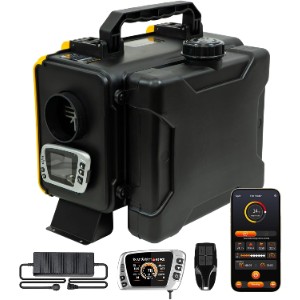
At £111, the HTB1 is the most expensive unit on this list, and the Bluetooth connectivity is the reason. Pair it with the companion app and you can start the heater, set a timer, adjust the temperature, and monitor fuel consumption from your phone, without fumbling with a wall-mounted controller in the dark. For someone who spends a lot of time in their van, particularly in cold weather, the quality-of-life improvement of app control is noticeable. Set it going from your sleeping bag twenty minutes before you need to get up, and the van is warm by the time you do.
The underlying heater is 8KW and 12V, broadly similar to the other budget units in this class, though HTB1 have put more effort into build quality at this price point. The Bluetooth functionality has worked reliably for most reviewers, and the app is functional if not polished. There’s also the option to set automated schedules directly through the app. At 34 reviews the HTB1 is a newer market entrant with a shorter track record, which is worth bearing in mind alongside the higher price.
If smart features don’t matter to you, the Triclicks 8KW gives you the same core heating for £50 less. But if app control is something you’d actually use, the HTB1 earns its premium.
Features
- 8KW heat output
- 12V DC operation
- Bluetooth connectivity, control via smartphone app
- Schedule and timer setting through app
- LCD controller and remote also included
- Full installation kit
- Bluetooth app control, start the heater before you need it
- Programmable schedules via app
- Stronger build quality than entry-level alternatives
- Noticeably more expensive than comparable non-Bluetooth models
- Fewer reviews, shorter track record than Triclicks
- App polish is basic compared to premium brand equivalents
7. LF Bros 5KW Diesel Heater (12V/24V)
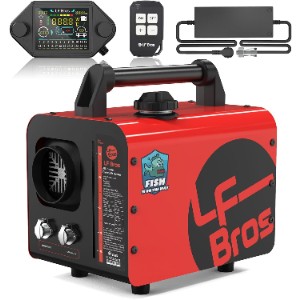
LF Bros is one of the more recognisable names in the budget diesel heater space, with a slightly more consistent build quality reputation than some of the more generic listings. The dual 12V/24V compatibility is the headline spec here, it works with both standard leisure battery setups and the 24V electrical systems found in larger trucks, coaches, and heavy vehicles. If your vehicle runs 24V, options are limited on Amazon UK, which makes this a more useful pick than the price alone would suggest.
At 5KW it’s sized for mid-range campervans, and the 53-review count sits in an acceptable range for this category. LF Bros have built a modest community of support online, and their heaters tend to have marginally better documentation than some of the completely unbranded alternatives.
Features
- 5KW heat output
- Dual voltage: 12V or 24V DC
- LCD controller with remote
- Full installation kit
- Suits both standard leisure battery and 24V truck systems
- 12V/24V compatibility, works in trucks and larger vehicles
- Slightly better brand recognition than fully unbranded alternatives
- Good documentation and online support community
- Fewer reviews than Triclicks, shorter established track record
- 5KW only, no 8KW version in this listing
8. 8KW 240V Mains-Powered Portable Diesel Heater
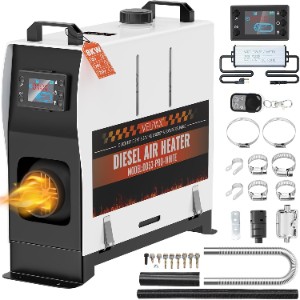
This is the only model on the list that runs exclusively on 240V mains power, with no 12V option. It’s aimed at a different use case entirely: static caravans and holiday lodges, workshops and garages with mains supply, boats with permanent shore power, or outbuildings where running cable is easier than installing a leisure battery. If you want a diesel air heater for a space that always has mains power available and you want to avoid any 12V electrical work, this is the straightforward choice.
With 29 reviews it’s one of the newest listings on this shortlist, so approach with the caveat that the track record is limited. But what reviews exist are consistent. At £85 it sits in the same price range as the 12V alternatives, and the 8KW output makes it useful for medium-to-large spaces. Just be clear going in: this will not work in a vehicle unless you have a mains inverter, and it’s not suitable for off-grid use.
Features
- 8KW heat output
- 240V mains power only
- Portable design
- LCD controller included
- Suits workshops, garages, static caravans, and shore-power boats
- No leisure battery or 12V knowledge required
- Good for static installations with mains access
- 8KW suits medium-large workshops and garages
- Useless off-grid or in a vehicle without a mains inverter
- Very limited review count, short track record
- No 12V flexibility if your use case changes
Diesel Heater Buying Guide
Key Takeaways
- Most diesel air heaters on Amazon UK are 12V DC units designed for campervans and leisure vehicles, if you need mains-powered or 24V, filter specifically for those.
- Running costs are low: fuel consumption ranges from 0.12 litres/hr at the lowest setting to around 0.6 litres/hr at full blast, that’s roughly 18p to 90p per hour at current diesel prices of ~£1.50/litre.
- 5KW suits most mid-size campervans (Sprinter, Transit, Master); 2KW is enough for smaller vans (Transporter, Caddy); 8KW is for large motorhomes, workshops, and very cold climates.
- All budget diesel heaters on Amazon UK are Chinese-manufactured. They share broadly similar components and performance. The main variable is features (Bluetooth, AC/DC) and the quality of the installation kit.
- Install a carbon monoxide detector regardless of which heater you buy. It’s a non-negotiable safety requirement for any combustion appliance in an enclosed space.
What Is a Diesel Air Heater?
A diesel air heater is a combustion-based space heater that burns diesel fuel to heat incoming air and distribute it through a duct. Unlike a gas heater or a wood burner, all combustion gases are vented outside through a dedicated exhaust pipe, the air blown into your living space is fresh, drawn from outside or from within the space itself and passed over heat exchangers. This makes diesel air heaters much safer than open-flame alternatives in enclosed spaces, provided the exhaust is correctly installed and sealed.
The term “parking heater” is sometimes used interchangeably, these units were originally developed for truck cabs and motorhomes to maintain temperature while the engine was off, without the fuel cost of idling. The budget Chinese versions available on Amazon UK are essentially reverse-engineered versions of established European designs, most notably units from Webasto and Eberspacher, at a fraction of the original price.
How Does a Diesel Air Heater Work?
A small electric pump draws diesel from the fuel supply at a controlled rate and injects it into a combustion chamber, where it mixes with air supplied by a separate inlet. A glow plug ignites the mixture during start-up. Once combustion is established, a heat exchanger separates the hot exhaust gases from the air being pushed into the living space. A blower fan pulls in cool ambient air, passes it over the heat exchanger, and distributes warm air dtrough the outlet duct. The exhaust exits through its own dedicated pipe that must terminate outside the vehicle or building.
The entire system runs on 12V DC (or 24V or 240V depending on the model). The power demand is highest during the 30–60 second start-up cycle when the glow plug is drawing current, typically 8–15A. Once the heater is running, the draw drops to less than 1A, making it exceptionally lean on battery capacity for an overnight heat source.
Choosing the Right Output for Your Space
Getting the output right matters. An undersized heater runs at full blast continuously and still can’t keep the space warm; an oversized heater short-cycles, switching on and off repeatedly, which puts unnecessary strain on the glow plug and costs more per unit of heat than running at a sustained lower setting. Here’s a practical sizing guide for typical UK use cases:
| Space / Vehicle | Recommended Output | Notes |
|---|---|---|
| Small van (VW Transporter, Caddy, Vivaro) | 2KW | 2KW heaters are less common on Amazon UK, a 5KW running at low output also works |
| Mid-size campervan (Ford Transit, Sprinter LWB, Renault Master) | 5KW | The sweet spot for UK van life, 5KW at mid-setting suits most 3-season use |
| Large motorhome or converted coach | 8KW | Or two 5KW units if the space is very large |
| Narrowboat or canal boat (up to 40ft) | 5KW | Steel hull loses heat quickly, 5KW is minimum; 8KW for longer boats |
| Garden shed or small workshop (up to 20m²) | 5KW | Adequate for insulated spaces; poorly insulated sheds may need 8KW |
| Garage or large workshop (20–50m²) | 8KW | Consider two units or a 240V model if mains is available |
A useful rule of thumb for insulated vehicle spaces: allow approximately 0.75–1KW per cubic metre of living space. A Sprinter high-roof conversion with 10–12m³ of usable space needs 8–12KW at full output, but 5KW running continuously will maintain temperature once the van is up to warmth. Insulation quality is the biggest variable, a well-insulated build with Celotex and spray foam will hold temperature far better than bare-metal conversion with thin foam matting.
Running Costs: What to Budget For
Diesel heaters are extremely economical to run. Most units consume between 0.1 and 0.6 litres per hour depending on output setting. With diesel at approximately £1.50 per litre (as of May 2026), that puts the running cost at roughly 15p per hour on the lowest setting and 90p per hour at maximum output. In practice, most van lifers report real-world overnight costs of around 30–50p for a full night’s use with the heater cycling on and off to maintain temperature, comparable to a single cup of coffee.
| Setting | Fuel Consumption (L/hr) | Cost per Hour (at £1.50/L) | Overnight Cost (8 hrs cycling) |
|---|---|---|---|
| Low (1–2KW) | 0.10–0.15 | 15–23p | ~£1.20–£1.80 |
| Medium (3–4KW) | 0.20–0.30 | 30–45p | ~£2.40–£3.60 |
| Full blast (5–8KW) | 0.40–0.60 | 60–90p | ~£4.80–£7.20 |
The electrical consumption is a separate but important consideration. Start-up draws 8–15A for roughly 60 seconds. Running draw is 0.5–1A. Over an eight-hour night with the heater cycling on and off perhaps four or five times, you’re using perhaps 10–15Ah of battery capacity in total, a small fraction of what a typical 100Ah leisure battery can supply.
12V, 24V or 240V: Which Type Do You Need?
Most campervans and leisure vehicles use a 12V leisure battery system, and most diesel heaters on Amazon UK are designed for 12V. That’s the default assumption for van life use. A 24V system is found in larger trucks, coaches, and some HGV-derived motorhome conversions, if your vehicle runs 24V, confirm compatibility before buying, as running a 12V heater from a 24V supply will damage it. The LF Bros 5KW is one of the few budget options on Amazon UK that accommodates both 12V and 24V.
The 240V mains models are in a different category altogether. They’re for static or semi-static use: workshops, garages, outbuildings, static caravans, or boats with permanent shore power. They’re not suitable for off-grid van use unless you have a substantial mains inverter drawing from a large battery bank, which would be an unusual setup. The Sunster dual-power model is the flexible middle ground, it acceptsboth 12V and 240V, making it the most versatile option if your use case bridges both worlds.
Kit Heater vs All-in-One: What’s the Difference?
A kit heater is a separate heater unit that installs into the vehicle, with a fuel line connecting it to either a standalone tank or the vehicle’s own diesel tank. The components are fixed in place, usually under a seat or in a storage locker, with the exhaust routed outside through the floor or wall. This is the more common setup for full-time van lifers because the fuel supply is reliable, the installation is tidy, and the heater doesn’t take up living space.
An all-in-one unit has the fuel tank built into the heater housing. You fill it up like a petrol generator, place it somewhere convenient, and run the exhaust outside through a flexible pipe. No plumbing, no fuel lines, no installation beyond routing the exhaust. The advantage is simplicity and portability, you can use it in different vehicles or locations. The disadvantage is that the built-in tank is small, requiring more frequent refilling, and the bulkier unit takes up more interior space than a neatly installed kit heater.
For occasional weekend use, an all-in-one is the easier starting point. For regular use and full-time van life, a properly installed kit heater is more practical long-term.
Safety: Carbon Monoxide, Exhaust Installation and Best Practice
Diesel air heaters separate combustion gases from the air distributed into the living space by design, but that separation depends entirely on the exhaust system being correctly sealed and intact. A cracked exhaust joint, a poorly fitted seal, or an exhaust pipe that terminates too close to an air intake can introduce carbon monoxide into the living space. Carbon monoxide is odourless and colourless, and the consequences of exposure in a sealed van are serious.
A CO detector is not optional. Install one near sleeping height and test it regularly. This applies even if you’re experienced with diesel heaters and confident in your installation. CO detectors rated to EN 50291-1 standard are available from around £20–£30 and are a straightforward addition to any van build.
Other safety requirements worth covering: the exhaust pipe must terminate at least 10cm away from any combustible material and should not point towards the vehicle’s air intakes. Keep the inlet air pipe clear of snow, mud, or blockages. Run the heater at high output for 10 minutes periodically to burn off carbon soot build-up in the combustion chamber, running it exclusively on low settings causes excessive fouling over time. Finally, don’t run a diesel heater in a completely sealed, unventilated space. A small amount of fresh-air ventilation (a cracked window or a roof vent slightly open) provides a safety margin and helps prevent condensation.
Noise Levels: What to Expect
All budget diesel heaters produce some noise. The fuel pump is the main culprit, a distinctive ticking sound during operation that carries less inside the van than outside. The start-up cycle is the noisiest phase: the glow plug and priming pump create a louder pulse for the first 30–90 seconds before settling into a quieter steady hum. Most users describe the running noise as similar to a quiet fan heater or a distant extractor fan, present but ignorable once you’re used to it.
The silencer (also called a fuel pump muffler) that ships with most kit heaters reduces the pump tick noticeably. Mounting the fuel pump on a rubber isolation mount reduces vibration transmission to the vehicle body. Positioning matters too, mounting through the floor with the pump isolated from bare metal makes a real difference.
Premium European heaters (Webasto, Eberspacher) are meaningfully quieter than budget Chinese equivalents, particularly during start-up. If you’re a light sleeper and noise is a primary concern, that price gap has a clearer justification. For most van lifers who’ve never used a diesel heater before, the budget models are quieter than expected, the forum posts about noise are mostly from people who had unrealistic expectations rather than a genuine problem with the heaters themselves.
Budget Chinese Heaters vs Premium European Brands
The honest answer is that budget Chinese diesel heaters, Triclicks, LF Bros, Maxpeedingrods, and the various unbranded equivalents, all share broadly similar internal components and performance characteristics. They are reverse-engineered versions of established designs, manufactured at much lower cost with lighter-grade materials. They work well for the majority of users, and there are van lifers who have run them for four or five years without issues.
Webasto and Eberspacher are the premium alternative. They cost between £400 and £900 for the heater unit alone, with installation on top. The differences are real: quieter fuel pumps, better cold-start performance at -20°C and below, factory altitude compensation, proper manufacturer warranties, and dealer service networks. If you’re planning a multi-year van build or expedition vehicle where reliability is critical and you’ll be operating in demanding conditions (very cold climates, high altitudes), the premium cost is defensible.
For UK-based van life, camping in Scotland in November, weekend trips to the Alps, full-time living in a temperate climate, the budget Chinese heaters represent genuinely good value. The failure rate is higher than premium brands, but at £60–£90 a replacement is a fraction of what a Webasto service call costs. Buy a budget heater, install it properly, maintain it correctly, and it will very likely outlast your van conversion.
Types of Diesel Heater
Air heaters are by far the most common type and the focus of this guide. They draw in cool air, pass it over a heit exchanger, and blow warm air into the space. They don’t heat water and don’t connect to any radiator or underfloor heating circuit. Simple, effective, and suitable for the vast majority of campervan and leisure vehicle applications.
Hydronic heaters, also called water heaters or coolant heaters, circulate heated water through the vehicle’s cooling system and potentially through additional radiators or underfloor heating mats. They can also provide hot water for washing. These are more complex to install, significantly more expensive, and only worthwhile for high-spec motorhomes or expedition vehicles with full water heating requirements. Webasto’s Thermo Top range is the main example available in the UK.
Combination air and water heaters offer some of both, though they’re relatively rare at the consumer level. For most van builders, an air heater for space heating combined with a separate diesel or electric hot water system is a more practical split than a single combo unit.
Benefits of Using a Diesel Air Heater
The main advantage over alternative heating methods is the combination of low running cost and off-grid capability. Unlike a propane heater, a diesel air heater can run directly from the vehicle’s existing fuel tank with no separate gas supply to manage or refill. Unlike an electric heater, it doesn’t put any significant drain on the leisure battery, the 0.5A running draw is trivial compared to the 50–100A that an electric fan heater would need.
Diesel combustion also produces dry heat, which actively reduces condensation inside the van. Propane and butane heaters produce water vapour as a combustion by-product, running one inside a van adds moisture to the air and contributes to condensation on cold metal surfaces and windows. Diesel heaters have no equivalent moisture output because all combustion products exit through the exhaust.
Safety during overnight use is better than open-flame alternatives (provided the exhaust is correctly installed). The heater can run all night on a thermostat setting, maintaining temperature through cold nights without any manual intervention. And unlike a wood burner, it starts reliably in any weather, doesn’t require tending, and can be controlled remotely.
Diesel Heaters vs Alternative Heating Methods
Electric fan heaters are the simplest option but are impractical off-grid. A 2KW electric heater draws around 167A from a 12V battery, a 100Ah leisure battery would last less than 40 minutes. Even with a large solar setup, electric heating is unreliable in winter UK conditions when solar yield is low. Electric heating only makes sense when connected to hookup.
Propane/butane heaters (Gaslow, Truma, Alde) are popular in motorhomes with existing gas systems. They’re quieter than diesel heaters and simple to operate. The trade-off is the moisture produced during combustion and the need to manage gas cylinder supply and LPG regulations, particularly when travelling abroad. For van conversions without an existing gas setup, adding an LPG system adds complexity and cost.
Wood burners have a strong following among van lifers for ambience and fuel availability. They can’t be thermostatically controlled, require hands-on management, and have specific installation requirements for Class 1 chimney flues. They work beautifully in the right build, a large, well-insulated panel van with good ventilation, but they’re not a practical primary heat source for most people.
For most UK van lifers and boat users, diesel air heaters win on the combination of low running cost, off-grid capability, ease of use, and safety. Propane is the main realistic alternative, and for many the choice comes down to whether an LPG system is already in the vehicle.
Common Mistakes When Buying a Diesel Heater
Buying the wrong voltage is a classic error. If your vehicle is 12V (the majority of campervans and motorhomers) and you accidentally buy a 24V heater, it won’t run. Check the electrical specification before purchasing, especially when buying from a listing that shows multiple voltage variants.
Skipping the CO detector is the dangerous one. People assume that because the combustion gases are “supposed to” go outside, they don’t need monitoring. They do. Exhaust seals fail. Fittings work loose over time. A CO detector costs £20 and takes two minutes to mount. Not buying one because the install looks good is a risk not worth taking.
Running the heater exclusively on the lowest setting causes soot build-up in the combustion chamber. Budget heaters in particular need a regular high-output burn to clean themselves out. Running at low power for weeks on end leads to incomplete combustion, fouled glow plugs, and hard starts. Get into the habit of giving the heater a ten-minute full-output run every week or two.
Neglecting the installation because the unit is cheap is the fourth one. A badly installed heater with a leaking exhaust joint or a fuel line run near a heat source is genuinely dangerous. Take the installation as seriously as you would for a more expensive unit. Use the correct fittings, route the exhaust properly, and pressure-test joints before first use.
When Not to Buy a Diesel Heater
If you only camp on electric hookup pitches and never go off-grid, a 240V electric fan heater or a 240V diesel model is simpler and the electric option avoids the installation work entirely. A diesel heater is overkill for purely mains-connected use.
If your vehicle runs on petrol rather than diesel, a diesel heater adds an additional fuel type to manage. Some budget kits can be adapted for use with petrol with a different jet, but this is a modification and reduces reliability. A petrol vehicle user is better served by a propane heater or an electric option if hookup is available.
If you’re using the heater in a garage or workshop with excellent mains access and you never need portability, a 240V diesel heater or a properly rated electric workshop heater is simpler. The 12V leisure battery ecosystem isn’t necessary in that context.
And if you need the absolute minimum noise output, a converted horse lorry for night stealth camping in urban areas, or a van where light-sleeping occupants need complete silence, budget Chinese diesel heaters will disappoint. That use case genuinely warrants the cost of a Webasto or Eberspacher.
Quick Buyer Checklist
- What voltage does your vehicle or leisure system use, 12V, 24V, or 240V?
- What’s the approximate volume of the space you need to heat, and have you sized the output accordingly?
- Do you want a kit heater (fixed installation, plumbed fuel supply) or an all-in-one (portable, standalone tank)?
- Do you need Bluetooth or app control, or are manual panel and remote controls sufficient?
- Will you ever be at altitudes above 2,000m, and if so, does the model have altitude compensation?
- Have you bought (or do you already own) a CO detector for the space?
- Are you comfortable with the installation, or do you need to budget for professional fitting?
- Have you factored in the fuel tank requirement, standalone 10L tank, or will you tap into the vehicle tank?
Case Study: Heating a Full-Time Campervan Conversion
Background
A couple from the East Midlands converted a high-roof Mercedes Sprinter into a full-time home in 2023. After two winters relying on a portable propane heater and sleeping in multiple sleeping bags, they decided to install a diesel air heater before their third winter on the road. The van was well insulated with 60mm Celotex throughout and a spray foam finish, but the living space measured approximately 12 cubic metres and the propane heater had been struggling to keep pace on sub-zero nights.
Project Overview
They chose a 5KW 12V kit heater, plumbing the fuel line into the Sprinter’s existing diesel tank via a T-piece connector on the return line. The heater was mounted under the rear seating area, with the exhaust routed through the floor and terminating at the rear offside corner of the van, well clear of the air intake. A fuel pump silencer and rubber mounting isolators were added to reduce transmitted vibration.
Implementation
Installation took a full day, with most of the time spent on the fuel line routing and exhaust sealing. The 12V wiring was connected directly to the leisure battery with a 15A fuse. A CO detector was mounted above the sleeping area. On first start, the heater ran through its priming cycle and was producing warm air dwithin four minutes.
Results
In two winters of daily use since installation, the heater has performed reliably. On the coldest nights experienced (around -8 C in the Scottish Highlands), the 5KW unit running at 60–70% was sufficient to maintain 19°C inside. Running costs averaged around 40p per night. The fuel pump ticking was audible but not disruptive. A single service, cleaning the combustion chamber and replacing the glow plug, was carried out after approximately 18 months of use.
Expert Insights From Our Heating Engineers About Diesel Air Heaters
One of our senior heating engineers with over 20 years of experience across mobile and static heating systems shares this on diesel air heaters in the UK campervan market:
“The technology in these budget diesel heaters is sound, it’s the same fundamental principle as units that have been used in professional vehicles for decades. The difference is in the quality of components and the level of quality control during manufacture. Most failures come from one of three places: the glow plug failing prematurely due to carbon build-up (avoid by running at high output periodically), the fuel pump wearing out (these do have a finite lifespan), or an exhaust seal working loose over time due to vibration. None of these are catastrophic failures, they’re maintenance items. Buy a spare glow plug and fuel pump when you buy the heater, and you’ll be able to sort most issues yourself.”
“The thing I stress to van builders is the exhaust installation. Every other part of this installation is forgiving, get the exhaust wrong, or skip the CO detector, and the risks are serious. Route the exhaust so it terminates well away from any opening, use proper high-temperature seals on every joint, and physically inspect every joint every six months. That’s not paranoia, it’s just good practice with any combustion appliance in an enclosed space.”
“On the question of budget vs Webasto, I’d say this: if you’re building a van you expect to live in for five years or more, and budget isn’t the limiting factor, a Webasto is worth the investment. You’ll spend less time troubleshooting, it’ll start more reliably in extreme cold, and the noise is genuinely better. But the budget alternatives are not unsafe or unreliable if installed and maintained correctly. I know van lifers who’ve had the same Triclicks unit running for four years without touching it. Set expectations appropriately, maintain it properly, and they do the job.”
Frequently Asked Questions
How much does a diesel heater cost to run in the UK?
Running costs are very low. Fuel consumption ranges from around 0.12 litres per hour on the lowest setting to 0.6 litres per hour at full output. At approximately £1.50 per litre for diesel (May 2026), that works out at roughly 18p to 90p per hour. Most van lifers running a 5KW heater overnight on a thermostat setting report spending 30–50p per night, far less than any alternative heating method that doesn’t rely on mains electricity.
Is it safe to run a diesel heater overnight in a van?
Yes, if installed correctly and if a carbon monoxide detector is fitted. Diesel air heaters vent all combustion gases outside through a dedicated exhaust pipe, so the air inside the van is not in contact with combustion products. The key safety requirements are: a properly sealed and routed exhaust system, a working CO detector mounted near sleeping height, and a small amount of ventilation (a slightly open roof vent is ideal). Do not run any combustion heater in a completely sealed, unventilated space.
What size diesel heater do I need for my van?
5KW suits most mid-size campervans, Ford Transit, Mercedes Sprinter, Renault Master, and similar. For a smaller van like a VW Transporter or a Vivaro, a 2KW unit (or a 5KW running at a low setting) is sufficient. For large motorhomes, coach conversions, or use in extreme cold (below -15°C regularly), choose 8KW. If in doubt, size up rather than down, an oversized heater running at a lower setting is more efficient and quieter than an undersized one working at full blast.
Can I use a diesel heater in a petrol van?
You can, but it means carrying a separate diesel supply, either a standalone tank included with the heater kit, or a jerry can. Budget diesel heaters cannot generally be converted to run on petrol (the jet sizing and combustion characteristics are different). For petrol vehicle owners, a standalone 10-litre diesel tank supplied with most kit heaters is the standard workaround. Factor in the additional cost and hassle of keeping a separate fuel supply topped up.
How noisy are diesel heaters?
Budget Chinese diesel heaters make a noticeable ticking sound from the fuel pump during operation. From inside the van, most users describe it as similar to a quiet fan heater, present but easy to ignore once you’re used to it. Start-up is the noisiest phase, lasting 30–90 seconds. The silencer included in most kits reduces the pump noise meaningfully. Premium European brands (Webasto, Eberspacher) are measurably quieter, particularly during start-up. If very low noise is a priority, the premium cost is genuinely justified.
How do I maintain a diesel air heater?
The main maintenance tasks are: running the heater at full output for 10–15 minutes every couple of weeks to burn off carbon soot build-up (especially important if you usually run it on low settings); inspecting all exhaust joints every few months for signs of loosening or sooting; and replacing the glow plug every 1–2 seasons depending on use (budget around £5–15 for a replacement). Keep a spare glow plug and fuel pump in the van if you rely on the heater daily, both are straightforward DIY replacements.
Are cheap Chinese diesel heaters worth buying?
For most UK van lifers and leisure vehicle users, yes. The budget Chinese heaters available on Amazon UK, Triclicks, LF Bros, and similar, share broadly the same fundamental technology as premium European brands at a fraction of the cost. They have higher failure rates over the long term and offer no manufacturer warranty, but at £60–£90 a replacement unit costs less than a single Webasto service call. Install one properly, maintain it correctly, and it will serve most buyers well. If you’re building a high-spec, long-term expedition vehicle and budget is not the constraint, Webasto or Eberspacher is worth the premium.
Do I need a carbon monoxide detector with a diesel heater?
Yew, absolutely. A CO detector is non-negotiable for any combustion appliance in an enclosed living space, regardless of how well the heater is installed or how confident you are in the exhaust routing. CO is odourless and colourless, and a loose exhaust joint or cracked seal, both of which can develop over time from vibration, can introduce it into the living space without any obvious sign. A detector rated to EN 50291-1 standard costs around £20–£30. That’s not optional expenditure.
Summing Up
For UK campervan owners and leisure vehicle users, diesel air heaters offer one of the best combinations of low running cost, off-grid capability, and overnight safety available at this price point. The budget Chinese heaters dominating Amazon UK are genuinely functional products, not perfect, and not as refined as a Webasto, but reliable enough for the majority of use cases when installed and maintained correctly. The Triclicks 5KW remains the top pick for most mid-size van builds, with the 8KW version the better choice for larger motorhomes and cold-climate use. If Bluetooth control is something you’d actually use, the HTB1 earns its premium. And if you need the flexibility to run from mains hookup or 12V, the Sunster dual-power model is the most versatile option on the shortlist.
Whatever you buy, fit a CO detector before first use. No heater review should end without saying that.
Updated