
Wall-mounted split air conditioners are the most effective way to cool or heat a single room. They work more quietly and more efficiently than portable air conditioners, they don’t block a window, and the better models double as heat pumps, providing cheaper-than-electric heating through autumn and spring. UK summers are hotter than they used to be, and a well-chosen split system, properly installed, will be working for you in July and again in October.
The electriQ 12000 BTU WiFi Smart A++ Inverter is our top pick for most UK buyers. It’s the right size for living rooms and master bedrooms, comes from a brand with genuine UK support, includes a five-year warranty that beats most of the competition, and the pipe kit is included in the box. The buying guide below covers everything from F-Gas installation requirements to BTU sizing, SEER ratings, and an honest look at what Amazon UK’s selection does and doesn’t give you access to.
Our Top Picks
| Image | Name | |
|---|---|---|
| electriQ 12000 BTU Smart WiFi DC Inverter | |
| electriQ 9000 BTU Wall Split Air Conditioner | |
| Senville LETO Series Wall Mounted Air Conditioner | |
| TANGZON 12000 BTU 5-in-1 Wall Mounted Unit | |
| TANGZON 18000 BTU 5-in-1 Wall Mounted Unit | |
| Belaco 12000 BTU Wall Split Air Conditioner |
6 Best Wall-Mounted Air Conditioners
1. electriQ 12000 BTU WiFi Smart A++ Inverter Wall Split
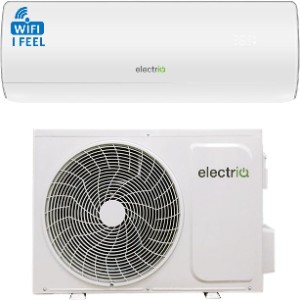
electriQ is a UK brand with genuine domestic customer support, and that matters more than it might seem for a product that requires professional F-Gas installation and may need after-sales help. This 12000 BTU model is the sweet spot for most UK living rooms and bedrooms, enough output for rooms up to around 30m², efficient enough to run without wincing at the electricity bill. The A++ rating keeps running costs to roughly 13p per hour in cooling mode (based on a SEER of 6.5 at the current Ofgem rate of ~24p/kWh), which is a meaningful advantage over a portable AC running the same room for less cooling effect.
The five-year warranty is the headline differentiator here. Most budget split units offer two years; some offer three. Five years on both parts and labour is rare at this price point and reflects electriQ’s confidence in the product. The 4.5-metre pipe kit is included in the box, which removes one item from your installation shopping list. WiFi control via the electriQ SmartHome app works reliably and is more straightforward to set up than some competing apps. The unit also functions as a heat pump in reverse, delivering heating at a fraction of the running cost of a direct electric heater.
A few practical points: the indoor unit needs a flat wall with enough clearance above it for airflow, and the outdoor condenser needs to go somewhere weather-exposed with reasonable access for an engineer. You’ll need to source an F-Gas registered installer separately, more on that in the buying guide. None of that is specific to this model, but it’s worth factoring the installation cost into your total budget upfront.
If you want a reliable, well-warranted split system from a brand you can actually get support from in the UK, this is the one to start with.
Features
- 12000 BTU / 3.5kW cooling and heating capacity
- A++ energy efficiency (SEER ~6.5)
- WiFi control via electriQ SmartHome app
- Heat pump function, cooling and heating
- 4.5m pipe kit included
- 5-year warranty
- Inverter compressor for variable-speed efficiency
- Suitable for rooms up to ~30m²
- 5-year warranty, the best in this price bracket
- UK brand with domestic customer support
- Pipe kit included, one less thing to buy
- A++ efficiency, low running costs at ~13p/hr cooling
- Requires F-Gas certified installer, budget installation cost separately
- Not a premium brand name, buyers wanting Daikin or Mitsubishi should go through a specialist
2. electriQ 9000 BTU WiFi Smart A++ Inverter Wall Split
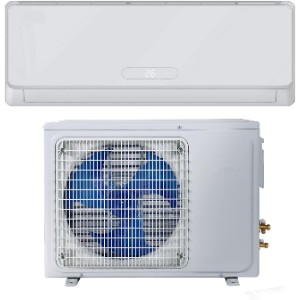
The smaller version of our top pick, sized for bedrooms, home offices, and single rooms up to around 22m². Nine thousand BTUs is enough output for a double bedroom or a comfortable home office, more than a portable unit can achieve quietly, and efficient enough to run overnight without significant electricity cost. The five-year warranty carries over from the 12000 BTU model, which is a genuine point of difference in the budget split market.
Running costs are particularly low for this size: in cooling mode, a 9000 BTU A++ inverter draws around 0.42kW of electricity, costing roughly 10p per hour at the current rate. In heating mode it delivers around 2.6kW of warmth for the same input, substantially better than a 2kW electric panel heater at 48p per hour. If you’re primarily buying this as a bedroom heater for autumn and winter use, the cooling capability is a useful bonus rather than the main reason to buy.
The trade-off versus the 12000 BTU model is obvious: if you have any doubt about whether the room is genuinely under 22m² or if the room has high ceilings, poor insulation, or a lot of sun exposure, size up. An undersized unit running at full output continuously will cool the room less effectively and wear the compressor harder. When in doubt, take the larger model.
Features
- 9000 BTU / 2.6kW cooling and heating
- A++ energy efficiency
- WiFi via electriQ SmartHome app
- Heat pump function included
- 4.5m pipe kit included
- 5-year warranty
- Suited for rooms up to ~22m²
- Right-sized for bedrooms and home offices
- 5-year warranty carries over from the 12000 BTU range
- Very low running costs, ~10p/hr cooling
- Pipe kit included
- Too small for living rooms or open-plan spaces
- Still requires F-Gas installation, same cost as any other model
3. Senville LETO Series 12000 BTU Wall Split (3.5kW)
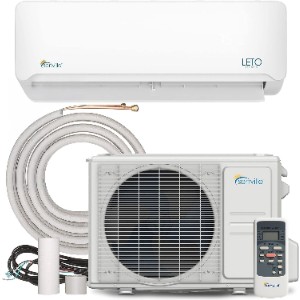
Senville is a North American brand with a solid international reputation, and the LETO Series is their entry-level residential split. The 12000 BTU 3.5kW version runs on 230V, which is the correct voltage for UK installations. Reviews on the UK listing are consistently positive: quiet operation, reliable cooling, and an installation process that experienced F-Gas engineers find straightforward.
Where the Senville LETO distinguishes itself slightly from the generic budget alternatives is in build quality and reliability data. Senville have been selling through Amazon UK for longer than some of the newer listings, and the review pattern reflects a product that works as expected rather than one that polarises buyers. The unit is inverter-driven, handles both cooling and heating, and includes installation hardware. It lacks the five-year warranty of the electriQ models, standard warranty terms apply, which is the main reason it sits behind the electriQ as our top pick rather than ahead of it.
A good alternative top pick if you can find the electriQ model unavailable or out of stock.
Features
- 12000 BTU / 3.5kW cooling and heating
- 230V inverter, correct for UK mains
- Heat pump function (cooling and heating)
- Remote control and WiFi capable
- Suitable for rooms up to ~28–30m²
- Installation kit included
- Established international brand with strong review track record
- Inverter compressor, heat pump included
- Good alternative if the electriQ 12000 BTU is unavailable
- No extended warranty beyond standard terms
- UK customer support less direct than electriQ
4. 12000 BTU 5-in-1 WiFi Wall Split Air Conditioner
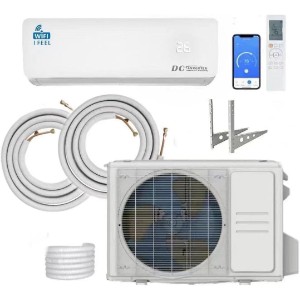
This is the budget pick on the shortlist. The 5-in-1 label refers to the five operating modes: cooling, heating, dehumidifying, air purifying, and fan-only. At 3.4kW and A++ rated, the specs are competitive for the price, and the kit includes two copper pipes and all installation fixings. For buyers who want to keep the unit cost down and put more of their budget towards the installation, this is a reasonable option.
The honest caveat is that this is an unbranded or lightly branded product without the support structure of electriQ or Senville. Reviews are mixed in the way budget generic products typically are: plenty of satisfied buyers who got exactly what they expected, and a minority who ran into problems and struggled to get after-sales assistance. The warranty terms are shorter than the electriQ models. If this is for a living room you rely on daily, the extra cost of the electriQ is probably worth it. If it’s for occasional use in a spare room or a home office, this does the job.
Features
- 12000 BTU / 3.4kW cooling
- 5-in-1: cooling, heating, dehumidifying, air purifying, fan
- A++ energy rating
- WiFi remote control
- Heat pump included
- 2 copper pipes and full installation kit included
- Lower unit cost than branded alternatives
- A++ efficiency rating
- Full installation kit with pipes included
- 5-in-1 mode range
- Unbranded, limited after-sales support
- Shorter warranty than electriQ models
- Mixed reviews compared to more established products
5. 18000 BTU 5-in-1 WiFi Wall Split Air Conditioner (5.1kW)
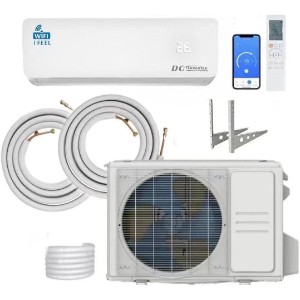
If you’re cooling a large living room, an open-plan kitchen-diner, or any space above 30m², this 18000 BTU 5.1kW model is the option on Amazon UK that fills that need. The five modes and A++ rating match the 12000 BTU variant from the same range; the difference is simply the greater output. In a large space, an 18000 BTU unit at mid-setting will be quieter, more comfortable, and no more expensive to run than a 12000 BTU unit struggling at full blast.
The same caveats apply as for the 12000 BTU budget model, unbranded product, limited support network, no extended warranty. For a large living room you depend on, a Daikin or Mitsubishi sourced through a specialist is a better long-term investment. But if you want an 18000 BTU Amazon UK option to install yourself (via an F-Gas engineer) at a competitive price, this is one of the few available.
Features
- 18000 BTU / 5.1kW cooling
- 5-in-1 modes: cooling, heating, dehumidifying, air purifying, fan
- A++ energy rating
- WiFi control and remote included
- Heat pump included
- Installation kit with pipes included
- Suited for rooms up to ~45m²
- One of the few 18000 BTU options available on Amazon UK
- A++ efficiency for a larger output unit
- Suits open-plan spaces and large living rooms
- Same unbranded support caveats as the 12000 BTU version
- For large rooms in primary use, a specialist-sourced brand is a better long-term investment
6. Belaco 12000 BTU Wall Mounted Inverter Split Air Conditioner
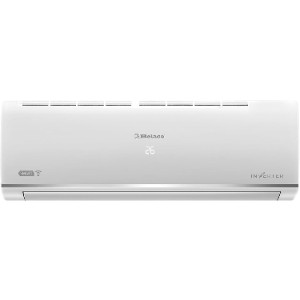
Belaco is a newer entrant to the Amazon UK split AC market. The 12000 BTU model hits the standard specification marks, A++ efficiency, inverter compressor, heat pump, WiFi control, remote, at a competitive price. The review count is lower than the established products on this list, which means you’re putting more trust in the spec sheet than in a proven track record. What reviews exist are positive, and the product presents well. For a secondary room or a property where you want the spec of a 12000 BTU split without the premium of the electriQ, this is worth considering.
The main reason it sits at the bottom of the list is simply that it’s unproven over time. That may change. Check current reviews before buying, as a listing that looks good today will have a clearer track record over the next six to twelve months.
Features
- 12000 BTU / 3.5kW cooling
- A++ energy rating
- Inverter compressor for efficient variable-speed operation
- Heat pump function (cooling and heating)
- WiFi and remote control
- Installation kit included
- Competitive price for the spec
- A++ efficiency, full heat pump functionality
- Good initial review quality
- Very new listing, limited track record
- Less established support than electriQ or Senville
Wall-Mounted Air Conditioner Buying Guide
Key Takeaways
- All wall-mounted split air conditioners require installation by an F-Gas registered engineer, this is a legal requirement in the UK, not a recommendation. Budget an additional £500–£1,000 for a single-room installation on top of the unit cost.
- Amazon UK’s selection of split systems is thinner than the full UK market. Premium brands (Daikin, Mitsubishi, Samsung, Bosch) are primarily sold through HVAC specialists, search those brands if budget allows and you want the best long-term reliability.
- SEER rating is the key efficiency measure: A++ corresponds to roughly SEER 6.5, A+++ to SEER 8+. A better SEER rating means lower running costs, at 24p/kWh, a 12000 BTU A++ unit costs around 13p/hr cooling, versus 20p+/hr for a portable AC doing the same job less effectively.
- Most split systems also function as heat pumps, delivering 3–4kW of heat for every 1kW of electricity, significantly cheaper to run than a 2kW direct electric heater.
- For bedroom use, aim for under 30 dB (A) indoor noise, check the spec sheet before buying. For living rooms, 35–40 dB is generally acceptable.
What Is a Wall-Mounted Air Conditioner?
A wall-mounted air conditioner is a split system: two units, one indoor, one outdoor, connected by a refrigerant pipe and an electrical cable. The indoor unit is mounted high on a wall inside the room. The outdoor unit (the condenser) sits outside, usually on a wall bracket or on the ground beside the building. The refrigerant circuit moves heat from inside the room to outside (cooling mode) or from outside into the room (heating mode).
The “split” design keeps the noisy compressor outside, which is why wall-mounted units are far quieter indoors than portable air conditioners, which house the compressor in the room. It also means the indoor unit doesn’t need an exhaust hose through a window, doesn’t require a drip tray, and doesn’t disrupt the room’s thermal envelope the way a window unit does.
How Does a Wall-Mounted Split System Work?
The indoor unit draws warm air from the room, passes it over a refrigerant-cooled coil (the evaporator), and returns cooled air back into the space. The refrigerant absorbs the heat from the room air, circulates to the outdoor unit, and releases that heat to the outside air via the condenser coil. An inverter compressor regulates the speed of the refrigerant circuit continuously, adjusting output to match the cooling demand rather than running at full blast and switching off repeatedly. This is more efficient and maintains a more stable room temperature than a non-inverter system.
In heating mode, the process reverses. The outdoor unit extracts heat energy from outside air (even at temperatures below 0°C, modern heat pump technology can work down to -15°C ambient) and transfers it indoors. This is why a modern split system functioning as a heat pump is significantly more efficient than a direct electric heater: it moves heat rather than generating it, typically delivering 3–4 units of thermal energy for every unit of electricity consumed.
Choosing the Right Capacity: How Many BTUs Do You Need?
Capacity is measured in BTUs per hour (or kW, where 1kW = 3,412 BTU). For UK homes, a rule of thumb of 350–400 BTU per square metre works for reasonably insulated rooms. Adjust upward for rooms with large south-facing windows, high ceilings, or poor insulation, and adjust downward for north-facing, well-insulated rooms.
| Room Size | Recommended Capacity | Typical Use Case |
|---|---|---|
| Up to 18m² | 9,000 BTU (2.6kW) | Small bedroom, home office, box room |
| 18–30m² | 12,000 BTU (3.5kW) | Master bedroom, living room, kitchen-diner up to 30m² |
| 30–45m² | 18,000 BTU (5.3kW) | Large living room, open-plan kitchen-diner |
| 45–60m² | 24,000 BTU (7kW) | Large open-plan space, limited Amazon UK options at this size |
The golden rule: if you’re on the borderline between two sizes, go up. An oversized unit will cool the room faster and then modulate down, an inverter handles this efficiently. An undersized unit will run at full capacity constantly, struggle to reach the set temperature on hot days, and wear more quickly.
Running Costs: What to Budget For
Split system running costs depend on the SEER (Seasonal Energy Efficiency Ratio) for cooling and the SCOP (Seasonal Coefficient of Performance) for heating. The higher these numbers, the less electricity you use per unit of cooling or heating delivered.
| Rating | SEER | Running Cost (12000 BTU cooling, at 24p/kWh) | Annual Cost (3 hrs/day, 90 days summer) |
|---|---|---|---|
| A (minimum) | ~4.6 | ~18p/hr | ~£49 |
| A++ (good) | ~6.5 | ~13p/hr | ~£35 |
| A+++ (best) | ~8.5 | ~10p/hr | ~£27 |
For context, a portable air conditioner providing similar cooling to a 12000 BTU split might cost 20–30p per hour to run, with less effective results because of exhaust heat re-entering the room. The efficiency advantage of a split system is real and accumulates over a season.
In heating mode, an A++ split system in heat pump mode delivering 3.5kW of heat draws around 0.9–1kW of electricity, costing roughly 22–24p per hour. A 2kW direct electric heater costs 48p per hour for less heat. Over a full heating season, the difference is significant.
F-Gas Installation: What UK Buyers Must Know
This is the most important section for anyone buying a split system for the first time. Under UK law, anyone who handles refrigerants, filling, connecting, or discharging the refrigerant circuit, must hold a valid F-Gas qualification. This applies to all domestic split air conditioner installations without exception. There is no “DIY exemption”, even for products marketed as “easy-fit” or “self-install”. The easy-fit label refers to pre-charged pipe connections that simplify the fitting process, not to an exemption from certification requirements.
The practical implication is that your total cost of buying a wall-mounted split system is the unit price plus the installation cost. A typical single-room installation, fitting the indoor unit, mounting the outdoor condenser, connecting the pipes, pressure-testing the refrigerant circuit, and commissioning the system, costs approximately £500–£1,000 in labour, depending on your location, the difficulty of the wall penetration, and the engineer’s day rate. In London and the South East, budget closer to £800–£1,200.
To find an F-Gas registered engineer, check the Refcom website (refcom.org.uk) or ask local HVAC companies. Many local heating engineers also hold F-Gas certification. When getting quotes, confirm that the price includes commissioning and any refrigerant needed (some pre-charged systems come with enough refrigerant for a standard pipe run, but longer pipe runs may need a top-up).
SEER Ratings: How to Compare Efficiency
The Seasonal Energy Efficiency Ratio (SEER) measures how efficiently an air conditioner cools over a full season. It’s calculated by dividing the total seasonal cooling output (in kWh) by the total seasonal electrical input (in kWh). A SEER of 6.5 means the unit delivers 6.5kWh of cooling for every 1kWh of electricity consumed. A higher SEER is always better from a running cost perspective.
Under the current EU/UK energy label system, the letter ratings map approximately as follows: A is the minimum sold in the UK, A+ and A++ represent better efficiency, and A+++ represents the current highest tier. Most budget split systems on Amazon UK are A++. Premium brands like Daikin, Mitsubishi, and Panasonic typically achieve A+++ with SEER ratings of 8 or above. The running cost difference between A++ and A+++ over a cooling season is relatively modest, perhaps £10–£15 per year for a typical UK household, but a higher SEER unit also tends to be quieter and more precisely temperature-controlled.
Noise Levels: Which Rooms Need the Quietest Unit?
Indoor noise is one of the key reasons buyers choose a split system over a portable unit. Split systems are quieter because the compressor is outside. What you hear indoors is primarily the fan and airflow from the indoor unit. Most budget models operate at 28–40 dB (A) indoors depending on fan speed; premium models can go as low as 18–20 dB (A) on their quiet setting.
| Indoor Noise Level | Room Suitability | Notes |
|---|---|---|
| Below 25 dB | Bedrooms, nurseries | Premium models (Mitsubishi, Daikin), generally not on Amazon UK at these levels |
| 25–32 dB | Bedrooms, home offices | electriQ 9000/12000 BTU range falls here on quiet/low settings |
| 33–40 dB | Living rooms, kitchens | Most budget Amazon UK models at mid-speed |
| Above 40 dB | Non-sleeping spaces only | Old or poorly maintained units; avoid for bedrooms |
The outdoor unit also makes noise during operation, typically 40–55 dB from a metre away. Check permitted development guidelines if your outdoor unit will be close to a neighbour’s window or in a conservation area. For most UK detached and semi-detached properties, a modern inverter outdoor unit running at low speed is not a nuisance issue in practice.
Heat Pump Function: Year-Round Value
All the units on this list operate as heat pumps in reverse, extracting heat from outside air and delivering it indoors. This is one of the most compelling reasons to choose a split system over a cooling-only device: the same installation gives you cheaper-than-electric heating from October through April. A split system delivering 3.5kW of heat at a SCOP of 3.5 draws 1kW of electricity to do so, costing around 24p per hour. Compare that to a 2kW direct electric heater at 48p per hour delivering less heat, or to an oil-filled radiator at 48p per hour for 2kW of output.
The heat pump function works most effectively between about 7°C and 15°C outside, the temperature range for much of a UK autumn and spring. Below -5°C, some budget models lose efficiency noticeably. If you’re planning to use the heating function heavily through a British winter, check the minimum operating temperature for the model you’re considering. Premium brands (Daikin, Mitsubishi) typically perform better at low ambient temperatures than budget alternatives.
Smart Features: When Wi-Fi Control Is Worth It
Wi-Fi connectivity lets you control the unit from a smartphone app, set schedules, and (on some models) integrate with voice assistants. For a bedroom or home office where you want the room cooled before you arrive, app control has practical value: set the unit running twenty minutes before you need it, and the room is comfortable when you walk in. For a living room that’s already occupied when you turn the AC on, a standard remote is perfectly adequate.
The app quality varies considerably between products. electriQ’s SmartHome app is functional and reliable. Budget unbranded units typically use a generic smart home app that works but isn’t polished. If smart integration with Alexa, Google Home, or HomeKit matters to you, confirm this specifically before buying, not all Wi-Fi-enabled units support third-party voice assistants.
Wall-Mounted vs Portable Air Conditioners
Portable air conditioners have one significant advantage: no installation. You plug them in, vent the exhaust through a window or door, and they work. The price is lower upfront and there’s no F-Gas engineer to organise.
The trade-offs are real. Portable ACs are noisier (the compressor is in the room), less efficient (the exhaust hose conducts heat back into the room), less effective at cooling (they cool a smaller usable volume because of the heat re-entry from the exhaust hose), and more disruptive to use. They need to be stored somewhere in winter, they produce significant noise and vibration, and for anything more than occasional use on very hot days, most buyers who’ve owned both strongly prefer the fixed split system.
If you’re renting and can’t make permanent modifications to external walls, or you need a cooling solution for a single week’s heatwave without the cost of installation, a portable is the right tool. For anything beyond occasional use, the fixed split system wins on every metric except upfront simplicity.
Benefits of Using a Wall-Mounted Air Conditioner
The efficiency case is strong and often undersold. A well-sized A++ split system costs less to run in cooling mode than a portable AC and far less in heating mode than a direct electric heater. For a home office or bedroom used year-round, the heating efficiency alone can offset a meaningful portion of the installation cost over two or three winters.
Noise is the second major benefit. A modern split system at low setting on a warm night is barely audible, most sleepers don’t notice it. A portable AC at the same cooling capacity sounds like a running dishwasher. If you’ve suffered through a hot summer night with a portable AC whirring next to your head, you’ll understand why this matters.
The third benefit is air quality control. Modern split systems include a basic filter that reduces dust and some allergens in circulated air. Models with dehumidifying functions also reduce the sticky humidity that makes UK summers uncomfortable at 28°C in a way that 32°C dry heat in Southern Europe isn’t. The dehumidify mode used on its own (without maximum cooling) is a useful mid-season setting.
The Amazon UK Market for Split Systems: An Honest Note
The UK market for wall-mounted split systems is dominated by HVAC specialists selling brand-name units, Daikin, Mitsubishi, Samsung WindFree, Bosch, Haier, Panasonic. These brands have better efficiency ratings, more precise temperature control, lower noise levels, better heat pump performance at low ambient temperatures, and longer warranties. Most UK HVAC companies will quote you a supply-and-install package for a Daikin or Mitsubishi single-room unit for somewhere between £1,800 and £3,500 depending on model and installation complexity.
Amazon UK’s selection of split systems is narrower. The brands on this shortlist, electriQ, Senville, and the unbranded alternatives, are functional, well-specified at their price points, and backed by genuine reviews. They’re not the first choice for a high-use primary living room in a family home, but they represent genuinely good value for bedrooms, home offices, and secondary rooms where the premium of a Daikin would be hard to justify on a cost basis.
Common Mistakes When Buying a Wall-Mounted Split System
Underestimating the total cost is the most common one. Buyers who focus on the unit price and get a shock when they ring an HVAC engineer. The product cost is typically 30–50% of the total project cost for a single room. Factor in installation from the start and set a realistic overall budget.
Buying the wrong size. Undersizing to save money on a smaller unit and then finding it can’t cope on a 28°C day is a frustrating mistake. Use the sizing table above; if in doubt, go up one size. The energy cost difference between a 9000 BTU and 12000 BTU unit is small, but the difference in comfort on a hot day is significant.
Ignoring the outdoor unit location. Some buyers purchase the unit and only then discover the outdoor condenser has nowhere suitable to go, blocked by a listed building restriction, too close to a neighbour’s property boundary, or on a wall that can’t support the bracket load. Think about where the outdoor unit will go before you buy.
Trying to DIY the refrigerant connection. Some products are marketed as “easy-fit” and it’s tempting to interpret this as DIY-safe. It isn’t, see the F-Gas section above. An improperly commissioned refrigerant circuit can underperform, leak refrigerant (an environmental offence under UK law), or operate dangerously. Always use a certified engineer for the final connection and commissioning.
When Not to Buy a Wall-Mounted Air Conditioner
If you rent and can’t get landlord permission for a through-wall installation, or if you’re in a listed building or conservation area where external changes need approval you’re unlikely to get, a portable air conditioner or a good quality fan is more practical. The installation requirements for a split system aren’t negotiable.
If you only need cooling for a few days per year, say, the two or three exceptional heatwaves a UK summer might produce, the cost of installation is hard to justify on purely financial grounds. A portable AC or a tower fan serves that use case at much lower total cost.
And if your priority is the best possible performance, noise level, or warranty, go through a specialist rather than Amazon UK. The products on this list are good, but Daikin, Mitsubishi, and Samsung represent a meaningfully higher tier in terms of engineering quality, noise performance, and cold-climate heat pump efficiency. The premium is real, but so is the difference.
Quick Buyer Checklist
- What is the room size in square metres, and have you matched the BTU output accordingly?
- Where will the outdoor condenser unit go, and is that location accessible and suitable?
- Have you got a quote from an F-Gas registered engineer, and does your total budget include installation?
- Is the property owned (or do you have landlord permission for a permanent installation)?
- Do you need heat pump function for winter use, or cooling only?
- What noise level is acceptable for the room, bedroom use requires under 32 dB, living room use allows more?
- Do you need Wi-Fi app control, and if so, does the model support your preferred smart home system?
- Have you compared the Amazon UK options with a specialist-quoted brand-name unit for value?
Case Study: Cooling a South-Facing Living Room and Home Office
Background
A homeowner in a 1970s semi-detached property in the East of England had two rooms that became consistently uncomfortable from June through August: a south-west-facing living room (26m²) and a first-floor home office (14m²). The property had gas central heating and no existing air conditioning. Two portable air conditioners had been tried over previous summers, both were noisy, both left the rooms feeling clammy, and one had failed after two seasons.
Project Overview
The decision was made to install a wall-mounted split system in the living room and a smaller unit in the home office. For the living room, a 12000 BTU A++ unit was selected, adequate for the 26m² space with manageable window areas. The home office, at 14m², suited a 9000 BTU model. Both were sourced from Amazon UK; an HVAC engineer holding F-Gas certification was quoted and booked through a local trade directory.
Implementation
Installation of both units took one day. The outdoor condensers were mounted on the rear wall on brackets, connected by refrigerant pipes through 65mm core holes in the cavity wall. The engineer pressure-tested both circuits, commissioned the refrigerant charge, and provided a brief demonstration of the app control for each unit. Total installation cost for both units combined was £950.
Results
Through two summers of use, both units have performed reliably. The living room drops from 28°C to 22°C within 25 minutes on a hot day. The home office runs throughout the working day without any noise disturbance. Both units have been used in heating mode from October to December, the living room unit providing 3kW of heat at a running cost of around 22p per hour, compared to the previous 2kW electric oil radiator at 48p per hour for less output. The combined investment has paid back a meaningful portion of its cost in heating savings.
Expert Insights From Our Heating Engineers About Wall-Mounted Air Conditioners
One of our senior heating engineers with over 18 years of experience in domestic HVAC installations shares this on wall-mounted split systems in UK homes:
“The biggest misconception I encounter is people thinking of this as a summer luxury product. A good inverter split system with heat pump function is a year-round tool. In October and November when it’s 8°C outside, the COP on these units is 3.5 or better, you’re getting three and a half kilowatts of heat for one kilowatt of electricity. That’s half the cost of electric heating. For rooms without radiators, or rooms where the radiator never quite gets them to temperature, this is genuinely the most cost-effective heating upgrade you can make.”
“On the question of Amazon UK brands versus specialist-supplied ones, there’s a real difference. The Daikin and Mitsubishi units I install are noticeably quieter, particularly the outdoor units, and they have better low-temperature performance for the heating function. In a bedroom where silence is important, I’d push clients towards a premium brand. In a utility room or a kitchen, the budget options are perfectly adequate. The quality of the installation matters at least as much as the brand, I’ve seen premium units installed poorly and budget units installed correctly. Get the installation right and any of these units will serve you well.”
“One thing I tell every buyer: don’t skimp on the outdoor unit location. I’ve been called to properties where the previous owner mounted the condenser in a poorly ventilated recess or facing into a prevailing weather wall, and the unit runs hot and inefficiently as a result. Ideally the outdoor unit should face north, east, or west, not south, be at least 30cm clear of any obstruction, and have somewhere for the drainage from the defrost cycle to go. Get that right at install and the unit will run efficiently for 10 to 15 years.”
Frequently Asked Questions
Do I need planning permission to install a wall-mounted air conditioner in the UK?
In most cases, no. Permitted development rights cover most domestic air conditioner installations without requiring planning permission. Exceptions include listed buildings, conservation areas, and some flats where permitted development rights have been removed by a planning condition. If you’re in any of these categories, check with your local planning authority before proceeding. The outdoor condenser unit must also meet volume limits under permitted development rules, though a standard single-room condenser is well within those limits.
Can I install a wall-mounted split air conditioner myself?
No. Under UK law (the F-Gas Regulation), only an F-Gas certified engineer can handle, connect, or commission the refrigerant circuit in a split air conditioner. This applies regardless of whether the product is marketed as “easy-fit” or “self-install”. The mounting and pipework can be prepared by a competent DIYer, but the refrigerant connection and system commissioning must be done by a certified professional. Attempting to connect the refrigerant circuit yourself risks an inefficient, potentially unsafe system and creates liability for an environmental offence (refrigerant is a potent greenhouse gas under UK law).
How much does it cost to install a wall-mounted air conditioner in the UK?
For a standard single-room installation, indoor unit, outdoor condenser, pipe connection, commissioning, expect to pay £500–£1,000 in labour, excluding the unit itself. In London and the South East, budget closer to £800–£1,200. The variation depends on installation complexity (difficult wall penetrations, long pipe runs, access issues) and your location. Getting two or three quotes from F-Gas registered engineers is straightforward and worth doing for a job of this size.
What size split system do I need for my room?
A rule of thumb is 350–400 BTU per square metre for typical UK rooms. For a 20m² bedroom, that points to 7,000-8,000 BTU, making a 9,000 BTU unit the sensible choice. For a 26m² living room, 9,100–10,000 BTU points to a 12,000 BTU unit. If the room is south-facing with large windows or has high ceilings, add 20% to your estimated requirement. When in doubt between two sizes, choose the larger, an inverter system will modulate down in mild conditions.
Can a wall-mounted air conditioner heat as well as cool?
Yes, all the models on this list operate as heat pumps in reverse. In heating mode, the system extracts heat from outside air and transfers it indoors. This works down to around -7°C to -15°C ambient temperature depending on the model, covering the vast majority of UK winter conditions. The efficiency in heating mode (measured as SCOP) is typically 3–4, meaning 3–4kW of heat for every 1kW of electricity. That’s significantly cheaper to run than a direct electric heater and makes a split system a genuinely useful year-round tool rather than a summer-only purchase.
How much does a wall-mounted air conditioner cost to run in the UK?
For cooling, a 12000 BTU A++ unit (SEER ~6.5) draws approximately 0.54kW of electricity at typical load. At the current Ofgem unit rate of around 24p/kWh, that’s roughly 13p per hour. For a full summer season of 3 hours/day over 90 days, the total cooling cost is around £35. In heating mode, the same unit at SCOP 3.5 delivers 3.5kW of heat for approximately 0kW of input, around 24p per hour for 3.5kW of warmth, compared to 48p per hour for 2kW from a direct electric heater.
What is an F-Gas engineer and how do I find one?
An F-Gas engineer holds a qualification to handle refrigerants under the UK F-Gas Regulation. This certification is required by law for anyone connecting, maintaining, or decommissioning refrigerant systems including air conditioners. To find one, check the Refcom register at refcom.org.uk or search for local HVAC/air conditioning companies and confirm they hold F-Gas certification. Most reputable local heating and cooling engineers will have this qualification. When getting quotes, ask for written confirmation that the engineer is F-Gas certified and that the quote includes all commissioning and any required refrigerant.
Are the brands on Amazon UK as good as Daikin or Mitsubishi?
Honestly, no, not at the premium end. Daikin, Mitsubishi, Samsung, and Bosch have better SEER and SCOP ratings, lower operating noise (particularly the outdoor unit), stronger cold-climate heat pump performance, and longer warranties than the Amazon UK budget alternatives. For a primary living room in a family home where you want the best comfort and reliability, going through an HVAC specialist for a brand-name unit is worth the additional cost. The Amazon UK options are genuinely good for bedrooms, home offices, and secondary rooms where the economics of a premium brand are harder to justify.
Summing Up
A wall-mounted split system is the most effective, most efficient, and quietest way to cool a single room, but it’s a bigger purchase decision than a portable air conditioner because installation is mandatory and adds to the total cost. Do the maths from the start: unit plus installation, not just unit. The electriQ 12000 BTU WiFi Smart A++ Inverter is the best-balanced option on Amazon UK for most buyers, with a five-year warranty and genuine UK support that set it apart from the budget alternatives. If you’re looking at a larger space, the 18000 BTU variant does the job. And if your priority is the absolute best performance money can buy in terms of noise, efficiency, and cold-climate heating, go through a specialist for Daikin, Mitsubishi, or Samsung, the products are simply better, and the installation cost is the same either way.
Updated