
A radiator cover is one of the simplest home improvements you can make, and when you get it right, you will wonder why you waited. The Vida Designs Arlington is the most tried-and-tested option available in the UK right now, with over 11,000 verified reviews and a track record that no other cover on Amazon UK can match. But it is white, it comes in one style, and it suits certain rooms better than others. Below you will find eight covers across different budgets, materials, and finishes, followed by a buying guide detailed enough that you will not need to go back to Google to make your decision.
One important note before you dive in: radiator covers work brilliantly in the right context, but they are not suitable for every situation. If you have storage heaters, skip this article entirely. Storage heaters run at much higher temperatures than standard central heating radiators, and covering them is a fire hazard.
Our Top Picks
| Image | Name | |
|---|---|---|
| Vida Designs Arlington Radiator Cover | |
| Vida Designs Chelsea Radiator Cover | |
| Vida Designs Milton Radiator Cover | |
| HOMCOM Slatted Radiator Cover | |
| Blisswood Traditional Radiator Cover | |
| Modern Vertical Slatted Radiator Cover | |
| HMD High Gloss Radiator Cover | |
| Kingwudo High Gloss Radiator Cover |
8 Best Radiator Covers
1. Vida Designs Arlington Radiator Cover
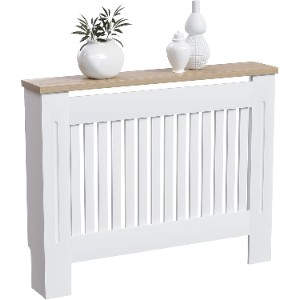
The Arlington earns its place at the top of this list not through marketing but through sheer volume of buyer experience. With over 11,000 reviews on Amazon UK and a 4.2-star average, it is the most validated radiator cover you can buy right now. And the numbers are not misleading: the feedback is consistently positive on fit, ease of assembly, and the quality of the painted finish. It is a Shaker-style vertical slat design in painted MDF, available in white across four sizes, and it does exactly what it promises.
The medium size (external: H83.3 x W111 x D19cm) covers the majority of standard UK living room and hallway radiators. The slimline 19cm depth is one of its most practical features: it does not eat into the room, even in a narrow hallway where every centimetre counts. The solid wood-effect top shelf is genuinely useful rather than just decorative, and it holds a mirror, plant, or small lamp without wobbling. Assembly takes around 30 to 40 minutes using basic hand tools.
Where does it fall short? The painted MDF finish is not as durable as a lacquered surface. If the corners take a knock from a hoover or a pushchair, they can chip. And because the Arlington only comes in white, it will not suit every interior. But for the price, the quality of fit and the sheer depth of buyer confidence behind this product, nothing else on Amazon UK competes at this volume. If you want one cover for a living room or hallway and you want to get it right first time, start here.
Features
- Shaker-style vertical slat pattern in painted MDF
- Available in small (78cm), medium (111cm), large (152cm), extra-large (172cm)
- Internal dimensions (medium): H81 x W105 x D16cm
- External dimensions (medium): H83.3 x W111 x D19cm
- Solid wood-effect top shelf
- Wall-mount anti-toppling clips included
- Over 11,000 UK reviews, the most of any cover in this category
- Four sizes cover almost every standard UK radiator
- 19cm depth works in narrow hallways
- Solid top shelf for displaying ornaments or framed prints
- Anti-toppling wall clips included
- White only, no colour options in the Arlington range
- Painted MDF corners can chip if knocked
2. Vida Designs Chelsea Radiator Cover
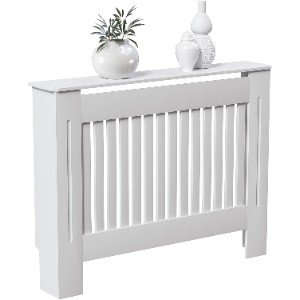
The Chelsea is essentially the Arlington’s more affordable sibling, and for most buyers the differences are marginal enough that it is the smarter buy. It has almost identical dimensions (19cm deep, four sizes, vertical slat pattern), a comparable review count of nearly 11,000, and costs a few pounds less. The main visual distinction is the top shelf: the Chelsea’s is plainer, without the wood-effect lip of the Arlington. In practice, most people do not notice once it is in situ.
If you are covering several radiators in one house and want a consistent look without spending heavily on each, buying multiples of the Chelsea adds up to meaningful savings. The fit and finish are good for the price, and the anti-toppling clips work reliably. Not a choice that will impress anyone with its design distinction, but that is not what the Chelsea is for. It is a no-nonsense workhorse of a radiator cover, and at this price, it is difficult to fault.
Features
- Vertical slat design in white painted MDF
- Four sizes: small (78cm) through extra-large (172cm)
- External dimensions (medium): H82 x W111 x D19cm
- Internal dimensions (medium): H80 x W102 x D16cm
- Anti-toppling wall bracket included
- Nearly 11,000 reviews, close behind the Arlington in buyer validation
- Lowest price in this list
- Identical depth and size range to Arlington
- Good value if buying multiple units for the same house
- Plainer top shelf than the Arlington
- White only
- Not suitable for bathrooms or high-humidity rooms
3. Vida Designs Milton Radiator Cover
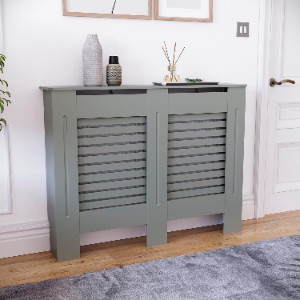
If the white vertical slat style of the Arlington and Chelsea does not suit your interior, the Milton offers a credible alternative. The horizontal slat pattern gives it a distinctly more modern, Scandi-influenced feel, and the olive grey finish is one of the better non-white painted MDF colours available at this price: it photographs well and suits both contemporary and warmer traditional schemes without looking drab.
The dimensions match the Vida Designs range (same footprint as the Chelsea), and at 4.4 stars from over 4,600 reviews, buyers are genuinely satisfied. It is worth noting that horizontal slats do not perform differently from vertical ones in terms of heat flow: the slat direction affects aesthetics, not ventilation. So the choice between the Milton and the Arlington is purely a design decision. At around £34 for the medium size, the Milton delivers solid value for a distinctive finish that most competitors at this price point do not offer.
Features
- Horizontal slat pattern in olive grey painted MDF
- Four sizes: small through extra-large
- External dimensions (medium): H82 x W111 x D19cm
- Top display shelf
- Wall-mounting clips included
- Olive grey finish suits modern and traditional rooms
- Horizontal slat design for a different look
- 4.4-star average from 4,600+ buyers
- Budget-friendly price
- One colour only
- Painted MDF, not solid wood
4. HOMCOM Slatted Radiator Cover
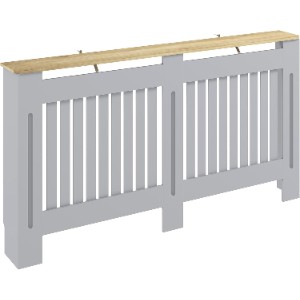
HOMCOM’s entry feels more substantial than the Vida Designs options. The panels are heavier, the grey paint finish is denser and more even, and the slatted grill design has wider spacing that allows convection to move through freely. The built-in anti-toppling system is a practical feature rather than an afterthought: the rear bracket attaches to the wall securely and means the cover will not pull forward if a child uses it for support. At 152cm wide it is the right choice for a large hallway or living room radiator where the Vida Designs large sizes might feel borderline.
The catch is sizing: this HOMCOM comes in one width (152cm), so it is not suitable for smaller radiators. If your radiator is standard medium-width (around 111cm), the Vida Designs range is more appropriate. But for a wider radiator in a room where you want grey rather than white, the HOMCOM is genuinely the best-built option at this price.
Features
- Grey painted MDF with slatted grill front
- Overall dimensions: 152L x 19W x 81H cm
- Inner size: 146.8W x 16.8D x 80.3H cm
- Anti-toppling wall-mount bracket included
- Top display shelf
- Heavier, more substantial build than budget MDF options
- Grey suits modern and Scandi interiors
- Wide slat spacing for strong heat flow
- Anti-toppling mount for child safety
- Only one size (152cm): not suitable for smaller radiators
- Grey only, no white or black option in this model
5. Blisswood Traditional Radiator Cover
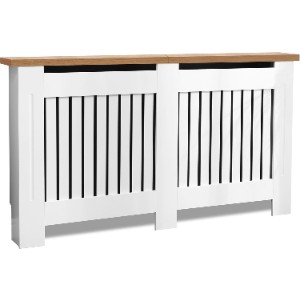
The Blisswood sits at 4.5 stars from over 400 reviews, which puts its satisfaction rate above all three Vida Designs options. The panels feel more substantial close-up, the white finish holds well at edges and corners, and the overall construction reads as a step up from entry-level flat-pack. This is the cover to consider if you want something that looks convincing when people stand in front of it rather than just from across the room.
It is large-size only (152cm wide externally), which limits its application but suits the sizeable radiators common in Victorian and Edwardian hallways. Assembly is straightforward, and buyers consistently report that the instructions are clear. One practical note: check your wall material before you attempt to fix the anti-toppling bracket. On plasterboard over a stud wall without hitting a stud, you will need appropriate cavity fixings rather than the standard screws provided.
Features
- Vertical slat white MDF with sturdy panel construction
- External dimensions: H83.2 x W152 x D19cm
- Internal dimensions: H80.7 x W141.5 x D16.9cm
- Wide top display shelf
- Wall-mounting hardware included
- 4.5-star average: highest buyer satisfaction in this list
- Heavier, more substantial panels than budget MDF options
- Wide top shelf for display
- Large size only: not suitable for smaller radiators
- Standard wall fixings may not work on plasterboard without cavity anchors
6. Modern Vertical Slatted Radiator Cover
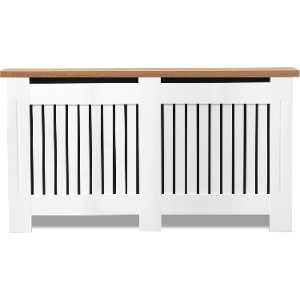
The distinguishing feature here is the tighter slat spacing, which gives the front panel a more refined, almost architectural appearance from across a room. Where the Vida Designs and HOMCOM covers have clearly visible individual slats, this one reads as a more cohesive textured surface. It suits minimalist or contemporary interiors where you want the cover to disappear into the room rather than draw attention to itself.
At 4.5 stars from 425 reviews and £45.99 for the large size (152cm wide), it is priced reasonably for what it delivers. The wall-mount anti-tip brackets are included and the build quality is solid. Tighter slats do restrict airflow slightly more than wider spacing, so make sure you are not covering a radiator that already struggles to heat the room. For a well-sized radiator in a medium-to-large room, it is not an issue.
Features
- Modern tight-spaced vertical slat design in white MDF
- External dimensions: 19D x 152W x 83.2H cm
- Wall-mountable anti-tip brackets included
- Wide top shelf
- Refined close-slat design reads as architectural rather than functional
- 4.5-star average from verified buyers
- Suits minimal and contemporary interiors particularly well
- Large size only
- Tighter slats restrict airflow slightly more than wider-spaced alternatives
7. HMD High Gloss Radiator Cover
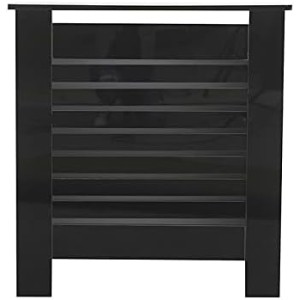
This is the most honest entry into high-gloss territory. The UV panel finish is not lacquered wood, but it gives a surface that catches the light credibly and looks far more premium than painted MDF from a normal viewing distance. Three colour choices (black, white, and grey) are a genuine advantage over most MDF covers, and four sizes mean you can find a combination to suit most radiators. Buyers give it 4.6 stars, which is the joint-highest average on this list.
The honest caveat is that the review base is still small (83 ratings at the time of writing). That is not necessarily a red flag, but it means you are taking slightly more of a leap than with the Vida Designs range. The gloss surface shows fingerprints clearly and needs a specific wipe-clean approach: microfibre cloth, no abrasive cleaners. If that sounds like an irritant in a family household with young children, the matte MDF options above will be easier to live with day to day.
Features
- UV gloss panel finish in black, white, or grey
- Horizontal slat design, four sizes
- External dimensions (small): W78 x D19 x H82cm
- Internal dimensions: W73 x D16.5 x H80cm
- High-gloss UV finish looks notably premium for the price
- Three colour options including black and grey
- Four sizes available
- 4.6-star average
- Only 83 reviews: less buyer validation than others in this list
- Gloss surface shows fingerprints; needs regular wiping
8. Kingwudo High Gloss Radiator Cover
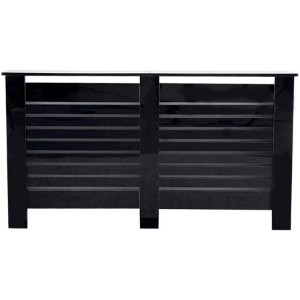
The premium pick. If you have a modern, dark-palette room and you want the radiator cover to be a deliberate design feature rather than something you are hoping people overlook, this is the one to choose. The black high-gloss finish is deep and lacquer-like in a way that the HMD’s UV panel is not. Close up, the horizontal slats are precisely cut and the side panels sit flush. It genuinely looks like a piece of furniture rather than a utility cover.
The XL size (172cm wide) is a practical advantage too: very few covers on Amazon UK reach this width, which makes the Kingwudo the only real option for covering a full double-panel radiator in a large open-plan room. At £69.99 it is the most expensive choice in this list, and that is the appropriate lens for it. Do not buy the Kingwudo as a budget option and feel short-changed by the price. Buy it because your room calls for exactly this kind of cover, in which case it will repay the investment every time someone notices it.
As with all black gloss surfaces: keep a microfibre cloth nearby. Dust settles visibly, and fingerprints from light switches or handles nearby will show on the surface within days of fitting. That is the trade-off for the look, not a quality issue specific to this product.
Features
- Deep black high-gloss wooden finish
- Horizontal slat decorative cabinet design
- Four sizes: S (78cm), M (111.5cm), L (151.5cm), XL (172cm)
- External dimensions (large): L151.5 x W19 x H82cm
- Internal dimensions (large): L146.5 x W16.5 x H80cm
- The most visually striking cover in this list
- XL size (172cm) covers very wide radiators, rare at this price
- Robust build with flush panel edges
- 4.6-star average
- Most expensive pick on this list
- Black gloss shows every fingerprint and dust particle
- Black only: no alternative colour options
Radiator Covers Buying Guide
Key Takeaways
- Always measure your radiator including valves and pipework, then add at least 5cm to the width and 3cm to the height and depth when comparing to internal cover dimensions.
- A well-ventilated cover with wide slats and an open or slatted top has minimal impact on heat output. A solid-top or tightly slatted cover can reduce room heating efficiency by up to 20%.
- Never fit a radiator cover over a storage heater. The high heat output is a fire hazard.
- MDF covers are fine for living rooms, hallways, and bedrooms. In bathrooms, use only moisture-resistant versions or a non-wood alternative.
- Wall-mounting with the included anti-toppling hardware is strongly recommended in any household with children under ten or with pets.
- Check bleed valve access before you fix anything permanently. Most modern covers allow removal of the front panel, but some radiator positions make this awkward.
- If your radiator is under a window with a low sill, make sure the cover’s top is low enough for the warm air convection to rise freely, not be trapped by the sill above.
What Is a Radiator Cover and Who Actually Needs One?
A radiator cover is a decorative cabinet or panel that surrounds a central heating radiator. The front panel is slatted or grilled to allow warm air to circulate while hiding the radiator body. The top is typically a flat shelf for displaying ornaments or keeping things handy near an entry.
You genuinely need one if: your radiator is old, unsightly pressed steel that clashes with an otherwise decent-looking room; you have young children who risk touching or falling against a hot radiator surface; your hallway or living room would benefit from an extra shelf surface; or you are in rented accommodation and cannot replace the radiator with something more attractive.
You probably do not need one if: your radiator is already a stylish column or designer panel that adds to the room aesthetics; you have a storage heater (covers are dangerous with storage heaters); your room is already struggling to reach temperature and adding a cover will worsen it; or your radiator is in a very small room where even a slim 19cm cover would feel intrusive.
Do Radiator Covers Reduce Heat Output?
This is the single most common concern, and the answer requires a bit more nuance than most articles offer. A radiator heats a room primarily through convection: air flows past the hot fins, heats up, rises, and circulates. A cover that restricts this convection will reduce the radiator’s effectiveness. A cover that allows convection to move freely will barely affect it.
The two biggest factors are slat spacing and top ventilation. Slat spacing affects how much warm air can move through the front panel per second: wider slats allow more flow. Top ventilation is even more critical. If the top of the cover is solid or the shelf is loaded with heavy objects flush to the cover edge, the warm air cannot rise freely and collects behind the cover before eventually dissipating. The practical result is that your thermostat takes longer to detect that the room has reached temperature, your boiler runs longer, and your bills go up.
The standard guidance from heating engineers is that a good-quality cover with wide front slats and a clear, unobstructed top will add less than 5% to your heating run time, which translates to a negligible impact on bills. A poor cover with a solid top or very narrow slats can increase run time by 15 to 20%, which on a typical UK gas bill is not trivial. The covers in this list all have adequate ventilation, provided you do not block the top shelf.
How to Measure for a Radiator Cover
Getting the measurements right is the step most buyers rush, and it accounts for the majority of returns. Here is the correct process.
Start with the width. Measure from the outermost point of the thermostatic radiator valve (TRV) on one side to the outermost point of any valve or pipework on the other. Do not measure just the radiator panel body. Valves typically add 5 to 8cm per side. Take this full width measurement and compare it against the internal width of the cover: the cover’s internal width must be at least 5cm wider than your full radiator measurement.
For height, measure from the floor to the top of the radiator, including any valves sitting above the panel. Add at least 3cm to this for clearance, and compare against the cover’s internal height. For depth, measure from the wall to the front face of the radiator, accounting for any pipe connections coming out of the wall directly behind. Add 3cm and compare against the cover’s internal depth.
One practical trap: skirting boards. Most modern covers have a base cut-out to sit over a standard UK skirting board (typically 10 to 12cm tall). If your skirting is unusually tall, angled, or if the radiator is on a raised plinth, check this detail in the product specifications before ordering.
If your radiator is under a window: measure the height from the floor to the window sill and make sure the cover you choose is low enough that the top sits at least 3cm below the sill. If the cover’s top is flush with or above the sill, rising warm air will be deflected back down rather than circulating into the room.
Types of Radiator Cover
Off-the-peg flat-pack covers in MDF are by far the most common type sold in the UK, and they account for all eight products in this list. They come in standard widths from around 78cm up to 172cm, are delivered flat-packed for self-assembly, and typically cost between £30 and £70. They suit standard pressed-steel panel radiators of any age. The main limitation is that they come in fixed widths, so if your radiator is an unusual size, you may need a different approach.
Adjustable or extendable covers are a useful variant worth knowing about. These have an extending mechanism, usually a sliding inner panel, that allows them to fit a range of widths. They are particularly useful in rental properties where the radiators may not be standard sizes, and they are generally easier to take with you when you move. The trade-off is that the extending mechanism can look slightly less clean than a fixed cover, and they are typically only available in a limited size range.
Made-to-measure covers are commissioned from specialist cover companies or local carpenters and built to fit your exact radiator dimensions. They cost significantly more (typically £200 to £600 or more) but deliver a finish and precision that off-the-peg flat-pack cannot match. If your radiator is a non-standard size or position, or if you want a bespoke grille pattern, made-to-measure is the right approach.
Glass and metal covers exist but are relatively uncommon on Amazon UK. Metal covers conduct heat and can be hot to touch, which makes them unsuitable in households with children. Tempered glass covers look striking and are heat-resistant, but they are expensive, typically made-to-measure, and more fragile than wood or MDF.
Materials and Build Quality
MDF (medium-density fibreboard) is the material used in the vast majority of affordable covers, including all eight in this list. It is stable, does not warp in normal domestic conditions, and machines into precise shapes cleanly. The painted finish is durable enough for the low-impact environment of a hallway or living room, but it is not as hard as lacquered wood: corners and edges will chip over time if knocked regularly. MDF is not suitable for sustained damp, which is why standard painted MDF covers should not be used in bathrooms unless the room has genuinely effective extraction and the radiator is not near the shower.
Moisture-resistant MDF is available in some specialist cover products and is worth seeking out for kitchen applications where steam is a factor. It is denser and slightly heavier than standard MDF, with a green-tinted core that you can see at cut edges.
High-gloss UV panel covers use a standard MDF carcass with a UV-cured lacquer panel bonded to the front and sides. The UV finish is harder and more scratch-resistant than standard paint, takes on a reflective sheen that standard paint cannot replicate, and is easier to wipe clean. The trade-off is that gloss surfaces show fingerprints and dust far more visibly than matte finishes, which can make them impractical in high-traffic areas with young children.
Solid wood covers are rare in the Amazon UK market but do exist through specialist retailers. They are heavier, more durable, and better-looking close-up than MDF. They can be sanded and repainted rather than just wiped down. The cost premium is significant: a comparable solid oak cover can cost three to five times the price of an equivalent MDF option.
Room Suitability
In a hallway, a radiator cover is almost always a good idea. The hallway is typically where your central heating radiator is most visible, most awkwardly positioned, and most likely to be knocked into by anyone with a bag or a pushchair. A slim (19cm deep) cover with a decent top shelf transforms the radiator into a functional console table. Choose a cover in white or grey for light neutrals, or match the cover colour to your front door for a more considered look.
In a living room, the calculus is similar but the heat efficiency point matters more, since the living room is typically the largest space your boiler is trying to heat. Choose a cover with wide slats and keep the top shelf clear of bulky items that block convection. If your living room has a single large radiator doing heavy lifting, think carefully about whether a cover is right: if the room already takes a long time to warm up, a cover may not help.
In a bedroom, radiator covers can add useful surface space in small rooms, but bedrooms are typically less problematic from an aesthetic standpoint since radiators are usually less visible. A cover is a nice addition if the radiator is in an obvious position, but it is rarely urgent.
In a bathroom, tread carefully. Standard painted MDF will degrade with repeated steam exposure over 18 to 24 months in a poorly ventilated bathroom. If you have powerful extraction and the radiator is not near the shower or bath, a standard MDF cover will last longer than you might expect. If the bathroom is small and steamy, look for a moisture-resistant MDF option or consider leaving the radiator Uncovered and painting it to match the wall instead.
Safety Considerations
Radiator covers provide a meaningful safety benefit in households with young children and pets. A standard central heating radiator surface reaches 60 to 80°C during normal operation, which is hot enough to cause a contact burn within seconds. An MDF cover, being a poor heat conductor, stays at a much safer temperature even when the radiator behind it is at full output. This is one of the clearest practical reasons to fit one.
Wall-mounting is not optional if you have children under about ten or a large dog. A free-standing MDF cover can topple forward if a child pushes against it or if a large pet knocks it. All the covers in this list include anti-toppling wall brackets. Before screwing into the wall, use a pipe and cable detector to locate any wires or pipes behind the plaster, particularly in older properties where wiring routes are less predictable.
Never fit any radiator cover over a storage heater. This is a genuine fire risk. Storage heaters cycle to very high temperatures overnight as they charge, and an MDF cover placed around one will overheat and can ignite. If you are unsure whether you have storage heaters or central heating radiators, storage heaters are typically much heavier and chunkier than standard panel radiators, are wired directly into the mains rather than connected to a central heating circuit, and do not have thermostatic valves.
Installation and Assembly
All the flat-pack covers in this list follow a similar assembly process. Unpack and lay out the panels on the floor so you can see all the components. Most are three-piece: two side panels and the front grill panel. The top shelf is either pre-attached or fitted after the main body is assembled. Assembly typically requires a screwdriver and sometimes an Allen key, both of which are usually included or standard household tools.
Once assembled, slide the cover over the radiator and check the fit before fixing to the wall. It should sit clear of the radiator on all sides with no panel touching the hot surface. Then mark the wall bracket positions in pencil, check with your detector, and drill. Use the correct wall plug for your wall type: standard masonry plugs in brick or blockwork, cavity fixings in plasterboard where you cannot hit a stud. The anti-toppling bracket is typically a small metal L-bracket that fixes to the wall behind the cover and clips or screws into the cover’s rear panel.
Fitting time is typically 30 to 60 minutes for a first-time installer. If you are replacing an existing cover with a new one, allow extra time for removing the old fixings and filling the old plug holes before fitting the new bracket.
Accessing the Bleed Valve
This is a practical point that buyers often overlook until they have a cold patch in the radiator and need to bleed it. The bleed valve is usually at the top corner of the radiator, and with a cover in place, reaching it with a radiator key or small flathead screwdriver can require removing or lifting the front grill panel.
Most modern MDF covers are designed so the front panel simply lifts out or Unclips from the top. Check this on your specific model before you fix the cover permanently to the wall. If the bleed valve is on the end of the radiator rather than at the top (which is common on some older radiators), you may need to slide the whole cover to the side to access it. In a tight hallway with no manoeuvring room, plan this before you commit.
Maintenance and Cleaning
Painted MDF covers need very little maintenance. A wipe with a slightly damp cloth removes most dust and marks. Avoid saturating the surface or letting water pool at the base joints, where it will penetrate the MDF and cause swelling. If the painted finish chips at a corner, a small pot of matching emulsion or chalk paint from a DIY shop (choose a similar sheen level) will touch it up acceptably.
The slatted front panel accumulates dust between the slats over time. A soft-bristle brush attachment on a vacuum cleaner is the fastest way to clear it without dismantling the cover. Doing this when you hoover the room takes about 30 seconds and prevents a slow build-up that eventually becomes visible.
High-gloss covers need a microfibre cloth rather than a standard cloth: standard cloths can leave fine scratches on gloss surfaces over time. Avoid any abrasive cleaner or cream polish. A proprietary furniture wax designed for lacquered wood surfaces, applied sparingly every six months, will protect the gloss and keep it looking its best.
When to Spend More
Spend more if: you are covering a radiator in a room you have invested heavily in and you want the cover to look like it belongs rather than like a cheap afterthought; you need an unusual size that only a higher-end or made-to-measure option can cover; you want a specific finish (black gloss, oak veneer, natural timber) that the budget MDF range does not offer; or you want a product that will last visibly well for more than five years with no maintenance beyond cleaning.
Stay at the budget end if: you are covering a radiator in a room you are likely to redecorate within a few years anyway; the radiator is in a secondary space (utility room, spare bedroom) where the cover is purely functional; you are furnishing a rental property and want something presentable at low cost; or you want to cover multiple radiators consistently without spending a significant sum on each.
When Not to Buy a Radiator Cover
Do not buy a standard off-the-peg cover if your radiator is already struggling to heat the room. The marginal reduction in heat output from even a well-ventilated cover will make an undersized or underperforming radiator worse. The right fix in that case is to bleed the radiator, check the TRV is working, or consult a heating engineer about whether the radiator is appropriately sized for the room.
Do not buy a standard MDF cover for a bathroom without good ventilation. The degradation can happen faster than you expect, and you will be replacing it within two years.
Do not buy a cover for a storage heater, as covered above.
And do not buy a cover if the real issue is that you want a different radiator. If the radiator itself is ugly, old, or poorly positioned, a cover is a sticking plaster. Replacing the radiator with a column or designer panel costs more but solves the problem permanently and may actually improve heat output.
Alternatives to a Radiator Cover
If a full cover does not suit your room or budget, there are a few alternatives worth knowing about. The simplest is painting the radiator to match the wall behind it: a coat of metal primer followed by solvent-based radiator paint (available from most DIY retailers in a wide range of colours) makes a conventional white radiator virtually disappear against a painted wall. The cost is under £20 for materials and an hour of your time.
Radiator shelves are a partial solution: a shelf fitted above the radiator channels the warm air forward into the room rather than letting it rise directly to the ceiling, which can modestly improve efficiency, and it gives you the display surface without fully enclosing the radiator. These work well when the issue is purely lack of shelf space rather than the radiator’s appearance.
If the aesthetic problem is a radiator in an unusual colour or finish, a specialist radiator wrap (a thin vinyl film applied to the surface) can change the appearance without affecting heat output at all.
Quick Buyer Checklist
- Measure radiator width including both valves, height from floor to top, and depth from wall to front face
- Add 5cm to width and 3cm each to height and depth
- Check internal cover dimensions against your measurements
- Confirm the cover has a slatted or open top, not a solid panel
- Check whether the front panel is removable for bleed valve access
- Confirm skirting board cut-out will clear your skirting height
- If under a window, confirm cover height is at least 3cm below sill
- MDF only in rooms without sustained steam or moisture
- Anti-toppling bracket: plan your wall type and fixings before drilling
- Do not put on a storage heater
Case Study: Updating Three Radiators in a Victorian Terrace
Background
A homeowner in south Leeds with a three-bedroom Victorian terrace undertook a whole-house redecoration and decided to address the original pressed-steel panel radiators in the hallway and two reception rooms at the same time. The radiators were in good working order but visually dated.
Project Overview
Three radiators required covering: a 111cm-wide panel in the hallway, a 152cm double panel in the living room, and a smaller 78cm single panel in the dining room. The brief was a consistent look across all three rooms without spending more than £150 in total.
Implementation
The Vida Designs Chelsea small and medium sizes covered the dining room and hallway for around £65 combined. For the larger living room radiator, the HOMCOM slatted grey cover was chosen at 152cm wide, providing a grey finish that worked with the room’s dark green walls far better than a white cover would have. Total spend came in at approximately £103 delivered.
Results
Before-and-after temperature logging over two weeks showed no meaningful difference in room warm-up time or peak temperature, confirming the slatted covers were not restricting heat output. The hallway cover in particular transformed the entrance: the radiator became a console-style unit with a mirror and key hook arrangement above it. Assembly across all three covers took one Saturday morning.
Expert Insights From Our Heating Engineers About Radiator Covers
One of our senior heating engineers with over 18 years of experience across UK homes has a straightforward view on radiator covers: “The cover is almost never the problem. The problem is the installation. People block the top, choose a size that restricts the convection on all four sides, and then complain that the room is cold. Get the size right, keep the top clear, and you will not notice a difference.”
On the bathroom question: “I see damaged MDF covers in bathrooms all the time. The paint blisters at the joints within 18 months if there is any real steam in the room. If someone insists on a cover in a bathroom, I always tell them to get the moisture-resistant MDF version or just paint the radiator instead. The painting job will outlast three flat-pack covers in a wet room.”
His top tip on installation: “Check your bleed valve access before you fix anything to the wall. I have been called out twice to homes where someone fitted a beautiful cover and then could not get to the bleed valve when the radiator airlockes. Both times the answer was removing the whole cover in a room full of furniture. Take five minutes to plan that out first.”
Frequently Asked Questions
Can I use a radiator cover on a storage heater?
No. This is a serious fire hazard. Storage heaters reach much higher temperatures than central heating radiators during their overnight charging cycle, and an MDF or wood cover placed around one will overheat and can ignite. If you are unsure whether you have storage heaters or central heating radiators, storage heaters are significantly heavier, are wired directly into the mains (not connected to pipes), and have no thermostatic valves.
Will a radiator cover increase my heating bills?
A well-ventilated cover with wide slats and an unobstructed top will have a negligible effect, typically less than 5% on run time. A poorly ventilated cover or one where the top is blocked by heavy objects can increase run time by 15 to 20%, which does add measurable cost. The practical rule: choose a cover with generous slat spacing and keep the top shelf light and unobstructed.
How do I measure for a radiator cover?
Measure the full width of your radiator including both thermostatic or manual valves at the sides, not just the panel body. Then add at least 5cm. This gives you the minimum internal width the cover must have. Do the same for height (add 3cm) and depth (add 3cm). Always compare your measurements against the internal dimensions of the cover, not the external ones. The difference between the two is typically 3 to 5cm on each dimension.
Are radiator covers safe in a bathroom?
Standard painted MDF covers are not ideal for bathrooms. Repeated steam exposure causes the MDF to absorb moisture, swell at joints, and eventually blister the painted finish. In a well-ventilated bathroom with powerful extraction and a radiator away from the shower, a standard cover can last several years. In a poorly ventilated bathroom or one with a shower enclosure nearby, expect damage within 18 months. In those cases, painting the radiator to match the wall is a more durable approach.
How do I access the bleed valve with a cover fitted?
On most modern flat-pack covers, the front grill panel simply lifts out or unclips to allow access to the radiator. Before fixing your cover permanently, check where your bleed valve sits and confirm you can reach it with the front panel removed. If the bleed valve is on the end of the radiator rather than the top, you may need to slide the whole cover sideways to access it. Plan this before drilling any wall brackets.
Can I paint a radiator cover a different colour?
Yes. MDF takes paint readily. The most reliable approach is to lightly sand the existing painted surface with 120-grit sandpaper to give the new paint something to key into, then apply a water-based primer before your chosen topcoat. Use a foam roller for a smooth finish without brush marks. Chalk paint and eggshell finishes both work well on MDF covers. Do not use oil-based gloss directly on MDF without primer as it can raise the grain and produce a rough finish.
How long do radiator covers typically last?
In a dry room with normal use, a good-quality painted MDF cover should last five to ten years before the finish starts to look tired. The weak points are the corners (which chip if knocked) and the base joints (which can swell if floor cleaning water gets into them repeatedly). High-gloss UV panel covers tend to hold their appearance for longer since the UV finish is harder than standard paint. Solid wood covers can last indefinitely with occasional repainting.
My radiator is under a window. Can I still fit a cover?
Yes, but measure carefully. The top of the cover must sit below the window sill by at least 3cm to allow warm air to rise freely without being deflected back by the sill. If the sill is very low (common in some 1960s and 70s builds), a standard-height MDF cover may not fit without restricting convection. In that case, a lower-profile cover or a radiator shelf (which channels air forward rather than enclosing the radiator) may be a better solution.
Summing Up
For most UK hallways and living rooms, the Vida Designs Arlington remains the default recommendation: the most reviewed, the most validated, and a reliable performer. If budget is the priority, the Chelsea does the same job for a few pounds less. For grey, horizontal slat, or a heavier build, the HOMCOM and Milton offer credible alternatives. The Blisswood and Modern Slatted options are worth the slight premium if you want a more considered finish in a room that deserves it. And if your room calls for high gloss, the Kingwudo is the most convincing option in black. Whatever you choose: measure first, keep the top clear, and wall-mount it properly.
Updated