
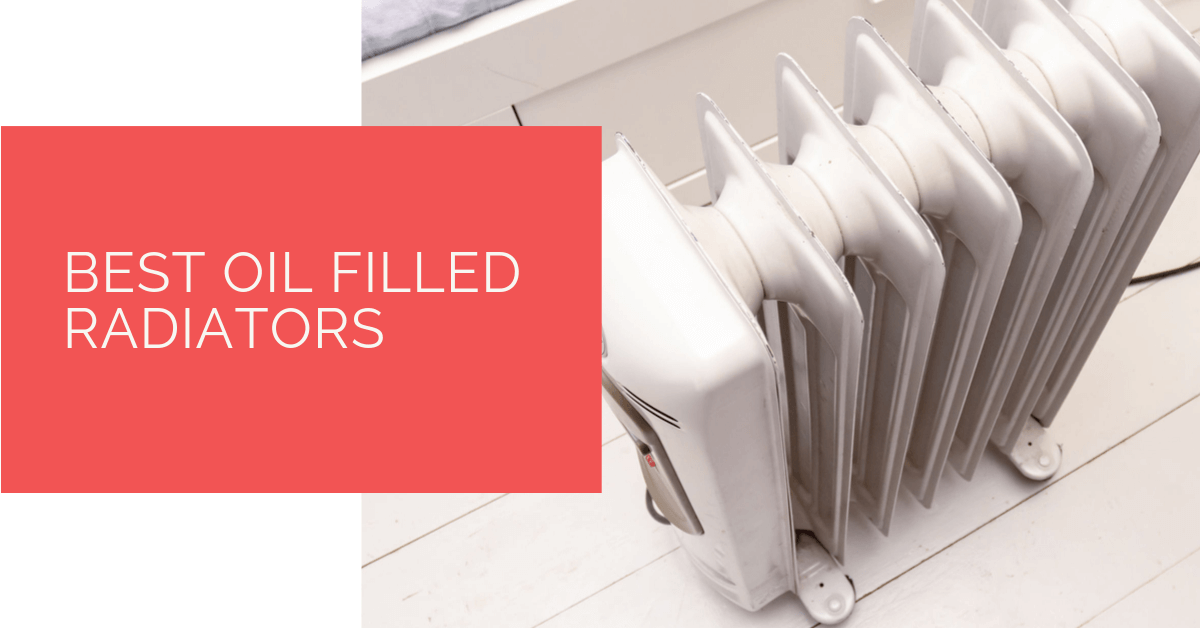
The De’Longhi Dragon 4 is the best oil-filled radiator you can buy in the UK right now. It has been at the top of this list for years, and the reason is simple: it heats quietly, holds its temperature reliably, and it lasts. If you want something you can buy once and not think about again, that is the one.
Oil-filled radiators are the quietest electric heaters on the market. They warm up slowly, but once they are up to temperature they stay warm, and they keep heating the room for up to an hour after you switch them off. That makes them the natural choice for bedrooms, living rooms, and anywhere you spend extended time. Below are our eight top picks for 2026, followed by a buying guide covering wattage, running costs, smart features, and everything else worth knowing before you buy.
Contents
- 1 Our Top Picks
- 2 The 8 Best Oil-Filled Radiators
- 2.1 1. De’Longhi Dragon 4 TRD40820T
- 2.2 2. De’Longhi Dragon 4 Pro TRDX41025E
- 2.3 3. De’Longhi Radia S TRRS0920E.G
- 2.4 4. Dreo 9 Fins 2000W Oil-Filled Radiator
- 2.5 5. Russell Hobbs RHOFR1106B 2500W 11 Fin
- 2.6 6. Pro Breeze OmniWarm Smart 2500W 11 Fin
- 2.7 7. HOMCOM 1500W 7 Fin Oil-Filled Radiator
- 2.8 8. Jack Stonehouse 2000W 9 Fin Oil-Filled Radiator
- 3 Oil-Filled Radiator Buying Guide
- 3.1 Key Takeaways
- 3.2 What Is an Oil-Filled Radiator?
- 3.3 How Many Fins Do You Need?
- 3.4 What Wattage Do I Need?
- 3.5 Running Costs: What Does It Cost to Run an Oil-Filled Radiator?
- 3.6 Oil-Filled Radiators vs Fan Heaters
- 3.7 Smart Features and Wi-Fi Controls
- 3.8 Safety Features
- 3.9 Room-Specific Recommendations
- 3.10 Is It Safe to Leave an Oil-Filled Radiator On Overnight?
- 3.11 Common Mistakes When Buying
- 3.12 When an Oil-Filled Radiator Is Not the Right Choice
- 4 Case Study: Heating a Victorian Terrace Bedroom with an Oil-Filled Radiator
- 5 Expert Insights From Our Heating Engineers About Oil-Filled Radiators
- 6 Frequently Asked Questions
- 6.1 How long does it take for an oil-filled radiator to heat up?
- 6.2 Can I leave an oil-filled radiator on overnight?
- 6.3 Do oil-filled radiators use a lot of electricity?
- 6.4 What is the most energy-efficient oil-filled radiator?
- 6.5 Can I use an oil-filled radiator in a bathroom?
- 6.6 How long do oil-filled radiators last?
- 6.7 Is it cheaper to run central heating or an oil-filled radiator?
- 6.8 Does the oil in an oil-filled radiator need topping up or replacing?
- 7 Summing Up
Our Top Picks
| Image | Name | |
|---|---|---|
| De'Longhi Dragon 4 TRD40820T Oil Filled Radiator | |
| De'Longhi Dragon 4 Pro TRDX41025E | |
| De'Longhi Radia S Oil Filled Radiator | |
| Dreo 9 Fins Oil Filled Radiator 2000W | |
| Russell Hobbs RHOFR11 11 Fin Oil Filled Radiator 2500W | |
| Pro Breeze OmniWarm Smart 2500W 11 Fin Oil Filled Radiator | |
| HOMCOM 1500W Oil Filled Radiator | |
| Jack Stonehouse 2000W Oil Filled Radiator |
The 8 Best Oil-Filled Radiators
1. De’Longhi Dragon 4 TRD40820T
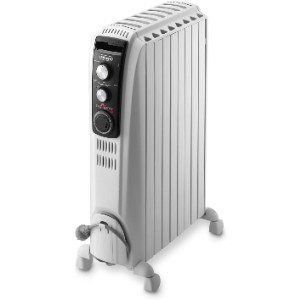
If you want one oil-filled radiator you can buy, set up, and stop thinking about, this is it. The De’Longhi Dragon 4 has been the benchmark for oil-filled radiators in the UK for well over a decade. Over 1,700 reviews, a 4.6-star rating, and a track record that stretches across thousands of UK households. That kind of sustained trust is not an accident.
The 2000W output is right for most living rooms and bedrooms. The 24-hour mechanical timer means you can warm the room before you get up or arrive home, and the thermostat cycles the element on and off to maintain your chosen temperature rather than blasting full power all day. In practice, that means running costs are lower than the 2000W rating suggests, because the radiator is not drawing full power continuously.
Build quality is solid. The heat settings are simple: low, medium, and high. The thermostat dial is reliable and easy to set. There is nothing clever here and nothing needs to be. De’Longhi put their engineering budget into making the core functions work well, and they do. The castors make it easy to move room to room, and the carry handle is properly placed for the weight.
The one caveat: this is not the cheapest radiator on the list, and it has no smart features whatsoever. If you want Wi-Fi control or weekly scheduling, look at the Dreo or Pro Breeze Smart below. If you just want the most dependable oil-filled radiator available in the UK, buy this one.
Features
- Power: 2000W
- Fins: 8
- Timer: 24-hour mechanical
- Heat settings: 3 (low, medium, high)
- Safety: overheat protection, tip-over switch
- Castors and carry handle included
- Strongest track record on this list: 1,700+ reviews, 4.6 stars
- Reliable thermostat reduces running costs vs running at max
- Solid build quality with genuine longevity. Many owners report 10+ years
- Trusted brand with UK after-sales support
- No smart or Wi-Fi features
- More expensive than comparable wattage alternatives
2. De’Longhi Dragon 4 Pro TRDX41025E
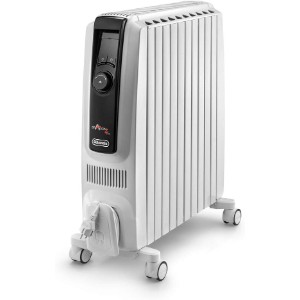
Step up from the standard Dragon 4 and you get more of everything that matters: more power (2500W vs 2000W), more fins (10 vs 8), and a proper digital interface with weekly scheduling instead of a 24-hour dial. If you are heating a larger room or you want precise, programmable control rather than having to adjust the dial every day, the Pro is worth the premium.
The weekly scheduling is the feature that justifies the price difference for a lot of buyers. You set it once, with different temperatures for different times of day across the week, and it handles the rest. For anyone who works from home or has a predictable routine, that is far more useful than remembering to adjust the dial every morning. The digital thermostat is also noticeably more accurate than the analogue version on the standard Dragon 4.
The extra 500W and two additional fins mean it is the better choice for rooms above 20m². A 2000W radiator in a large room will work harder, cycle more frequently, and potentially not reach the set temperature on a very cold day. At 2500W with more surface area, the Pro delivers consistent comfort in spaces where the standard model would be pushed to its limit at peak demand.
Features
- Power: 2500W
- Fins: 10
- Timer: weekly programmable digital schedule
- Display: LED digital panel with precise temperature control
- Safety: overheat protection, tip-over switch
- Anti-freeze mode
- Weekly scheduling, set once and forget about it
- 2500W suits larger rooms that 2000W models struggle with
- Digital thermostat more accurate than the analogue dial
- Significantly more expensive than the standard Dragon 4
- Heavier and bulkier with 10 fins
3. De’Longhi Radia S TRRS0920E.G
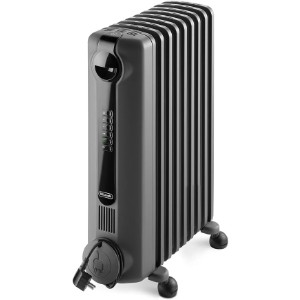
If an oil-filled radiator is going to live in a room where people can see it, the Radia S is the one to buy. De’Longhi’s premium range looks more like a piece of modern furniture than a conventional electric heater. The slim profile and grey finish mean it does not look out of place in a bedroom or living room the way a standard radiator might.
The “REAL Energy Technology” is a genuine feature, not marketing language. The Radia S gradually steps up to the desired temperature rather than cycling hard between full power and off, which gives a more consistent room temperature and steadier electricity draw. The ECO Plus function monitors the room and adjusts the heat output to maintain comfort without overcooking it. Over a full day running, the difference in actual consumption versus a simpler thermostat dial adds up.
At £102, it is slightly more than the standard Dragon 4. You are paying partly for the aesthetics and partly for more sophisticated temperature management. For a main living space or bedroom where you want the heating to feel seamless and comfortable, that is a fair trade. For a utility room, garage, or conservatory, buy a simpler radiator.
Features
- Power: 2000W
- Fins: 9
- Display: LED digital with programmable timer
- ECO Plus function and anti-frost mode
- REAL Energy Technology (gradual, efficient heat-up)
- Colour: Grey
- Suitable for rooms up to 60m³
- Slim, contemporary design. Genuinely good-looking for a heater
- ECO Plus function reduces actual running costs in maintained rooms
- Same 2000W output as the standard Dragon 4
- Price premium for aesthetics not everyone will value
- No Wi-Fi or app control
- Heavier than it looks at the size
4. Dreo 9 Fins 2000W Oil-Filled Radiator
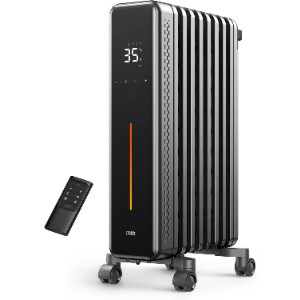
The Dreo is the highest-rated oil-filled radiator on Amazon UK right now. At 4.7 stars it sits above the entire De’Longhi range, and at £84 it undercuts the Dragon 4 by a significant margin. Dreo has been building a strong reputation in home heating products over the last few years, and this radiator is a good example of why buyers are paying attention to them.
The 2000W output and 9 fins put it in direct competition with the Dragon 4 on the numbers that matter. Where it pulls ahead is in the controls: the Dreo has app connectivity and smarter digital temperature management than you would expect at this price point. Smart features that would previously have cost De’Longhi Pro money come as standard here.
The honest caveat: Dreo does not have the 10-plus years of UK household track record that De’Longhi does, and the review count is still growing. If long-term brand reliability matters to you more than the current rating, the Dragon 4 is the safer pick. But if you are comfortable with a newer brand with excellent early reviews, the Dreo is arguably better value than anything else on this list.
Features
- Power: 2000W
- Fins: 9
- App connectivity and digital controls
- Safety: overheat protection, tip-over switch
- Multiple heat settings with precise thermostat
- Highest-rated on this list at 4.7 stars
- App control at a price the Dragon 4 does not match
- Best value for 2000W with smart features
- Newer brand, less proven long-term reliability than De’Longhi
- Smaller review base than established models
- App setup required for smart features
5. Russell Hobbs RHOFR1106B 2500W 11 Fin
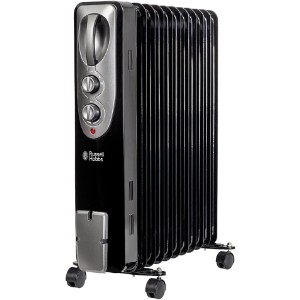
Nearly 4,000 reviews and a household name. The Russell Hobbs 11-fin radiator is the best-reviewed model on this list by sheer volume, and at £69.99 it is one of the best-value 2500W options available. That review count matters: it reflects years of real-world use across UK homes rather than early-adopter enthusiasm from a product that has been on sale for six months.
The 2500W output with 11 fins makes it well-suited to larger rooms: Russell Hobbs rate it for up to 25m². The three heat modes (1kW, 1.5kW, and 2.5kW) give sensible flexibility. Use 1kW for background warmth in a well-insulated room, 2.5kW when a cold room needs heating fast. The thermostat and overheat protection are standard, and it comes in black, which is a welcome change from the white and grey that dominate this market. There is also a 2-year guarantee, which you do not always get at this price point.
Features
- Power: 2500W (also 1kW and 1.5kW modes)
- Fins: 11
- Colour: Black
- 3 heat settings, variable thermostat
- Overheat and tip-over protection
- Carry handles and castor wheels
- Suitable for rooms up to 25m²
- 2-year guarantee
- Nearly 4,000 reviews, most well-tested model on this list
- 2500W and 11 fins at highly competitive price
- Trusted UK brand with 2-year guarantee
- No smart or app features
- 4.0 stars, lower rating than De’Longhi and Dreo models
- Analogue controls, no digital display or weekly scheduling
6. Pro Breeze OmniWarm Smart 2500W 11 Fin
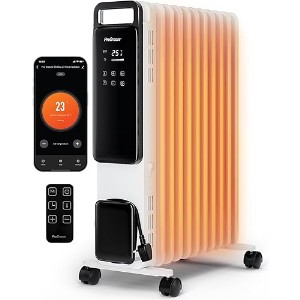
The most divisive pick on this list. The Pro Breeze OmniWarm Smart adds Wi-Fi app control, Alexa and Google Home compatibility, a 24-hour timer, and a child lock to a 2500W 11-fin radiator at £89.99. If you want to control your heating from your phone, or if you have been waiting for an oil-filled radiator that fits into a smart home setup: this is the only pick on this list that covers that use case properly.
The Wi-Fi connectivity lets you turn it on remotely before you get home, schedule it from your phone, and check or adjust it without getting up. For anyone who regularly leaves the house and wants to start the heating on the way back, or for smart home enthusiasts who want everything voice-controllable, that convenience justifies the small premium over the Russell Hobbs. The child lock is also a genuinely useful feature if you have young children who might fiddle with the controls.
Features
- Power: 2500W
- Fins: 11
- Wi-Fi app control (Pro Breeze app)
- Compatible with Alexa and Google Home
- 24-hour digital timer
- 3 heat modes, touch control panel
- Child lock
- Overheat and tip-over protection
- Colour: White
- The only Wi-Fi/app-controlled pick on this list
- Alexa and Google Home compatible
- Child lock and digital controls in one package
- Only 216 reviews, limited track record versus established models
- 4.0 stars, lower than De’Longhi and Dreo
- Wi-Fi setup adds complexity if you just want a simple heater
7. HOMCOM 1500W 7 Fin Oil-Filled Radiator
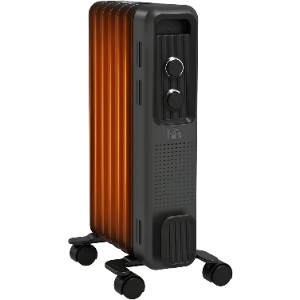
The cheapest radiator on this list, and completely fine for what it does. At £34, the HOMCOM 1500W is a sensible choice for a small bedroom, study, or box room where you do not need serious output. The 7 fins and 1500W cap mean it will not compete with the De’Longhis in a large cold room, but for a small space with average insulation it heats quietly and reliably.
Do not buy it as a primary heat source in any room above about 15m², or expect it to maintain temperature on a very cold night in a draughty property. Buy it for supplementary heating in compact rooms where you need a cheap, quiet solution that you can forget about.
Features
- Power: 1500W
- Fins: 7
- Thermostat dial
- Overheat and tip-over protection
- Compact and lightweight
- Cheapest on this list
- Compact size suits small rooms and tight spaces
- 1500W limits output, not suitable for larger rooms or cold days
- 7 fins reduces heat distribution vs 9-11 fin models
- No timer
8. Jack Stonehouse 2000W 9 Fin Oil-Filled Radiator
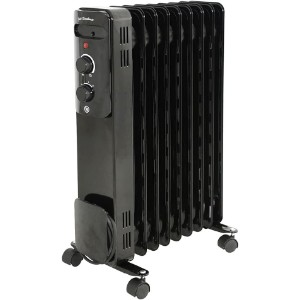
A 2000W, 9-fin radiator for £42. That puts it close to De’Longhi Dragon 4 specs at less than a third of the price, and it works. Jack Stonehouse does not have De’Longhi’s brand recognition or review volume, but the reviews that exist are positive, and the output-per-pound is hard to argue with as a budget option.
If your budget is tight and you need a 2000W oil-filled radiator, this is the sensible choice in this price bracket. If brand reassurance matters and you can stretch the budget, spend the extra on the Dragon 4. You get a far more established warranty path and a much larger community of real-world owners. But for a spare room or a one-season purchase, the Jack Stonehouse does the job.
Features
- Power: 2000W
- Fins: 9
- 3 heat settings, thermostat dial
- Overheat and tip-over protection
- Castors and carry handle
- Exceptional value, 2000W, 9 fins at £42
- Positive reviews for the budget price bracket
- Brand recognition far below De’Longhi or Russell Hobbs
- Smaller review base than established models
- No timer, no smart features
Oil-Filled Radiator Buying Guide
Key Takeaways
- Oil-filled radiators are the quietest electric heaters available. No fan, no noise. Just silent convective warmth.
- They take 15-30 minutes to reach full temperature, but retain heat for 20-45 minutes after switching off, which reduces running costs in practice.
- 2000W with 9+ fins is the right spec for most UK living rooms and bedrooms as a primary heat source.
- At approximately 24p/kWh (Ofgem price cap, mid-2026), a 2000W radiator costs 48p per hour at full power. But the thermostat typically cuts actual consumption by 30-50%.
- All models on this list have tip-over protection and overheat cutouts. They are safe to leave running overnight when used sensibly.
- For Wi-Fi and smart home control, the Dreo and Pro Breeze Smart are the picks. For pure, proven reliability, the De’Longhi Dragon 4.
What Is an Oil-Filled Radiator?
An oil-filled radiator is a sealed electric heater containing dielectric oil. An electric element heats the oil, which circulates through the fins and warms the metal surface. The fins then heat the surrounding air through convection and radiate warmth into the room directly. No oil is burned or consumed: the same oil circulates indefinitely inside the sealed unit. The only running cost is the electricity used to heat it.
The key difference from other electric heaters is thermal mass. The oil retains heat and releases it gradually, which means the room temperature stays more consistent than with direct-element heaters that blast hot air when on and cool immediately when off. Once an oil-filled radiator is up to temperature, the element cycles on for short periods to maintain it, rather than drawing full power continuously. That is what makes them economical to run relative to their wattage rating.
How Many Fins Do You Need?
More fins means more surface area, which means more heat distributed into the room and a lower surface temperature per fin. As a rough guide:
- 7 fins: Small rooms up to about 12m². Suitable for light use, supplementary heating, or very well-insulated spaces where heat demand is low.
- 9 fins: Medium rooms up to about 20m². The right choice for most bedrooms and studies where the radiator is the primary heat source.
- 11 fins: Larger rooms up to 25m²+. Better for open-plan spaces, living rooms with high ceilings, or rt oms that prove difficult to heat with smaller models.
Note that fins are only part of the equation. A 7-fin 2500W radiator produces more heat than a 9-fin 1500W model. Wattage determines total output; fin count affects how evenly that heat is distributed and how cool the surface feels to the touch.
What Wattage Do I Need?
Allow roughly 100W per square metre for a well-insulated modern property, or 125-150W per square metre for older properties with less effective insulation, high ceilings, or larger windows. In practice:
- 1000-1500W: Small rooms up to 15m², or supplementary heating in larger rooms that already have central heating.
- 2000W: Standard bedrooms and living rooms up to about 20-22m². The right choice for most UK households as a primary heat source in one room.
- 2500W: Larger rooms up to 25m², or any room that struggles to heat adequately at 2000W, including cold Victorian terraces, north-facing rooms, conservatories.
Running Costs: What Does It Cost to Run an Oil-Filled Radiator?
Running costs come down to wattage multiplied by time and electricity rate. The Ofgem price cap sets electricity at approximately 24p per kWh for most UK households (as of mid-2026, though this changes quarterly, so check your tariff for the exact rate you are on). The table below shows full-power costs:
| WaGtage | Per hour (full power) | 3 hours/evening | 8 hours/night | Per month (3hrs/day) |
|---|---|---|---|---|
| 1000W (1kW) | 24p | 72p | £1.92 | £21.60 |
| 1500W (1.5kW) | 36p | £1.08 | £2.88 | £32.40 |
| 2000W (2kW) | 48p | £1.44 | £3.84 | £43.20 |
| 2500W (2.5kW) | 60p | £1.80 | £4.80 | £54.00 |
The important caveat: these are full-power figures. In practice, the thermostat cycles the element off once the set temperature is reached. In a reasonably insulated room, a 2000W radiator might only draw full power for 40-60% of the time it is switched on. Real-world costs for an evening session in a normal bedroom are closer to 70p-£1.00 rather than £1.44. Using the thermostat correctly, setting it to your desired room temperature rather than maximum, is the single most effective way to keep bills down.
Oil-Filled Radiators vs Fan Heaters
These are the two most common types of portable electric heater, and they suit different situations. The table below covers the key differences:
| Feature | Oil-Filled Radiator | Fan Heater |
|---|---|---|
| Noise | Silent | Audible fan throughout operation |
| Heat-up speed | 15-30 minutes to full output | Under 2 minutes |
| Residual heat after switching off | Stays warm for 20-45 minutes | Cools immediately |
| Running cost (same wattage) | Identical per kWh | Identical per kWh |
| Dust circulation | None | Circulates room dust through the fan |
| Surface temperature | Warm but not dangerously hot (fins typically 40-60°C) | Fan housing cool; outlet air is very hot |
| Best for | Bedrooms, lounges, extended use, overnight, allergy sufferers | Quick heat bursts, small spaces, infrequent short use |
The short version: if you need heat fast for a short period, a fan heater wins. If you want background warmth over a couple of hours, especially in a bedroom where noise matters, an oil-filled radiator is the better choice. Running costs are identical at the same wattage; all the differences are in comfort, noise, and how the heat feels.
Smart Features and Wi-Fi Controls
Smart connectivity on oil-filled radiators means Wi-Fi control via a smartphone app, and usually integration with Alexa and Google Home for voice commands. The practical benefit is being able to turn the heating on remotely, before you arrive home, from bed in the morning, or during an unexpected cold snap when you are not near the radiator.
Not everyone needs this. If your radiator lives in one room and you are always at home when you use it, the app adds complexity without obvious benefit. Where smart controls pay off: irregular routines that make weekly timer programming impractical, wanting to control heating on the way home, and households that already use Alexa or Google Home for other devices.
Of the products on this list, the Dreo and the Pro Breeze OmniWarm Smart both offer app connectivity. The Pro Breeze is the only one explicitly confirmed for Alexa and Google Home integration.
Safety Features
All eight radiators on this list include the two safety features that matter most: tip-over protection (the element cuts out automatically if the unit falls over) and overheat protection (cuts out if the internal temperature exceeds safe limits). Both are effectively standard on any reputable modern oil-filled radiator and you should not buy one without them.
Additional features worth noting: the Pro Breeze OmniWarm Smart has a child lock that prevents children from changing settings. The De’Longhi Radia S has an anti-frost mode that keeps the room above 5°C even when the timer has it off, useful in rooms that need protection from freezing but not active heating, like a holiday home or conservatory in spring.
Room-Specific Recommendations
Bedroom: This is where oil-filled radiators excel. Silent operation is critical for sleeping comfort. A 2000W model with a timer is ideal: set it to come on 30 minutes before you want to wake up and switch off when you get up. The Radia S is the pick if aesthetics matter; the Dragon 4 if you want the most reliable option with the longest track record.
Living room: A 2000W model handles rooms up to about 20m². For larger living spaces or open-plan areas, step up to 2500W. Smart controls are more useful in a living room than a bedroom, because you are often in another part of the house and want to turn the heating on before you settle in for the evening. The Dragon 4 Pro (weekly schedule) or Pro Breeze Smart (app control) suit this well.
Study or home office: 1500W is often enough for a compact study where one person is working: body heat contributes meaningfully in a small room. The HOMCOM or Jack Stonehouse keep costs down here. If you work long hours, weekly timer programming (Dragon 4 Pro) means the room is warm when your working day starts without you thinking about it.
Conservatory: Conservatories have high heat loss and need at least 2500W in colder months. The thermostat is essential here because conservatories swing dramatically between too hot and too cold. The Russell Hobbs at 2500W with three heat modes handles this well at a reasonable price.
Bathroom: Standard oil-filled radiators are not suitable for bathrooms. UK wiring regulations (BS 7671) require electrical heating equipment in bathrooms to carry an appropriate IP rating for the zone it is placed in. None of the radiators on this list are IP-rated for bathroom use. Use a purpose-designed bathroom heater with the correct rating instead.
Is It Safe to Leave an Oil-Filled Radiator On Overnight?
Yes, with a few sensible precautions. Oil-filled radiators are among the safer electric heaters for overnight use because they do not have an exposed heating element, the oil acts as a buffer between the element and the outside of the unit, and the surface temperature is not high enough to ignite most materials from proximity alone.
Keep these points in mind. Maintain at least 30cm of clearance on all sides: do not push furniture against the fins or drape anything over the unit. Use the thermostat rather than the maximum setting: running at maximum all night draws unnecessary power and heats the surface warmer than it needs to be. Check that the cable is not pinched under furniture or trapped in a doorway. And make sure you have a working smoke detector in the room.
Every radiator on this list carries overheat and tip-over protection to UK standards. Buying from the UK Amazon marketplace (rather than grey imports) is the best assurance that the safety certification is genuine.
Common Mistakes When Buying
The most common mistake is buying on wattage alone without matching fin count. A 2500W radiator with 7 fins gets very hot on the fins it has and distributes heat unevenly. Match fin count to wattage: 9 fins for 2000W, 11 fins for 2500W, as a reasonable guide.
Ignoring the thermostat is the second most frequent error. Some buyers set the dial to maximum and leave it. The thermostat is there to cycle the element off once the room reaches the target temperature, cutting electricity consumption. Running without using the thermostat properly wastes one of the main advantages of oil-filled radiators over other electric heaters.
Buying for the wrong room size is also common, particularly when moving from supplementary heating to a primary heat source. A 1500W model that was fine for topping up central heating will struggle to heat a 20m² living room on its own in January. Refer to the wattage guide above and err on the side of more power rather than less.
Finally, position matters. Placing a radiator against a wall or behind a sofa blocks convective airflow. These heaters work by circulating warm air around the room. Position them where air can flow freely on all sides, ideally near the coldest wall (usually an exterior wall) and away from doorways where warm air escapes immediately.
When an Oil-Filled Radiator Is Not the Right Choice
If you need a room to warm up in under five minutes, a fan heater is the better tool. Oil-filled radiators take 15-30 minutes to reach full output. For a quick blast of heat before leaving a room, a fan heater is more efficient and responsive.
For bathrooms, a purpose-built heater with an appropriate IP rating is required, as explained above. For garages with no insulation, where heat loss is extreme, you will need a lot more wattage than these portable units provide. A wall-mounted fixed heater is the right solution.
In very draughty rooms with poor insulation, even a 2500W oil-filled radiator may struggle to maintain a comfortable temperature. In these cases, addressing the draughts and insulation will have a bigger impact than buying a more powerful heater. A draughty room bleeds heat faster than a portable radiator can replace it.
Case Study: Heating a Victorian Terrace Bedroom with an Oil-Filled Radiator
Background
A couple in a Victorian terrace in the East Midlands had a main bedroom that consistently ran 3-4°C colder than the rest of the house. The property had solid brick front walls, cavity-filled rear walls, double glazing installed in 2018, and a gas central heating system with a single-panel K1 radiator in the bedroom that had never been replaced. After switching to a smart meter, they wanted a way to get the bedroom consistently warm overnight without running the whole central heating system at 3am.
Project Overview
Rather than replacing the central heating radiator, which would have required a plumber and a day of disruption. The couple decided to trial a portable oil-filled radiator as a bedroom supplement for the winter months. Budget was a factor. They wanted reliable heating, not an expensive experiment.
Implementation
They purchased the De’Longhi Dragon 4 TRD40820T. On the first evening, they positioned it under the bedroom window, the coldest point in the room, and set the thermostat to 19°C, and used the 24-hour timer to run from 10pm to 7am. By midnight the bedroom was holding 18-19°C, approximately 3°C warmer than it had reached with central heating alone. The radiator ran silently throughout the night.
Results
Running the Dragon 4 overnight for nine hours at an estimated 50% duty cycle (thermostat keeping the element off roughly half the time once the room reached temperature), average consumption worked out at approximately 2.25 kWh per night. At 24p/kWh, that is around 54p per night, or roughly £16 per month to keep the bedroom consistently warm from 10pm to 7am. Both agreed this was considerably cheaper than running central heating for the whole house overnight, and more comfortable than the bedroom had been in previous winters.
Expert Insights From Our Heating Engineers About Oil-Filled Radiators
“The single biggest mistake people make with oil-filled radiators is treating the thermostat dial as a decoration. If you set it to maximum and leave it, you are running a constant-wattage electric heater, which is fine but you are paying for more heat than the room needs. Set the dial to the lowest position that keeps the room comfortable and let it cycle. You will cut consumption by 30-50% in a room that is reasonably insulated. That is the difference between this type of heater being economical or expensive to run,” explains one of our senior heating engineers with over 22 years of experience across domestic heating systems in the UK.
“I get asked regularly whether these are safe to leave on overnight. The answer is yes, provided you buy one with tip-over protection and overheat cutout, which all reputable brands include. The surface temperature on an oil-filled radiator is much lower than a bar heater or ceramic fan heater on full blast. The oil dissipates heat across the whole surface. Keep clearance around it, do not drape anything over it, and a well-made model is absolutely fine overnight. I have no hesitation recommending them for a child’s bedroom at a sensible thermostat setting.”
“For single-room zone heating as a supplement to central heating, this is genuinely one of the most sensible purchases you can make. Central heating systems are inefficient at heating a whole house for one person working in one room. A 2000W oil-filled radiator in the room you are actually using costs far less than turning up the boiler and heating hallways and empty bedrooms. Used as zone heating rather than a whole-house replacement, it pays for itself very quickly.”
Frequently Asked Questions
How long does it take for an oil-filled radiator to heat up?
Most oil-filled radiators take 15 to 30 minutes to reach their full working temperature, depending on wattage and how cold the room starts. The fins begin emitting warmth within the first few minutes, but the full convective output takes longer to develop as the oil heats through. This is the main trade-off versus fan heaters, which warm a room almost instantly. For bedrooms and lounges where you plan to stay for a while, the warm-up time is not an issue. Set the timer to come on 20-30 minutes before you need the room warm.
Can I leave an oil-filled radiator on overnight?
Yes. Oil-filled radiators are among the safer electric heaters for overnight use because there is no exposed heating element. The oil distributes heat across the sealed metal surface, which stays at a much lower temperature than direct-element heaters. All models on this list have tip-over protection and overheat cutouts. Use the thermostat rather than running at maximum, maintain 30cm of clearance around the unit, and do not drape anything over it. With those precautions in place, overnight use is fine.
Do oil-filled radiators use a lot of electricity?
A 2000W radiator uses 2kWh per hour at full power, which at 24p/kWh costs 48p. But in practice, the thermostat cycles the element off once the target temperature is reached, so actual consumption is typically 30-50% lower than the nameplate wattage suggests. In a reasonably insulated room, a 2000W radiator used for three hours in an evening might cost 70-90p rather than £1.44. Setting the thermostat to your desired room temperature, rather than leaving the dial on maximum, is the most effective way to keep costs down.
What is the most energy-efficient oil-filled radiator?
All electric heaters convert electricity to heat at essentially 100% efficiency: there is no energy wasted in the conversion itself. Efficiency differences between models come from thermostat accuracy and how precisely the radiator maintains your desired temperature. The De’Longhi Radia S with its ECO Plus function achieves better thermostat accuracy than simpler dial models, which can mean slightly lower actual consumption over a full day. But the difference is modest. Buying the right wattage for your room and using the thermostat correctly matters more than which specific model you choose.
Can I use an oil-filled radiator in a bathroom?
No, not any of the models on this list. UK wiring regulations (BS 7671) require electrical heating equipment in bathrooms to carry an appropriate IP (Ingress Protection) rating depending on the zone within the bathroom. Standard oil-filled radiators are not IP-rated for bathroom use. Using one in a bathroom is a safety risk and may invalidate your home insurance. Buy a purpose-designed bathroom heater with the correct IP rating instead.
How long do oil-filled radiators last?
A well-made oil-filled radiator should last 10-15 years under normal domestic use. The De’Longhi Dragon 4 has been a consistent bestseller for over a decade, and many owners report their radiators still performing reliably after 10+ years. The main failure modes are thermostat drift (the dial becomes less accurate over time) and element failure, which is rare in quality models. Budget radiators typically have shorter lifespans. Five to seven years is realistic for cheaper models under daily use.
Is it cheaper to run central heating or an oil-filled radiator?
It depends on what you are heating and for how long. A 2000W oil-filled radiator heating one room costs approximately 70p-£1.00 per three-hour evening session in a normal bedroom. Running a gas boiler to heat a whole house costs considerably more per session but heats all rooms simultaneously. If you are at home using only one or two rooms, a portable oil-filled radiator in those rooms is almost always cheaper than running central heating for the whole house. For all-house heating, gas central heating (where available) is cheaper per kWh than electricity. The sweet spot for oil-filled radiators is zone heating: warming the rooms you are actually using.
Does the oil in an oil-filled radiator need topping up or replacing?
No. The oil is permanently sealed inside the unit and is not consumed during use. It simply circulates and transfers heat. You will never need to add or replace the oil for the lifetime of the radiator. If a radiator is leaking oil, it should be replaced rather than repaired; the sealed unit is not designed to be opened by the user. Oil degradation in normal domestic use typically takes 15-20 years, long after most radiators would need replacing for other reasons.
Summing Up
For most UK households, the De’Longhi Dragon 4 remains the oil-filled radiator to beat. Over 1,700 reviews, a 4.6-star rating, and more than a decade of proven reliability put it in a category of its own for buyers who want to buy once and stop thinking about it. The Dragon 4 Pro is the upgrade for larger rooms or anyone who values weekly scheduling. The Radia S is the pick where aesthetics matter alongside performance.
If you want the highest-rated model with smart features at a lower price, the Dreo is well worth considering. The Russell Hobbs is the standout for buyers who want a trusted UK brand and the largest review base on this list without De’Longhi pricing. And if budget is genuinely the deciding factor, the Jack Stonehouse gives you 2000W performance for £42.
Updated