

For most UK buyers, the Airthings View Plus is the best air quality monitor to buy. It offers the strongest mix of practical performance, value and usability in a category where the right choice depends heavily on your room, budget and expectations.
The best air quality monitor is the one that measures the pollutants you can actually act on: PM2.5, CO2, VOCs, humidity, temperature, and radon where relevant.
Contents
- 1 Our Top Picks
- 2 6 Best Air Quality Monitors
- 3 Air Quality Monitors Buying Guide
- 3.1 Key Takeaways
- 3.2 PM2.5, VOCs, CO2, and Radon: Which Pollutants Should You Actually Monitor?
- 3.3 Display vs. App-Only: Which Tells You More in Real Time?
- 3.4 How Accurate Are Consumer Air Quality Monitors Really?
- 3.5 CO2 Monitors vs. Full-Spectrum Air Quality Monitors: Understanding the Difference
- 3.6 Portable vs. Fixed Monitors: When to Use Each
- 3.7 WiFi and Smart Home Integration: Do You Actually Need It?
- 3.8 Battery Life, Power, and Placement Practicalities
- 3.9 Price Tiers: What You Actually Get at Each Level
- 3.10 Quick Decision Guide
- 4 Case Study: Improving Comfort in a UK Home
- 5 Expert Insights From Our Heating Engineers About Air Quality Monitors
- 6 Frequently Asked Questions
- 7 Summing Up
Our Top Picks
| Image | Name | |
|---|---|---|
| Airthings View Plus | |
| Airthings Wave Plus | |
| Temtop M10+ 6-in-1 Air Quality Monitor | |
| Temtop CO2 Monitor | |
| Airthings Wave Mini | |
| Airthings Corentium Home Radon Detector |
6 Best Air Quality Monitors
1. Airthings View Plus
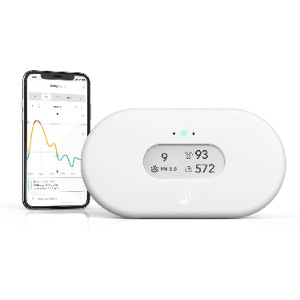
The View Plus is the strongest choice if you want a serious indoor air picture rather than a simple CO2 alarm. It covers the big home metrics and adds radon, which many cheaper monitors ignore. The e-ink display is easy to read, and Wi-Fi/app support makes it better for trends than a monitor you only glance at occasionally.
It is not cheap, but it is the most complete pick for people who want useful long-term data. Airthings View Plus should be treated as a decision tool, not a decorative display. The value comes from linking readings to action: opening a window, using an extractor, running a purifier, reducing moisture or investigating a specific risk such as radon. A monitor that shows useful trends can quickly change how you use a room, especially if you have never measured CO2, humidity or particles before.
The best monitor for you depends on what you are trying to understand. A CO2-focused monitor is brilliant for ventilation but weak for smoke particles. A radon detector is useful for long-term property risk but tells you little about cooking pollution. A multi-sensor monitor gives a broader picture, but the data can feel overwhelming if you do not know what to do with it, so choose based on the readings you will actually act on.
Features
- Radon monitoring
- PM2.5 sensor
- CO2 and VOC sensors
- Humidity and temperature
- Air pressure
- Wi-Fi and app support
- Most complete sensor set
- Good for long-term trends
- Includes radon
- Expensive
- More data than some users need
2. Airthings Wave Plus
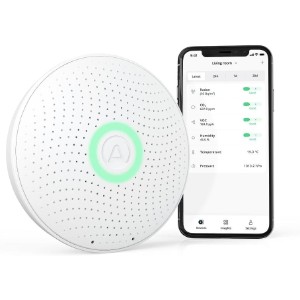
The Wave Plus is a sensible choice if radon is high on your list but you do not need PM2.5 monitoring built in. It is a strong long-term home-health monitor. Airthings Wave Plus should be treated as a decision tool, not a decorative display. The value comes from linking readings to action: opening a window, using an extractor, running a purifier, reducing moisture or investigating a specific risk such as radon. A monitor that shows useful trends can quickly change how you use a room, especially if you have never measured CO2, humidity or particles before.
The wave-to-check light system is simple, but the real value is in the app data over time. Radon and ventilation issues are rarely understood from a single reading. Choose the View Plus if you want PM2.5 as well. Choose this if radon, CO2 and VOCs are your main concerns. The best monitor for you depends on what you are trying to understand. A CO2-focused monitor is brilliant for ventilation but weak for smoke particles. A radon detector is useful for long-term property risk but tells you little about cooking pollution. A multi-sensor monitor gives a broader picture, but the data can feel overwhelming if you do not know what to do with it, so choose based on the readings you will actually act on.
Features
- Radon sensor
- CO2 monitoring
- VOC monitoring
- Humidity and temperature
- Air pressure
- App support
- Excellent radon choice
- Strong review base
- Useful app trends
- No PM2.5 sensor
- Needs time for meaningful radon averages
3. Temtop M10+ 6-in-1 Air Quality Monitor
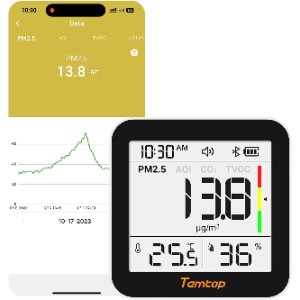
The Temtop M10+ is the practical middle ground. It measures the everyday indoor issues most people want to track, especially particles, CO2 and VOCs. It works well for spotting cooking pollution, poor ventilation and humidity swings. That makes it useful alongside an air purifier or dehumidifier.
It does not have the same radon focus as Airthings, but not every home needs that in the main monitor. Temtop M10+ 6-in-1 Air Quality Monitor should be treated as a decision tool, not a decorative display. The value comes from linking readings to action: opening a window, using an extractor, running a purifier, reducing moisture or investigating a specific risk such as radon. A monitor that shows useful trends can quickly change how you use a room, especially if you have never measured CO2, humidity or particles before.
The best monitor for you depends on what you are trying to understand. A CO2-focused monitor is brilliant for ventilation but weak for smoke particles. A radon detector is useful for long-term property risk but tells you little about cooking pollution. A multi-sensor monitor gives a broader picture, but the data can feel overwhelming if you do not know what to do with it, so choose based on the readings you will actually act on. For most homes, trends matter more than single readings. You are looking for patterns: a bedroom that climbs overnight, a kitchen that spikes after frying, a damp room that stays humid, or a workspace that feels stuffy by mid-afternoon. That makes placement and regular use just as important as the sensor list on the box.
Features
- PM2.5 monitoring
- CO2 sensor
- VOC sensor
- Temperature and humidity
- App support
- Portable design
- Good everyday sensor mix
- More affordable than premium radon monitors
- Useful for purifier checks
- No radon monitoring
- VOC readings are broad rather than compound-specific
4. Temtop CO2 Monitor
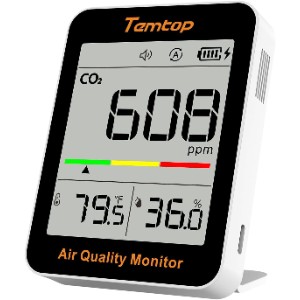
This is the monitor to buy if your main question is simple: is this room well ventilated? CO2 is a useful proxy for stale indoor air in occupied rooms.
It is especially useful in home offices, bedrooms and small rooms where people feel tired or stuffy after a few hours. It will not tell you everything about air quality. Pair it with a PM2.5 monitor or purifier data if particles are the issue. Temtop CO2 Monitor should be treated as a decision tool, not a decorative display. The value comes from linking readings to action: opening a window, using an extractor, running a purifier, reducing moisture or investigating a specific risk such as radon. A monitor that shows useful trends can quickly change how you use a room, especially if you have never measured CO2, humidity or particles before.
The best monitor for you depends on what you are trying to understand. A CO2-focused monitor is brilliant for ventilation but weak for smoke particles. A radon detector is useful for long-term property risk but tells you little about cooking pollution. A multi-sensor monitor gives a broader picture, but the data can feel overwhelming if you do not know what to do with it, so choose based on the readings you will actually act on.
Features
- CO2 monitoring
- Temperature and humidity
- 400 to 5000 ppm range
- Rechargeable battery
- Alarm function
- Portable body
- Good ventilation check
- Simple display
- Portable
- No PM2.5 or VOC readings
- Limited if you want full air-quality tracking
5. Airthings Wave Mini
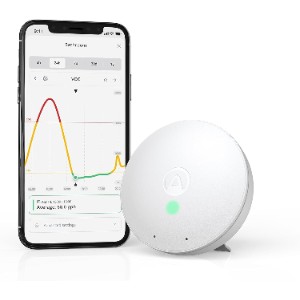
The Wave Mini is not trying to be a full air quality lab. It is a small room monitor that helps you keep an eye on humidity, VOCs and mould risk. That makes it useful in wardrobes, bedrooms, spare rooms and homes where condensation appears in corners. It is not the right choice if you want CO2, PM2.5 or radon. It is best as a focused second monitor.
Airthings Wave Mini should be treated as a decision tool, not a decorative display. The value comes from linking readings to action: opening a window, using an extractor, running a purifier, reducing moisture or investigating a specific risk such as radon. A monitor that shows useful trends can quickly change how you use a room, especially if you have never measured CO2, humidity or particles before. The best monitor for you depends on what you are trying to understand. A CO2-focused monitor is brilliant for ventilation but weak for smoke particles. A radon detector is useful for long-term property risk but tells you little about cooking pollution. A multi-sensor monitor gives a broader picture, but the data can feel overwhelming if you do not know what to do with it, so choose based on the readings you will actually act on.
Features
- VOC monitoring
- Humidity and temperature
- Mould-risk indication
- Compact body
- App support
- Battery powered
- Good for damp-prone rooms
- Small and simple
- Useful mould-risk prompts
- No CO2, PM2.5 or radon
- Best as a secondary monitor
6. Airthings Corentium Home Radon Detector
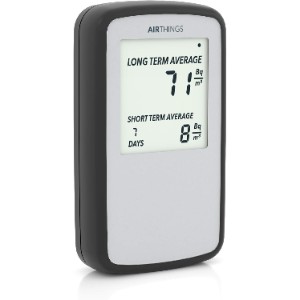
This is a specialist, and that is its strength. If you only want continuous radon tracking, the Corentium avoids app clutter and multi-sensor compromise. Radon should be judged over time, not from a single spot reading. A dedicated detector makes that easier for households in higher-risk areas.
It is not a general air quality monitor, so do not buy it for cooking particles, CO2 or humidity problems. Airthings Corentium Home Radon Detector should be treated as a decision tool, not a decorative display. The value comes from linking readings to action: opening a window, using an extractor, running a purifier, reducing moisture or investigating a specific risk such as radon. A monitor that shows useful trends can quickly change how you use a room, especially if you have never measured CO2, humidity or particles before.
The best monitor for you depends on what you are trying to understand. A CO2-focused monitor is brilliant for ventilation but weak for smoke particles. A radon detector is useful for long-term property risk but tells you little about cooking pollution. A multi-sensor monitor gives a broader picture, but the data can feel overwhelming if you do not know what to do with it, so choose based on the readings you will actually act on.
Features
- Continuous radon monitoring
- Portable display
- Short and long-term averages
- No lab fees
- Battery powered
- Simple setup
- Excellent dedicated radon option
- No subscription or lab return needed
- Clear readings
- Radon only
- Not a full indoor air monitor
Air Quality Monitors Buying Guide
Key Takeaways
- PM2.5, VOCs, and CO2 are the most important pollutants to monitor indoors; radon matters more if you live in a high-risk area such as parts of Scotland, Cornwall, Devon, or Wales
- Display monitors cost more but give you instant readings without a smartphone; app-only models are cheaper but require a device nearby for detailed data
- Accuracy varies significantly between budget and premium monitors; expect to pay £150+ for reliable, consistent measurement
- WiFi connectivity lets you get alerts from anywhere, but battery-powered models are simpler to install and position
- iPhone users may want HomeKit-compatible monitors like Eve Room; Alexa users benefit from Amazon’s Smart Air Quality Monitor
- Budget options like IKEA VINDSTYRKA cost under £50 but only monitor basic pollutants and VOCs
- Premium models like Airthings View Plus (£250+) monitor radon and can act as a hub for other smart home sensors
- A full-spectrum monitor is almost always worth more than a single-pollutant device, as different sources produce different types of pollution
PM2.5, VOCs, CO2, and Radon: Which Pollutants Should You Actually Monitor?
Indoor air quality monitors track different combinations of contaminants, and not all of them matter equally for your home. Particulate matter (PM2.5) refers to tiny particles from vehicle pollution, diesel engines, cooking, candles, and wood burning that your eyes can’t see but your lungs absorb. Volatile organic compounds (VOCs) are chemical off-gassing from paint, new furniture, cleaning products, and carpets. Carbon dioxide (CO2) builds up in poorly ventilated rooms and makes you feel tired, unfocused, and headachy. Humidity and temperature affect how comfortable your space feels and whether mould will grow on cold surfaces.
Most people should prioritise PM2.5 and VOCs as the non-negotiables. CO2 matters if you spend long hours in one room without opening windows, particularly relevant for home offices since the pandemic. Radon is only important if you live in a higher-risk area: parts of Scotland, Cornwall, Devon, and Wales have naturally elevated radon levels due to underlying granite geology. Temperature and humidity tracking are useful bonuses because they help you spot damp and mould risk before it becomes visible on walls and ceilings.
Display vs. App-Only: Which Tells You More in Real Time?
Monitors with a built-in screen show you air quality instantly without opening an app. This matters if you want quick feedback: you walk into a room, glance at the display, and know immediately whether the air needs improving. Airthings View Plus, for example, has a 2.9-inch e-paper display that updates every few minutes and shows multiple readings at once.
App-only monitors save money (often under £100) but require a smartphone nearby to see detailed readings. They usually have a simple LED indicator that glows green, amber, or red, which works for basic at-a-glance status. The advantage is that app-only monitors often sync data to your phone automatically, sending alerts when pollution spikes. The disadvantage is you can’t see trends or detailed numbers unless you unlock your phone and open the app.
For most homes, an LED indicator plus a smartphone app is enough. But if you’re in a shared space, have visitors regularly, or want to check readings at a glance, a display monitor is worth the extra cost.
How Accurate Are Consumer Air Quality Monitors Really?
Consumer-grade monitors are not laboratory instruments. They won’t match professional air quality testing equipment, but they’re accurate enough to track trends and identify problem areas in your home. Premium models like Airthings monitors use electrochemical sensors for reliable VOC and CO2 detection. Budget models under £50 sometimes struggle with consistency, especially at the edges of their measuring range.
For the best accuracy, buy from an established brand with strong customer reviews (500+ on Amazon.co.uk is a good indicator of reliability). Position the monitor away from windows, direct sunlight, heating vents, and air purifiers, as all of these affect readings. If you place two monitors side by side, expect slight differences: this is normal. The key is consistency over time, not absolute accuracy against a laboratory standard.
CO2 Monitors vs. Full-Spectrum Air Quality Monitors: Understanding the Difference
PM2.5-only monitors cost as little as £30 but tell you nothing about chemical pollution or gases. CO2-only monitors focus on ventilation and are common in offices and classrooms. Full-spectrum monitors track multiple pollutants at once, which is why they cost more but give you a complete picture of indoor air quality.
A full-spectrum monitor is almost always worth it over a single-pollutant device because it costs only slightly more and catches problems a limited monitor would miss. Cooking produces high PM2.5 and odours (VOCs). New furniture off-gasses (VOCs). Mould risk shows in both humidity and often in CO2 stagnation from poor airflow. A monitor tracking only PM2.5 would miss the furniture off-gassing problem entirely.
Portable vs. Fixed Monitors: When to Use Each
Portable monitors run on batteries or USB power and let you move them between rooms. Fixed monitors stay plugged into one location and often have WiFi to send data to the cloud. Portable is better if you want to check air quality in your bedroom one day and the kitchen the next. Fixed works if you’re primarily concerned about one problem area: a poorly ventilated home office, a child’s bedroom, or a living room where cooking odours linger.
Most air quality problems happen in the rooms you spend the most time in, so a single fixed monitor in your bedroom or home office often reveals the problem before you’d spot it with a portable device moved around occasionally. Battery-powered portables like Airthings Wave Plus are reasonably accurate and avoid the hassle of finding a convenient power outlet.
WiFi and Smart Home Integration: Do You Actually Need It?
WiFi-enabled monitors send alerts to your phone and let you check readings from work or when you’re away. This is useful if you’re tracking a specific problem: testing whether an air purifier is working, managing mould risk in a property, or monitoring a newly renovated room. Bluetooth-only monitors sync data only when the app is open on your phone, so you won’t get automatic alerts if you’re not nearby.
Smart home integration matters if you already own compatible devices. Airthings View Plus works with HomeKit and can trigger compatible air purifiers or humidifiers automatically. Amazon Smart Monitor integrates with Alexa and can trigger devices based on air quality readings. Eve Room works with Apple HomeKit. If you don’t have a smart home setup and don’t need remote alerts, a basic monitor without WiFi saves money and battery life.
Battery Life, Power, and Placement Practicalities
Battery-powered monitors last anywhere from 6 months to over 2 years depending on the model and how frequently they sync data. USB-powered monitors need to stay plugged in but avoid the nuisance of battery replacement. Airthings Wave Plus runs on two AA batteries for over a year. Airthings View Plus can run on batteries or USB power (USB is needed for full hub functionality). Amazon Smart Monitor must stay plugged in via micro-USB.
Think carefully about where you want the monitor before buying. A bedroom shelf with no nearby socket calls for a battery-powered model. A home office desk near a lamp or computer is fine with USB power. The monitor should be at breathing height (1 to 1.5 metres off the floor), away from windows and heating vents, for the most representative readings.
Price Tiers: What You Actually Get at Each Level
Under £50 covers basic sensors, limited pollutant detection, and a simple LED display or none at all. IKEA VINDSTYRKA sits here, offering PM2.5 and VOC tracking at a low entry price.
£50 to £150 gets you multiple pollutants including PM2.5 and VOCs, app tracking with WiFi connectivity, and better accuracy than budget options. The Amazon Smart Air Quality Monitor (around £70) and Temtop M10i sit in this range.
£150 to £250 covers premium sensors, radon detection where offered, a built-in display, a comprehensive companion app, and WiFi plus Bluetooth. Airthings Wave Plus (around £180) and Airthings View Plus (around £250) are the benchmarks here.
Above £250, you’re into commercial or research-grade territory. This is rarely necessary for residential use.
| Pollutants Monitored | Best For | Typical Cost | Display Type |
|---|---|---|---|
| PM2.5 + VOCs only | Budget entry, quick indoor checks, renters | £30-80 | Basic LCD or LED |
| PM2.5 + VOCs + CO2 | Home offices, living rooms, households with pets | £50-150 | Small screen or app-only with LED |
| VOCs + CO2 + Radon | Radon risk areas (Scotland, Devon, Cornwall, Wales) | £150-250 | Ring indicator or e-paper display |
| PM2.5 + VOCs + CO2 + Radon + Humidity | Complete monitoring, smart home integration, multiple rooms | £180-280 | E-paper display or full dashboard |
Quick Decision Guide
| If you want… | Choose… |
|---|---|
| Budget entry, unsure if you need one | Amazon Smart Air Quality Monitor or IKEA VINDSTYRKA (under £80, portable, no long-term commitment) |
| iPhone user, minimalist, mainly concerned about VOCs | Eve Room (tiny e-paper display, HomeKit integration, sleek design) |
| Alerts when away from home, Alexa household | Amazon Smart Air Quality Monitor (WiFi alerts, Alexa commands, competitive price) |
| Live in a radon risk area | Airthings Wave Plus or View Plus (radon detection is the critical differentiator; Wave Plus is cheaper, View Plus has a better display) |
| Instant visual feedback without unlocking your phone | Airthings View Plus (e-paper display always visible, hub functionality, complete monitoring) |
| Testing multiple rooms, want portability | Airthings Wave Plus or Temtop M10i (battery-powered, reliable sensors, good app, easy to move) |
Case Study: Improving Comfort in a UK Home
Background
A family in a 1990s detached house wanted to improve comfort in a bedroom and home office. The rooms were not dangerously poor, but they felt stale at night and uncomfortable during winter heating season.
Project Overview
Rather than buying the first product with the highest rating, they looked at room size, noise, maintenance and what problem they were actually trying to fix.
Implementation
They chose equipment matched to the room instead of the largest unit available. They also changed daily habits: better ventilation after cooking and showering, regular filter checks, and more consistent monitoring of humidity and indoor air readings.
Results
The rooms felt easier to live with, and the family avoided buying a product that would have added moisture or noise in the wrong place. The biggest improvement came from matching the product to the cause rather than the symptom.
Expert Insights From Our Heating Engineers About Air Quality Monitors
“The product that looks strongest on paper is not always the best one for a real home. Room size, airflow, moisture, power supply and maintenance are what decide whether it works day after day.”
“One of our senior heating engineers with over 15 years of experience recommends checking the upkeep before you buy. Filters, descaling, replacement parts and installation costs are easy to overlook, but they are often what decide whether people are still happy six months later.”
“Do not use smart readings as decoration. If a monitor shows high CO2, ventilate. If humidity is high, reduce moisture and improve airflow. If a purifier filter needs replacing, replace it. The data only helps when it changes what you do.”
Frequently Asked Questions
What should an air quality monitor measure?
For most homes, PM2.5, CO2, humidity and temperature are the most useful readings because they lead to clear actions. PM2.5 helps you understand fine particles from cooking, smoke, traffic and dust. CO2 helps you judge ventilation in occupied rooms. Humidity helps with damp, mould and dry-air comfort. VOC and radon sensors are worth adding if those risks matter in your property.
Are home air quality monitors accurate?
Home air quality monitors are useful for trends and everyday decisions, but they are not laboratory instruments. A reading that rises every time you cook, sleep with the door shut or dry laundry indoors is more useful than obsessing over tiny differences between devices. Treat the numbers as guidance for better habits, not as a medical diagnosis.
What CO2 level is too high indoors?
Many people use 1000 ppm as a practical sign that ventilation should improve, especially in bedrooms, offices and classrooms. Lower is usually better in occupied rooms, but the pattern matters too. If CO2 climbs quickly and stays high for hours, opening a window, using trickle vents or improving ventilation is sensible.
Do air quality monitors detect mould?
Some monitors track humidity and estimate mould risk, but they do not inspect walls, diagnose leaks or identify hidden damp. A monitor can warn you that conditions are favourable for mould, especially if humidity stays high, but the fix still depends on reducing moisture, improving airflow and dealing with cold surfaces or water ingress.
Is radon monitoring worth it in the UK?
Radon monitoring can be worth it, especially in higher-risk areas or older properties with ground-floor rooms, basements or poor sub-floor ventilation. Radon should be judged over time rather than from a one-day reading, so continuous monitors are useful if you want a clearer long-term picture. If readings remain high, seek proper mitigation advice.
Can a monitor improve air quality by itself?
No. A monitor only shows what is happening, but that can still be valuable because it points you towards the right action. High CO2 means ventilate. High PM2.5 may mean use extraction or filtration. High humidity means reduce moisture and improve airflow. The monitor is the prompt, not the cure.
Summing Up
A good air quality monitor should help you make better decisions, not just give you another screen to check. The best models show the readings that matter for your home, whether that is PM2.5 from cooking and outdoor pollution, CO2 from poor ventilation, humidity from damp risk, or radon for long-term property health.
For most people, the Airthings View Plus is the strongest all-round choice because it covers the widest mix of useful readings in one device. If you only care about ventilation, a simpler CO2 monitor may be enough. If radon is the main concern, a dedicated detector can make more sense. The right choice is the one that gives you information you will actually act on.
Updated