
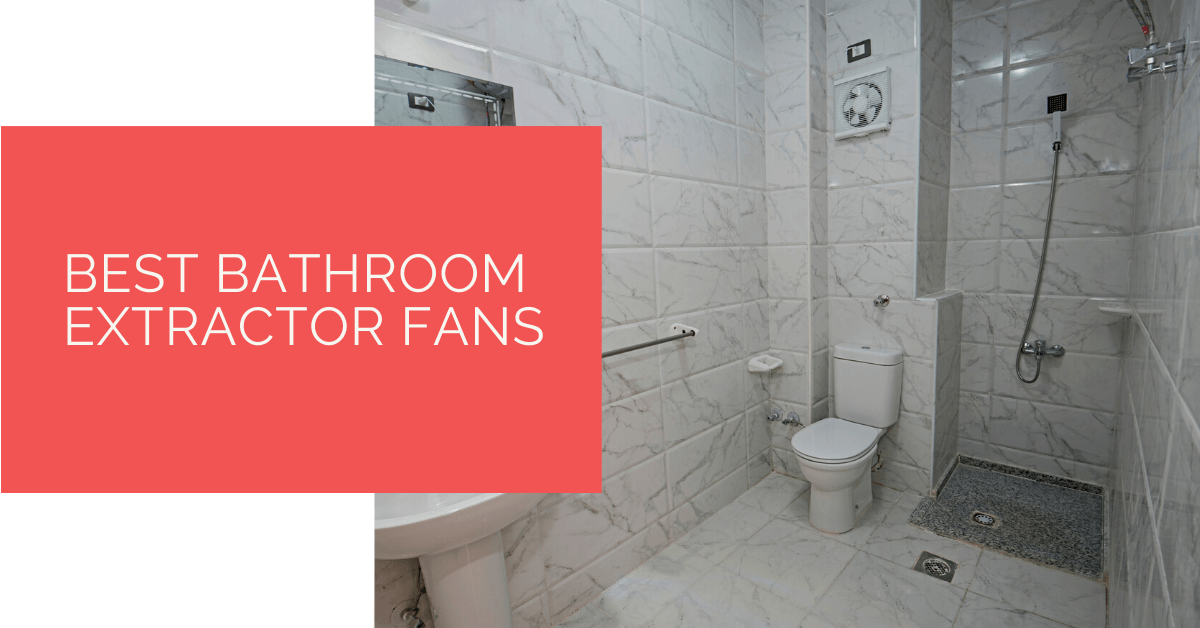
If you want a bathroom that actually gets rid of steam, condensation, and that lingering damp smell, a decent extractor fan is non-negotiable. After testing and researching what’s available on the UK market in 2026, our top recommendation is the Xpelair DX100. It’s quiet enough not to annoy you, powerful enough to do the job properly, and at around £32 it won’t break the bank.
Below you’ll find our full breakdown of the best bathroom extractor fans available in the UK right now, followed by a complete buying guide to help you choose the right one for your bathroom.
Contents
- 1 Our Top Picks
- 2 The 8 Best Bathroom Extractor Fans
- 2.1 1. Xpelair DX100 Bathroom Extractor Fan
- 2.2 2. Manrose QF100T Quiet Extractor Fan with Timer
- 2.3 3. Fantronix 100mm Inline Bathroom Extractor Fan with Timer
- 2.4 4. VENTS Silenta 100mm Bathroom Extractor Fan with Timer
- 2.5 5. Xpelair DX100TS Simply Silent Twin Speed Extractor Fan
- 2.6 6. Devola 100mm Designer Bathroom Extractor Fan with Timer
- 2.7 7. Airflow iCON 30 Extractor Fan
- 2.8 8. Bosch Bathroom Extractor Fan 1500 100mm
- 2.9 Key Takeaways
- 2.10 How to Size a Bathroom Extractor Fan
- 2.11 Duct Run Length: The Performance Factor Most People Ignore
- 2.12 Control Options
- 2.13 Noise: What the Numbers Mean
- 2.14 IP Ratings for Bathroom Zones
- 2.15 Things to Keep in Mind Before Buying
- 2.16 Types of Bathroom Extractor Fan
- 3 Case Study: Solving Persistent Damp in a Victorian Terrace Bathroom
- 4 Expert Insights From Our Heating Engineers About Bathroom Extractor Fans
- 5 Frequently Asked Questions
- 5.1 What size bathroom extractor fan do I need?
- 5.2 Do bathroom extractor fans need to be wired by an electrician?
- 5.3 What’s the difference between a timer fan and a humidistat fan?
- 5.4 Can I install a bathroom extractor fan myself?
- 5.5 How long should a bathroom extractor fan run after a shower?
- 5.6 Why is my bathroom extractor fan not clearing the steam?
- 5.7 What IP rating does a bathroom extractor fan need?
- 5.8 How noisy should a bathroom extractor fan be?
- 6 Summing Up
Our Top Picks
| Image | Name | |
|---|---|---|
| Xpelair DX100B Bathroom Extractor Fan | |
| Manrose QF100T Quiet Fan with Timer | |
| Fantronix 100mm Inline Extractor Fan | |
| VENTS Silenta-100 Timer Extractor Fan | |
| Xpelair DX100TS Twin Speed Timer Fan | |
| Devola 100mm Timer Extractor Fan | |
| Airflow iCON 30 Bathroom Extractor Fan | |
| Bosch Design Fan 1500 |
The 8 Best Bathroom Extractor Fans
1. Xpelair DX100 Bathroom Extractor Fan
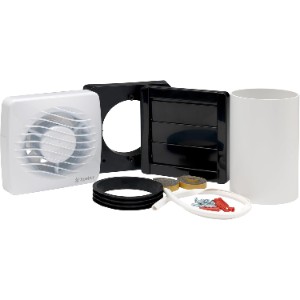
The Xpelair DX100 is the standard against which most other bathroom extractor fans are measured, and for good reason. It extracts at 76m³ per hour, carries an IPX5 waterproofing rating, and meets Building Regulations Part F without any fuss. Xpelair has been making ventilation products in the UK since 1957, and this particular model has been refined over the decades into something genuinely dependable.
At 35dB measured at three metres, it’s not whisper-quiet, but it’s far from obtrusive either. You’ll hear it running, but it won’t drown out conversation. It switches on and off with your light switch in its standard configuration, which keeps wiring simple and eliminates any complicated controls or settings to worry about.
The DX100 comes with a wall and window fitting kit as standard, so it can be installed through a wall, ceiling, or panel with equal ease. The kit includes a telescopic wall tube and external louvred grille, which means you’re not hunting for accessories afterwards. Installation is genuinely straightforward for a competent DIYer, though the wiring should always be handled by a qualified electrician if you’re not confident.
If you just want something that works reliably for years without fuss, this is the one to buy. It’s not the quietest fan on this list, and it lacks a built-in timer, but its combination of reputation, build quality, and competitive price makes it our top overall pick. More than 580 verified buyers agree, giving it 4.5 stars on Amazon.
Features
- Extraction rate: 76m³/hour
- Noise level: 35dB at 3 metres
- IP rating: IPX5
- Operation: standard (switches with light)
- Includes wall/window fitting kit and telescopic wall tube
- Complies with Building Regulations Part F
- BEAB approved
- Trusted UK brand with decades of reliability
- IPX5 waterproofing — suitable for Zone 1 and 2
- Fitting kit included as standard
- Part F compliant out of the box
- No timer — switches off immediately with light
- 35dB is audible, not silent
2. Manrose QF100T Quiet Extractor Fan with Timer
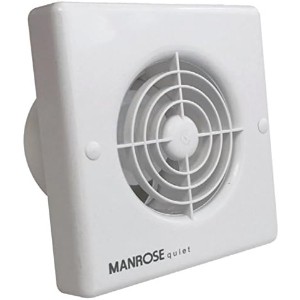
The Manrose QF100T is the most reviewed bathroom extractor fan on Amazon UK, with over 3,600 ratings and a solid 4.4-star average. That’s not a coincidence. Manrose is one of Britain’s most established ventilation brands, and the QF100T is their bestselling residential fan for a reason: it combines genuine quiet operation with a built-in overrun timer at a price that undercuts many rivals.
At 27dB, it’s noticeably quieter than the Xpelair DX100, and quieter than most fans in this price range. Manrose achieves this through their patented turning vane technology, which redirects airflow more efficiently and reduces turbulence noise inside the housing. The overrun timer means it keeps running for a set period after you switch off the light, which is exactly what you want after a shower to clear the remaining humidity before the fan stops.
It carries an IP44 rating, which is sufficient for Zone 2 installations (areas beyond 0.6m from the shower or bath edge). The backdraught shutter prevents cold air from flowing back through the duct when the fan isn’t running. At around £33, it’s excellent value for a timer fan from a reputable British manufacturer, and the review count alone tells you it’s been trusted by a huge number of UK homeowners.
Features
- Noise level: 27dB
- Operation: timer overrun
- IP rating: IP44
- Duct size: 100mm (4 inch)
- Turning vane technology for reduced noise
- Backdraught shutter included
- Very quiet at 27dB
- Built-in overrun timer
- Best-reviewed bathroom fan on Amazon UK
- Reputable British brand
- IP44 only — not suitable for Zone 1
- Timer duration not adjustable
3. Fantronix 100mm Inline Bathroom Extractor Fan with Timer
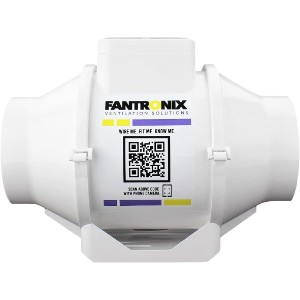
If your bathroom layout makes wall mounting difficult, or you’re dealing with a shower room on an internal wall with no direct external access, an inline fan is the solution. The Fantronix 100mm is a loft-mounted fan that sits in the ductwork rather than on the wall, which means you get all the extraction performance with virtually no noise in the bathroom itself. The motor housing sits up in the loft, connected to 100mm ducting, and the only thing visible in the bathroom is a standard grille.
With 187m³/hour extraction at 27 to 36dB depending on load, this is significantly more powerful than any standard axial wall fan and notably quieter in use. The 2 to 30 minute adjustable overrun timer means you can fine-tune how long it keeps running after you leave. IPX4 rated and designed for permanent mains connection via a switched live circuit, this is a hardwired installation that a competent electrician should handle. Over 1,400 buyers have rated it 4.5 stars, which is exceptional for a specialist product.
The trade-off is that installation is more involved than a standard wall fan — you’ll need loft access, suitable ductwork, and a proper electrical connection. But if you’ve got those things in place, or you’re doing a bathroom renovation where you can plan for it, the Fantronix delivers a level of performance that no simple axial fan can match.
Features
- Extraction rate: up to 187m³/hour
- Noise level: 27–36dB
- IP rating: IPX4
- Operation: switched live with adjustable overrun timer (2–30 min)
- Duct spigot: 96mm outer diameter for 100mm ducting
- Loft-mounted (inline installation)
- Massively more powerful than wall-mounted fans
- Extremely quiet in the bathroom itself
- Adjustable timer (2–30 minutes)
- 4.5 stars from 1,400+ buyers
- Requires loft access and suitable ducting
- More complex and costly to install
4. VENTS Silenta 100mm Bathroom Extractor Fan with Timer
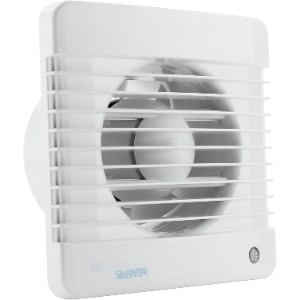
At under £21, the VENTS Silenta is by far the best value bathroom extractor fan on this list. It runs at just 26dB — quieter than the Manrose QF100T — extracts at 78m³/hour, and pulls only 5.5 watts of power. The run-on timer keeps it running after the light goes off, clearing any remaining steam. VENTS backs it with a five-year warranty, which is exceptional at this price point and signals genuine confidence in their product.
With over 1,700 verified ratings averaging 4.3 stars, the review history is substantial enough to take seriously. Buyers consistently praise how quiet it is and how trouble-free the installation is. It also comes with a backdraught shutter as standard. If budget is the primary consideration and you want a fan that ticks every practical box, this is hard to argue with.
The only real limitation is cosmetic. It’s a fairly basic-looking white unit without any design flair, and the build feels slightly less premium than the Manrose or Xpelair offerings. But it performs well, runs quietly, and at £20.99 you’d struggle to find better value anywhere on the UK market.
Features
- Extraction rate: 78m³/hour (22 l/s)
- Noise level: 26dB at 3 metres
- Power consumption: 5.5W
- Operation: run-on timer
- Backdraught shutter included
- 5-year warranty
- Meets Building Regulations
- Excellent value — under £21
- Very quiet at 26dB
- 5-year warranty
- Low energy at just 5.5W
- Basic appearance
- Slightly less refined build quality than UK brands
5. Xpelair DX100TS Simply Silent Twin Speed Extractor Fan
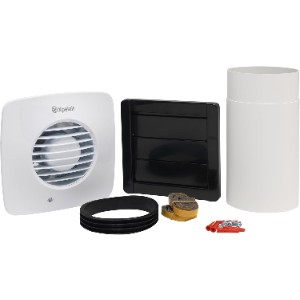
The DX100TS is Xpelair’s premium step up from the standard DX100, adding two selectable speeds and an overrun timer with an adjustable duration between 90 seconds and 30 minutes. The Ghost Air Movement Technology reduces motor turbulence noise, giving it a noticeably quieter character in use. If you have a larger bathroom, or you want the option of running at a lower, near-silent speed for background ventilation and a higher speed when the shower is in use, this is the fan to choose.
It can be installed through walls, ceilings, or panels and comes with a wall fitting kit as standard, including telescopic wall tube and external grille. The two speeds are set at installation rather than controlled on the fly, so you select the mode that best suits your bathroom at fitting time. The timer means the fan continues extracting moisture for your chosen period after the light goes off, which is good practice for mould prevention.
At £36.99 it’s only £4 more than the standard DX100, which makes the twin speed and timer functionality feel like genuinely good value rather than an expensive upgrade. Buyers rate it 4.4 stars from 293 reviews, which is solid for a product at this price.
Features
- Two selectable speeds (set at installation)
- Adjustable timer: 90 seconds to 30 minutes
- Ghost Air Movement Technology
- Wall, ceiling, and panel installation
- Includes wall fitting kit and telescopic tube
- Meets Building Regulations Part F
- Twin speed gives flexibility for different situations
- Adjustable timer (90s to 30 min)
- Ghost Air Movement for quieter operation
- Only £4 more than the standard DX100
- Speed must be set at installation, not on the fly
- Fewer reviews than the DX100
6. Devola 100mm Designer Bathroom Extractor Fan with Timer
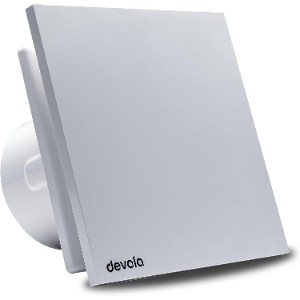
If you care about how the fan looks as much as how it performs, the Devola 100mm stands out from the crowd. Made in Britain, it has a cleaner, more modern front panel than most standard extractor fans — it’s the kind of thing you’d actually be comfortable mounting in a newly tiled, well-designed bathroom without it looking like an afterthought. The adjustable overrun timer runs between 2 and 30 minutes, so you’ve got full control over how long it stays on after the light goes off.
Performance is solid: 85m³/hour extraction, a built-in backdraught shutter, and a protective cover that blocks the view into the fan opening. The timer is individually adjustable during installation rather than fixed, which gives you more control than most fans in this category. At £44.99 it sits at the upper end of the standard wall-fan price range, and with only 99 reviews it doesn’t have the track record of the Manrose or Xpelair options yet. The “Made in Britain” badge will matter to some buyers, and the aesthetics genuinely are a step above the competition.
Worth considering if you’re doing a full bathroom renovation and want the fan to complement the room rather than just do a functional job in the corner.
Features
- Extraction rate: 85m³/hour
- Adjustable overrun timer: 2–30 minutes
- Backdraught shutter included
- Made in Britain
- Wall and window mounting
- Protective cover included
- Attractive modern design
- Adjustable timer (2–30 min)
- Made in Britain
- Good extraction rate (85m³/h)
- Fewer reviews than established competitors
- Pricier than the Manrose and VENTS for similar functionality
7. Airflow iCON 30 Extractor Fan
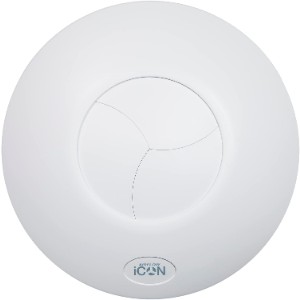
The Airflow iCON 30 is the premium choice on this list, and it justifies its £100 price tag with a genuinely innovative approach. Where standard fans use a backdraught shutter that’s open whenever the fan runs, the iCON 30 uses an iris shutter — a radial mechanism that opens and closes smoothly in concentric petals, sealing completely when the fan is off. This eliminates backdraught more effectively than a standard flap shutter, prevents cold air infiltration between uses, and contributes to noticeably lower noise at 33.3dB despite extracting at 121m³/h (33 litres per second).
At just 10.7W, it’s also one of the most energy-efficient high-output fans available. Airflow backs it with a 3-year warranty, and the 4.4 stars from over 1,800 reviews tell a consistent story: people who buy this fan are happy with it. The base model runs as a standard on/off fan, but the system is designed to accept optional humidity sensor, PIR motion detector, and timer modules that can be added separately depending on your needs. This modular approach is smart — you buy what you actually need rather than paying for features you might not use.
The installation requirement of a 160mm hole for recessed fitting is worth noting before you buy. If you’re retrofitting this into an existing bathroom wall tile, that’s a larger hole than a standard fan. Surface mounting requires only a 110mm hole, which is more manageable.
Features
- Extraction rate: 33 l/s (121m³/h)
- Noise level: 33.3dB at 3 metres
- Power consumption: 10.7W
- Iris shutter technology — automatic seal when not in use
- 3-year warranty
- Optional humidity, PIR, and timer modules (sold separately)
- 100mm duct connection
- Iris shutter seals completely — no backdraught
- Very energy efficient at just 10.7W
- Modular — add humidity sensor or timer separately
- 3-year warranty
- Premium price — £100+
- Control modules cost extra
- Recessed fitting requires 160mm hole
8. Bosch Bathroom Extractor Fan 1500 100mm
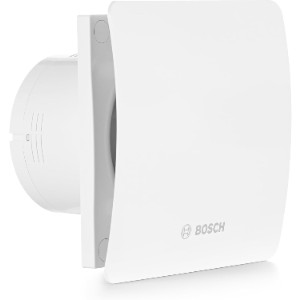
Bosch’s 1500 model has brand recognition on its side, and it does extract effectively at 95m³/hour — which is actually more airflow than most fans on this list. The integrated non-return valve keeps outside air from flowing back in, installation is straightforward, and the neutral white design suits most bathrooms. However, at 39dB it’s the noisiest fan here, and at 3.9 stars from 732 reviews it’s the lowest-rated pick on this list. Several buyers note it’s louder than expected, particularly in tiled bathrooms where sound reflections amplify the motor noise.
It also has no timer, switching off immediately when you turn off the light. That means any residual steam from your shower clears less effectively than with a timer fan. At £35.99 you can buy the Manrose QF100T — which is quieter, has a timer, and has far more positive reviews — for a similar price. The Bosch 1500 isn’t a bad fan, but it’s hard to recommend when better alternatives exist at the same price point. Buy it if you specifically want a Bosch product and volume of airflow matters more than noise.
Features
- Extraction rate: 95m³/hour
- Noise level: 39dB at 3 metres
- Integrated non-return valve
- Operation: light switch (no timer)
- Simple one-person installation
- High extraction rate (95m³/h)
- Recognised brand name
- 39dB — noticeably noisy
- No timer
- Lowest-rated fan on this list (3.9 stars)
Key Takeaways
- Building Regulations Part F requires a minimum extraction rate of 15 litres per second (54 m³/h) for bathrooms and 30 l/s (108 m³/h) for kitchens. Any fan sold for bathroom use should meet the 15 l/s minimum; undersized fans don’t comply and fail to clear steam before condensation forms
- Extraction rate, not price, is the most important specification. A cheap fan that moves enough air beats an expensive fan that doesn’t. Match the fan to the room volume: aim for 8 to 10 air changes per hour for standard bathrooms, 15+ for en-suites with showers that run for long periods
- Humidity-controlled fans react to moisture in the air and switch on and off automatically. They’re more energy-efficient than timer fans and far more effective than pull-cord manual fans at actually preventing condensation, because they respond to actual humidity rather than a fixed time interval
- Duct run length and diameter directly affects fan performance. Every 1 metre of duct reduces effective airflow; every 90° bend reduces it further. A fan that meets spec at zero duct length may fall significantly short of target extraction by the time air reaches the outside, so longer runs need a higher-rated fan or a larger duct diameter
- Noise is measured in sB(A). Standard bathroom fans run at 25 to 40 dB(A); quieter models are available from 14 to 25 dB(A). For en-suites adjoining bedrooms, noise level is worth prioritising
- IP ratings define suitability for wet locations. Zone 1 (directly above the bath or shower) requires IP45 minimum; Zone 2 (within 60cm of a water source) requires IP44 minimum. Most standard bathroom fans are IP44 or IP45; confirm before installing near a shower
- Condensation on windows, mould on grouting and ceiling corners, and peeling wallpaper in adjacent rooms are all signs an existing fan is inadequate or has a fault in the duct run
How to Size a Bathroom Extractor Fan
Extraction rate is measured in litres per second (l/s) or cubic metres per hour (m³/h). The two are directly convertible: 1 l/s = 3.6 m³/h. Building Regulations Part F requires 15 l/s (54 m³/h) as a minimum for bathrooms with no opening window; 30 l/s (108 m³/h) for kitchens. These are minimums, not targets.
For a more precise calculation, use the air changes per hour (ACH) method. Calculate the room volume (length x width x ceiling height in metres). Multiply by the target ACH and divide by 3.6 to get the required l/s:
- Standard bathroom (bath or shower, used normally): Target 8 to 10 ACH
- En-suite with long showers or multiple daily uses: Target 10 to 15 ACH
- Wet room or high-humidity bathroom: Target 15 ACH or above
Example: a bathroom measuring 2m x 2.5m with a 2.4m ceiling has a volume of 12m³. At 10 ACH: 12 x 10 / 3.6 = 33.3 l/s. A fan rated at 35 to 40 l/s would be appropriate.
For small en-suites (under 4m²), the 15 l/s regulatory minimum usually achieves 10+ ACH without oversizing. For larger family bathrooms, you’ll often need 22 to 30 l/s to achieve meaningful air changes rather than just meeting the minimum.
Duct Run Length: The Performance Factor Most People Ignore
Manufacturer extraction rates are measured at zero static pressure, with nothing connected to the fan. Every component of the duct run reduces effective airflow. The losses compound:
- Each metre of duct: Typically reduces airflow by 3 to 8%, depending on duct diameter and fan power
- Each 90° bend: Equivalent to roughly 1 to 1.5 metres of additional straight duct resistance
- Each 45° bend: Roughly 0.5 to 0.75 metres equivalent
- Duct wall terminals and grilles: Can add resistance equivalent to 1 to 2 metres of duct
A practical rule: for duct runs over 3 metres, or runs with more than two bends, specify a fan with 20 to 30% more rated output than the calculation requires. For very long runs (over 5 metres) or complex routes through floor joists or roof spaces, move up a duct diameter. A 100mm or 125mm duct versus the standard 100mm reduces resistance significantly and preserves more of the fan’s rated output at the grille.
Flexible corrugated duct is widely available and easy to install but creates more airflow resistance than smooth rigid duct for the same diameter. Where run length is a concern, rigid duct or semi-rigid aluminium duct will preserve more of the fan’s rated output.
Control Options
How the fan is triggered affects both energy use and effectiveness:
Manual (pull-cord or switch): The most basic and cheapest option. Relies entirely on the occupant remembering to turn it on and leaving it running long enough after bathing to clear moisture. In practice, most people switch it off too quickly. Fine for utility rooms or secondary bathrooms used infrequently.
Timer: Switch-activated but includes a built-in run-on timer (typically 2 to 30 minutes, adjustable). Continues running after the light switch is turned off. A significant improvement over manual operation for compliance and condensation control. The timer runs regardless of actual humidity, which can mean unnecessary running in dry conditions or insufficient run time after a long shower.
Humidity sensor (humidistat): Automatically activates when humidity rises above a set threshold and switches off when the target level is restored. No occupant input required; responds to actual conditions rather than fixed timing. The most effective option for preventing condensation consistently. Humidity-controlled fans use less energy than timer fans that run regardless of need, and they catch condensation problems from overnight moisture build-up that manual or timer fans would miss entirely.
Motion sensor: Activates when the room is occupied and runs for a set period after the sensor detects no movement. Effective for cloakrooms and utility bathrooms used briefly. Less appropriate for main bathrooms where occupancy duration varies. A short visit doesn’t warrant full extraction, while a bath doesn’t trigger the sensor once you’re in the bath.
Combined humidity and motion: Some mid-range fans combine both: activates on motion and continues running until humidity drops below the set threshold. The best of both approaches, particularly for bathrooms used at varying times of day.
Noise: What the Numbers Mean
Fan noise is measured in dB(A). The numbers can seem small but the differences are perceptible:
- Under 20 dB(A): Essentially inaudible, suitable for en-suites adjacent to bedrooms without any noise concern
- 20 to 28 dB(A): Very quiet. You’ll know it’s running, but it’s not intrusive. Fine for bedrooms and quiet en-suites
- 28 to 35 dB(A): Audible but acceptable for most bathrooms used normally. Budget and mid-range fans typically fall here
- 35 to 45 dB(A): Clearly audible, similar to a quiet conversation. Typically associated with higher-extraction fans running at full speed. Acceptable for utility rooms or locations away from sleeping areas
Noise is not solely determined by fan speed; motor design, blade geometry, and duct termination all affect it. Some fans offer variable speed settings, running quietly on low speed during normal extraction and stepping up automatically if humidity is very high. If noise is a priority, look for this feature alongside the headline dB(A) figure, as the quoted noise level is usually measured at maximum speed.
IP Ratings for Bathroom Zones
Bathroom electrical zones are defined by distance from water sources. Part P of the Building Regulations and BS 7671 define which equipment can be installed where:
- Zone 0: Inside the bath or shower itself. Not relevant for extractor fans
- Zone 1: Directly above the bath or shower to a height of 2.25m. IP45 minimum required
- Zone 2: Within 60cm horizontally of the bath or shower edge, or directly above Zone 1 to 3m. IP44 minimum required
- Outside zones: Standard IP20 fans are acceptable but IP44 is common and sensible for any bathroom installation
Most bathroom extractor fans are rated IP44 or IP45 and are suitable for Zone 2 installation. If mounting directly above a shower (for example in a ceiling tile), confirm the unit is rated for Zone 1. Installation in Zones 0, 1, and 2 must be carried out by a Part P registered electrician or notified to the local authority building control.
Things to Keep in Mind Before Buying
If you’re replacing an existing fan, check the duct diameter before ordering. UK bathrooms use either 100mm or 125mm duct. Fitting a fan to the wrong duct size requires an adaptor at minimum and re-ducting at worst. It’s a five-minute job to check before you order.
Also check the duct route before specifying the fan’s rated output. A fan that meets spec at zero back pressure may underperform if it’s venting through two floors and a roof space with three bends. Size up if in any doubt. An oversized fan running at 70% capacity costs less to run than an undersized one running at 100% and still failing to clear moisture.
External grilles and wall terminals need a check every couple of years. Blocked or stuck louvre grilles prevent the fan exhausting effectively and can cause the motor to overwork and fail early. Insect ingress and debris build-up are common in grilles that haven’t been inspected for years.
Types of Bathroom Extractor Fan
Axial fans are the most common type for standard bathroom installations. The motor and impeller sit directly in line with the duct. Affordable, compact, and available in a wide range of outputs. Best suited to short duct runs where back pressure is low.
Centrifugal (inline) fans install within the duct run itself rather than on the wall or ceiling. They’re better suited to long or complex duct runs because they generate more pressure to push air through resistance. Quieter in the bathroom as the motor is remote from the room. The right choice for loft conversions, through-wall installations over 3 metres, or anywhere the axial fan struggles against the duct’s back pressure.
Slimline and low-profile fans fit into shallow ceiling voids where a standard axial fan won’t fit. Output is typically lower, so confirm the rated extraction meets the room’s ACH requirements before choosing a slimline model on aesthetics alone.
Decorative and designer fans focus on aesthetic integration: flush-mounted grilles, chrome finishes, and minimal visibility. Performance specifications vary widely, and some sacrifice extraction rate for appearance. Always verify the l/s rating against your room size calculation before committing to a decorative model.
Case Study: Solving Persistent Damp in a Victorian Terrace Bathroom
Background
A family in a Victorian terrace in the north of England had been struggling with recurring black mould on the bathroom ceiling for several years. The bathroom had no window and relied on a 20-year-old axial fan that switched off with the light. Despite regular cleaning, the mould kept returning each winter.
Project Overview
The plan was to replace the existing fan with a timer model and re-run the ducting, which had partially collapsed in the ceiling void. The bathroom measured approximately 4m² with a 2.4m ceiling height, and the duct run to the external soffit vent was around 2.5 metres with two 45-degree bends.
Implementation
A Manrose QF100T was fitted by a local electrician, replacing the old fan and new semi-rigid ducting was installed from the fan housing to the soffit. The overrun timer was set to 15 minutes after the light switch is turned off. The electrician also improved the seal around the duct penetration in the external wall, which had been allowing cold air infiltration.
Results
After one winter, the mould on the ceiling had not returned. The family reported the fan was noticeably quieter than the old one and that the bathroom felt less damp after showering. The total cost including the fan, ducting, and electrician’s labour was under £200. For the family, that was considerably cheaper than the re-plastering and repainting that the mould problem had been making necessary every couple of years.
Expert Insights From Our Heating Engineers About Bathroom Extractor Fans
One of our senior heating engineers with over 18 years of experience in domestic ventilation and building services work shared his perspective on choosing and installing bathroom extractor fans:
“The most common mistake I see is people buying a fan and then discovering the duct run is longer or more complex than they assumed. Every bend adds resistance, and a standard axial fan has a relatively limited ability to push air against back-pressure. If you’ve got a bathroom on an internal wall with three or four bends in the duct run to get to the outside, a cheap axial fan will be running at maybe 30% of its rated flow rate by the time air reaches the outlet. You’re getting almost nothing. In those situations, an inline fan installed in the ceiling void, or a centrifugal fan with higher pressure capability, is the right solution — not a more powerful axial fan.”
“I’d also always recommend a timer, as a minimum. The idea of a fan that switches off with the light is well-intentioned but practically useless for post-shower moisture removal. The steam hasn’t fully evaporated when you turn the light off — it takes another 10 to 15 minutes. A timer set to run for 15 to 20 minutes after the light goes off is the single biggest improvement you can make to bathroom ventilation effectiveness, and it typically adds just a few pounds to the cost of the fan.”
“One thing that catches people out is IP ratings. I’ve seen fans installed directly above shower enclosures that weren’t rated for Zone 1. It’s not just a compliance issue — it’s a safety issue. Always check the IP rating and compare it to where you’re installing. If in doubt, go for the higher rating. The difference in cost between an IPX4 and IPX5 fan is usually negligible.”
Frequently Asked Questions
What size bathroom extractor fan do I need?
For most UK bathrooms, a 100mm (4 inch) axial fan producing at least 54m³/hour (15 litres per second) meets Building Regulations Part F. Every fan on this list exceeds that threshold. Larger wet rooms or bathrooms with long duct runs may need an inline fan or a higher flow rate — aim for enough airflow to change the room’s air volume at least once every 5–7 minutes.
Do bathroom extractor fans need to be wired by an electrician?
In England, Wales, and Scotland, any new electrical installation in a bathroom is notifiable work under Part P of the Building Regulations. Unless you’re a competent person registered with a scheme like NICEIC or SELECT, you’ll need either to use a registered electrician or to apply for Building Regulations approval yourself. The mechanical installation (cutting the hole, fitting the housing) can be DIY, but the wiring should not be.
What’s the difference between a timer fan and a humidistat fan?
A timer fan runs for a set period after the light goes off — typically 2 to 30 minutes depending on the model. A humidistat fan activates automatically when bathroom humidity rises above a set threshold (usually 60–80% relative humidity) and turns itself off when humidity drops back to normal. Humidistat fans are more responsive to actual conditions and will also activate if someone leaves the shower without turning on the fan. They cost more and require slightly more complex wiring.
Can I install a bathroom extractor fan myself?
The mechanical part — cutting the hole, mounting the housing, and running the duct — is within the capability of a competent DIYer. The electrical connection is where you need to be careful. If you’re simply replacing a like-for-like fan on an existing circuit with no changes to wiring, many people do this themselves. If you’re installing a new fan on a new circuit, or wiring a humidistat model with additional connections, use a registered electrician.
How long should a bathroom extractor fan run after a shower?
Most ventilation guidance recommends 15–20 minutes after the shower ends. That’s enough time for the residual steam to evaporate and the fan to clear it. If you’re setting a timer fan, 15 minutes is a reasonable starting point for most UK bathrooms. Larger bathrooms, longer showers, or colder external conditions may benefit from a longer overrun.
Why is my bathroom extractor fan not clearing the steam?
The most common reasons are a blocked or collapsed duct, a duct run that’s too long or has too many bends, or a fan that switches off with the light before the steam has cleared. Check the external vent isn’t blocked with debris first — this is a surprisingly common issue. If the duct run is over 3–4 metres or has multiple bends, your axial fan may not have enough pressure capability. An inline fan with greater back-pressure resistance may be required.
What IP rating does a bathroom extractor fan need?
It depends where you’re installing it. Zone 1 (directly above a bath or shower) requires a minimum of IPX4, but IPX5 is preferable and most Zone 1 installations use IPX5-rated fans. Zone 2 (within 0.6m of the bath or shower edge) requires at least IP44. Outside the zones, any standard IP rating is acceptable. Always confirm the zone location before choosing a fan.
How noisy should a bathroom extractor fan be?
The quietest fans on this list run at 26–27dB, which is barely perceptible and significantly quieter than normal conversation (around 60dB). The noisiest here is 39dB, which is clearly audible. In general, anything below 30dB is considered quiet, and anything above 35dB will be noticed. Note that tiled bathrooms amplify fan noise due to sound reflections, so real-world noise levels in a hard-tiled room may be higher than the quoted figure.
Summing Up
The Xpelair DX100 is our top pick for most UK bathrooms: reliable, well-priced, and IPX5 rated for flexible installation. If you want something quieter with a built-in timer, the Manrose QF100T is the most-reviewed bathroom fan on Amazon UK and deserves its reputation. Budget buyers should look at the VENTS Silenta — at under £21 it’s remarkably quiet and competent. And if you’re doing a full renovation or dealing with a difficult duct run, the Fantronix inline fan or the premium Airflow iCON 30 are worth the extra investment.
Whatever you choose, a timer fan will serve you significantly better than a standard on/off model — it’s one of those small decisions that makes a real difference to how well your bathroom actually ventilates.
Updated