
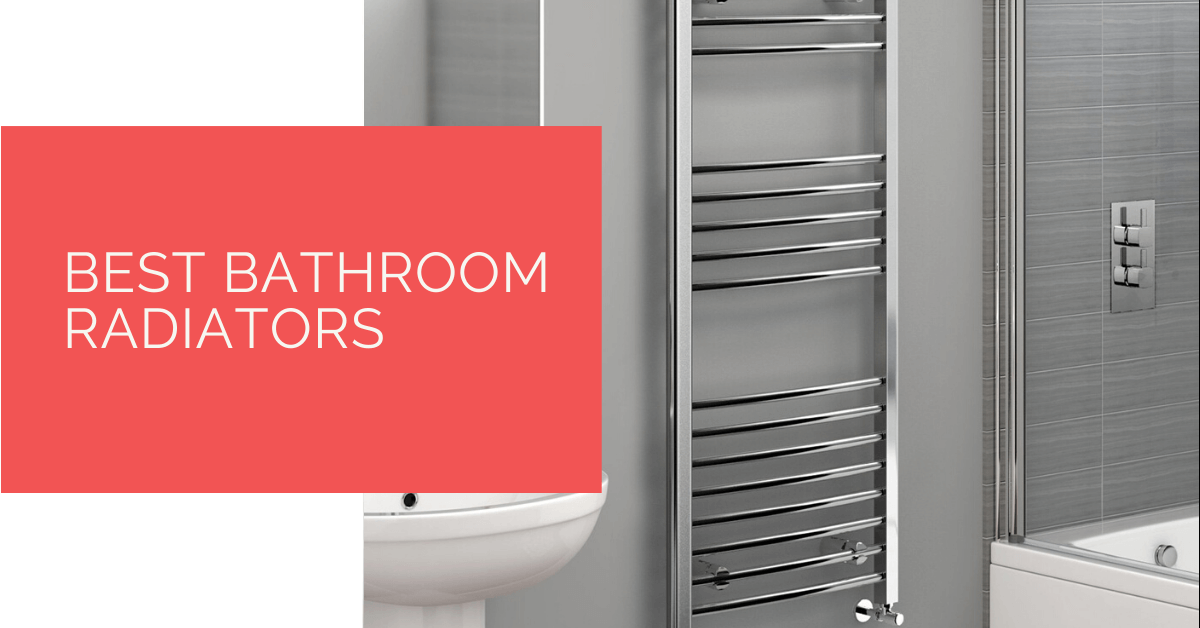
The iBathUK Zerith Wall Mounted Flat Panel Heated Towel Rail (1600 x 600mm, Chrome) is the best bathroom radiator for most homes: 544 reviews at 4.7 stars, central heating compatible, and a slim flat-panel design that fits neatly in any bathroom layout. Whether you’re replacing a tired old radiator or fitting out a new bathroom from scratch, the eight options below cover central heating panels, electric towel rails, and on-trend finishes from brushed gold to anthracite grey.
We’ve focused on products with genuine review histories from verified UK buyers on Amazon, covering standard central heating radiators, electric towel rails, and dual-fuel options across a range of sizes and price points.
Our Top Picks
| Image | Name | |
|---|---|---|
| iBathUK Zerith Wall Mounted Flat Panel Heated Towel Rail (1600 x 600mm Chrome) | |
| NRG 650 x 500mm Gloss White Flat Panel Bathroom Radiator | |
| Manissa Firenze Straight Electric Heated Towel Rail H1200mm W400mm | |
| DuraTherm 700 x 400mm Curved Electric Heated Towel Rail | |
| Go Bathrooms Ark 800 x 500mm Brushed Gold Heated Towel Rail | |
| Myhomeware Anthracite Grey Heated Bathroom Towel Rail Radiator (700 x 800mm) | |
| Chrome Electric Curved Heated Towel Rail 500 x 1400mm | |
| NRG 1800 x 450mm Chrome Designer Flat Panel Heated Towel Rail |
8 Best Bathroom Radiators
1. iBathUK Zerith Wall Mounted Flat Panel Heated Towel Rail (1600 x 600mm Chrome)
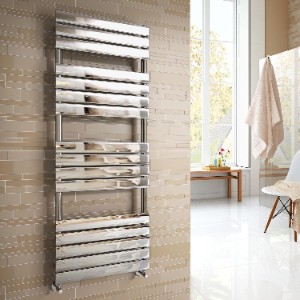
At 544 reviews and 4.7 stars, the iBathUK Zerith is the most proven bathroom radiator on Amazon UK right now, and it earns that position. The 1600 x 600mm chrome flat-panel design fits neatly on most bathroom walls and produces a solid heat output of 994 BTU at T60. It’s central heating compatible, which means it connects to your existing system with standard radiator valves (not included, but widely available on Amazon UK for around £15 to £20).
The 16-column slim flat steel construction gives this radiator genuine substance without being bulky. Chrome finishes can look cheap at the budget end of the market, but the Zerith’s polished finish holds up well and doesn’t show water marks the way cheaper chrome plating does. At 1600mm tall it creates a real statement in the bathroom, and the 600mm width provides enough rail space to hang two or three towels at once.
iBathUK is a UK-based bathroom specialist with a solid track record on Amazon, and the Zerith has been their consistent bestseller for several years. Reviews repeatedly mention the quality of the finish, the ease of installation with a competent plumber, and the warmth output during colder months. At £154.27 this is mid-range pricing for a quality central heating towel rail of this size, and it represents good value.
If you’re fitting a new bathroom or replacing an old towel rail that connects to your central heating, start here. The Zerith is the product that sets the benchmark for what a bathroom radiator at this price should do.
Features
- 1600 x 600mm chrome flat-panel heated towel rail
- 16-column slim flat steel construction
- Heat output: 994 BTU (delta rating T60)
- Central heating compatible, standard valve connections
- 4.7 stars from 544 reviews
- 544 reviews at 4.7 stars, the most proven option here
- Solid 994 BTU heat output for a towel rail
- Quality chrome finish that holds up over time
- Wall-mounted, space-efficient design
- Radiator valves not included, additional cost
- Requires a plumber for central heating connection
2. NRG 650 x 500mm Gloss White Flat Panel Bathroom Radiator
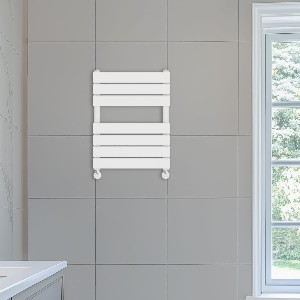
If budget is the priority, the NRG 650 x 500mm Gloss White Flat Panel is the pick. At around £48 it’s by far the most affordable well-reviewed central heating radiator here, and at 78 reviews with a 4.8-star average it’s got a genuine track record for a product at that price. The compact 650 x 500mm size suits smaller bathrooms and cloakrooms where you need heat output without sacrificing wall space.
NRG is a UK radiator brand that’s built a solid reputation on Amazon by delivering consistent quality at competitive prices. The gloss white finish is clean and neutral, and will suit virtually any bathroom colour scheme. Central heating compatible with standard valve connections, and the panel construction is straightforward to install with a competent plumber.
The heat output won’t match the larger Zerith, so this one is best suited to a bathroom under 5 square metres or as a supplementary radiator rather than the primary heat source. For small bathrooms that just need something neat and affordable, the NRG at this price is hard to argue with.
Features
- 650 x 500mm central heating flat panel radiator
- Gloss white finish, suits standard bathroom decor
- Central heating compatible, standard valve connections
- Compact size suited to small bathrooms and cloakrooms
- 4.8 stars from 78 reviews
- Excellent value at around £48
- 78 reviews at 4.8 stars, strong rating for the price
- Compact size suits small bathrooms and cloakrooms
- Lower heat output, not suitable for larger bathrooms
- Gloss white only, no colour options in this size
- Radiator valves not included
3. Manissa Firenze Straight Electric Heated Towel Rail H1200mm W400mm
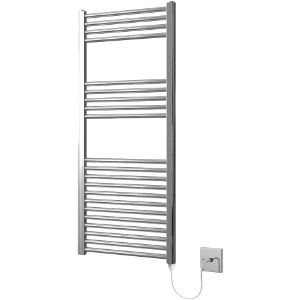
The most reviewed electric towel rail here at 96 ratings and 4.7 stars, the Manissa Firenze Straight is a solid all-rounder for bathrooms that aren’t connected to central heating, or where you want a towel rail that operates independently of your heating schedule. Electric towel rails are particularly useful in bathrooms added to a property after the central heating was installed, where running new pipework isn’t practical.
At 1200mm tall and 400mm wide, the Firenze Straight gives you reasonable rail space for a couple of large bath towels. The 300W PTC element is energy efficient and self-regulating to 65 degrees Celsius, which means no external thermostat is required. It comes pre-filled and ready to install, with wall brackets and fixing hardware included. At £106.88 it sits in a sensible price range for a standalone electric towel rail with this feature set.
The Manissa range has a long track record on Amazon UK, and the Firenze Straight is their consistent performer. Buyers particularly mention the quality of the chrome finish relative to the price, and the straightforward installation. You’ll need an electrician to wire it in permanently, but the rail itself is solid and well-made.
Features
- 1200mm x 400mm chrome electric heated towel rail
- 300W PTC energy-efficient self-regulating element
- Pre-filled and ready to install, all fixings included
- IP55 rated, suitable for bathroom Zone 2
- 4.7 stars from 96 reviews
- 96 reviews at 4.7 stars, most proven electric option here
- No central heating required, fully standalone
- Energy-efficient PTC element, self-regulating temperature
- Requires professional electrical installation
- No timer or thermostat control included
- 400mm width limits towel-hanging capacity
4. DuraTherm 700 x 400mm Curved Electric Heated Towel Rail
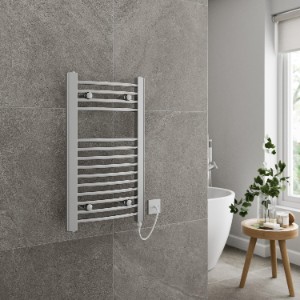
This is the budget electric pick. At £74.97 with 48 reviews and a 4.8-star average, the DuraTherm 700 x 400mm Curved Electric Heated Towel Rail is the most affordable reliable electric option here. The 700mm height is shorter than the Manissa Firenze, which makes it better suited to bathrooms where wall space is limited or where the towel rail is supplementary rather than the main heat source.
The curved ladder design has a slightly more traditional appearance than the straight variants, and the 150W manual element is simple to operate. The 10-year guarantee on the rail body is a genuine point of difference at this price. Note that at 150W this rail gets warm rather than hot, which is fine for drying towels between uses but won’t significantly heat a cold bathroom on its own.
Features
- 700 x 400mm curved chrome electric heated towel rail
- 150W manual element with 10-year guarantee
- 14 rails, all fixings included
- 322 to 863 BTU heat output depending on delta T
- 4.8 stars from 48 reviews
- Affordable at under £75
- 10-year guarantee on the rail body
- 150W only, limited heat output for a cold bathroom
- No timer or thermostat control included
- Shorter 700mm height, less towel space than taller rails
5. Go Bathrooms Ark 800 x 500mm Brushed Gold Heated Towel Rail
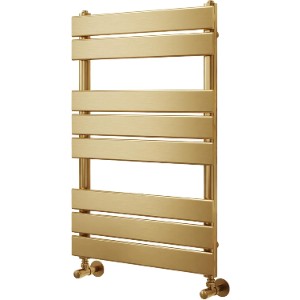
Brushed gold has become one of the most popular bathroom finishes over the past three years, and the Go Bathrooms Ark is the pick if you’re designing around that trend. At 54 reviews and 4.8 stars it’s well-reviewed for a relatively new product, and the 800 x 500mm dimensions give you a balanced, proportionate towel rail that doesn’t dominate the wall.
Central heating compatible, the Ark produces 994 BTU at T60 delta rating, which is a reasonable output for a bathroom of up to around 8 square metres. The mild steel construction is solid and the brushed gold finish has a premium feel without the price tag you’d pay at a plumbing showroom. Brushed finishes are more forgiving than polished ones when it comes to fingerprints and watermarks, which matters in a bathroom.
The Ark range is available in multiple sizes and colours including chrome and matt black, so if brushed gold isn’t quite right for your scheme the wider range is worth exploring. The 800 x 500mm variant is the sweet spot for most standard UK bathrooms.
Features
- 800 x 500mm brushed gold heated towel rail
- Central heating compatible, mild steel construction
- 994 BTU heat output at T60 delta rating
- Flat panel ladder design, available in multiple sizes and colours
- 4.8 stars from 54 reviews
- On-trend brushed gold finish at an accessible price
- Good heat output at 994 BTU
- Available in multiple sizes for flexible installation
- Fewer reviews than the top pick at similar pricing
- Valves not included, additional cost
- Gold finishes may date more quickly than chrome or anthracite
6. Myhomeware Anthracite Grey Heated Bathroom Towel Rail Radiator (700 x 800mm)
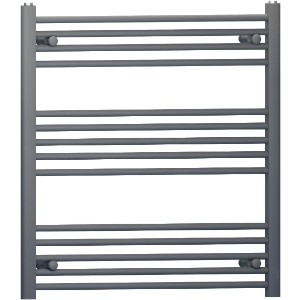
Anthracite grey is the other dominant trend in contemporary bathroom design alongside brushed gold, and the Myhomeware offers one of the wider anthracite options here at 700mm across. The 700 x 800mm format gives this radiator a relatively wide, lower profile compared to the tall narrow towel rails, which suits bathrooms where you have horizontal wall space rather than height.
Central heating compatible, with a heat output of 479W and 1,634 BTU at T60 for the 700 x 800mm variant. That’s a genuinely useful output for a bathroom radiator, and combined with the 15-tube construction there’s good space for towel hanging too. The RAL 7016 anthracite grey matt finish is a proper dark grey rather than the washed-out near-black that some manufacturers pass off as anthracite.
Features
- 700 x 800mm anthracite grey central heating towel rail
- 479W and 1,634 BTU heat output at T60
- RAL 7016 matt anthracite grey finish
- 15-tube construction, good towel hanging capacity
- 4.8 stars from 44 reviews
- Strong 1,634 BTU heat output
- Genuine RAL 7016 anthracite, not a grey approximation
- Fewer reviews than the top picks
- Wide format doesn’t suit narrow wall spaces
- Valves and fixings not included
7. Chrome Electric Curved Heated Towel Rail 500 x 1400mm
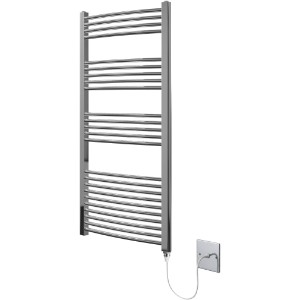
The highest-rated product on this list at 4.9 stars from 41 reviews. At 1400mm high and 500mm wide it has enough presence to work as a focal point in the bathroom, and the curved ladder design has a slightly warmer, more traditional appearance than the straight flat-panel variants. Electric, so no central heating connection is required.
At £112 it sits between the budget DuraTherm and the more established Manissa Firenze, and the 4.9-star rating suggests early buyers have been consistently pleased. If you want an electric towel rail with a tall, statement profile and aren’t committed to the straight-bar aesthetic, this is the one to consider.
Features
- 500 x 1400mm chrome electric curved heated towel rail
- Electric, no central heating connection required
- Tall format, good visual presence in the bathroom
- All fixings included
- 4.9 stars from 41 reviews
- Highest rated on this list at 4.9 stars
- Tall 1400mm height, genuine statement rail
- No central heating required
- Only 41 reviews, limited long-term track record
- Curved design suits traditional bathrooms more than minimalist schemes
8. NRG 1800 x 450mm Chrome Designer Flat Panel Heated Towel Rail
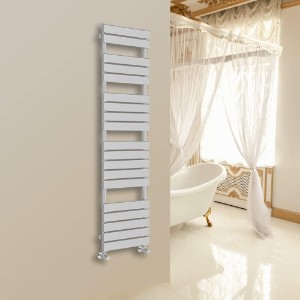
At 1800mm tall, the NRG Designer Flat Panel is the most imposing radiator here. It’s the option for a large bathroom or en-suite where you want the towel rail to be a proper statement piece rather than just functional hardware. The flat-panel format looks clean and contemporary, and at 450mm wide it’s slim enough to fit in spaces where a wider radiator wouldn’t work.
Central heating compatible, 63 reviews at 4.8 stars, and priced at £189. That puts it at the upper end of the budget for a heated towel rail but well below what you’d pay at a plumbing merchant for a comparable product. NRG’s track record across their smaller models gives confidence that the quality on this larger unit is consistent.
Worth noting that at 1800mm this radiator needs a wall with sufficient clear height to mount it properly, particularly if you have low ceilings or a window above where the radiator will sit. Measure carefully before ordering.
Features
- 1800 x 450mm chrome flat-panel designer heated towel rail
- Central heating compatible
- Tall statement design for larger bathrooms
- Slim 450mm width suits narrower wall spaces
- 4.8 stars from 63 reviews
- Statement 1800mm height for large bathrooms
- Slim profile suits narrow wall spaces
- 63 reviews at 4.8 stars, consistent NRG quality
- Requires significant clear wall height for installation
- £189, the most expensive central heating option here
Bathroom Radiator Buying Guide
Key Takeaways
- Central heating radiators offer better heat output and lower running costs than electric, but require existing pipework or a plumber to fit
- Electric towel rails are easier to install and ideal for bathrooms without central heating connections, but cost more to run per hour
- Heat output is measured in BTU and watts: aim for at least 1,000 to 1,200 BTU for a standard UK bathroom of 4 to 6 square metres
- Chrome is the most popular finish, but anthracite grey and brushed gold are now mainstream and suit modern bathroom schemes
- Always check radiator valve compatibility before buying: towel rails typically use 15mm connections with standard TRV or manual valves
- Electric towel rails must be installed by a qualified electrician and must meet the IP rating required for their bathroom zone
What Are Bathroom Radiators?
Bathroom radiators are heating units designed specifically for use in bathrooms. They differ from standard room radiators in that they’re typically built to a higher IP (Ingress Protection) rating to handle the humid, moisture-rich environment of a bathroom, and many double as heated towel rails, providing the dual function of warming the room and keeping towels dry between uses.
The two main types sold on Amazon UK are central heating bathroom radiators and electric heated towel rails. Central heating radiators connect to your existing hot water heating system and run from your boiler, while electric variants plug into a mains socket or are hardwired and operate independently of your central heating.
How Do Bathroom Radiators Work?
Central heating bathroom radiators work in exactly the same way as radiators elsewhere in your home. Hot water from your boiler circulates through the radiator via two valve connections (flow and return), heating the metal panels or tubes, which then radiate heat into the bathroom. A thermostatic radiator valve (TRV) controls the water flow and therefore the heat output.
Electric heated towel rails use a sealed element inside the rail itself, pre-filled with a water and inhibitor solution. A PTC (Positive Temperature Coefficient) element heats this fluid, which then circulates through the rail via convection. PTC elements are self-regulating: as the fluid reaches operating temperature, the element’s electrical resistance increases automatically, reducing power draw. This makes electric towel rails more efficient than a simple resistance heater of the same rated wattage.
Benefits of Using Bathroom Radiators
The most obvious benefit is warmth, but bathroom radiators do more than heat the air. A heated towel rail keeps towels warm and dry between uses, which prevents the damp, musty smell that builds up in bathrooms with poor ventilation. Dry towels are also more hygienic: damp fabric left on a cold rail encourages bacteria and mildew.
Heated towel rails also help reduce bathroom humidity, which protects against mould growth on grout lines, sealant, and paintwork. A bathroom that’s consistently warmed and dried will have fewer condensation problems than one that’s only occasionally heated.
From an aesthetic standpoint, a quality bathroom radiator is one of the quickest ways to lift the look of a bathroom without a full renovation. Swapping an old white column radiator for a chrome flat panel or a brushed gold towel rail is a job that can noticeably improve the feel of the room for a modest outlay.
Things to Keep in Mind Before Buying
Size and heat output are the critical considerations. Measure your wall space before selecting a radiator and work out the BTU requirement for your bathroom: a well-insulated bathroom of around 5 square metres needs approximately 1,000 to 1,200 BTU. Add 10 to 20% for bathrooms with external walls, large windows, or poor insulation.
Valve compatibility matters more than most buyers realise. Standard UK central heating uses 15mm copper pipe, and most towel rails use 15mm valve connections. If your existing valves are angled or straight, check that the new radiator’s pipe centres match your existing pipework position. Pipe centres are usually listed in the product specification.
For electric towel rails, check the IP rating. Zone 1 (directly above the bath or shower tray) requires IP65 or higher. Zone 2 (within 600mm of the bath or shower) requires IP44 or higher. Most electric towel rails on Amazon UK are rated IP44 or IP55, which suits Zone 2 installation in a standard bathroom.
Types of Bathroom Radiators
Flat panel radiators are the modern standard: a smooth steel panel with a clean profile, available in various sizes and colours. They’re more efficient than traditional column radiators because the flat surface radiates heat more evenly across the room, and they’re much easier to wipe clean. Most central heating bathroom radiators on Amazon UK are flat panel.
Heated towel rails are the ladder-style alternative, with horizontal bars across the front that provide space for towels. They can be flat or curved, and are available in both central heating and electric versions. The rail format is more focused on towel drying than raw heat output, so if warmth is the priority, a flat panel radiator will typically outperform a towel rail of the same width.
Dual-fuel radiators can be used either with central heating or as a standalone electric unit. They’re useful for households that want to keep the bathroom warm during summer when the central heating is off. Dual-fuel conversion kits are also available separately for standard central heating towel rails.
Case Study: Replacing a Dated Bathroom Radiator in a 1970s Semi-Detached
Background
A homeowner in South Yorkshire had a 1970s semi-detached with a small main bathroom of around 4.5 square metres. The existing radiator was an old white column type with two sections, producing inconsistent heat and with one section that had partially seized. The bathroom felt cold in winter and towels came out of the wash damp and stayed that way.
Project Overview
The goal was to replace the column radiator with a modern chrome flat-panel heated towel rail that would improve heat output, dry the towels properly, and update the look of the bathroom without a full renovation. Budget was around £200 all-in for the radiator and installation.
Implementation
They chose a 1600 x 600mm chrome flat-panel towel rail compatible with their existing central heating. A local plumber drained the relevant section of pipework, removed the old column radiator, and fitted the new rail in under two hours. The existing pipe centres were compatible, so no alterations to the pipework were needed. New TRV valves were fitted at the same time for better temperature control.
Results
The bathroom now reaches a consistent temperature within 15 minutes of the heating coming on. Towels dry properly between uses and no longer smell damp. The chrome flat panel looks considerably better than the old column radiator, and the homeowner noted that the bathroom now feels like the rest of the house rather than the coldest room on the ground floor. Total spend including installation was £220.
Expert Insights From Our Heating Engineers About Bathroom Radiators
One of our senior heating engineers with over 22 years of experience advising on domestic central heating and bathroom installations has this to say: “The most common mistake I see when people replace bathroom radiators is buying purely on looks without checking the heat output. A slimline 400mm-wide towel rail looks great on the wall but if your bathroom has a cold external wall and a single-glazed window, it won’t keep the room warm. Always work out the BTU requirement first, then choose a radiator that meets it.”
“Electric towel rails are genuinely useful in bathrooms that were added to a property after the central heating was designed, like a converted loft or a downstairs cloakroom fitted in what used to be a utility room. Running new pipework to those spaces is expensive and disruptive. An electric towel rail with a timer keeps the bathroom comfortable without the cost of replumbing.”
“On finishes: chrome will always look clean if you maintain it, but brushed finishes hide marks better in daily use. Anthracite grey is the finish I’d choose for a modern bathroom because it ages better than chrome when the chrome starts to look tired. Whichever finish you go for, make sure the valves match. Nothing looks worse than a brushed gold towel rail fitted with chrome valves.”
Frequently Asked Questions
How do I calculate what size bathroom radiator I need?
A standard rule of thumb is 100W per square metre for a well-insulated room. For a typical bathroom of 4 to 5 square metres, that’s 400 to 500W, or around 1,400 to 1,700 BTU. Add 10 to 20% for bathrooms with external walls, large windows, or poor insulation. Use an online BTU calculator if you want a more precise figure based on your room dimensions and wall construction.
What is the difference between a heated towel rail and a bathroom radiator?
The terms are often used interchangeably, but there’s a practical distinction. A heated towel rail is the ladder-style unit with horizontal bars designed primarily for hanging and drying towels. A bathroom radiator is more typically a flat-panel unit optimised for heat output. In practice, a tall flat-panel bathroom radiator will heat a room more effectively than a narrow towel rail of the same width, but the towel rail is better for keeping towels dry.
Can I fit a bathroom radiator myself?
For central heating radiators, you can legally do the work yourself, but it involves draining the system, working with pipework, and refilling and bleeding correctly. Most homeowners have it done by a plumber rather than risk air locks or leaks. For electric towel rails, Part P of the Building Regulations requires that electrical work in bathrooms is carried out or certified by a qualified electrician. Don’t DIY the electrical connection.
How much does it cost to run an electric heated towel rail?
A 150W electric towel rail running for 4 hours a day uses 0.6 kWh daily. At around 28p per kWh, that’s approximately 17p per day or about £5 per month. A 300W rail running the same hours costs roughly 34p per day or £10 per month. PTC elements reduce this by up to 30% once the rail reaches operating temperature. Using a timer to run the rail only when needed keeps costs down further.
What finishes are available for bathroom radiators?
Chrome is the classic and most widely available finish. Anthracite grey (typically RAL 7016) is the most popular contemporary alternative. Brushed gold and brass finishes have grown significantly in popularity and are now available from most brands. Matt black and white are also common. Brushed finishes are more practical for daily use as they show fewer marks than polished ones.
Do I need special valves for a heated towel rail?
Standard 15mm radiator valves work with most towel rails, but you need to check that the pipe centres of the rail match your existing pipework position. Towel rails typically use either straight or angled valves depending on whether the pipes come from the floor or the wall. If you’re fitting a TRV on a towel rail, make sure it’s positioned upright rather than on a horizontal bar, as TRVs need to be vertical to work correctly.
How long do bathroom radiators last?
A quality central heating bathroom radiator should last 15 to 20 years with proper maintenance, including annual bleeding and central heating inhibitor added to the system. Chrome finish can deteriorate earlier if the bathroom has very high humidity and poor ventilation. Electric towel rails typically last 10 to 15 years. The element may need replacing before the rail itself wears out, and most manufacturers sell replacement elements separately.
Can a heated towel rail heat a whole bathroom?
It depends on the rail size and the bathroom. A large flat-panel towel rail of 1600 x 600mm producing around 994 BTU can comfortably heat a small to medium bathroom of 4 to 6 square metres as the primary heat source. Smaller or lower-output rails, particularly narrow 400mm-wide electric units, are better suited to maintaining warmth and drying towels rather than heating a cold room from scratch.
Summing Up
The iBathUK Zerith Wall Mounted Flat Panel Heated Towel Rail (1600 x 600mm, Chrome) is the best bathroom radiator for most homes: 544 reviews at 4.7 stars, solid heat output, and a quality chrome finish at a fair mid-range price. For a budget central heating option, the NRG 650 x 500mm Gloss White at around £48 is the pick for small bathrooms. If you need electric rather than central heating, the Manissa Firenze Straight is the most proven option at 96 reviews and 4.7 stars.
Updated