
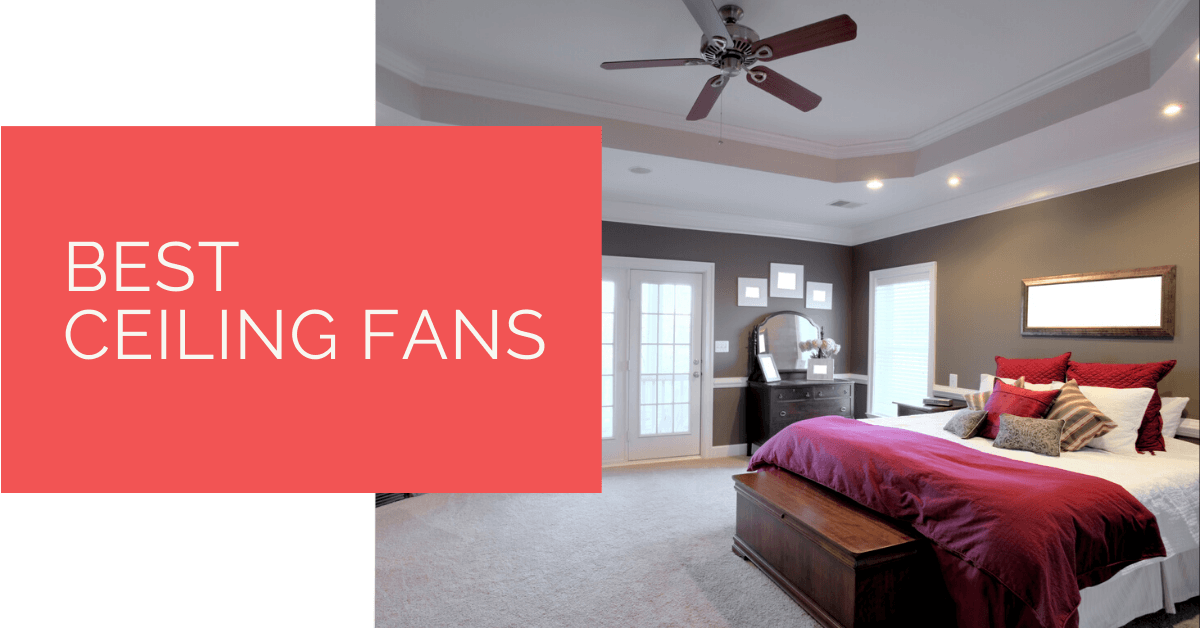
Ceiling fans are one of those rare home improvements that genuinely earn their keep all year round. In summer they keep you cool by circulating air and creating a wind-chill effect; in winter, simply reverse the motor and they push warm air back down from the ceiling. The Airwit 106cm Silent DC Ceiling Fan is our top pick, combining a whisper-quiet DC motor, six speed settings, full reversibility, and genuine value at around £117.
Whether you’re after a flush-mount model for a low ceiling, a smart fan you can control via Alexa, or a premium statement piece for a living room, there’s more choice on Amazon UK than ever before. Here’s what we found after testing and researching the current market.
Contents
- 1 Our Top Picks
- 2 8 Best Ceiling Fans
- 2.1 1. Airwit 106cm Silent DC Ceiling Fan
- 2.2 2. DWDVBL 50cm Smart Flush Mount Ceiling Fan
- 2.3 3. YOLEDY Smart 88cm Alexa Ceiling Fan
- 2.4 4. Ensenior 60cm Flush Mount DC Ceiling Fan
- 2.5 5. Depuley 52″ Walnut Ceiling Fan with App & Remote
- 2.6 6. VONLUCE 52″ Black Indoor/Outdoor Ceiling Fan
- 2.7 7. DIAMONDFORGE 20″ Fandelier Ceiling Fan
- 2.8 8. Hunter 42″ Low Profile Premium Ceiling Fan
- 2.9 Key Takeaways
- 2.10 How Ceiling Fans Work: Summer and Winter
- 2.11 AC vs DC Motors
- 2.12 Blade Span and Room Sizing
- 2.13 Mounting Types and Ceiling Height
- 2.14 Things to Keep in Mind Before Buying
- 2.15 Types of Ceiling Fan
- 3 Case Study: Ceiling Fan Installation in a Victorian Terraced House
- 4 Expert Insights From Our Heating Engineers About Ceiling Fans
- 5 Frequently Asked Questions
- 5.1 Do ceiling fans actually cool a room?
- 5.2 Can ceiling fans be used in winter?
- 5.3 What size ceiling fan do I need?
- 5.4 How much does it cost to run a ceiling fan?
- 5.5 Do I need an electrician to install a ceiling fan?
- 5.6 What is the difference between AC and DC ceiling fan motors?
- 5.7 Can ceiling fans be used on low ceilings?
- 6 Summing Up
Our Top Picks
| Image | Name | |
|---|---|---|
| Airwit 106cm Silent DC Ceiling Fan | |
| DWDVBL 50cm Smart Flush Mount Ceiling Fan | |
| YOLEDY Smart 88cm Alexa Ceiling Fan | |
| Ensenior 60cm Flush Mount DC Ceiling Fan | |
| Depuley 52" Walnut Ceiling Fan | |
| VONLUCE 52" Black Indoor/Outdoor Ceiling Fan | |
| DIAMONDFORGE 20" Fandelier Ceiling Fan | |
| Hunter 42" Low Profile Premium Ceiling Fan |
8 Best Ceiling Fans
1. Airwit 106cm Silent DC Ceiling Fan
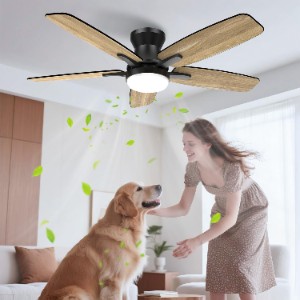
If you want a ceiling fan that genuinely disappears into the background, acoustically speaking, this is the one to buy. The Airwit 106cm uses a DC motor rather than a conventional AC motor, and the difference is immediately noticeable. At low and medium speeds you’ll struggle to hear it at all. At full speed there’s a faint hum, but nothing you’d call disruptive. For a bedroom or living room where background noise matters, this is exactly what you want.
The 106cm blade span makes it well-suited to rooms of around 15 to 25 square metres. Smaller than that and you’ll get more air movement than you need; larger and you might want to look at two fans rather than one. It comes with a full-function remote control that handles speed selection (six settings), lighting brightness, and the reversible motor mode. The summer setting pushes air downward for that cooling wind-chill effect; the winter setting runs the blades in reverse at low speed to gently redistribute warm air that collects near the ceiling.
Build quality is solid for the price. The blades feel well-balanced out of the box, which matters for quiet running. There’s an integrated LED light fitting that delivers a clean, neutral-white output, and brightness is adjustable via the remote. Installation is straightforward if you’re replacing an existing ceiling rose, though first-time installation into a new position will need an electrician.
With 388 reviews averaging 4.8 stars, this has a genuinely strong track record. It’s not the cheapest option on this list, but it comfortably outperforms fans costing twice the price in terms of noise and build. Our top recommendation without hesitation.
Features
- 106cm (42″) blade span
- Energy-efficient DC motor
- 6 speed settings, summer/winter reversible operation
- Integrated dimmable LED light
- Full-function remote control included
- Timer function
- Low noise operation
- Exceptionally quiet DC motor
- Six speeds gives genuinely fine control
- Reversible for year-round use
- Strong customer satisfaction record
- Professional installation recommended if no existing rose
- 106cm may be too large for small rooms
2. DWDVBL 50cm Smart Flush Mount Ceiling Fan
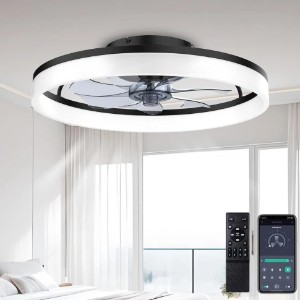
If budget is the main consideration and you have a smaller room or a low ceiling to deal with, the DWDVBL 50cm flush mount is hard to argue with at under £65. It sits tight against the ceiling, making it workable in rooms where a pendant-style fan simply wouldn’t fit, and the smart functionality, including app control alongside the standard remote, is a genuine bonus at this price point.
The 50cm blade span means it’s best suited to rooms up to around 12 square metres: a small bedroom, a home office, or a hallway. Don’t expect it to shift serious air in a large open-plan space. What it does well, it does reliably. Three speed settings, a reversible motor, and a dimmable LED light round out the feature set. With 268 reviews at 4.7 stars, it’s clearly a quality product for the money.
Features
- 50cm blade span, flush-mount design
- Smart app control plus remote
- 3 speed settings, reversible motor
- Dimmable LED light
- Suitable for low ceilings
- Excellent value at under £65
- Flush mount works on low ceilings
- Smart app control included
- Only 3 speeds
- 50cm is small — not suitable for large rooms
- AC motor, so slightly noisier than DC alternatives
3. YOLEDY Smart 88cm Alexa Ceiling Fan
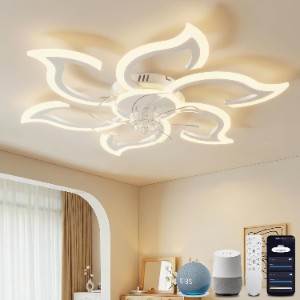
For anyone who’s built a smart home around Alexa or Google Assistant, the YOLEDY 88cm is the most accessible way to add a ceiling fan to your setup without breaking the bank. At £79.99 you get Wi-Fi connectivity, full voice control compatibility, and app control from anywhere. That means you can have the fan running before you even walk into the room, which is a legitimately useful feature on a hot summer evening.
The 88cm blade span covers the middle ground nicely, suitable for rooms up to around 18 square metres. Six speeds and a reversible DC motor make it genuinely versatile, and the LED light has colour temperature adjustment as well as dimming, so you can shift from warm white in the evening to cooler daylight tones during the day. It’s a well-thought-out package.
With 203 reviews at 4.7 stars it’s a relatively newer product, but the ratings suggest it’s hitting its stride. Setup is reported to be straightforward, with the app walking you through the Wi-Fi pairing process. The one area where it can’t quite match the Airwit is sheer build quality, but at £80 that’s a fair trade.
Features
- 88cm blade span
- DC motor, reversible
- Alexa and Google Assistant compatible
- App + remote control
- 6 speed settings
- Dimmable LED with colour temperature adjustment
- Voice control at a very accessible price
- Colour temperature adjustment on the LED
- DC motor for quieter, efficient running
- Requires stable Wi-Fi for smart features
- Build quality a step below the Airwit
- Fewer reviews than established alternatives
4. Ensenior 60cm Flush Mount DC Ceiling Fan
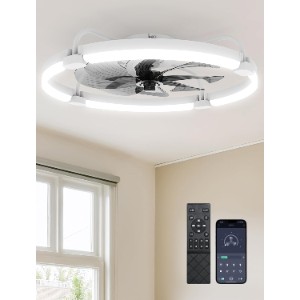
Low ceilings tend to rule out a lot of ceiling fan options, but the Ensenior 60cm flush mount is designed specifically for that situation. It sits flat to the ceiling rather than hanging down on a rod, so you lose minimal headroom. The 60cm blade span slots into the gap between the very compact 50cm models and the larger 80cm-plus fans, making it useful for medium-small rooms where a 50cm would feel underpowered.
The DC motor is the standout specification for this price bracket. You get quieter operation and lower energy consumption than AC-motor alternatives, plus six speed settings that give you real control over airflow rather than having to choose between full blast and low. The reversible motor works well in winter mode too, and the remote makes switching between summer and winter operation easy without needing to get on a step ladder.
313 reviews at 4.7 stars is a reassuring track record for a flush-mount design. The integrated LED delivers good light output for a room of this size. Overall, this is a strong mid-range option for anyone prioritising ceiling clearance without wanting to compromise too much on performance.
Features
- 60cm blade span, flush mount design
- DC motor, reversible
- 6 speed settings
- Remote control included
- Integrated LED light
- Low-profile build for low ceilings
- Flush mount suits low ceilings
- DC motor is quieter and more efficient
- 6 speeds for fine control
- 60cm may feel underpowered in larger rooms
- No smart/app control
- Light output modest compared to dedicated fittings
5. Depuley 52″ Walnut Ceiling Fan with App & Remote
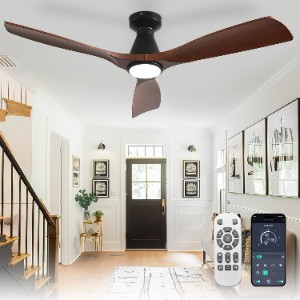
Most ceiling fans look like appliances. The Depuley 52″ walnut model is one of the few on this list that looks like a piece of furniture. The warm walnut-effect blades and brushed finish give it a natural, Scandi-adjacent aesthetic that sits well in living rooms and bedrooms where the fan will be a visible focal point. If the look of the fan matters as much as the function, this is worth serious consideration at £99.99.
Function is solid too. The 52″ (132cm) blade span is among the largest on this list, making it suited to rooms of up to 25 square metres or so. App control and a physical remote are both included, and the DC motor keeps things quiet across all six speed settings. The reversible motor handles winter circulation duty competently, and the integrated LED has dimming capability.
With 174 reviews at 4.7 stars it’s a newer product, but the positive feedback is consistent. A few reviewers note that installation takes a bit longer than more basic models due to the blade mounting system, but nothing that requires specialist skills beyond basic DIY confidence.
Features
- 52″ (132cm) blade span
- Walnut-effect blades with brushed finish
- DC motor, reversible
- App + remote control
- 6 speed settings
- Dimmable LED light
- Distinctive, attractive walnut aesthetic
- Large 132cm span for bigger rooms
- App control included
- Installation slightly more involved than basic models
- Walnut finish won’t suit all interiors
- Fewer reviews than some alternatives
6. VONLUCE 52″ Black Indoor/Outdoor Ceiling Fan
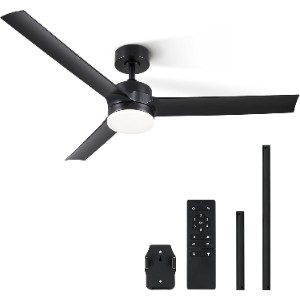
A ceiling fan rated for outdoor use is a niche requirement, but if you have a covered porch, a glazed veranda, or an outdoor kitchen with a sheltered ceiling, indoor-only fans simply aren’t designed for the humidity and temperature variation involved. The VONLUCE 52″ is one of the few fans on Amazon UK rated for outdoor installation, which makes it essentially the default choice for that use case.
Indoors it works perfectly well too. The matte black finish is clean and contemporary, and at 52″ (132cm) it moves serious air. The remote control handles all the basics: speed, light, and reverse. The 4.4-star rating from 214 reviews reflects a product that delivers on its primary promise, with occasional criticism around the instruction clarity for first-time ceiling fan installers.
At £104.99 it’s fair value for a weatherproof fan. If your installation is purely indoor, you’d be better served by one of the DC-motor options on this list. But for outdoor or mixed-use locations, this is the one to go for.
Features
- 52″ (132cm) blade span
- Rated for indoor and outdoor (covered) use
- Matte black finish
- Remote control included
- Reversible motor
- Integrated LED light
- Genuinely rated for outdoor use
- Large 52″ span
- Clean contemporary aesthetic
- 4.4 stars rather than 4.7-4.8 of top picks
- Instructions reported as unclear
- AC motor — noisier than DC alternatives
7. DIAMONDFORGE 20″ Fandelier Ceiling Fan
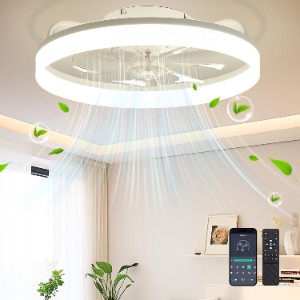
A fandelier combines the function of a ceiling fan with the appearance of a chandelier-style light fitting. It’s a decorative compromise — you’re sacrificing raw airflow for aesthetics — but for hallways, dining rooms, or any space where a standard fan would look out of place, it solves the problem neatly. The DIAMONDFORGE 20″ is the most distinctive product on this list, and at £129.99 it’s priced fairly given the design work involved.
At 20″ (51cm) the blade span is compact. This is not a serious cooling machine for a hot summer’s day; it’s an air circulator and light fitting combined, best suited to spaces of 10 to 15 square metres where aesthetics take priority. The 88 reviews at 4.8 stars is impressive for a newer product, suggesting the people buying it are getting exactly what they expected. Worth considering if you want something that looks genuinely different.
Features
- 20″ (51cm) fandelier design
- Chandelier-style LED light fixture
- Remote control included
- Reversible motor
- Decorative finish
- Distinctive chandelier aesthetic
- 4.8-star rating from early buyers
- Good solution for decorative spaces
- 20″ span — limited airflow in larger rooms
- Fewer reviews than established products
- Style-led rather than performance-led
8. Hunter 42″ Low Profile Premium Ceiling Fan
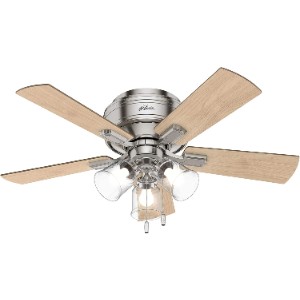
Hunter is the closest thing the ceiling fan market has to a heritage brand. They’ve been making ceiling fans for well over a century, and that experience shows in how the 42″ Low Profile is engineered. The motor is exceptionally smooth. The balancing is precise from the factory. The finish quality is noticeably a step above everything else on this list. At £496 it should be, but if you want the best ceiling fan money can buy in the UK without going into specialist territory, this is a serious contender.
The low-profile design keeps blade clearance reasonable despite the 42″ (107cm) span, making it workable in rooms where a hanging rod would cause problems. With 1,820 reviews at 4.8 stars it has by far the most established track record on this list, and the consistency of positive feedback across that volume of reviews is telling. Buyers report it lasting many years without developing the vibration or noise issues that plague cheaper alternatives.
It’s an honest premium product. If £500 is within budget and you want a ceiling fan that you’ll never need to think about again, this is the one to choose. If you’re price-conscious, the Airwit delivers the best performance-per-pound further up this list.
Features
- 42″ (107cm) blade span, low-profile design
- Premium Hunter motor
- Remote control included
- Reversible motor
- Established brand with long warranty
- 1,820+ reviews at 4.8 stars
- Best build quality and longevity
- Largest review base — consistently excellent
- Heritage brand with genuine track record
- Whisper-quiet motor
- £496 is a significant investment
- 42″ may feel modest for large rooms
Key Takeaways
- DC motor ceiling fans use 40 to 70% less electricity than AC motor models. A DC ceiling fan typically draws 15 to 35W; an equivalent AC fan draws 50 to 100W. At 27p/kWh running 8 hours a day for 90 summer days, the saving is £3 to £7 per fan, modest for one room but significant across multiple rooms
- Ceiling fans cool through the wind-chill effect in summer. They do not lower air temperature. In winter, most fans include a reverse function: the motor runs slowly in reverse to push warm air trapped at the ceiling back down into the occupied zone, reducing heating costs by 5 to 10% in rooms with high ceilings
- Blade span determines airflow. A 52-inch (132cm) fan suits rooms up to 25m²; a 42-inch (107cm) fan suits rooms up to 15m²; larger 60-inch (152cm) fans suit living rooms and open-plan spaces up to 35m² and above. Using a fan that’s too small creates noise without useful airflow
- Ceiling height determines which mounting type you need. Standard drop-rod mounting suits ceilings above 2.7m; flush-mount (hugger) fans attach directly to the ceiling box and suit rooms with 2.4m ceilings. Below 2.1m, ceiling fans are not safe to install
- Ceiling fans require a hardwired electrical connection, not a plug socket. Installation means connecting to the lighting circuit or running a new spur. If you’re not comfortable with electrical work, factor in the cost of an electrician (typically £80 to £150 for a straightforward installation)
- Smart ceiling fans connect via Wi-Fi and integrate with Alexa, Google Home, and Apple HomeKit. They allow scheduling, speed control by voice or app, and integration with smart home automations. For a bedroom fan, smart control is a genuine quality-of-life feature
- Weight matters for installation. Ceiling fans are heavier than light fittings (typically 4 to 12kg). They must be mounted to a fan-rated ceiling box (also called a pancake box), not a standard light fitting box. Most standard UK ceiling roses are not rated to support a spinning fan
How Ceiling Fans Work: Summer and Winter
In summer, ceiling fans spin counter-clockwise (when viewed from below), creating a downdraft of air. This moving air accelerates evaporation from skin, creating a cooling sensation of 3 to 5°C without actually lowering room temperature. You can raise the thermostat set point by the same amount and save on air conditioning running costs, or simply use the fan alone in milder UK summers.
In winter, the reverse direction (clockwise when viewed from below) creates an updraft along the ceiling. Warm air naturally rises and stratifies at the ceiling in rooms with any height. A ceiling fan in winter mode gently circulates this trapped warm air back down without creating a cold draught at sitting level. The benefit is most pronounced in rooms with ceiling heights above 2.7m, conservatories, and open-plan spaces where stratification is significant. In a standard 2.4m ceiling room, the effect is modest.
The key is running the fan slowly in winter mode. High-speed reverse creates a noticeable downdraft that defeats the purpose. Most ceiling fans with a winter mode are set to low speed automatically when reversed.
AC vs DC Motors
AC (alternating current) motors are the traditional ceiling fan design. They run on mains power directly, are simple and reliable, and typically offer 3 speed settings. At 50 to 100W, they cost around £4 to £9 per month running 8 hours daily through summer. They hum slightly at low speeds, which is noticeable in quiet bedrooms.
DC (direct current) motors use an electronic controller to vary speed precisely. This produces several benefits: much lower power draw (15 to 35W), up to 6 speed settings including very slow speeds for near-silent background airflow, and quieter operation because the motor generates less electromagnetic noise. Premium DC fans run almost silently at low speed. The trade-off is price: a decent DC ceiling fan costs £80 to £200; an equivalent AC model costs £40 to £100.
For a bedroom or living room fan used regularly through summer, the DC motor’s quieter operation and lower running cost justifies the premium. For an occasional-use room or utility space, AC is adequate.
Blade Span and Room Sizing
Match fan size to room area for effective circulation without excessive noise:
- Up to 10m²: 36-inch (91cm) fan. Suitable for small bedrooms and box rooms. Smaller fans move less air per rotation but are quieter at equivalent speeds
- 10 to 15m²: 42-inch (107cm) fan. The most common size for standard UK double bedrooms and home offices
- 15 to 25m²: 52-inch (132cm) fan. The standard choice for master bedrooms, dining rooms, and living rooms
- 25m² and above: 60-inch (152cm) fan or two smaller fans. Large living rooms, conservatories, and open-plan spaces benefit from two fans positioned to circulate air across the full floor area
Blade pitch (the angle at which blades are set) also affects airflow. A pitch of 12 to 15° moves more air per revolution than a shallower 8 to 10°. Manufacturers’ stated CFM (cubic feet per minute) figures are measured at maximum speed in test conditions; real-world airflow at a comfortable mid-speed will be somewhat lower.
Mounting Types and Ceiling Height
Standard ceiling fans hang from a drop rod, placing the blade assembly 300 to 450mm below the ceiling. This suits rooms with ceilings of 2.7m or more, where the fan blades will be at least 2.1m above the floor (the minimum safe clearance for a spinning fan). For rooms with standard UK ceilings of 2.4m, flush-mount (hugger) fans mount the motor directly to the ceiling without a drop rod. Blade clearance from the floor is reduced to around 2.1 to 2.2m, which is acceptable for most adults but worth measuring in rooms with unusually low ceilings.
Angled ceiling adapters are available for sloped ceilings such as in loft conversions and rooms under a pitched roof. The angle adapter allows the fan to hang vertically even when the ceiling is sloped. Most adapters accommodate slopes up to 45°.
Things to Keep in Mind Before Buying
Check the existing ceiling box before buying. UK ceiling fans require a fan-rated ceiling box capable of supporting the dynamic load of a spinning motor (typically rated to 35kg). Most standard ceiling roses are not rated for this. Replacing the ceiling box adds 20 to 30 minutes to installation but is essential for safe mounting.
Integrated light kits are available on most ceiling fans and replace the ceiling light entirely. This is a practical combination for bedrooms and living rooms where you want both air movement and overhead lighting from a single fitting. Check that the light kit uses standard E27 or GU10 bulbs; proprietary fittings make bulb replacement inconvenient.
Remote controls and pull chains are the two standard control methods. Pull chains require reaching up to the fan to change speed or toggle the light, which is impractical for fans mounted high. Remote controls (included with most mid-range and premium fans) allow adjustment from anywhere in the room. Smart fans allow phone app and voice control.
Types of Ceiling Fan
Standard AC ceiling fans are the budget-friendly choice for occasional use, garages, conservatories, and rental properties. 3 speed settings, reliable motor, basic pull-chain or remote control. Output 50 to 100W. Price range £40 to £100.
DC ceiling fans are the right choice for bedrooms and living rooms where quiet operation and energy efficiency matter. 6 speed settings, near-silent at low speed, significantly lower running costs. Best UK examples include Hunter, Westinghouse DC, and Devanti models. Price range £80 to £200.
Smart ceiling fans add Wi-Fi connectivity, app control, and voice assistant integration. Useful for scheduling the fan to start before you arrive home, or setting temperature-triggered automation. Depuley, Hunter, and Fanimation offer smart models compatible with UK smart home systems. Price range £100 to £300.
Designer ceiling fans combine function with aesthetics: wooden blades, brushed nickel or matte black finishes, and integrated dimmable LED light kits. Suitable for living rooms and dining rooms where the fan is a prominent visual feature. Brands including Westinghouse, Monte Carlo, and Beacon Lighting at the premium end. Price range £150 to £500.
Case Study: Ceiling Fan Installation in a Victorian Terraced House
Background
A homeowner in south London with a Victorian mid-terrace was experiencing significant temperature variation between floors. The upstairs bedrooms were uncomfortably warm during the summer, and the open-plan ground floor lost heat rapidly in winter despite good insulation.
Project Overview
The brief was to install two ceiling fans: one in the main bedroom and one in the living room. The bedroom had a 2.5m ceiling height and an existing ceiling rose, making installation relatively straightforward. The living room had 2.7m ceilings and no existing fan or pendant light fitting, requiring an electrician to run a new spur.
Implementation
The bedroom received a flush-mount DC fan to maintain headroom clearance, while the living room used a standard pendant-style fan with a short drop rod. Both were fitted with remote controls. Installation of the bedroom fan took around two hours including painting the ceiling rose. The living room required a half-day electrician visit to install the appropriate wiring and ceiling support bracket.
Results
The homeowner reported that the bedroom was noticeably more comfortable during the following summer and that the fan ran quietly enough not to disturb sleep. In winter, using the reverse function on low speed noticeably reduced the time the radiators needed to run to maintain temperature. The living room fan performed similarly. Total energy cost for both fans running daily through summer was under £10 for the season.
Expert Insights From Our Heating Engineers About Ceiling Fans
One of our senior heating engineers with over 18 years of experience in residential ventilation and cooling systems has this to say about ceiling fans in UK homes: “The biggest mistake people make is treating ceiling fans as a summer-only product. The reversible motor in a modern ceiling fan, running slowly in reverse during winter, is one of the most cost-effective ways to improve heating efficiency in a room with a high ceiling. You’re redistributing heat that’s already there rather than generating new heat.”
He adds: “DC motors have genuinely transformed the product category in the last five years. The energy consumption is a fraction of what older AC-motor fans used, and the noise reduction is remarkable. I’d always recommend specifying DC over AC now, even at a small price premium, because the efficiency savings over the lifetime of the fan are significant.”
On installation: “A ceiling fan needs proper support in the ceiling joist or a rated fan-brace bracket — a standard electrical box is not strong enough for the dynamic load a spinning fan creates. If you’re replacing an existing light fitting that’s just on a standard box, get an electrician to check the mounting before you install the fan. It’s a straightforward job but important to get right.”
Frequently Asked Questions
Do ceiling fans actually cool a room?
Not in the way an air conditioner does. Ceiling fans don’t lower the air temperature; they create a wind-chill effect that makes the air feel cooler against your skin. The difference can be around 3-4°C in perceived temperature, which is enough to make a warm room feel comfortable without any refrigeration. Because of this, it’s best to turn ceiling fans off when you leave the room, since the cooling effect is personal rather than spatial.
Can ceiling fans be used in winter?
Yes — this is one of their underrated benefits. Most ceiling fans include a reversible motor. Running the fan in reverse at low speed during winter pushes warm air down from the ceiling, where it naturally collects, back into the living space. This can improve heating efficiency noticeably in rooms with ceilings above 2.5m and reduce the time your heating needs to run.
What size ceiling fan do I need?
Blade span is the key measurement. For rooms under 12m², a 45-60cm fan is appropriate. Rooms of 12-20m² suit 75-90cm fans. For larger rooms up to 25m², look at 100cm-plus. As a simple rule, it’s better to slightly oversize than undersize — a larger fan running at lower speed is quieter and moves more air than a small fan at full speed.
How much does it cost to run a ceiling fan?
Very little. A typical AC-motor ceiling fan uses around 50-75W, while a DC-motor fan may use as little as 15-35W. At current UK electricity rates, running a 35W DC fan for eight hours a day costs roughly 10-15p. Over a full summer, that’s around £8-12. Compare that to a portable air conditioner at 900-2,000W and the economics are clear.
Do I need an electrician to install a ceiling fan?
It depends on your setup. If you’re replacing an existing ceiling pendant light with an existing ceiling rose and proper support bracket, a competent DIYer can handle it with the instructions provided. If there’s no existing electrical provision or if the current mounting point is only rated for a static light fitting, an electrician should assess the wiring and mounting before installation. The ceiling fan bracket must be supported by a joist or a rated fan-brace bar — not just a standard electrical box.
What is the difference between AC and DC ceiling fan motors?
AC motors use alternating current directly from the mains. They’re simpler, cheaper to manufacture, and have been the standard for decades, but they’re less efficient and tend to be noisier. DC motors use a built-in converter to run at lower voltages, making them significantly more energy efficient (typically 70% less power consumption) and noticeably quieter. DC motors also allow for finer speed control — you’ll typically get six or more settings versus the three speeds common on AC fans. The trade-off is cost: DC fans tend to run £20-40 more expensive at equivalent specifications.
Can ceiling fans be used on low ceilings?
Yes, with the right type. You need a minimum of 2.1m clearance between the floor and blade tips for safety. For ceilings at 2.2-2.4m, a flush-mount (hugger) ceiling fan that sits flat to the ceiling without a drop rod is the appropriate choice. The DWDVBL 50cm and Ensenior 60cm on this list are both flush-mount designs. Standard pendant fans with drop rods are for ceilings of 2.5m and above.
Summing Up
The Airwit 106cm Silent DC Ceiling Fan is the clear standout for most homes: quiet, efficient, well-reviewed, and priced sensibly at around £117. If you have a low ceiling, the Ensenior 60cm flush-mount is our pick. For smart home integration without spending a fortune, the YOLEDY 88cm Alexa model is a strong choice. And if budget is tight and the room is small, the DWDVBL 50cm does the basics reliably for under £65.
For a wider look at portable cooling and air movement options, see our guides to the best pedestal fans and best bladeless fans.
Updated