
If you’re after a heater that warms up fast, stays quiet, and doesn’t cost a fortune to run, a ceramic heater is one of the smartest choices you can make. They use PTC (positive temperature coefficient) ceramic heating elements that self-regulate temperature, meaning they’re more efficient than old-fashioned wire-element heaters and safer too. The Dreo Atom 316 is our top pick — it’s the best-selling ceramic heater on Amazon UK for a reason, with over 10,000 reviews and a price that’s hard to argue with. But there are excellent options at every price point, and the right one really depends on your room size and how you plan to use it.
We’ve tested and researched the best ceramic heaters currently available on Amazon UK, covering compact desk heaters, oscillating tower models, smart Wi-Fi options, and wall-mounted units. Here’s what we found.
Our Top Picks
| Image | Name | |
|---|---|---|
| Dreo Atom 316 Ceramic Heater | |
| Dreo Solaris Slim H3 | |
| Olsen & Smith 1800W Smart Ceramic Heater | |
| PELONIS 2000W Ceramic Tower Heater | |
| Dreo 16 Inch Tower Ceramic Heater | |
| AIRMATE 25 Inch Tower Ceramic Heater | |
| Dreo Atom 320 Compact Ceramic Heater | |
| Dreo Smart Wall-Mounted Ceramic Heater |
8 Best Ceramic Heaters
1. Dreo Atom 316 Ceramic Heater
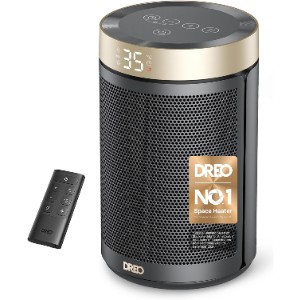
More than 10,000 Amazon UK reviews don’t lie: the Dreo Atom 316 has earned its place as the go-to ceramic heater for most people. At £39.99, it delivers 1,500W of PTC ceramic heat, a proper remote control, a 12-hour timer, and a thermostat that lets you dial in your preferred temperature to within 1°C. It warms up noticeably fast, reaching comfortable heat within seconds of switching on rather than the slow build you get with panel heaters or oil-filled radiators.
Dreo’s Hyperamics technology pushes warm air further than a standard desk heater, and the tip-over sensor is more reliable than older models. The V0 flame-retardant casing and overheat cutout are standard across this price bracket, but the safety plug is a thoughtful extra. The gold finish looks more considered than the usual white or black plastic.
Who it suits: anyone heating a bedroom, home office, or smaller living room who wants something straightforward that works well out of the box. Who it doesn’t suit: anyone wanting smart home integration or who needs to heat a room bigger than about 18 square metres. For those use cases, step up to one of the models below.
Features
- 1,500W PTC ceramic heating element
- Thermostat adjustable from 5-35°C in 1°C increments
- 3 heating modes plus 12-hour programmable timer
- Remote control included
- Tip-over and overheat protection, V0 flame-retardant materials
- Compact freestanding design
- Exceptional value at under £40 with remote included
- Heats up within seconds of switching on
- Precise thermostat with 1°C increments
- Over 10,000 Amazon UK reviews — battle-tested reliability
- No Wi-Fi or smart home integration
- Best suited to smaller rooms rather than large open spaces
2. Dreo Solaris Slim H3 Ceramic Heater
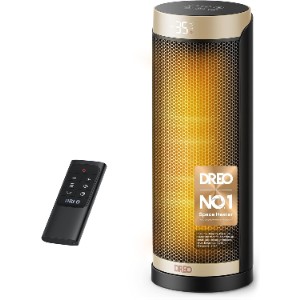
The Solaris Slim H3 is the answer to a specific question: is it worth spending £18 more than the Atom 316? For two groups of people, yes. If you’re placing this in a bedroom where you’ll be sleeping, the 34dB noise floor is genuinely quieter than the Atom 316 and the difference is noticeable in a quiet room at night. And if your room is 18-25 square metres, the 2,000W output and 70° oscillation give you meaningfully better coverage than a 1,500W model with no sweep.
The trackball oscillation is one of those small engineering details that matters. Cheaper oscillating heaters develop a clicking or grinding noise from their motor within months of use. Dreo’s trackball system runs smoothly and quietly, which matters because it’s running while you’re in the room. With over 4,200 reviews at 4.5 stars, reliability isn’t in question here.
If your room is small and noise doesn’t bother you, save the money and get the Atom 316. If you’re heating a medium-to-large bedroom or you’re a light sleeper, the Solaris Slim H3 is the more sensible purchase.
Features
- 2,000W PTC ceramic heating element
- 70° wide-angle oscillation with trackball system
- 34dB operating noise
- 3 modes and 12-hour timer
- Tip-over and overheat protection
- Slimline tower design
- 34dB is excellent for bedroom and study use
- 2,000W covers rooms the Atom 316 can’t handle alone
- Smooth trackball oscillation stays quiet over time
- 4,200+ reviews confirms consistent long-term performance
- No smart home or Wi-Fi capability
- Extra spend only justified for larger rooms or light sleepers
3. Olsen & Smith 1800W Smart Ceramic Heater
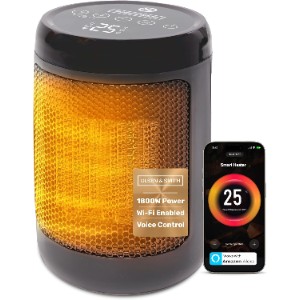
Full Wi-Fi, Tuya app, Alexa, a built-in display, and ECO mode for £29.99. If those words appeal to you, this is the one to buy. The spec sheet would be impressive at £60; at £30 it’s exceptional. For anyone who wants to turn the heating on from bed or set it on a schedule from their phone without spending Dreo’s premium prices, this is genuinely the best value on this list.
It’s a compact tabletop unit rather than a tower, which limits it to smaller rooms. And it’s a newer product with fewer reviews than the established Dreo models, so you’re taking a small bet on long-term reliability. The early review pattern is positive, but with any newer brand you’re not getting the 4,000+ verified reviews that back up the Dreo range. If smart control is non-negotiable and the room is small, buy this. If reliability track record matters more than smart features, step up to the Atom 316 or the wall-mounted Dreo below.
Features
- 1,800W PTC ceramic heating element
- Wi-Fi / Tuya app / Alexa voice control
- Touch controls with digital temperature display
- Thermostat from 5-35°C with ECO mode
- Tip-over and overheat protection
- Compact tabletop freestanding design
- Best-value smart heater on this list by some margin
- App and Alexa control for remote management
- ECO mode cycles output to reduce running costs
- Compact size limits it to smaller rooms
- Fewer reviews than the established Dreo models
- No remote control included
4. PELONIS 2000W Ceramic Tower Heater
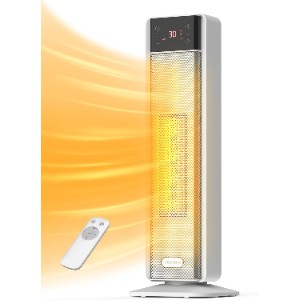
PELONIS uses dual DC motors rather than a single motor, which gives this heater a meaningfully wider heat coverage than similarly priced single-motor models. The 23-inch heating screen and 75° horizontal oscillation are both broader than what the Dreo freestanding towers offer at this price. In an open-plan living room or a larger bedroom where you want heat spread across the whole space rather than directed from one point, that engineering difference is worth knowing about.
The 24-hour timer, ECO mode, and 5-35°C thermostat are all solid. It’s slightly louder than the Solaris Slim H3 at full power, but acceptable for daytime use. Worth choosing if you want a capable non-Dreo option, particularly if you have a room that needs broader coverage than the Dreo towers provide.
Features
- 2,000W dual-motor PTC ceramic heating
- 75° wide oscillation with 23-inch heating screen
- 3 modes (High, Low, ECO) with 5-35°C thermostat
- 24-hour programmable timer
- Tip-over and overheat protection
- Tower freestanding design
- Dual-motor design gives wider heat coverage than most
- 75° oscillation is broader than the Dreo freestanding towers
- 24-hour timer is more flexible than 12-hour models
- Fewer reviews than the Dreo range at this price
- No smart home connectivity
- Slightly louder than the Solaris Slim H3 at full output
5. Dreo 16 Inch Tower Ceramic Heater
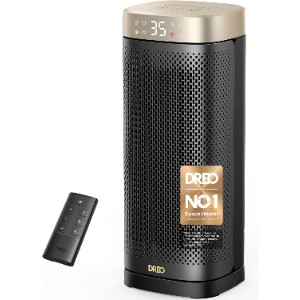
This is the most capable freestanding Dreo on the list, and if you want a mid-sized room heated quickly with a product backed by serious review numbers, it’s the obvious choice. The Hyperamics airflow technology Dreo claims delivers warm air at 11.6 feet per second, which in practice means a larger room reaches comfortable temperature faster than with a standard 2,000W tower. Add 70° oscillation and 3,500 reviews at 4.6 stars, and you have the best-reviewed large-format ceramic heater currently available on Amazon UK.
At £74.99 it’s the priciest freestanding heater on this list, but the Shield360° safety system (tip-over, overheat, auto-off, and V0 flame-retardant casing), the 1°C thermostat precision, and the Dreo build quality make it feel like money well spent. Check the price relative to the Solaris Slim H3 before buying, though: if they’re within £10 of each other, this is the better product. If the gap is wider, the Solaris Slim H3 delivers most of the benefit for less.
Features
- 2,000W PTC ceramic with Hyperamics airflow technology
- 70° wide-angle oscillation
- 5-35°C thermostat in 1°C increments
- Remote control and 3 heating modes
- Shield360° safety system
- 16-inch tower freestanding design
- Hyperamics airflow heats larger rooms faster than standard 2,000W models
- 3,500+ reviews at 4.6 stars — outstanding track record
- Shield360° safety suite is the most comprehensive on this list
- 1°C thermostat precision is rare at this price
- No smart home connectivity
- Priciest freestanding heater here — check price gap vs. Solaris Slim H3
6. AIRMATE 25 Inch Tower Ceramic Heater
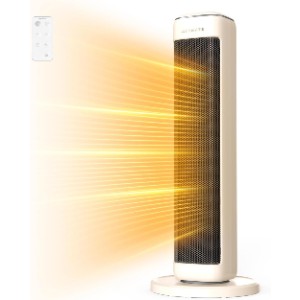
The AIRMATE stands out on two specs: 80° oscillation (widest on this list) and a 25-inch height that gives it a more even heat distribution from floor to sitting level than shorter towers. The all-copper power cord and relay protection circuit are signs that AIRMATE have paid attention to the parts most manufacturers cut corners on. Five heating modes and an 18-35°C thermostat give it more flexibility than the simpler 3-mode models.
The honest caveat: this is a newer product with fewer reviews than the Dreo range, so you’re placing more trust in the spec sheet than in a proven track record. The early signs are positive, but if you want the reassurance of thousands of real-world reviews behind your purchase, the Dreo 16 Inch Tower is the more sensible choice at a similar price. If the wider oscillation and taller format suit your room specifically, the AIRMATE is worth the slight leap of faith.
Features
- 2,000W PTC ceramic heating element
- 80° oscillation — widest on this list
- 5 heating modes with 18-35°C adjustable thermostat
- 24-hour timer with all-copper power cord
- Tip-over and overheat protection
- 25-inch tall tower freestanding design
- 80° oscillation is the widest available at this price
- All-copper cord and relay circuit show quality engineering
- 5 heating modes gives more flexibility than 3-mode alternatives
- Fewer reviews than the established Dreo towers
- Tall format may not suit rooms with limited floor space
- No smart home connectivity
7. Dreo Atom 320 Compact Ceramic Heater
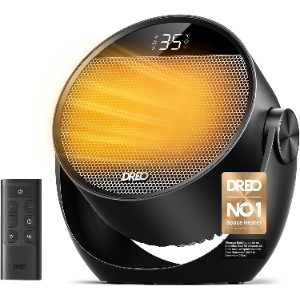
This is the heater for desk workers and armchair readers. The 60° manual tilt adjusts to four positions so you can aim warm air at your feet, your torso, or your face depending on where you’re sitting. Oscillating heaters spread heat around a room; this one directs it at you. For solo heating at a specific spot, that’s actually more efficient. At 34dB with a brushless DC motor, it’s also quiet enough for video calls and light sleepers.
Same price as the Atom 316 at £39.99. The choice between the two is entirely about use case: if you want to warm a whole room, get the Atom 316. If you want personal targeted heat at a desk or by a chair, the Atom 320 is the better tool. Don’t buy both.
Features
- 1,500W PTC ceramic with Hyperamics technology
- 60° manual tilt in 4 positions (0°, 20°, 40°, 60°)
- 34dB operating noise with brushless DC motor
- Remote control and 12-hour timer
- 8 safety certifications including tip-over and overheat protection
- Compact freestanding design
- 4-position tilt directs heat precisely where you’re sitting
- 34dB is quiet enough for video calls and light sleepers
- 8 safety certifications — the most thoroughly tested compact heater here
- Tilt not oscillation — won’t heat a whole room evenly
- Not suited to rooms where more than one person needs warmth
- No smart home integration
8. Dreo Smart Wall-Mounted Ceramic Heater
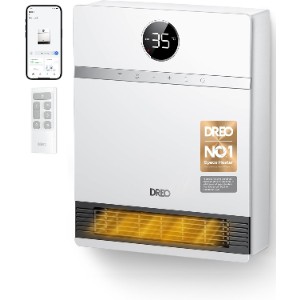
If you can commit to wall-mounting, this is the most impressive heater on the list. At 28dB it’s the quietest model here. It’s IP24-rated, which means it’s certified safe for UK bathroom zones where no freestanding heater should be used. It has full Alexa and Dreo app integration. It takes up zero floor space. And with 2,678 reviews at 4.6 stars, it’s a properly established product rather than a new entrant.
The £89.99 price and the need to drill into a wall immediately rule it out for renters and anyone not prepared to make a permanent commitment. The 30° oscillation is narrower than the freestanding towers, and the wall-mount means you can’t move it between rooms. These aren’t flaws; they’re just the trade-offs that come with the format. For a kitchen, hallway, bathroom, or utility room where floor space is limited and moisture is a factor, this is categorically the right choice. For anywhere else, weigh up whether the smart features and wall-mount justify the premium over the freestanding options.
Features
- Wall-mounted PTC ceramic heater with IP24 waterproofing
- 28dB ultra-silent operation
- Wi-Fi, Dreo app, and Alexa voice control
- 30° manual oscillation with 24-hour timer
- 5VA flame-retardant materials and overheat protection
- Takes up zero floor space once mounted
- IP24 waterproofing — the only bathroom-safe heater on this list
- 28dB is the quietest heater here
- Full smart home integration with Alexa and Dreo app
- Wall-mount frees all floor space
- Wall installation required — not suitable for renters
- Most expensive at £89.99
- 30° oscillation is narrower than freestanding towers
Ceramic Heater Buying Guide
Key Takeaways
- PTC ceramic elements self-regulate temperature, making them safer and more stable than older wire-element heaters
- For a well-insulated UK home, budget 100W per square metre. For an older or draughty property, use 125-150W per square metre
- At current UK electricity rates (around 24p/kWh), a 2,000W heater costs roughly 48p per hour at full power — but thermostat cycling reduces real-world costs to 20-30p/hr in a maintained room
- Oscillation spreads heat more evenly; 70-80° sweep angles are noticeably better for open rooms
- For bedrooms, look for heaters rated below 45dB. For light sleepers, below 35dB
- Only IP24-rated heaters are permitted in UK bathroom zones. Never use a standard heater near water
- ECO mode combined with a proper thermostat can reduce running costs by 20-30% compared to running on full power continuously
What Is a Ceramic Heater?
A ceramic heater uses a PTC (positive temperature coefficient) ceramic heating element rather than a wire coil or metal strip. The key property of PTC ceramics is that their electrical resistance increases as temperature rises, which automatically limits how hot the element gets. This means the heater self-regulates without relying solely on an external thermostat cutting the circuit, making it inherently safer and more stable than older coil-element fan heaters.
Most ceramic heaters pair this element with a fan to distribute warm air around the room, which is why they’re sometimes called ceramic fan heaters. The fan pushes air over the heated ceramic surface and out into the room, giving fast, even warmth rather than the radiant heat of an infrared heater or the slow build of a panel heater.
How Do Ceramic Heaters Work?
Current passes through the PTC ceramic element, which heats up. As it gets hotter, resistance increases and current flow reduces, preventing the element from overheating. A fan draws cool air from the back of the unit, passes it over the ceramic, and expels warm air from the front. Oscillation (on models that have it) rotates the unit horizontally to spread that warm air across a wider arc of the room.
The digital thermostat measures ambient room temperature and cycles the heater on and off to maintain your set point. On ECO mode, the heater typically runs at reduced output rather than full power, which is more economical in a room that’s already partially warm.
Choosing the Right Wattage for Your Room
Getting the wattage right is the most important decision you’ll make. Too little and the heater runs at full power constantly, warming the room inadequately and shortening its own lifespan. Too much and you’re paying for capacity you don’t need, though an oversized model running on ECO mode is still perfectly usable.
As a starting point, use 100 watts per square metre for a modern, well-insulated room. For an older UK property with solid walls, sash windows, or poor draughtproofing, use 125-150W per square metre instead.
- Small bedroom (8-10m²): 800-1,250W — a 1,000-1,500W model is sufficient
- Average bedroom (12-15m²): 1,200-1,875W — a 1,500W model works well, 2,000W gives headroom
- Small living room (18-20m²): 1,800-2,500W — a 2,000W model is at or near its limit in an older property
- Larger living room (25m²+): 2,500W+ — most ceramic heaters top out at 2,000-2,400W, which may be insufficient as a primary heat source in a large or poorly insulated room
One practical note: if your room has high ceilings, a north-facing external wall, or large single-glazed windows, apply the higher multiplier regardless of the construction age. Heat loss in these situations is significant.
Running Costs: What to Budget For
At the current Ofgem price cap rate of around 24p per kWh, here’s what each wattage level costs to run:
- 1,000W: approximately 24p per hour at full power
- 1,500W: approximately 36p per hour at full power
- 2,000W: approximately 48p per hour at full power
In practice, a heater with a working thermostat and ECO mode doesn’t run at full power continuously. Once a room is up to temperature, a well-set thermostat cycling at 50-60% duty cycle brings those costs down to roughly 15-22p/hr for a 1,500W model or 20-29p/hr for a 2,000W model. Running a 2,000W heater in a bedroom for three hours each evening on a thermostat works out to around £1.40-£2.10 per week — more than manageable as a supplementary heat source.
Where costs escalate is when a heater is undersized for its room or when people set the thermostat too high and leave it on ECO mode in a room that can’t hold heat well. Match the wattage to the room, insulate as best you can (door draught excluders and lined curtains make a real difference), and use a timer so the heater isn’t running while the room is empty.
Safety Features: What to Look For
Every heater on this list includes tip-over protection and overheat cutout as standard. These are the minimum you should accept. Tip-over protection cuts power immediately if the unit falls or is knocked sideways; overheat cutout does the same if internal temperatures exceed a safe limit. V0-rated flame-retardant casing (the highest standard) means the outer shell won’t ignite even if something goes wrong inside.
Beyond those basics, look for cool-touch exteriors if children or pets are present. The ceramic element itself doesn’t get red-hot like an exposed coil, but the outlet grille on some models gets warm enough to cause a burn on brief contact. Check the manufacturer’s guidance on this if it’s relevant to your household.
On placement: keep at least 90cm of clearance from curtains, bedding, furniture, and anything else that could catch. Never place a heater on a carpet if you can avoid it. Plug directly into a wall socket rather than an extension lead, as the current draw can overheat underrated extension cables. And don’t leave any portable heater running unattended overnight regardless of the safety features fitted.
Noise Levels: Which Rooms Need the Quietest Model?
All fan-assisted heaters make some noise. The question is how much and whether it matters for your specific use case.
- Below 35dB: effectively silent in a quiet room. Fine for light sleepers, study use, or video calls. The Dreo Atom 320 (34dB), Dreo Solaris Slim H3 (34dB), and Dreo Wall Heater (28dB) all fall here
- 35-45dB: quiet and unobtrusive. Suitable for most bedroom and study use. You’ll notice it in a silent room but it won’t keep you awake
- 45-55dB: clearly audible in a quiet room, similar to a running refrigerator. Fine for living rooms, kitchens, or when background noise is present
- 55dB+: noticeably loud. Better suited to garages, workshops, or spaces where you don’t need background quiet
Most models don’t publish dB figures prominently, but it’s worth checking before buying if noise is a concern. Models that list it in their spec are often the ones where the engineering puts it in a flattering range.
Controls, Timers and Smart Features: What’s Worth Paying For
A mechanical thermostat is the baseline. A digital thermostat with 1°C increments is noticeably better because it holds the room temperature more accurately without as much cycling. If your heater only has “low, medium, high” without a thermostat, you’re doing manual temperature management yourself, which wastes energy.
A 24-hour timer is more useful than a 12-hour timer for most households. Being able to schedule “on at 6:30am, off at 8:00am, on again at 5:30pm” without touching the heater each day is genuinely convenient and reduces energy waste.
Smart Wi-Fi control (via app or Alexa) is worth paying for if you want to start heating a room before you enter it, track energy usage, or integrate with a broader smart home setup. It’s not essential, but if you already use Alexa or a smart home system, the Olsen and Smith at £29.99 or the Dreo wall heater are both good entry points. The energy tracking features on smart heaters can also reveal useful patterns in how and when you’re using them.
Remote controls are a smaller convenience but worth having. Having to walk across a cold room at midnight to adjust a thermostat by hand is the kind of minor irritation that adds up.
Benefits of Using a Ceramic Heater
Speed is the most obvious advantage. A ceramic fan heater reaches target temperature in minutes, compared to 20-30 minutes for an oil-filled radiator. That makes them well-suited to supplementary heating — topping up a room that central heating keeps at 17°C when you want 21°C — rather than having to maintain heat throughout the day.
They’re compact, portable, and don’t require any installation beyond plugging in (unless you’re going for the wall-mounted option). There are no fumes, no moisture, and almost no residual heat after switching off, which makes them safer around children and easier to store between seasons.
Ceramic Heater vs Oil-Filled Radiator vs Fan Heater
These three product types are often compared, and the right choice depends on how you’re heating.
Ceramic heaters heat fast, cool down fast, are portable and quiet. Best for: supplementary heating, warming a room quickly before use, rooms that are occupied for predictable short periods.
Oil-filled radiators heat slowly (20-30 minutes to reach temperature) but retain heat well after switching off and are the quietest portable option. They’re better for background heating in occupied rooms over longer periods. Running costs are similar to ceramic heaters at the same wattage.
Traditional fan heaters (without PTC ceramic elements) heat quickly like ceramic models but the wire elements run hotter, carry a slightly higher fire risk, and are generally louder. Modern ceramic fan heaters have largely replaced them as the better option at the same price.
Types of Ceramic Heater
Compact tabletop heaters are designed for personal use at close range. They’re the right choice for home offices, beside desks, or by an armchair where you want targeted warmth rather than heating the whole room. Tower heaters are taller freestanding units with wider oscillation, better for whole-room heating. Wall-mounted models take up no floor space and are the best permanent option for kitchens, bathrooms, and hallways. Smart ceramic heaters add Wi-Fi and voice control for scheduling and remote management. Some models combine ceramic heating with a cooling fan for year-round use, which is worth considering if storage space is limited.
Room-Specific Recommendations
For bedrooms, prioritise noise. Any heater above 45dB will be noticeable in a quiet room at night. Use a model with a 1°C thermostat and a timer so you can set it to warm the room before sleep and switch off automatically. A 1,500-2,000W model is sufficient for most UK bedrooms. Position it on the opposite side of the room from the bed so you’re getting ambient warmth rather than direct heat.
For bathrooms, IP24 rating is non-negotiable under UK building regulations. Only the Dreo Smart Wall Heater on this list is bathroom-rated. It also needs to be wall-mounted at the right height and distance from the bath or shower — check the installation guide against your specific bathroom layout.
For living rooms and open-plan spaces, 2,000W and a wide oscillation angle (70-80°) are your most important criteria. A tower heater placed in a corner can sweep warm air across the entire room. For very large rooms (30m²+), consider whether a single ceramic heater is realistic as a primary source or whether you need it alongside central heating rather than instead of it.
For home offices, a compact model with quiet operation and a desk-level tilt (like the Dreo Atom 320) often outperforms a room-filling tower, especially if you’re the only one in the space. Keep an eye on noise during video calls — below 35dB is the safe threshold for most conferencing setups.
Maintenance and Cleaning
Ceramic heaters need very little maintenance, but a small amount of regular attention extends their lifespan significantly.
Every month or so, unplug the heater and wipe the exterior with a dry or slightly damp cloth. Check the air intake and output vents for dust buildup — a soft brush or the crevice tool on a vacuum works well for this. Blocked vents force the motor to work harder and can trigger the overheat protection unnecessarily.
At the start and end of each heating season, give the vents a more thorough clean. If your model allows partial disassembly, the manufacturer’s guide will confirm how to access the interior safely. Check the power cable for any signs of fraying or unusual warmth near the plug, and if the cable shows any damage at all, stop using the heater.
On first use, a faint burning smell is normal as manufacturing residue burns off the element. It should clear within 20-30 minutes. If the smell returns after initial use or is accompanied by unusual sounds, stop using the heater and contact the manufacturer.
Common Mistakes
Buying a heater that’s too small for the room and expecting it to compensate is the most common error. An undersized heater running at full power all the time uses more energy than a correctly sized heater cycling on a thermostat, warms the room less effectively, and wears out faster.
Placing a heater directly under a window or behind a door is also a reliable way to reduce its effectiveness. Under a window, it’s fighting constant heat loss through the glass. Behind a door, airflow is restricted and the sensor reads the temperature at the door rather than in the middle of the room.
Running the heater without setting the thermostat and relying on ECO mode alone is another one. ECO mode adjusts output relative to a target temperature — without a specific temperature set, it defaults to a manufacturer preset that may or may not suit your room. Set the temperature you actually want and let ECO mode do the rest.
When Not to Buy a Ceramic Heater
If you need to heat a room above about 25 square metres as a primary heat source, most ceramic heaters will struggle. They’re designed for supplementary room heating, not whole-house or whole-flat solutions.
If your priority is silent overnight heating over long periods, an oil-filled radiator is a better fit. Oil radiators can run at a whisper and retain warmth for an hour or more after switching off, which ceramic fan heaters don’t do.
If you’re in a rental property and want a bathroom heating solution, a standard ceramic heater isn’t the answer. IP24-rated models are the only safe option, and they require wall installation that most rental agreements don’t permit without landlord approval.
And if your home’s primary heating system is fundamentally inadequate — a broken boiler, no central heating in a cold climate, single-glazed windows throughout — portable ceramic heaters are an expensive stop-gap rather than a real solution. They work well as top-up heating in an otherwise adequately heated home, not as a replacement for a properly functioning heating system.
Quick Buyer Checklist
- What is the room’s square metreage? Use 100W/m² for modern homes, 125W/m² for older properties
- Do you need oscillation (for whole-room heating) or a fixed/tilt option (for personal heating at a specific spot)?
- Is the room a bathroom or wet area? If yes, IP24 rating is required by UK regulations
- Is noise important? Check the dB rating if you’re placing it in a bedroom or study
- Do you want smart/Wi-Fi control? Budget at least £30 for this feature
- Will it be wall-mounted permanently or moved between rooms? Wall-mount models cannot be repositioned
- Have you checked the running cost at your electricity rate against your budget?
- Are you supplementing existing heating or replacing it? If replacing, you may need more wattage than the room size suggests
Case Study: Home Office in a Period Property
Background
A freelance graphic designer working from a converted Victorian terrace in the East Midlands found that the central heating rarely kept the back bedroom (converted to a home office) at a comfortable working temperature during winter mornings. The radiator in the room was undersized relative to the room’s heat loss, and the solid brick walls made the cold noticeable until mid-morning even with the heating running.
Project Overview
The brief was simple: a supplementary heater that could bring the room up to a comfortable temperature quickly in the mornings without running all day. Budget was under £60, noise was a consideration (video calls required), and the heater needed to be portable enough to move occasionally.
Implementation
A Dreo Solaris Slim H3 was selected for its combination of 2,000W output, 34dB noise level, and 70° oscillation. It was placed in the corner of the room opposite the desk, using the oscillation to distribute heat evenly. The 12-hour timer was programmed to switch on 30 minutes before the working day started, so the room was already at temperature by the time work began. During video calls, the heater was set to ECO mode to reduce fan noise further.
Results
The room reaches a comfortable working temperature within 15-20 minutes of the heater switching on. Running costs on ECO mode during working hours are estimated at around 15-25p per hour depending on electricity tariff, which is reasonable for a supplementary solution. The noise level has not caused issues on video calls when set to ECO or low mode.
Expert Insights From Our Heating Engineers About Ceramic Heaters
One of our senior heating engineers with over 18 years of experience in residential heating systems offered the following perspective on ceramic heaters as a supplementary heating solution:
“The PTC ceramic element is genuinely a better design than the old nichrome wire heaters people used to buy. The self-regulating resistance means you don’t get the same risk of element failure from overheating, and the surface temperature is lower, which matters a lot if you have young children or pets. The fan distribution also means you’re actually heating the air in the room rather than just the area directly in front of the heater, which is more comfortable in practice.”
“I always tell people to match the wattage to the room properly. A 1,500W heater running in a large, draughty room will run at full power all the time and still struggle. Better to get a 2,000W model and let it cycle on the thermostat. That’s more efficient than an undersized heater fighting a losing battle. And if you’re using it in a bathroom, please check the IP rating. Standard ceramic heaters are not bathroom-safe, full stop.”
“ECO mode is underused. Most people set the temperature and leave it on full power, but ECO mode gives the thermostat control over output and can cut your running costs by 20-30% in a room that’s already partially warm. Set your preferred temperature, switch to ECO, and let the heater do the work.”
Frequently Asked Questions
How much does it cost to run a ceramic heater in the UK?
At the current rate of around 24p per kWh, a 1,500W heater costs about 36p per hour at full power and a 2,000W model costs around 48p per hour. In practice, a heater with a thermostat doesn’t run at full power continuously. Once the room is up to temperature, cycling on ECO mode brings real-world costs down to roughly 15-22p/hr for a 1,500W model. Running a bedroom heater for three hours each evening typically works out to 50-80p per night, or around £15-25 per month during winter use.
Are ceramic heaters safe to leave on overnight?
Modern ceramic heaters with tip-over protection and overheat cutout are considerably safer than older designs, but most fire safety guidance recommends not leaving any portable heater unattended overnight. If you do use one while sleeping, position it at least 90cm from curtains and bedding, use the timer function to switch it off automatically after a set period, and make sure smoke alarms in the room are working. Using a timer rather than leaving it on all night also saves energy.
Can I use a ceramic heater in a bathroom?
Only if it carries an IP24 (or higher) splash-proof rating. Under UK building regulations, heaters used within bathroom zones must meet this standard. Standard ceramic heaters without an IP rating must never be used in a bathroom. The Dreo Smart Wall Heater on this list is IP24-rated and wall-mounted, which also meets the zone placement requirements. If you’re unsure about your bathroom’s zone layout, check the wiring regulations guidance or ask a qualified electrician.
What size ceramic heater do I need?
Use 100W per square metre for a modern, well-insulated room. For an older property with solid walls or single glazing, use 125-150W per square metre. A typical 12-15m² bedroom needs 1,200-1,875W, so a 1,500W or 2,000W model covers it well. A 20-25m² living room needs 2,000-3,125W. Most ceramic heaters top out at 2,000W, which works as supplementary heating in a larger room but may not be sufficient as the sole heat source in a cold, poorly insulated space.
How do I maintain a ceramic heater?
Very little maintenance is needed. Unplug the heater and clean the intake and output vents with a soft brush or vacuum crevice tool every month or two to prevent dust buildup, which restricts airflow and makes the motor work harder. Wipe the exterior with a dry cloth. Before each winter season, inspect the power cable for any damage and test the tip-over protection by gently tilting the unit to confirm it cuts out. There are no filters to replace and no internal servicing required for most domestic models.
How long does a ceramic heater last?
The PTC ceramic element itself is very durable. There’s no filament to burn out and the self-limiting nature of the material reduces thermal stress considerably. A quality ceramic heater used sensibly should last 5-10 years. The fan motor is the component most likely to show wear first, particularly on cheaper models. Running the heater at lower settings where possible, keeping vents clean, and not blocking airflow all extend its lifespan.
Do ceramic heaters dry out the air?
Slightly, yes. All convective heaters warm the air, which reduces relative humidity. The effect is mild in most cases. If you notice the air feeling dry after extended heating, a small bowl of water near the heater or a compact humidifier in the room addresses it without needing to change heaters. The effect is most noticeable in well-sealed, small rooms run on full heat for several hours.
What is the difference between a ceramic heater and an oil-filled radiator?
Ceramic heaters warm a room in 5-10 minutes and cool down quickly after switching off. They’re ideal for targeted, on-demand heating. Oil-filled radiators take 20-30 minutes to reach temperature but retain heat for an hour or more after switching off, making them better for sustained background warmth over long periods. Oil radiators are also completely silent, while ceramic heaters have fan noise. Running costs at the same wattage are broadly similar. The choice comes down to use pattern: quick top-up heating suits ceramic; slow, steady overnight warmth suits oil.
Summing Up
For most people, the Dreo Atom 316 is the right starting point. It’s under £40, it’s backed by over 10,000 reviews, and it does everything a bedroom or home office heater needs to do. If your room is larger or noise matters more, the Dreo Solaris Slim H3 at £57.99 is worth the step up. For a bathroom or any room where moisture is a factor, the Dreo Smart Wall Heater is the only properly rated option on this list, and the smart home features make it good value at £89.99. Whatever your room size or budget, the buying guide above should give you enough to make the right call with confidence.
Updated