
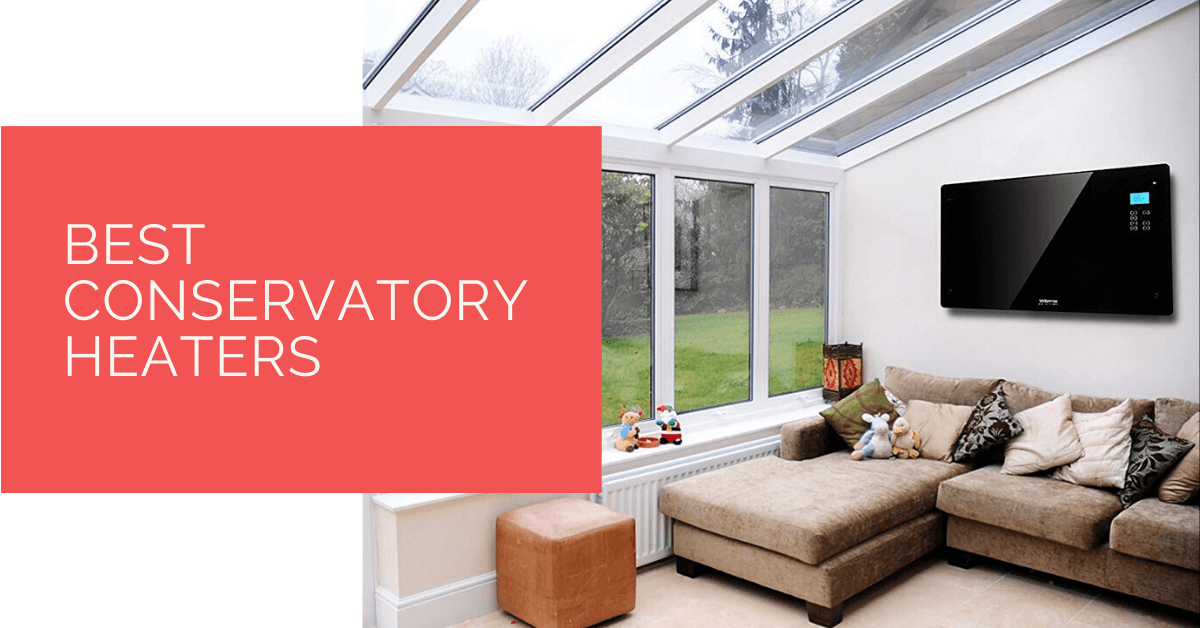
Finding the best conservatory heater can transform how much you actually use the room. Conservatories lose heat quickly through their glass panels and roof, which means an ordinary radiator rarely keeps up. After testing and researching the latest options available in the UK, the Adax Neo Electric Panel Heater is our top pick. It heats quickly, holds a set temperature efficiently, and its slim wall-mounted design doesn’t eat into your floor space.
Below you’ll find our expert reviews of nine of the best conservatory heaters on the market right now, from panel heaters and smart wall heaters to oil-filled radiators, ceramic fans, and convectors. Whatever your budget or room size, there’s a strong option here.
Our Top Picks
| Image | Name | |
|---|---|---|
| Adax Neo Electric Panel Heater | |
| Devola Wifi Smart Electric Glass Panel Heater 2000W | |
| Dreo Smart Electric Wall Heater | |
| Dreo 1500W Energy Efficient Space Heater | |
| Pro Breeze 2000W Mini Ceramic Fan Heater | |
| QEXREED 2000W PTC Electric Heater | |
| PureMate 2500W 11 Fin Oil Filled Radiator | |
| VonHaus Oil Filled Radiator 11 Fin | |
| DONYER POWER 2KW Electric Convector Heater |
9 Best Conservatory Heaters
1. Adax Neo Electric Panel Heater, Wall Mounted
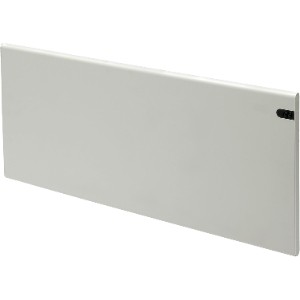
The Adax Neo is the gold standard for permanently installed electric heating in a conservatory. Norwegian-designed and manufactured, it’s the heater that heating professionals specify when a client wants something that will still perform reliably in 15 years. The 4.6-star rating from over 320 verified buyers is a strong signal, sustained across a genuine spread of installations rather than a burst of early reviews.
A conservatory places specific demands on a heater that a living room doesn’t. High glass surface area means significant radiant heat loss on cold nights. Single-pane or older double-glazed panels make this worse. The Adax Neo handles this with a precision thermostat accurate to 0.5°C. That half-degree accuracy sounds minor until you realise it means the heater isn’t cycling on and off in overshooting bursts. It holds a steady temperature with minimal energy waste, which is exactly what you want in a room where heat escapes quickly.
The wall-mounted installation is a genuine advantage in a conservatory. Floor space is often limited, and you don’t want a portable heater blocking access to garden doors or competing with furniture. The Adax mounts flat to the wall, stays out of the way, and comes with a 24-hour timer with weekly scheduling. You can set it to bring the room to temperature 20 minutes before you use it in the morning, then drop to frost protection overnight. The open window detection feature, which reduces output if a sudden temperature drop is detected, is a particularly thoughtful touch for conservatory use where doors to the garden are opened and closed regularly.
The one genuine limitation is the hardwired installation. This isn’t a plug-in heater. It requires a qualified electrician to connect it. That adds cost up front, and it’s not the right choice if you rent or want flexibility to move it around. But if you own your home and plan to use your conservatory regularly, the installation cost is a one-off and the long-term performance justifies every penny of it.
Features
- Digital thermostat accurate to 0.5°C
- Built-in 24-hour timer with weekly scheduling
- Wall-mounted slim Norwegian design
- Multiple wattage sizes available
- Open window detection for energy saving
- Highest-rated heater on this list (4.6 stars)
- Precision thermostat with no energy waste from overshoot
- Timer perfect for pre-warming before use
- Norwegian quality, built to last
- Highest price at around £198
- Hardwired installation requires an electrician
2. Devola Wifi Enabled Smart Electric Glass Panel Heater 2000W
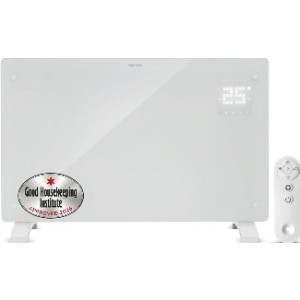
If you want smart scheduling and app control without paying Adax prices, the Devola WiFi Glass Panel Heater is the strongest option in that space. It’s Good Housekeeping Institute tested, which carries more weight than Amazon ratings alone since it involves hands-on lab assessment rather than buyer sentiment. At around £134.99, it sits in a sensible price bracket for a heater you’ll use regularly.
The glass panel design deserves a mention. Unlike a conventional metal panel heater that can look industrial, the Devola’s glass front suits modern conservatory interiors and the slim profile means it doesn’t dominate the room visually. You can mount it on a wall or use it freestanding with the included legs, which gives you flexibility if you’re renting or haven’t decided on permanent placement yet.
Where it earns its place on this list is the app and scheduling functionality. The Devola connects to the Tuya platform, which is well-supported and allows weekly scheduling from your phone. If your conservatory use pattern is predictable, you can set it to reach temperature before you arrive rather than heating it reactively. The 2000W output is appropriate for conservatories up to roughly 15 square metres. In very large or poorly insulated rooms, you might want to supplement it during the coldest weeks, but for an average UK lean-to or extension conservatory it handles the load well.
Features
- 2000W output with three heat settings
- WiFi app control via Tuya (iOS and Android)
- Glass panel design, wall-mountable or freestanding
- Weekly scheduling from your smartphone
- Adjustable thermostat with LED display
- Good Housekeeping Institute tested
- Good Housekeeping Institute tested for independent validation
- App scheduling for reactive-free heating
- Elegant glass design suits modern conservatories
- Relies on Tuya platform (third-party dependency)
- 2000W may struggle in large or poorly insulated rooms
- WiFi setup can be fiddly for less tech-savvy users
3. Dreo Smart Electric Wall Heater
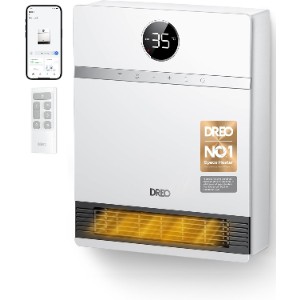
The Dreo Smart Wall Heater is the most conservatory-specific product on this list in terms of its design brief. The IP24 rating means it’s protected against water splashes from any direction, which matters in a room that regularly collects condensation on cold surfaces. It’s wall-mounted, Alexa-compatible, and operates at just 28dB. For context, that’s quieter than a library. In a conservatory where you’re working, reading, or just enjoying the garden view, fan noise from cheaper heaters becomes a genuine irritation. The Dreo eliminates it.
At 4.6 stars from 2,883 reviews, this is a product with real-world validation at scale. The PTC ceramic heating system self-regulates, which means the element doesn’t keep drawing full power once the target temperature is reached. Combined with 30-degree manual oscillation, heat distributes across the room rather than concentrating in one zone directly in front of the unit. That’s useful in a conservatory where you might be seated to one side of the heater.
Control options are comprehensive. You can use the physical controls on the unit, the included remote control, the Dreo app, or Alexa voice commands. The 24-hour timer lets you schedule heat before you arrive, and the adjustable thermostat keeps it there without constant monitoring. It also stands freestanding on the floor if you’d rather not wall-mount it, though the wall position gives better heat distribution in most conservatory layouts.
Features
- IP24 waterproof rating for humid conservatory environments
- 28dB ultra-quiet PTC ceramic heating
- Wall-mounted or freestanding installation
- Works with Alexa, Dreo app, and remote control
- 30° manual oscillation for even heat distribution
- 24-hour timer with adjustable thermostat
- IP24 rating specifically suited to condensation-prone conservatories
- Near-silent 28dB operation
- Alexa and app control for effortless scheduling
- Strong review base: 4.6 stars from 2,883 buyers
- £119.99 is a significant outlay for a 1500W portable
- Wall mounting requires drilling and plugging
4. Dreo 1500W Energy Efficient Space Heater
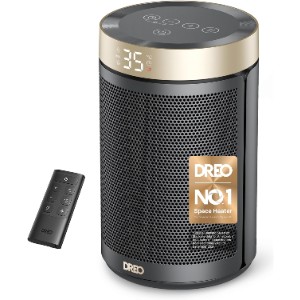
Over 11,600 reviews at 4.6 stars. That’s not a number you ignore. The Dreo Atom 316 is the most purchased heater on this list by a significant margin, and at £49.99 it’s easy to see why. It’s a compact, remote-controlled ceramic fan heater that punches well above its price bracket in terms of features and build quality.
The Hyperamics 1500W PTC system is the key technical claim. Dreo says it delivers warm air up to 200% further than conventional heaters through a combination of advanced PTC elements and an optimised heat funnel design. In practice, this means effective heat reach across a small or medium conservatory from a unit small enough to sit on a windowsill or side table. The remote control is a genuine quality-of-life feature that most budget heaters omit. You can adjust heat level, set the 12-hour timer, or switch between eco and high modes without getting up from your seat.
Eco mode is worth highlighting for conservatory use specifically. The heater monitors ambient temperature and tops up the heat automatically, rather than running at constant power. On a cool but not freezing day, this keeps the room comfortable at a fraction of full running cost. Safety covers the essentials: overheat protection and a tilt-detection sensor that improves on the basic tip-over switches found on cheaper models.
Features
- 1500W PTC Hyperamics ceramic heating system
- Remote control with 12-hour timer
- Three modes: eco, fan, and high heat
- Compact design: fits on a windowsill or side table
- Overheat protection and tilt-detection sensor
- Adjustable thermostat
- 11,600+ reviews at 4.6 stars: the best-validated budget pick on this list
- Remote control and eco mode justify the price premium over basic fan heaters
- Compact enough for small conservatories or supplementary use
- 1500W output won’t heat a large conservatory in deep winter
- Fan heaters are noisier than panel or oil-filled alternatives
5. Pro Breeze 2000W Mini Ceramic Fan Heater
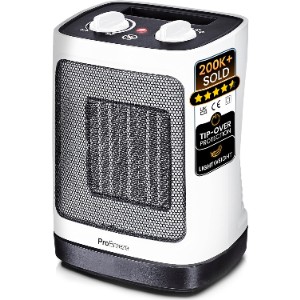
Plug it in, set the thermostat, done. The Pro Breeze Mini Ceramic Fan Heater is the most no-fuss option here. No app, no scheduling, no remote. Just a compact 2000W heater with two heat settings, oscillation, and an adjustable thermostat. If you use your conservatory for occasional afternoon sessions and need something that warms up fast without any setup time, this does exactly that.
The oscillation is particularly useful in a glazed room where heat loss is directional towards the cold glass. A static heater aimed at the centre of the room produces uneven warmth. The Pro Breeze distributes its output across the space as it rotates, which produces a noticeably more balanced heat for the price. At around £33, it’s the most affordable pick on this list.
Features
- 2000W with two heat settings and a cool fan mode
- Oscillating for even heat distribution
- Adjustable thermostat
- Compact, lightweight design
- Overheat and tip-over protection
- Cheapest option on this list at around £33
- Oscillation improves heat distribution in glazed rooms
- Simple controls, no learning curve
- No timer or scheduling
- Fan noise is audible at full power
6. QEXREED 2000W PTC Electric Heater
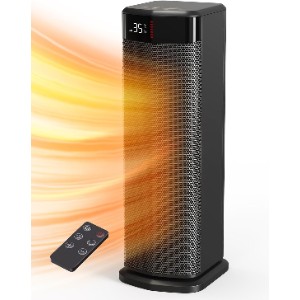
If you need quick warmth in a conservatory that you heat occasionally rather than continuously, the QEXREED PTC heater earns its place. PTC (Positive Temperature Coefficient) ceramic elements self-regulate their output. They heat up rapidly at full power, then automatically reduce current as they approach target temperature. This makes them faster to respond and marginally more energy-efficient than standard resistance elements for short-burst heating sessions.
At 4.5 stars from over 799 reviews and around £50.99, it’s the best-reviewed mid-range portable on this list outside the Dreo models. The controls are straightforward and the build feels solid. The honest caveat is that 2000W in a PTC heater is measured at peak draw, not sustained output, so it suits smaller conservatories or supplementary use in larger ones better than acting as a sole heat source in a big room.
Thermostat, overheat protection, and tip-over cut-off are all present. Nothing flashy, but nothing missing either. The QEXREED sits in the sensible middle ground between the budget Pro Breeze and the feature-rich Dreo models.
Features
- 2000W PTC self-regulating ceramic heating element
- Adjustable thermostat
- Two heat settings plus fan-only mode
- Overheat protection and tip-over cut-off
- Compact portable design
- PTC self-regulation improves efficiency for short-burst use
- 4.5 stars from 799 reviews is a strong real-world signal
- Good mid-range value at £50.99
- Limited scheduling options
- Better suited to smaller conservatories or supplementary use
7. PureMate 2500W 11 Fin Oil Filled Radiator
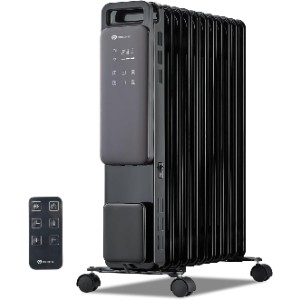
For a conservatory used for extended periods, an oil-filled radiator provides the most comfortable sustained warmth of any portable heater type. The thermal mass of the oil means the radiator continues to radiate heat even after the element cycles off, producing an even temperature rather than the alternating blast-and-silence pattern you get from a fan heater.
The PureMate at 2500W has the highest output on this list, making it well-matched to the heat loss demands of a glazed conservatory in winter when temperature differentials between inside and outside are significant. The 11-fin design improves on standard 9-fin models by increasing the total radiating surface area. Three heat settings and an adjustable thermostat give practical control. The tradeoff is weight and warm-up time. An oil-filled radiator takes longer to reach temperature than a fan heater, so it suits conservatories you plan to use for an hour or more, not a quick 20-minute session.
Features
- 2500W maximum output, highest on this list
- 11-fin design for improved heat retention and distribution
- Three heat settings and adjustable thermostat
- Overheat protection and tip-over safety cut-off
- Castors and carry handle for easy repositioning
- Highest 2500W output for larger or colder conservatories
- Sustained radiant heat ideal for long sessions
- 11-fin design improves efficiency over cheaper models
- Slow warm-up, not suited for quick sessions
- Heavier than fan or panel alternatives
8. VonHaus 11 Fin Oil Filled Radiator
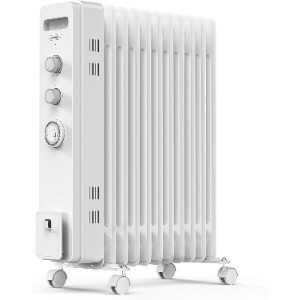
The most purchased oil-filled radiator on this list, with over 5,000 reviews behind it. The VonHaus 11 Fin isn’t the cheapest or the most powerful, but it’s the most reliably reviewed, which matters when you’re buying something that needs to perform for years without issue. At around £80, it sits squarely in budget territory for an oil-filled heater.
The basics are all present: three heat settings, adjustable thermostat, overheat protection, and tip-over cut-off. No timer, no digital display, no app. If that’s acceptable for your use case, you’re getting a solid, well-proven heater at a fair price. The 2000W output is slightly lower than the PureMate above, which means it suits a smaller or moderately insulated conservatory rather than a large exposed room in January.
Features
- 2000W with three heat settings
- 11-fin design for improved heat retention
- Adjustable thermostat
- Overheat protection and tip-over safety switch
- Castors for easy movement
- 5,000+ reviews: the most validated model here
- Good value at around £80
- No timer or digital controls
- 2000W may not be sufficient for a large cold conservatory
- Slower to heat up than fan alternatives
9. DONYER POWER 2KW Electric Convector Heater
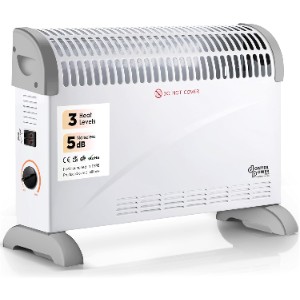
The most divisive pick on this list. Convector heaters work by drawing cold air in at the base, heating it over an element, and releasing warm air from the top by natural convection. No fan, which means near-silent operation. No oil, which means no long warm-up wait. For a conservatory where noise is a consideration but you don’t want the delay of an oil-filled radiator, a convector sits neatly in the middle.
The DONYER POWER 2KW model is a straightforward unit with adjustable thermostat and overheat protection. It won’t win on features against the Dreo or Devola products, and it won’t heat a large conservatory on a cold January night on its own. But for a mid-sized room with reasonable insulation, used for reading or working quietly, the convector principle suits conservatory use better than a noisy fan heater.
Features
- 2000W convection heating with no fan noise
- Adjustable thermostat
- Overheat protection
- Slim, upright portable design
- Silent operation compared to fan heaters
- No slow warm-up compared to oil-filled alternatives
- Less efficient heat distribution than fan or oscillating models
- Not powerful enough for large or poorly insulated conservatories
- Limited features at this price
Conservatory Heater Buying Guide
Key Takeaways
- Conservatories need 100-150W per square metre due to high glass surface area and rapid thermal losses
- Wall-mounted panel heaters like the Adax Neo offer the best long-term energy efficiency and keep floor space clear
- Smart heaters (Devola, Dreo Wall) justify the extra cost if you use your conservatory on a schedule
- Portable heaters work well for occasional use or supplementary warmth, but running costs mount on larger models
- Oil-filled radiators provide sustained heat for long sessions; ceramic fan heaters deliver quick warmth for short ones
- IP24 is the minimum rating worth seeking: it protects against condensation and humidity in this naturally damp environment
- No heater can overcome poor insulation. If your glazing is single-pane or your roof leaks cold air, heating costs will be punishing regardless of the heater you choose
Why Conservatories Are Difficult to Heat
The challenge with conservatories isn’t just the size of the room. It’s the physics of the materials. Glass has a very low thermal resistance (U-value), which means heat passes through it rapidly in cold weather. A typical polycarbonate conservatory roof can have a U-value of around 3.5-4.0 W/m²K. Compare that to a well-insulated cavity wall at 0.3 W/m²K and you start to understand why conservatories lose heat so quickly.
This has two practical consequences. First, you need a heater with enough output to overcome continuous heat loss, not just to heat the air once. Second, thermostats earn their keep here more than in any other room in the house. A heater without a thermostat will either overshoot (wasting energy and making the room uncomfortably warm briefly) or cycle on and off too crudely to maintain a steady temperature. Both the Adax Neo and the Dreo Smart Wall Heater solve this well with precision thermostats and smart scheduling.
Humidity is a secondary factor. Cold glass surfaces in a heated room collect condensation. Over time, without adequate ventilation or humidity management, this creates damp. The Dreo Smart Wall Heater’s IP24 rating addresses this directly. Other heaters on this list aren’t rated for water ingress, so positioning them away from dripping condensation points is sensible maintenance.
How Much Power Does a Conservatory Heater Need?
The rule of thumb for poorly insulated glazed spaces is 150W per square metre. A 10 square metre conservatory therefore needs around 1500W as a minimum, but 2000W is a more realistic target if you want to maintain comfort on cold days rather than just taking the edge off. For larger conservatories of 15-20 square metres, a single 2000W heater will struggle in deep winter unless the glazing is modern and well-sealed. In that case, consider either the PureMate’s 2500W output or running two heaters.
The orientation of your conservatory also matters. A south-facing room with good solar gain needs less supplementary heat on sunny days. A north-facing room with an older polycarbonate roof may need more than 150W per square metre to reach a comfortable temperature in January.
Running cost is worth calculating before you buy. At the current UK electricity price of around 24p per kWh, a 2000W heater running for three hours costs roughly £1.44. A 1500W heater at eco mode for the same period costs around £1.08. Over a full winter season, the difference between models and usage patterns becomes meaningful, which is exactly why thermostats and eco modes earn their value.
Panel Heaters: The Best Long-Term Choice
If you use your conservatory regularly, five or more times per week, a wall-mounted panel heater is almost certainly the right long-term investment. The Adax Neo and Devola are the picks here, each for different use cases.
Panel heaters work by heating a metal or glass panel that radiates warmth into the room at low surface temperatures. Because the surface never gets dangerously hot, they’re safer around children and pets than bar heaters or halogen lamps. They also integrate a thermostat far more effectively than portable heaters, because they’re calibrated to the specific room they’re mounted in rather than measuring the temperature at whatever position you’ve placed them.
The installation cost of a hardwired panel like the Adax is a one-off expense that pays for itself through better temperature control and lower energy use. If you can’t or won’t hardwire, the Devola’s plug-in design with optional wall mounting is the practical compromise.
Portable Heaters: Flexibility Over Efficiency
Portable heaters are the right answer for conservatories used infrequently, or for supplementary heating alongside a primary panel. The Dreo models and the Pro Breeze represent the best current portable options, each suited to a different use case.
The Dreo 1500W is the pick for small to medium conservatories where portability matters. The Dreo Smart Wall is the pick where you want a semi-permanent portable with smart features and IP protection. The Pro Breeze is the no-fuss budget option for occasional use.
Oil-filled radiators (PureMate, VonHaus) are portable in the technical sense, but they’re heavy and slow to warm up. They make more sense as semi-permanent fixtures left in the conservatory throughout winter than as heaters you move between rooms regularly.
Smart Controls and Wi-Fi: Is It Worth Paying Extra?
It depends on your use pattern. If your conservatory use is predictable, say you always use it on weekend mornings and Thursday evenings, smart scheduling pays for itself in energy savings within a season. Pre-heating a conservatory 20 minutes before use means you arrive to a warm room rather than waiting for it to reach temperature, and the heater turns off automatically when you leave. Without a timer, most people either forget to turn off the heater or arrive to a cold room.
The Devola connects via Tuya, which is widely supported and reliable. The Dreo Smart Wall connects via the Dreo app and Alexa. Both platforms allow weekly scheduling and remote control. The Adax Neo’s scheduling is built into the unit itself, with no app dependency, which some users prefer for simplicity and reliability.
If your conservatory use is unpredictable and you just want to heat it when you decide to use it, a smart heater’s scheduling features add limited value. In that case, the QEXREED or Pro Breeze will serve you just as well at a lower price.
IP Ratings and Humidity
IP ratings indicate protection against solid particles (first digit) and water ingress (second digit). In a conservatory context, you care about the water protection figure. IP24 means protection against water splashes from any direction. Most electric heaters carry no meaningful IP rating and are designed for dry indoor use only.
In practice, most conservatory heaters work fine without an IP rating as long as they’re positioned away from condensation drips and not left running in an unventilated room during freezing weather. But if your conservatory has significant condensation issues, single-pane glazing, or a leaky roof seal, the Dreo Smart Wall Heater’s IP24 rating gives it a genuine advantage over the rest of the list.
Things to Keep in Mind Before Buying
Check your wattage against your room size before buying. A 1500W heater in a 20 square metre room will run at full power continuously and never quite reach your target temperature on cold days.
Think about your usage frequency. Daily users benefit from panel heaters and smart scheduling. Occasional users are better served by portable, plug-in models with quick warm-up times.
Consider the noise. Oil-filled radiators and convector heaters are near-silent. Fan heaters are audible. The Dreo Smart Wall Heater at 28dB is exceptional for a ceramic fan product. If you’re working or reading in silence, fan noise at higher settings becomes irritating quickly.
Check the power source. Hardwired heaters (Adax) need an electrician. All other heaters on this list are plug-in. Make sure your conservatory has a suitable socket in a sensible position before ordering a wall-mounted model.
Types of Conservatory Heaters
Panel Heaters (Electric, Wall-Mounted) are slim metal or glass panels that mount on a wall. They heat the room gradually and hold a steady temperature with a thermostat. No moving parts, no fan noise, minimal maintenance. Best for conservatories you heat regularly where permanent installation is acceptable.
Ceramic Fan Heaters use a fan to blow air over a heated ceramic element. Cheap, portable, and warm up fast. Best for supplementary heat, quick warm-up, or small conservatories. Running costs can add up in a draughty glazed room if used all day.
Oil-Filled Radiators work on the same principle as a household central heating radiator but electrically. The oil doesn’t evaporate, so it retains heat well once warmed. Best for long sessions of two hours or more where sustained warmth matters more than quick response. Not suited to rooms you pop in and out of.
Convector Heaters draw cold air in at the base, heat it, and release warm air from the top. Silent, no warm-up lag, and compact. Best for quiet environments like reading rooms. Less effective than fan heaters at pushing heat across a large glazed space.
Infrared and Halogen Heaters emit radiant heat that warms objects and people directly rather than heating the air. Useful for spot heating a seating area quickly but less effective at maintaining a comfortable ambient temperature across the whole room. Not suitable as a primary heat source for regular conservatory use.
Case Study: Heating a North-Facing Victorian Terrace Conservatory
Background
A couple in a Victorian terrace in Derbyshire added a lean-to conservatory to the back of their home in 2019. North-facing, with polycarbonate roof panels and older single-glazed side panels, it was comfortable in summer but effectively unusable from October to March without heating. They contacted us for advice on the most cost-effective solution.
Project Overview
The conservatory measured approximately 12 square metres. Their usage pattern was daily: coffee in the morning and occasional evening use for reading. They wanted something they could leave on a schedule rather than switching on manually each morning.
Implementation
After reviewing the options, we recommended the Adax Neo for their specific use pattern. The daily usage frequency made the hardwired installation cost worthwhile, and the built-in 24-hour timer with open window detection suited their routine precisely. An electrician fitted the appropriate wattage model in a morning. The heater was programmed to bring the conservatory to 18°C by 7:30am each day, dropping to 10°C frost protection after 10am, with a second warm-up period at 5pm for evening use.
Results
Energy consumption during the first winter was significantly lower than their previous portable heater arrangement, partly because the precision thermostat prevented temperature overshooting, and partly because the timer ensured the heater was never left on when the room was empty. They reported being able to use the conservatory comfortably from late October through to early April, compared with effectively abandoning it from November the previous year. Total installation cost was recovered within 18 months through reduced energy waste.
Expert Insights From Our Heating Engineers About Conservatory Heaters
We spoke with one of our senior heating engineers with over 22 years of experience in residential electric heating installations.
“The mistake I see most often is people buying a heater that’s correctly sized for a living room and assuming it will work in a conservatory. It won’t. A 10 square metre conservatory with polycarbonate roof loses heat three or four times faster than a well-insulated living room of the same size. You need to size up accordingly, or accept that the heater will struggle to reach your target temperature on the coldest days. The 150W per square metre rule is a starting point, not a ceiling.”
“Smart controls are genuinely worth the investment in conservatories specifically. The room cools down fast when you’re not in it and takes time to warm up again. A thermostat and timer combination means you’re heating the room when you want to use it, not heating it all day because you can’t predict exactly when you’ll be in there. The Adax and the Dreo Smart Wall Heater both handle this well. The Adax is the better long-term installation. The Dreo is the better option if you want to avoid the electrician.”
“IP ratings come up in conservatory installs more than people expect. Most heaters are rated for dry indoor use only. In a cold conservatory with significant temperature swings between day and night, condensation on the heater body isn’t unusual. It won’t immediately destroy a standard heater, but it does shorten the life of the electronics and increases the risk of fault over time. If you’re fitting a heater in a conservatory that regularly gets below 5°C overnight, I’d look for at least IP24 protection.”
Frequently Asked Questions
What is the best type of heater for a conservatory?
Wall-mounted electric panel heaters are the best long-term choice for conservatories used regularly. They maintain a steady temperature efficiently, have no moving parts, and keep floor space clear. For occasional use, a portable ceramic fan heater or oil-filled radiator works well depending on whether you need quick heat or sustained warmth for longer sessions.
How many watts do I need to heat a conservatory?
The standard guidance for glazed rooms is 100-150W per square metre. A 10 square metre conservatory needs 1000-1500W as a minimum, though 2000W is a safer target for colder days and rooms with older polycarbonate roofs or single-glazed panels. Large conservatories above 15 square metres may need 2500W or two heaters in winter.
Are electric heaters expensive to run in a conservatory?
Running costs depend on wattage, usage hours, and the insulation quality of the conservatory. At roughly 24p per kWh (current UK rates), a 2000W heater costs around 48p per hour. A well-insulated conservatory with a thermostat-controlled heater will run significantly cheaper than an uninsulated room with a heater left on continuously, because the thermostat cycles it off once temperature is reached.
Can I put a normal radiator in a conservatory?
Building regulations in the UK restrict extending central heating into a conservatory that is not separated from the main dwelling by an insulated wall and door. Most conservatories are therefore heated with electric heaters rather than central heating radiators. If your conservatory meets the separation requirements, a plumber can advise on adding it to your existing system.
Is it worth heating a conservatory in winter?
Yes, particularly if you can do it on a timer. Even a low background temperature of 10-12°C prevents condensation buildup and makes the room usable again within 20 minutes of turning the heater to full. Without any background heat, a conservatory in January can take an hour to reach comfort temperature, which makes it effectively unusable unless you plan well ahead.
What IP rating should a conservatory heater have?
IP24 is the minimum worth looking for in a conservatory environment. This rating indicates protection against water splashes from any direction, which covers condensation and the incidental moisture that accumulates in a glazed room with significant temperature swings. Most standard portable heaters carry no IP rating and are designed for dry indoor use only.
Can I leave a conservatory heater on overnight?
A thermostat-controlled heater set to frost protection (7-10°C) can be left running overnight to prevent condensation and maintain a base temperature. A heater without a thermostat should not be left on overnight unattended. Oil-filled radiators with overheat protection and thermostat control are generally considered the safest option for overnight background heating.
Do conservatory heaters cause condensation?
Heating a conservatory reduces condensation overall by raising the temperature of surfaces above the dew point, which is where water vapour deposits onto cold surfaces. Condensation in conservatories is caused by cold surfaces meeting warm moist air. A heater that maintains a consistent temperature, particularly overnight, significantly reduces the problem. Fan heaters that circulate air across cold glass surfaces are particularly effective at clearing condensation quickly.
Summing Up
The Adax Neo is our top choice for anyone who uses their conservatory regularly and is prepared to hardwire it in. Its precision thermostat, built-in scheduling, and Norwegian build quality make it the most cost-effective long-term option despite the higher upfront cost. If you want smart features without the electrician, the Dreo Smart Electric Wall Heater is the conservatory-specific pick, with IP24 protection and Alexa compatibility at £119.99. For the best value portable with a massive real-world review base, the Dreo 1500W Space Heater at £49.99 is the obvious choice for smaller rooms and occasional use.
Whatever your conservatory size and usage pattern, the key principles stay the same: size up to at least 150W per square metre, get a thermostat, and use a timer if your routine allows it. The savings on running costs pay back any investment in better controls within a single heating season.
Updated