
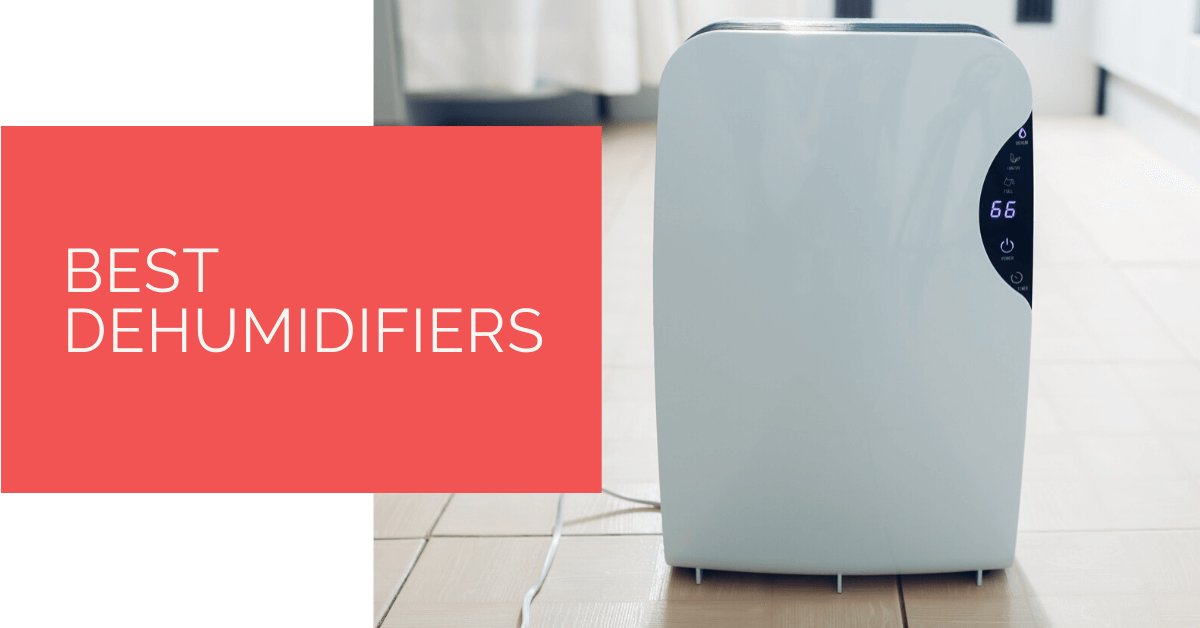
If you’re dealing with condensation on windows, damp patches on walls, or that persistent musty smell that just won’t shift, a dehumidifier is one of the most effective fixes available. The MeacoDry Arete One 12L is our top pick: it’s genuinely quiet, energy efficient, includes a HEPA filter for air purification, and comes with a five-year warranty that’s hard to beat at this price point.
Below, you’ll find our full rundown of the eight best dehumidifiers available in the UK right now, covering everything from compact bedroom units to high-capacity machines for large homes.
Contents
- 1 Our Top Picks
- 2 8 Best Dehumidifiers for UK Homes
- 2.1 1. MeacoDry Arete One 12L Dehumidifier and Air Purifier
- 2.2 2. EcoAir DD1 Simple Blue MK3 Desiccant Dehumidifier
- 2.3 3. Pro Breeze 20L WiFi Smart Dehumidifier
- 2.4 4. Dreo 20L Smart Dehumidifier
- 2.5 5. Inventor 20L EVA Dehumidifier with Wi-Fi
- 2.6 6. MeacoDry Arete One 25L Dehumidifier and Air Purifier
- 2.7 7. COMFEE’ 30L/Day Dehumidifier
- 2.8 8. Devola 12L/Day Low Energy Dehumidifier
- 2.9 Key Takeaways
- 2.10 Refrigerant vs Desiccant: The Core Choice
- 2.11 Understanding Extraction Rate Figures
- 2.12 Laundry Mode: More Useful Than It Sounds
- 2.13 Running Costs
- 2.14 Placement for Maximum Effectiveness
- 2.15 Things to Keep in Mind Before Buying
- 2.16 Types of Dehumidifier
- 3 Case Study: Tackling Persistent Damp in a Victorian Terrace
- 4 Expert Insights From Our Heating Engineers About Dehumidifiers
- 5 Frequently Asked Questions
- 5.1 How many litres per day do I need?
- 5.2 How much does it cost to run a dehumidifier?
- 5.3 Should I use a compressor or desiccant dehumidifier?
- 5.4 What humidity level should I aim for?
- 5.5 How often do I need to empty the water tank?
- 5.6 Can a dehumidifier get rid of mould?
- 5.7 Is it safe to leave a dehumidifier on overnight?
- 5.8 Do dehumidifiers help with laundry drying?
- 6 Summing Up
Our Top Picks
| Image | Name | |
|---|---|---|
| MeacoDry Arete One 12L Dehumidifier and Air Purifier | |
| EcoAir DD1 Simple Blue MK3 Desiccant Dehumidifier | |
| Pro Breeze 20L WiFi Smart Dehumidifier | |
| Dreo 20L Smart Dehumidifier | |
| Inventor 20L EVA Dehumidifier with Wi-Fi | |
| MeacoDry Arete One 25L Dehumidifier and Air Purifier | |
| COMFEE' 30L/Day Dehumidifier | |
| Devola 12L/Day Low Energy Dehumidifier |
8 Best Dehumidifiers for UK Homes
1. MeacoDry Arete One 12L Dehumidifier and Air Purifier
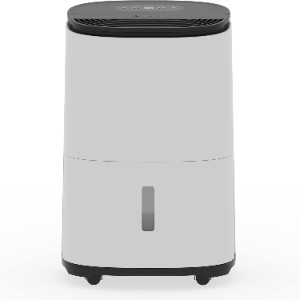
The MeacoDry Arete One 12L is comfortably the best all-round dehumidifier you can buy at this price. It removes up to 12 litres of moisture per day, which is plenty for most UK homes up to a medium-sized semi-detached, and the built-in HEPA filter means it’s working as an air purifier at the same time. If you have anyone in the house with allergies or asthma, that dual function is genuinely valuable.
Meaco is a UK brand that’s been making dehumidifiers for well over a decade, and it shows in the build quality. This unit runs at just 33 decibels on its quietest setting, making it suitable for bedrooms and living spaces without driving anyone mad. It also auto-restarts after a power cut, which sounds like a minor detail until your machine has been sitting idle for two days and the humidity has crept back up.
The five-year warranty is exceptional for this category. Most competitors offer two years at best, and the fact that Meaco backs this with five years tells you a lot about how confident they are in the product. You also get a laundry drying mode, a 2.3-litre water tank with an auto-shutoff, and continuous drainage if you’d rather not empty the tank manually.
The only real downside is the price, which sits above most 12-litre competitors. But for what you’re getting (build quality, noise levels, warranty, and the added HEPA purifier), it’s worth every penny.
Features
- 12 litres per day extraction rate
- HEPA filtration for simultaneous air purification
- Ultra-quiet 33dB operation
- Humidity display and automatic control
- Auto-restart after power cuts
- Laundry drying mode
- Continuous drainage option
- 5-year warranty
- Exceptional five-year warranty
- HEPA filter doubles as an air purifier
- Genuinely quiet at 33dB
- Auto-restart after power cut
- Higher price than comparable 12L units
- 2.3L tank is on the smaller side
2. EcoAir DD1 Simple Blue MK3 Desiccant Dehumidifier
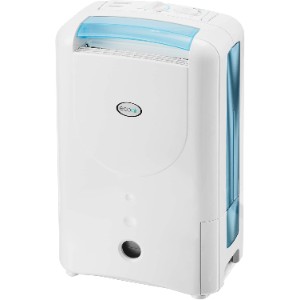
Most dehumidifiers on this list use compressor technology, which works well when the air is warm. But in a cold garage, a chilly conservatory, or any room that regularly drops below 15°C in winter, compressor units become drastically less effective. The EcoAir DD1 uses desiccant technology instead, which means it extracts moisture from the air using a rotating desiccant wheel and works right down to 1°C without losing performance.
This is the one to buy if you’re dealing with damp in a cold space. It’s also the most reviewed dehumidifier on this list with nearly 4,000 ratings, which gives you a high degree of confidence that the experience matches the marketing. The rotary dial controls are refreshingly simple, and at 6kg, it’s light enough to move between rooms without hassle.
It runs at 34dBA, which is quiet for a desiccant unit, and includes an anti-bacterial filter to keep the air clean. Worth noting that desiccant dehumidifiers do use slightly more electricity than compressor equivalents, so if it’s going in a warm living space, you’d be better off with one of the compressor options further down this list. But for garages, utility rooms, and winter use, nothing else comes close.
Features
- 7.5 litres per day desiccant extraction
- Operates effectively down to 1°C
- 34dBA quiet operation
- Anti-bacterial filter
- Lightweight at 6kg
- Rotary dial controls
- Laundry drying mode
- Works in cold rooms where compressors fail
- Nearly 4,000 reviews, very well tested
- Lightweight and portable
- Simple, reliable controls
- Higher running costs than compressor units in warm rooms
- Lower daily extraction than same-priced compressors
3. Pro Breeze 20L WiFi Smart Dehumidifier
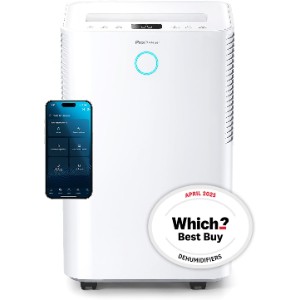
The Pro Breeze 20L earned a Which? Best Buy Award, and it’s easy to see why once you look at what you’re getting for the money. A 20-litre-per-day extraction rate, Wi-Fi control via the Pro Breeze app, a clear humidity display, and a continuous drainage option, all at a price well below many comparable smart dehumidifiers.
App control is more useful than it sounds. Being able to check the current humidity level and switch the unit on before you get home is handy, especially if you’ve left the kitchen or bathroom in a humid state. The 24-hour timer also means you can run it overnight and have it stop before you wake up, saving energy without thinking about it.
Build quality is solid, the controls are intuitive, and the auto-shutoff when the tank is full works reliably. If you want a proven, award-winning mid-range option that won’t let you down, this is an excellent choice.
Features
- 20 litres per day extraction rate
- Wi-Fi app control (iOS and Android)
- Which? Best Buy Award winner
- Digital humidity display
- 24-hour programmable timer
- Continuous drainage outlet
- Auto-shutoff when tank is full
- Which? Best Buy endorsement
- Good value for a Wi-Fi smart dehumidifier
- Reliable app control
- App can be slow to connect at times
- No HEPA filtration
- Louder than quieter premium models
4. Dreo 20L Smart Dehumidifier
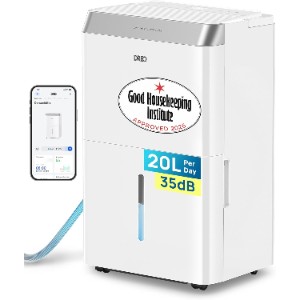
Dreo has been making steady inroads into the UK home appliance market, and the 20L smart dehumidifier is a good example of why. It holds a Good Housekeeping Institute (GHI) Award, which requires real-world testing rather than just a manufacturer’s spec sheet, so that endorsement carries weight.
The unit runs in sleep mode at 38dB, which is whisper quiet for a 20-litre machine, and the smart app gives you full control over scheduling and humidity targets. The child lock is a practical touch if you have young children around, and the LED display is clear and readable from across the room. At under £145, this is genuinely good value for a smart dehumidifier with an independent award behind it.
Features
- 20 litres per day extraction rate
- GHI Award winner
- Sleep mode at 38dB
- Smart app control
- LED display with real-time humidity reading
- Child lock
- 24-hour timer
- GHI Award gives independent credibility
- Very quiet in sleep mode
- Competitive price for a smart unit
- Smaller review base than some competitors
- No HEPA filter
- App features not as polished as more established brands
5. Inventor 20L EVA Dehumidifier with Wi-Fi
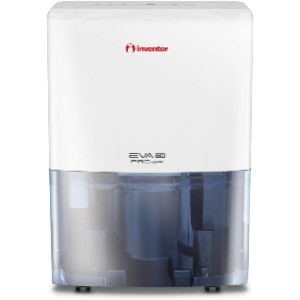
The Inventor EVA sits in a competitive part of the market at under £135 for a 20-litre Wi-Fi dehumidifier with an ioniser built in. The ioniser helps neutralise airborne bacteria and odours, which is a nice bonus even if it’s not as thorough as a full HEPA filter. Wi-Fi control works through the Inventor app, and the humidity display lets you monitor conditions at a glance without opening your phone.
Sleep mode, a 24-hour timer, and continuous drainage are all present, and the unit carries WEE energy certification so running costs are reasonable. It’s a sensible, capable machine with no major weaknesses. It won’t wow you the way the Meaco does, but at this price it delivers everything most people actually need from a dehumidifier.
Features
- 20 litres per day extraction rate
- Wi-Fi app control
- Built-in ioniser
- Digital humidity display
- Sleep mode
- Continuous drainage
- 24-hour timer
- WEE energy certification
- Competitive price for Wi-Fi + ioniser combo
- WEE certified for energy efficiency
- Good review count for a mid-range unit
- Ioniser less effective than HEPA filtration
- App could be more intuitive
- No specific quiet rating published
6. MeacoDry Arete One 25L Dehumidifier and Air Purifier
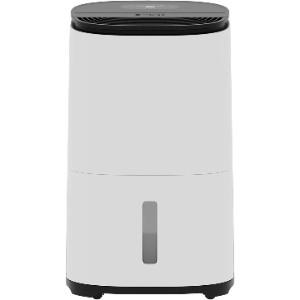
If you have a large home (a detached house, an open-plan ground floor, or serious damp issues that a 12-litre unit can’t keep up with), the MeacoDry Arete One 25L is the machine to look at. It removes up to 25 litres per day, includes the same HEPA air purifier as the 12L model, and comes with the same impressive five-year warranty.
Yes, it costs nearly £300. But if you need the capacity and want a unit that’s going to last and perform reliably for years, the premium is justified. The running costs are kept impressively low for a machine this size, and Meaco’s reputation for customer support means you’re well looked after if anything goes wrong. This is a serious machine for people with a serious damp problem.
Features
- 25 litres per day extraction rate
- HEPA air purifier built in
- 5-year warranty
- Suitable for large homes
- Low energy operation
- Automatic humidity control
- High capacity for large homes
- HEPA purifier and dehumidifier in one
- Five-year warranty
- Expensive at nearly £300
- Overkill for smaller properties
- Fewer reviews than the 12L sibling
7. COMFEE’ 30L/Day Dehumidifier
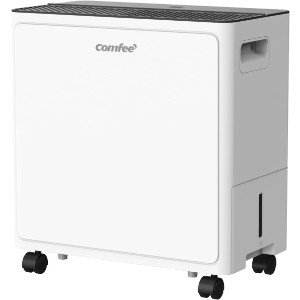
The COMFEE’ 30L is the highest-capacity unit on this list, and also one of the most reviewed, with over 2,000 ratings at 4.4 stars. If your priority is extracting large volumes of moisture as efficiently as possible and price matters, this is a strong contender. Thirty litres per day is substantially more than most home dehumidifiers manage, making it well suited to properties with significant damp issues or larger floor plans.
It has auto-defrost (useful in cooler rooms), a 24-hour timer, continuous drainage, and a clear LED display. It’s not the quietest unit and it’s not the most energy efficient relative to capacity, but for sheer moisture removal at this price it does the job well. Think of it as the workhorse option.
Features
- 30 litres per day extraction rate (highest on this list)
- Auto-defrost function
- LED display
- 24-hour timer
- Continuous drainage
- Auto-shutoff when tank full
- Highest daily extraction rate on the list
- Very competitive price for the capacity
- Over 2,000 reviews, well established
- Noisier than premium models
- No smart/Wi-Fi features
- Lower energy efficiency at higher capacities
8. Devola 12L/Day Low Energy Dehumidifier
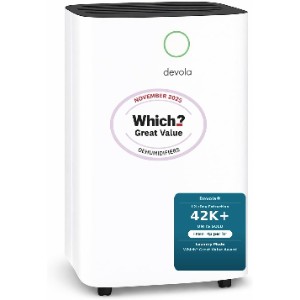
The Devola 12L holds a Which? Best Buy Award and costs under £120, which makes it the best-value pick on this list for smaller homes and flats. It runs for less than 5p per hour, which is remarkably cheap for a home appliance. The laundry drying mode is a genuinely useful feature for anyone without a tumble dryer or garden access.
It’s not flashy. No Wi-Fi, no ioniser, no HEPA filter. But for a studio flat, a one-bedroom flat, or a single damp room, it handles the job with minimal fuss and minimal running costs. The Which? endorsement means it’s been independently tested and found to do what it claims. At this price, that’s all you need to know.
Features
- 12 litres per day extraction rate
- Which? Best Buy Award winner
- Runs at under 5p per hour
- Laundry drying mode
- Dust filter included
- Auto-shutoff when tank full
- Quiet operation
- Which? Best Buy at an affordable price
- Exceptionally low running costs
- Ideal for flats and smaller homes
- No Wi-Fi or smart features
- Basic controls with no humidity display
- 12L/day may not be enough for larger properties
Key Takeaways
- Dehumidifiers remove moisture from the air to reduce relative humidity. In UK homes, the target range is 40 to 60%. Below 40% is too dry; above 60% promotes condensation, mould, and dust mite proliferation
- Refrigerant (compressor) dehumidifiers are the most energy-efficient option for rooms above 15°C. Desiccant dehumidifiers work better in cold spaces like garages and lofts where a refrigerant unit becomes ineffective, typically below 10 to 15°C
- Extraction rate is quoted in litres per 24 hours, but real-world extraction is significantly lower than the test-condition figure (30°C, 80% humidity). In a typical UK home at 20°C and 60% humidity, expect 40 to 60% of the rated figure
- Laundry mode runs the unit at maximum fan speed to accelerate drying of washing indoors. A 20-litre unit can dry a standard wash load in 4 to 6 hours, which is far faster than passive indoor drying, which can take 24 hours and adds several litres of moisture to the room in the process
- Running costs at 27p/kWh: a 200W refrigerant unit costs around 5p per hour; a 350W unit around 9p per hour; a 600W unit around 16p per hour. Desiccant units consume 300 to 700W and cost more per hour but operate effectively in cold conditions where refrigerant units would be inefficient anyway
- Tank capacity determines how long the unit runs before needing emptying. Most units hold 2 to 4 litres; continuous drain options via a hose eliminate this entirely if you can position near a drain
- Persistent condensation on windows or walls, musty smells, visible mould on grout or silicone, or aggravated dust mite allergies in winter are the clearest signals that a room has a humidity problem worth addressing
Refrigerant vs Desiccant: The Core Choice
The technology inside the unit determines where and when it’s effective. Getting this wrong means buying a dehumidifier that doesn’t work in the space you need it.
Refrigerant dehumidifiers work like a small fridge: a fan draws in room air, passes it over cold coils where moisture condenses and drips into a tank, then reheats the now-drier air before returning it. They’re efficient and effective, but only when the room temperature is above about 15°C. Below this, the coils start to ice up and extraction drops sharply. Most refrigerant units include an auto-defrost cycle, but in genuinely cold spaces (an unheated garage in January), a refrigerant unit is the wrong tool.
Desiccant dehumidifiers use a rotor coated in silica gel that absorbs moisture from the air, then a heater regenerates the rotor by baking off the moisture into a warm exhaust stream. They operate effectively at any temperature, including below freezing, making them the correct choice for unheated spaces, garages, caravans, and lofts. The trade-off is higher energy consumption: a desiccant unit typically uses 300 to 700W versus 150 to 400W for a comparable refrigerant unit. They also gently warm the room slightly due to their internal heating element.
Understanding Extraction Rate Figures
Manufacturers test extraction rate at 30°C and 80% relative humidity, conditions you’ll encounter in a tropical climate, not a UK home. In real UK conditions (typically 18 to 22°C and 55 to 70% humidity), a unit rated at 20 litres per 24 hours will typically extract 8 to 14 litres per day. This isn’t deceptive labelling. The test conditions are standardised so you can compare models fairly, but it does mean you shouldn’t size the unit to the headline figure.
For practical sizing:
- Small room damp problem (bedroom, box room, single bathroom): A unit rated 10 to 12 litres/24h is usually sufficient
- Whole-flat or whole-house use, or a moderate condensation problem: 16 to 20 litres/24h
- Severe damp, basement use, or post-flood drying: 20 to 25 litres/24h or a dedicated drying unit
- Unheated garage or outbuilding: A desiccant unit rated 7 to 10 litres/24h; the lower rating reflects more honest test conditions for cold-space operation
Laundry Mode: More Useful Than It Sounds
Most mid-range and above dehumidifiers include a laundry or “boost” mode that runs the fan at maximum speed, circulates dry air through the room, and often points airflow directly at the laundry load. It’s one of the most practical features on any dehumidifier.
Drying washing indoors without extraction adds 2 to 4 litres of water vapour to a room per standard load. In a sealed bedroom in winter, that moisture has nowhere to go. It condenses on windows, soaks into wall plaster, and raises the overall humidity of the home. Running laundry mode while the washing dries captures most of that moisture before it disperses into the fabric of the building.
A 20-litre unit on laundry mode typically dries a full wash load in 4 to 6 hours in a standard bedroom. That’s a meaningful reduction versus 18 to 24 hours of passive drying and prevents the humidity spike that passive drying causes. The energy cost for a 4-hour laundry cycle at 200 to 300W is 20 to 30p, comparable to a tumble dryer’s much shorter cycle, without venting requirements.
Running Costs
Dehumidifiers are relatively cheap to run compared to heaters or air conditioners. At 27p/kWh:
- 100 to 150W: 3 to 4p per hour. Small refrigerant units at eco or reduced setting. Running 8 hours costs around 24 to 32p
- 200W: 5p per hour. Typical for a 12 to 16 litre/day refrigerant unit at normal setting. Running 12 hours costs around 65p
- 300 to 350W: 8 to 9p per hour. Larger refrigerant units or small desiccant units. Running 12 hours costs around £1.00 to £1.10
- 500 to 600W: 14 to 16p per hour. Larger desiccant units. Running 8 hours costs around £1.10 to £1.30
The compressor on a refrigerant unit doesn’t run continuously. It cycles off when the target humidity level is reached. In a room that’s only moderately damp, actual run time may be 4 to 6 hours per day rather than continuous operation. Units with a built-in hygrometer and auto-shutoff are worth the slight premium for this reason: they reduce unnecessary running time rather than cycling at a fixed rate.
Placement for Maximum Effectiveness
Where you place the dehumidifier matters more than most buyers realise. The principles:
Place the unit where airflow is unobstructed on all sides. Most refrigerant dehumidifiers draw air from the sides and front and exhaust from the rear or top. Positioning in a corner or against a wall on the intake side reduces performance. Allow at least 30cm clearance around the unit.
For whole-room damp issues, a central position on the floor is most effective. For window condensation specifically, placing the unit near the worst-affected window during cold weather draws in the damp air that’s dropping moisture on the cold glass surface.
Don’t close internal doors. A dehumidifier in a bedroom with the door closed will reduce humidity in that room, but the rest of the home’s moisture will remain unaffected. Running the unit with interior doors open and using a fan to circulate air between rooms increases the effective coverage area significantly.
For bathrooms without extractor fans, running a small dehumidifier for 30 to 60 minutes after showering removes moisture far faster than leaving the door open. This is particularly effective in flats where natural ventilation is limited and condensation on tiles and ceilings is a persistent problem.
Things to Keep in Mind Before Buying
A dehumidifier treats a symptom. If the underlying cause of damp is penetrating damp through walls, a leaking roof, rising damp, or a plumbing fault, a dehumidifier will reduce surface condensation but won’t address the root cause. Structural damp issues need investigation and repair first. A dehumidifier is the right tool for condensation damp caused by everyday moisture from cooking, bathing, breathing, and laundry, not for damp coming in from outside.
Consider the tank emptying requirement. A 2-litre tank filling in 8 to 12 hours of operation means daily emptying, which becomes a chore in high-use periods. If you can position the unit near a floor drain or plumb it to a condensate pump, a continuous drain hose is a significant quality-of-life improvement. Most mid-range units include a drain hose connection as standard.
Noise is worth checking for bedroom use. Refrigerant units run the compressor in cycles, typically 40 to 50 dB when the compressor is running, quieter when it cycles off. Some people find the cycling noise more disruptive than continuous fan noise. If you plan to run the unit in a bedroom overnight, look for units with a night or quiet mode that limits fan speed and reduces compressor cycling frequency.
Types of Dehumidifier
Refrigerant (compressor) dehumidifiers are the right choice for most UK living spaces. Energy-efficient, high extraction rates in heated rooms, and a wide range of tank sizes and output capacities. The standard choice for bedrooms, living rooms, hallways, and kitchens above 15°C.
Desiccant dehumidifiers use a moisture-absorbing rotor and work in cold temperatures where refrigerant units fail. The correct choice for garages, lofts, caravans, holiday cottages that are left unheated, or any space consistently below 15°C. Higher running costs than refrigerant units, but effective where refrigerant units simply aren’t.
Whole-house dehumidifiers are larger, higher-capacity units designed to manage humidity across multiple rooms via ducting or by running continuously in a central location. Usually used in homes with persistent structural damp or in properties with limited natural ventilation. More expensive but dramatically more effective than running several portable units.
Mini and compact dehumidifiers are low-capacity units (0.5 to 2 litres per day) designed for wardrobes, caravans, or very small enclosed spaces. They don’t have the capacity to address room-level humidity problems, but they’re effective at preventing musty smells and mould in enclosed storage spaces.
Case Study: Tackling Persistent Damp in a Victorian Terrace
Background
A family living in a Victorian mid-terrace in South Yorkshire had been dealing with condensation and mould in the main bedroom and bathroom for several years. The property had solid walls with no cavity insulation, and despite new double glazing, humidity levels regularly exceeded 75% in winter. Previous attempts with a cheap £40 mini dehumidifier had done almost nothing.
Project Overview
After consulting with a damp specialist, the family decided to invest in a proper compressor dehumidifier rated at 20 litres per day. The goal was to get relative humidity down to 55–60% consistently across the ground floor and first floor, and to address the mould patches that had appeared on two bedroom walls.
Implementation
A 20-litre smart dehumidifier was installed in the hallway with continuous drainage routed to the kitchen sink. This central position allowed it to service the whole ground floor without needing to move it between rooms. It was set to maintain 55% relative humidity and ran automatically whenever humidity rose above that threshold. The family also used the laundry drying mode three times per week, which significantly reduced the amount of moisture being released from clothes drying indoors.
Results
Within three weeks, condensation on the bedroom windows had stopped almost entirely. After six weeks, the family’s humidity sensor recorded consistent readings of 52–58% throughout the house. The mould patches were treated and have not returned. Electricity costs for the dehumidifier came to approximately £12–14 per month, which the family considered excellent value given the improvement in living conditions and the likely long-term benefit to the property.
Expert Insights From Our Heating Engineers About Dehumidifiers
One of our senior heating engineers with over 18 years of experience working in UK residential properties shared these thoughts on dehumidifiers and home humidity control.
“The single most common mistake I see is people buying a dehumidifier that’s too small for the space and running it constantly without ever getting on top of the problem. If you’ve got a four-bedroom house with damp issues and you’re running a 10-litre dehumidifier, you’re fighting a losing battle. Get the right capacity for the property first. It’s the extraction rate relative to the building that matters, not the price tag.”
“Cold rooms are the other thing that catches people out. I’ve seen customers return compressor dehumidifiers as faulty when they’re just being used in an unheated garage in January. They work fine. Just not in the cold. If it’s a cold space, get a desiccant unit. They cost a bit more to run, but they actually do the job.”
“Placement makes a real difference. Central positioning in the home, away from walls, with good airflow around the unit, will outperform a unit shoved in a corner in a specific room. Think of it less like a room heater and more like a whole-house moisture manager. One decent machine in the right position beats three underpowered machines scattered around.”
Frequently Asked Questions
How many litres per day do I need?
For a one or two-bedroom flat, 10–12 litres per day is usually sufficient. A three-bedroom semi-detached typically needs 16–20 litres. A large detached house, or a property with serious damp issues, warrants 20–30 litres. When in doubt, go slightly larger. A bigger machine running less frequently uses less energy than an undersized one running flat out.
How much does it cost to run a dehumidifier?
Running costs depend on the model and how hard it’s working. Budget compressor models typically cost 5–8p per hour. Mid-range 20-litre units come in at around 8–12p per hour. At current electricity rates, running a dehumidifier for eight hours a day works out to roughly £5–12 per month for most home models.
Should I use a compressor or desiccant dehumidifier?
Compressor dehumidifiers are more energy efficient and work best when room temperature is above 15°C, ideal for bedrooms, kitchens, and living rooms throughout most of the year. Desiccant dehumidifiers use more electricity but maintain performance in cold conditions, making them the right choice for garages, conservatories, and unheated spaces, or for year-round use in British winters.
What humidity level should I aim for?
The ideal indoor relative humidity sits between 40% and 60%. Below 40%, the air becomes uncomfortably dry and can aggravate respiratory issues. Above 60%, you risk condensation, mould growth, and dust mite proliferation. Most modern dehumidifiers let you set a target humidity level and will cycle on and off automatically to maintain it.
How often do I need to empty the water tank?
It depends on the tank size and how humid your home is. Most home dehumidifiers have tanks between 2 and 6 litres. In a very damp environment, a 12-litre-per-day machine with a 2-litre tank might need emptying twice a day. If this is inconvenient, look for a model with a continuous drainage outlet so you can route it to a sink or drain and never think about it again.
Can a dehumidifier get rid of mould?
A dehumidifier won’t remove existing mould. You need to treat that directly with a mould remover and, where necessary, redecorate. What a dehumidifier does is remove the conditions that allow mould to grow. Once you bring relative humidity below 60% and keep it there consistently, mould stops spreading and won’t return to treated areas.
Is it safe to leave a dehumidifier on overnight?
Yes, in most cases. Modern dehumidifiers have auto-shutoff when the tank is full, overheat protection, and auto-restart functions. Running one overnight is perfectly normal, particularly with continuous drainage connected. If you’re concerned about noise, look for a model with a sleep mode: the Meaco Arete One 12L and Dreo 20L both run very quietly in this setting.
Do dehumidifiers help with laundry drying?
Yes, significantly. Many models include a dedicated laundry drying mode that increases airflow and targets the additional moisture released by wet clothes. Compared to letting clothes air dry in a closed room (which dumps large amounts of moisture into the air and worsens condensation), using a dehumidifier while drying laundry is both more effective and better for your home.
Summing Up
The MeacoDry Arete One 12L is our top pick for most UK households. It’s quiet, genuinely well built, includes a HEPA filter that most dehumidifiers skip entirely, and backs it all with a five-year warranty. If your priority is cold-weather performance, the EcoAir DD1 MK3 is the desiccant option to go for. And if budget is the deciding factor, the Devola 12L with its Which? Best Buy Award delivers excellent results at under £120.
Whatever your situation, there’s a dehumidifier on this list that fits. The key is matching the capacity and technology to your home rather than just buying the cheapest option and hoping for the best.
Updated