
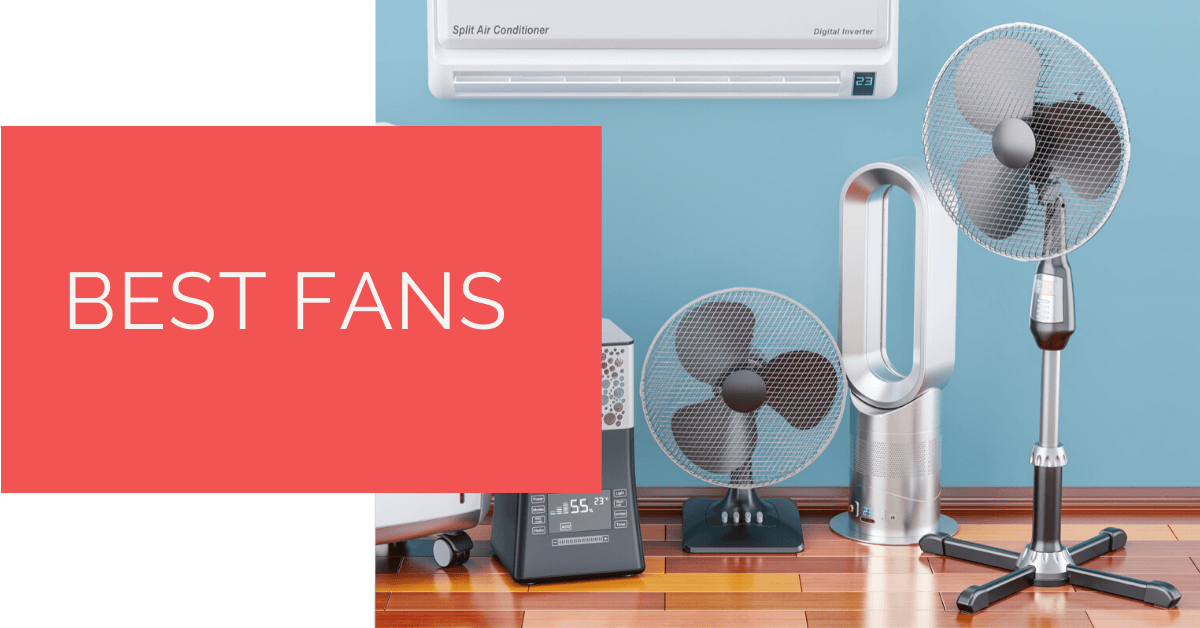
If you’re looking to keep cool without cranking up the air conditioning, a good electric fan is often your best bet. The DREO 20dB Smart Silent Tower Fan stands out as our top choice, delivering whisper-quiet operation at just 20 decibels whilst still pushing enough air to cool a generous living space. It’s smart, affordable at around £76, and has earned praise from over 12,000 UK buyers.
Whether you need something to circulate air in a bedroom, office, or living room, we’ve tested and reviewed eight of the best electric fans available on Amazon UK. This guide covers everything from powerful tower fans to compact desk models, so you’ll find exactly what suits your space and budget.
Contents
- 1 Our Top Picks
- 2 8 Best Electric Fans for Every Room
- 2.1 1. DREO 20dB Smart Silent Tower Fan
- 2.2 2. DREO 42 Inch Smart Tower Fan
- 2.3 3. DREO 20dB Standing Fan with 120°+120° Oscillation
- 2.4 4. Dreo 42″ Silent Standing Pedestal Fan
- 2.5 5. Levoit 20dB Quiet Pedestal Fan
- 2.6 6. 4UMOR Desk Fan with DC Motor
- 2.7 7. Dreo Tower Fan TF117
- 2.8 8. Igenix DF0030BL 30 Inch Oscillating Tower Fan
- 3 Fans Buying Guide
- 3.1 Key Takeaways
- 3.2 Tower Fans vs Pedestal Fans: Which Is Better for Your Space?
- 3.3 Understanding dB Ratings: What “Quiet” Actually Means
- 3.4 Oscillation Angles: Why It Matters More Than You Think
- 3.5 Smart Features: App Control, Timers, and Voice Assistants
- 3.6 AC vs DC Motors: Energy Use and Noise
- 3.7 Speed Settings: How Many Do You Actually Need?
- 3.8 Fan Comparison: Tower vs Pedestal vs Desk
- 4 Case Study: Staying Cool in a Top-Floor Flat During the Heatwave
- 5 Expert Insights From Our Heating Engineers About Cooling Your Home
- 6 Frequently Asked Questions
- 6.1 Will a fan actually cool down a room, or just move hot air around?
- 6.2 How many hours per day is safe to run a fan continuously?
- 6.3 Are tower fans better than pedestal fans?
- 6.4 Can I leave a fan on all night whilst sleeping?
- 6.5 What’s the difference between oscillation and static operation?
- 6.6 Do DC motor fans really use less electricity than standard fans?
- 6.7 Can I use a fan in a room with an open window?
- 7 Summing Up
Our Top Picks
| Image | Name | |
|---|---|---|
| DREO 20dB Smart Silent Tower Fan | |
| DREO 42 Inch Smart Tower Fan | |
| DREO 20dB Standing Fan with 120°+120° Oscillation | |
| Dreo 42" Silent Standing Pedestal Fan | |
| Levoit 20dB Quiet Pedestal Fan | |
| 4UMOR Desk Fan with DC Motor | |
| Dreo Tower Fan TF117 | |
| Igenix DF0030BL 30 Inch Oscillating Tower Fan |
8 Best Electric Fans for Every Room
1. DREO 20dB Smart Silent Tower Fan
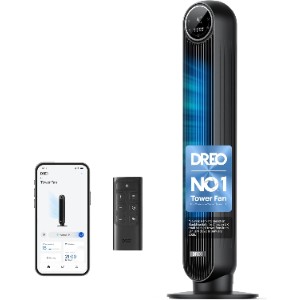
This is the one to buy if you want premium cooling without disturbing your household. At just 20 decibels, it’s remarkably quiet for a tower fan, meaning you can run it all night without waking yourself or anyone else. The DC motor technology is what sets it apart from budget alternatives, delivering efficiency that translates to lower running costs over the summer months.
The 90-degree oscillation covers a good spread of your room, and the 8 speeds give you fine control over air output. Smart features include app connectivity and voice control compatibility, though you’ll also get a physical remote if you prefer the traditional approach. The LED display shows the current speed and timer setting clearly, even in dimly lit rooms.
Run time is excellent thanks to the 8-hour timer option, so you can set it to switch off automatically before you fall asleep. The unit stands at a solid height and feels stable on most floors. Build quality is clearly a priority here, with smooth operation and responsive controls that don’t feel cheaply made.
With 4.7 stars across over 12,000 reviews, buyers consistently praise the quiet operation and reliable cooling. It’s a significant step up from budget tower fans, but the longevity and performance justify the investment if you plan to use it across multiple seasons.
Features
- DC motor technology for efficiency
- Operates at just 20dB (whisper-quiet)
- 90-degree oscillation range
- 8 adjustable speed settings
- 4 different operating modes
- 8-hour timer with LED display
- Smart home compatible (app and voice control)
- Remote control included
- Exceptionally quiet at 20dB
- Smart features add convenience
- Energy-efficient DC motor
- Excellent build quality and durability
- Higher initial cost than basic models
- Requires WiFi setup for full smart features
2. DREO 42 Inch Smart Tower Fan
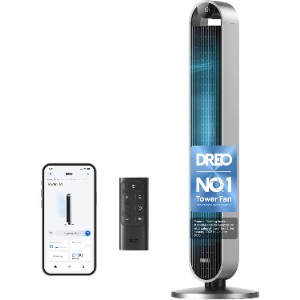
Step up to this 42-inch model if you need more power and coverage across a larger room. The taller design allows the fan to push air further and higher, meaning you get better circulation in spaces with high ceilings or open-plan layouts. At around £130, it’s a premium option, but 5,400+ reviews averaging 4.7 stars show it delivers genuine value for serious cooling needs.
What makes this model special is the extensive smart integration. Works with Alexa, Google Home, and the DREO app, so you can control it from your phone or voice commands. The 12-speed settings are far more granular than many competitors, letting you dial in the exact airflow you want. The 120-degree oscillation is also wider than the standard 90 degrees, ensuring better room coverage.
Assembly is straightforward, taking about 10 minutes with the included tools and instructions. The unit feels sturdy when operational and doesn’t wobble even on the highest speeds. The timer runs up to 12 hours, giving you flexibility for longer cooling sessions throughout the day.
Features
- 42-inch tower height for large rooms
- 12 granular speed settings
- 120-degree oscillation range
- Alexa and Google Home compatibility
- DREO app control from smartphone
- 12-hour timer option
- Quiet operation with DC motor
- LED display with remote control
- Excellent for large rooms and open spaces
- Comprehensive smart home integration
- 12-speed precision control
- 120-degree oscillation coverage
- Takes up more floor space
- Requires stable placement on level ground
3. DREO 20dB Standing Fan with 120°+120° Oscillation
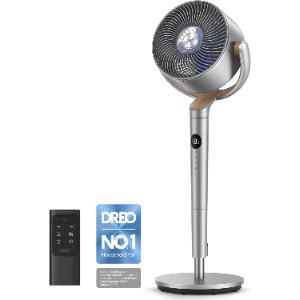
Here’s something genuinely different. Unlike standard fans that oscillate side to side, this standing pedestal model oscillates both horizontally and vertically. That means 120 degrees left to right and another 120 degrees up and down, creating true omni-directional airflow. If you’ve got an awkwardly shaped room or want air circulation at every height level, this is brilliant.
The 20dB quiet operation is matched only by the top-tier tower fans, which is impressive for a pedestal model. You’re looking at roughly £100, and the 4,400+ reviews averaging 4.7 stars show owners genuinely appreciate the unique circulation pattern. The adjustable height lets you fine-tune where the airflow concentrates, from waist level up to head height when sitting down.
DC motor efficiency means running costs stay low even if you’re using it constantly. The 8 speed settings are generous for a pedestal fan, and at 90 feet of circulation, it covers a decent-sized room without feeling inadequate.
Features
- Unique 120°+120° omni-directional oscillation
- 20dB whisper-quiet operation
- Pedestal standing design with adjustable height
- 8-speed settings for fine control
- 90 feet circulation range
- DC motor for energy efficiency
- Remote control included
- Child safety lock feature
- Unique omni-directional air circulation
- Extremely quiet at 20dB
- Adjustable height for targeted airflow
- Efficient DC motor technology
- Takes more floor space than tower models
- Vertical oscillation is less common (adjustment period needed)
4. Dreo 42″ Silent Standing Pedestal Fan
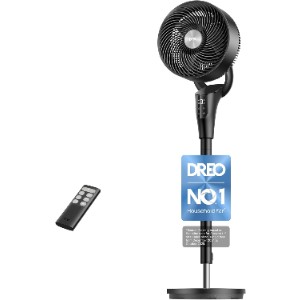
Want the cooling power of a larger fan without going for a tower? This 42-inch pedestal fan delivers exceptional value at around £68. It operates at just 20dB, matching the quiet performance of fans that cost twice the price. The 90-degree oscillation combined with manual vertical tilt adjustment gives you flexible airflow direction for any room layout.
The adjustable height means you can extend it to push cool air across a larger area, or position it lower if you want more concentrated cooling on yourself whilst working or relaxing. The 8-speed options let you match the speed to your preference, and over 3,500 buyers have rated it 4.7 stars, suggesting real reliability at this price point.
Features
- 42-inch pedestal height for extended reach
- 20dB quiet operation
- 90-degree horizontal oscillation
- 90-degree manual vertical tilt
- 8 adjustable speed settings
- Adjustable height design
- LED display with remote control
- Child lock safety feature
- Excellent value at under £70
- Very quiet operation
- Adjustable height and tilt
- Manual vertical angle adjustment
- No smart features or app control
- Less powerful than tower models
5. Levoit 20dB Quiet Pedestal Fan
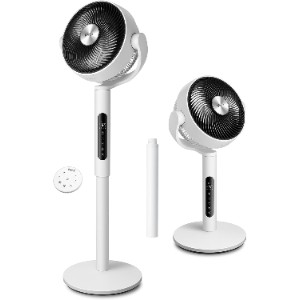
If you want to branch away from Dreo and explore what other premium brands offer, the Levoit pedestal fan is worth considering. At around £120, it sits in the upper-mid range and offers some unique features not found on cheaper models. The 1451 CFM airflow is genuinely powerful, moving substantial volumes of cool air across your room with impressive speed.
The 90-degree plus 120-degree oscillation setup is similar to the omni-directional Dreo above, giving you flexibility in how air distributes. You get 12 speed settings, which is excellent precision, and the 4-hour and 12-hour timer options mean you can set it and forget it. The adjustable height adds to the versatility, letting you position it exactly where cooling is needed most.
Features
- 1451 CFM powerful airflow output
- 20dB quiet operation
- 90-degree plus 120-degree oscillation modes
- 12 granular speed settings
- Adjustable height pedestal design
- 12-hour timer functionality
- 4 different operating modes
- Remote control with LED display
- High airflow output for powerful cooling
- Very quiet at 20dB
- Flexible oscillation options
- 12 speed precision settings
- Higher price than standard pedestal fans
- Takes reasonable floor space
6. 4UMOR Desk Fan with DC Motor
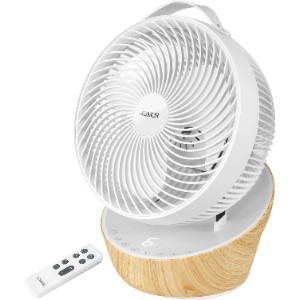
Need something compact for your desk or bedroom shelf? The 4UMOR desk fan is a compact powerhouse. Despite its small footprint, the 20dB operation is virtually silent, perfect for offices where you don’t want to distract colleagues. The 3D oscillating head moves side to side and up and down, so you can direct cool air exactly where you need it at your desk.
The 12-speed settings are generous for a desk fan, and the 3 operating modes cover different scenarios throughout your day. Whether you want gentle background cooling or a concentrated blast of air during a hot afternoon, it adapts. The 8-hour timer is helpful if you tend to forget to switch things off, and the remote means you don’t have to reach over your keyboard or work.
Features
- Compact desk-sized design
- 20dB quiet operation ideal for offices
- 3D oscillating head (side and vertical movement)
- 12 adjustable speed settings
- 3 different operating modes
- 8-hour timer function
- Remote control included
- DC motor for energy efficiency
- Perfect size for desks and small spaces
- Exceptionally quiet operation
- 3D oscillation for precise airflow
- Excellent speed range for small fan
- Limited coverage area compared to larger fans
- Not suitable for cooling entire rooms
7. Dreo Tower Fan TF117
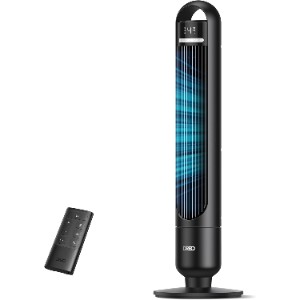
Don’t need all the smart features or countless speed settings? The TF117 is Dreo’s answer for buyers who simply want a reliable tower fan without complexity. At around £100, you’re paying for simplicity and dependability rather than WiFi connectivity. The 90-degree oscillation covers a typical lounge or bedroom effectively, and the 28dB operation is still reasonably quiet for background use.
The 4 speed levels are straightforward, and there are just 3 operating modes, so there’s no confusing menu system. Setup is literally unbox it, position it, plug it in, and adjust. The 8-hour timer means it’ll switch off automatically before bedtime, and the remote control lets you change settings without getting up.
Features
- Simple tower fan design with 4 speed levels
- 90-degree oscillation range
- 28dB quiet operation
- 3 operating modes
- 8-hour timer with auto-shutoff
- Remote control included
- No smart features or WiFi required
- Reliable performance and easy maintenance
- Straightforward operation, no learning curve
- Reliable build quality
- Good value at £100
- No WiFi setup required
- Limited speed control options
- No app or smart home integration
8. Igenix DF0030BL 30 Inch Oscillating Tower Fan
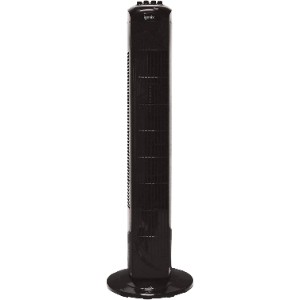
On a tight budget? The Igenix is the fan that proves you don’t need to spend £100+ to get something that works. At just £30, it’s the most affordable option on this list, yet it’s managed to accumulate over 5,400 reviews at 4.5 stars. That tells you something about the value proposition here. It won’t win awards for fancy features or whisper-quiet operation, but it’ll push cool air around your room reliably.
The 30-inch height is modest, so it’s best suited to smaller rooms, bedrooms, or as a backup unit. Three speed settings keep it simple, and the 2-hour timer is helpful if you want it running for a short spell during the hottest part of the afternoon. There’s no remote control, so you’re adjusting speeds manually at the unit itself, but honestly, at this price, that’s no hardship.
Features
- 30-inch compact tower design
- 3-speed operation settings
- Oscillating function for air distribution
- 2-hour timer
- No remote control (manual operation)
- Energy-efficient budget model
- Lightweight and easy to move
- Suitable for small to medium rooms
- Excellent value at £30
- Simple, no-nonsense operation
- Lightweight and portable
- Reliable performance for basic cooling
- No remote control
- Only 3 speed settings
- Less quiet than premium models
Fans Buying Guide
Key Takeaways
- Tower fans are the most popular living room and bedroom choice — slimmer footprint, often quieter, and better suited to modern interiors than traditional pedestal fans
- Pedestal fans deliver stronger, more focused airflow and are better for cooling a specific person or work area; height is adjustable, which is useful
- dB ratings matter: anything under 30 dB at the lowest setting is acceptable for sleeping; many modern fans like the Dreo 20dB range achieve this
- Oscillation angle makes a real difference — standard 90° oscillation covers one end of a room; 120°+120° bidirectional oscillation from models like the Dreo DR-HTF008 covers almost the whole room
- Smart fans with WiFi can be controlled from bed via app — useful for adjusting speed at night without getting up
- DC motor fans cost more upfront but use significantly less electricity than AC motor fans — worth the premium if you run the fan daily
- Speed settings: more settings mean finer control; 12 settings gives much smoother transitions than 3 settings
Tower Fans vs Pedestal Fans: Which Is Better for Your Space?
Tower fans have a vertical cylindrical design that takes up minimal floor space. They’re well suited to living rooms and bedrooms where you want something that doesn’t dominate the room. The airflow comes from a vertical column and distributes across a wider height range, which means everyone sitting in the room gets some air movement rather than just those in the direct path of the fan.
Pedestal fans have a round blade assembly on an adjustable pole. They’re more familiar, easier to repair, and tend to deliver more concentrated airflow that you can direct precisely. Height adjustment (usually 90–130 cm) is a practical advantage: lower for desk use, taller when standing. They’re better for personal cooling at a workbench or desk, or for circulating air in a workshop where you want targeted airflow.
For most homes, a tower fan in the living room or bedroom and a pedestal or desk fan for a workspace is a sensible combination. If space is tight, a tower fan is the more versatile of the two. If strong, directional airflow matters more than aesthetics, a pedestal wins.
Understanding dB Ratings: What “Quiet” Actually Means
Fan noise is measured in decibels (dB). To give this context: a quiet library is around 30 dB; a normal conversation is around 60 dB. Most fans at maximum speed reach 50–65 dB, which is fine in a kitchen or office but disruptive in a bedroom. The critical number is the lowest speed rating, because that’s what you’ll use overnight.
A fan rated at 20 dB on the lowest setting — like several Dreo models on this list — is genuinely near-inaudible. You’ll hear a faint white noise at most. A fan rated at 40 dB on the lowest setting is roughly equivalent to a quiet room with an aquarium running, which some people find fine for sleeping while others find intrusive.
Manufacturers sometimes quote the absolute minimum noise in ideal conditions. Real-world use with oscillation enabled often adds 2–5 dB. Take marketing dB claims as a useful comparison tool rather than a precise specification.
Oscillation Angles: Why It Matters More Than You Think
Standard fan oscillation sweeps left and right through 90°, covering about a quarter of the room in front of the fan. This works fine if you’re sitting directly in front of it, but leaves the sides of a room largely unaffected.
Some Dreo models offer 120°+120° bidirectional oscillation, meaning the fan sweeps 120° in one direction, then reverses and sweeps 120° the other way. In practice, this covers almost the full 240° arc in front of the fan — effective for cooling an entire living room from one corner placement.
Vertical oscillation is a separate feature some tower fans include. Combined with horizontal sweep, it helps move warm stratified air down from the ceiling and distribute it more evenly, which improves the perceived temperature even when it’s hot. This is particularly valuable in rooms with high ceilings.
Smart Features: App Control, Timers, and Voice Assistants
Smart fans connect to your home WiFi and can be controlled remotely via an app. For bedroom use, this means adjusting fan speed after you’ve settled into bed without having to get up or fumble for a remote. Scheduling features let you set the fan to reduce speed at midnight and switch off at 3 am automatically.
Dreo’s app is well-regarded and works with Alexa and Google Home. Levoit’s VeSync app offers similar functionality. For most people, the main practical benefit is in-bed control and sleep timer setting. Voice control (“Alexa, turn off the bedroom fan”) is genuinely convenient if you already have smart speakers.
If you don’t care about smart features, many models include a physical remote control that accomplishes most of the same tasks. A remote is always useful for a bedroom fan regardless of smart capability — nobody wants to walk across the room at 2 am to adjust the speed.
AC vs DC Motors: Energy Use and Noise
Most fans use AC (alternating current) motors. They’re reliable, affordable to manufacture, and work fine. DC (direct current) motors are more efficient, quieter at low speeds, and typically offer more speed settings (often 12 rather than 3–5). The trade-off is cost: a DC motor fan typically costs 20–40% more than a comparable AC model.
The efficiency difference matters if you run the fan a lot. A DC motor pedestal fan might use 25W at medium speed compared to 45W for a similar AC model. Over a summer running 8 hours a day, that saves roughly £5–10 depending on your electricity rate — not enormous, but the DC fan also tends to run quieter and smoother at low settings, which is arguably worth more.
Premium models in this review use DC motors and the difference at low speed is perceptible: AC fans at very low speed can sound slightly rough or buzzy, while DC fans glide smoothly and quietly. For bedroom use, the DC advantage is real.
Speed Settings: How Many Do You Actually Need?
Budget fans offer 3 speed settings: low, medium, high. This is adequate but coarse. Medium might feel too weak, high too strong, with nothing in between. Mid-range fans typically offer 5–8 settings. Premium models like the Dreo range offer 9–12 settings, which means you can find exactly the speed where the fan is quiet enough to sleep through but strong enough to feel the air movement.
For bedroom use, more settings is always better. For a kitchen or home office where you want either “on” or “off” and a decent breeze, 3–5 settings is perfectly fine.
Fan Comparison: Tower vs Pedestal vs Desk
| Type | Best For | Noise Level | Airflow Pattern | Space Needed |
|---|---|---|---|---|
| Tower fan | Bedrooms, living rooms, small flats | Very quiet at low settings | Wide vertical column, wide oscillation | Minimal — slim footprint |
| Pedestal fan | Offices, workshops, larger rooms | Moderate; louder at high speed | Focused directional airflow | Medium — round base |
| Desk/table fan | Personal cooling at a desk | Varies; DC models very quiet | Personal zone, adjustable tilt | None — sits on a surface |
Case Study: Staying Cool in a Top-Floor Flat During the Heatwave
Background
A family in a converted Victorian terraced house occupied the top two floors, with bedrooms tucked under the eaves and a sloped ceiling that trapped heat relentlessly. During the heatwave of summer 2023, daytime temperatures regularly hit 28 to 30 degrees Celsius, and the flat never cooled below 24 degrees even at night. Air conditioning wasn’t possible due to the period nature of the building, and the family was struggling with sleep disruption and afternoon fatigue.
The Challenge
Standard bedroom fans were too noisy for sleeping, creating a sound that was more disruptive than the heat itself. The family tried a basic budget fan borrowed from a neighbour, but at 40dB, it was like having a small engine running all night. They needed powerful cooling without sacrificing sleep quality, and they had limited floor space in the bedrooms due to furniture arrangement.
Solution
They chose two DREO 20dB Smart Silent Tower Fans, positioning one in the master bedroom and another in the children’s room. The tower design fitted into corners without requiring floor space rearrangement, and the 20dB operation was barely audible. They set the 8-hour timers to run from bedtime until early morning, providing consistent cooling through the hottest parts of the night.
Results
Bedroom temperatures dropped by 2 to 3 degrees Celsius with the fans running, which made a noticeable difference to sleep quality. The family reported falling asleep more easily and waking less frequently during the night. Over the summer, the combination of fans and strategic ventilation in the morning and evening kept the flat tolerable without needing expensive air conditioning installation. Total running cost for both fans across three months was estimated at £30, versus potentially £1,500 for a permanent AC system.
Expert Insights From Our Heating Engineers About Cooling Your Home
One of our senior heating engineers with over fifteen years of experience in home climate control notes that fans are an underrated cooling solution in the UK. “People assume they need air conditioning for summer comfort, but a quality fan moves enough air to create evaporative cooling and circulation that makes a real difference,” he explains. “The key is choosing the right type for your space and running it intelligently, not continuously.”
He emphasises the importance of opening windows early morning and late evening when outdoor temperatures are lower, then closing blinds and windows during the hot daytime to trap cooler air inside. The fan then circulates this cooler air throughout the space. “Add a tower fan into that routine, run it for 8 hours during sleeping hours, and you’ve got a genuinely comfortable bedroom without the cost and installation hassle of permanent air conditioning,” he says.
On energy efficiency, he recommends checking the motor type. “DC motors are more efficient than AC motors, meaning less power consumption for the same airflow. Over a summer, the difference compounds into real savings, and you also get the bonus of quieter operation because the motor runs more smoothly. If you’re using a fan regularly, spending the extra upfront for a DC motor model pays for itself in reduced electricity bills.”
Frequently Asked Questions
Will a fan actually cool down a room, or just move hot air around?
A fan doesn’t lower the ambient room temperature in the traditional sense, but it creates meaningful comfort through air circulation. Moving air accelerates evaporative cooling on your skin, which is why you feel cooler when a fan is on. Additionally, fans help distribute cooler air from outside or from naturally cooler areas of your home, preventing hot spots and creating more even temperatures. For actual temperature reduction, you’d need air conditioning or strategic ventilation opening windows during cooler hours.
How many hours per day is safe to run a fan continuously?
Fans are designed for extended use and can safely run 12 to 16 hours daily without damage. The main consideration is comfort and personal preference rather than equipment safety. Many people run fans 8 hours overnight for sleeping and additional hours during the day as needed. The timer function on quality fans helps you avoid leaving them running unnecessarily, which is good practice for energy savings rather than because of safety concerns.
Are tower fans better than pedestal fans?
Not necessarily better, just different advantages. Tower fans are more compact and space-efficient, fitting neatly in corners of most rooms. Pedestal fans offer adjustable height and broader coverage, plus they’re often slightly cheaper. Tower fans tend to be slightly quieter and more modern looking, whilst pedestal fans feel more traditional. Choose based on your space constraints and whether you want adjustable height capability.
Can I leave a fan on all night whilst sleeping?
Yes, fans are perfectly safe to leave on all night. Many people prefer to run them during sleeping hours for the cooling effect and the white noise they produce. This is actually a good use of the timer function, as you can set it to run for 8 hours from bedtime and switch off automatically, avoiding leaving it on all day and wasting electricity. As long as the fan is on a stable, level surface away from edges and hazards, it’s a safe sleeping aid.
What’s the difference between oscillation and static operation?
Oscillation is when the fan head moves back and forth (or up and down in some models), spreading airflow across a wider area. Static operation keeps the head in one fixed direction, concentrating airflow on a specific spot or person. Oscillation is more useful for general room cooling because it distributes air evenly, preventing hot spots. Static mode is better for personal cooling when you want concentrated airflow on yourself, such as at a desk.
Do DC motor fans really use less electricity than standard fans?
Yes, DC motors are genuinely more efficient. They consume 20 to 30 percent less power than AC motors for equivalent airflow output, meaning lower electricity bills over the summer season. The efficiency compounds across months of use, potentially saving £5 to £10 on a three-month summer run. You also get the bonus benefit of quieter, smoother operation because DC motors run more gently without the vibration characteristic of AC motors.
Can I use a fan in a room with an open window?
Absolutely. In fact, combining a fan with strategic window opening is an excellent cooling strategy. Open windows early morning and late evening when it’s cooler outside, then close blinds and windows during the hot day. Use the fan to circulate the cooler air trapped inside, preventing it from stagnating in corners. This approach uses fans to maximum effect and is more energy-efficient than trying to cool with fans alone on very hot days.
Summing Up
Electric fans are unbeatable for efficient, quiet cooling in UK homes. Whether you go for the premium quiet operation of the DREO 20dB Smart Silent Tower Fan, the powerful coverage of the larger 42-inch models, or the budget-friendly Igenix option, you’ve got something that genuinely improves summer comfort without the cost and installation of air conditioning.
Our top pick remains the DREO 20dB Smart Silent Tower Fan because it delivers the best balance of quiet operation, reasonable cost, useful smart features, and proven reliability across over 12,000 reviews. But every fan on this list has something to offer depending on your priorities, space constraints, and budget. Pick the type that suits your home, set the timer, and enjoy cooler nights and more comfortable days.
Updated