
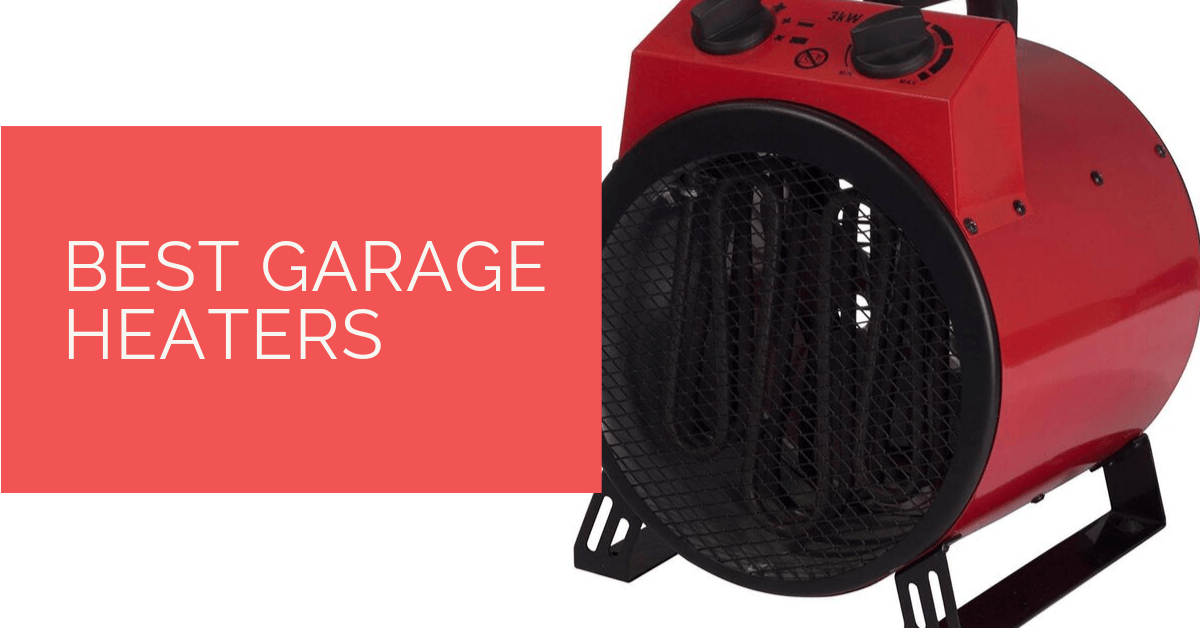
For most UK homeowners, the Dimplex 3KW Electric Fan Heater is the best garage heater: it plugs into a standard 13A socket, runs without any gas connection or ventilation concerns, and delivers enough heat for a single-car garage within 20 minutes. But garages vary enormously, from a well-insulated converted brick box to an uninsulated double-width steel-door workshop, and the right heater depends on your space, power supply, and how often you use it. We have reviewed eight options covering electric, propane, infrared, and frost-protection heaters to suit every situation and budget.
Below you will find detailed reviews of each pick, followed by a buying guide covering heat output calculations, electric versus gas comparisons, ventilation requirements, and safety advice for running gas heaters in enclosed spaces.
Our Top Picks
| Image | Name | |
|---|---|---|
| Dimplex 3KW Electric Fan Heater | |
| Mr. Heater Portable Buddy MH9BX | |
| Draper 2.0kW PTC Electric Space Heater | |
| Sealey Space Warmer Propane Heater LP14 | |
| Warmlite Infrared Heater WL42013 | |
| Mr. Heater Little Buddy MH4B | |
| Benross 2000W Industrial Fan Heater | |
| Dimplex 2FT Tubular Heater |
8 Best Garage Heaters
1. Dimplex 3KW Electric Fan Heater
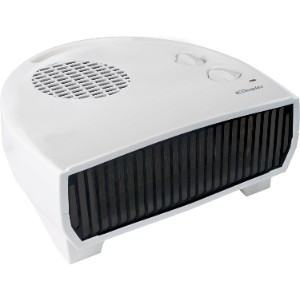
Dimplex has been making heating products in the UK for decades, and this 3kW fan heater is one of their most consistent sellers for good reason. It is compact enough to sit on a workbench or shelf, runs without any gas connection or ventilation requirements, and delivers enough output to warm a typical single-car UK garage in around 20 to 30 minutes. The 3kW rating matters: it is the highest output you can safely draw from a standard 13A UK plug, so you get maximum electric heat without rewiring or calling an electrician.
Two heat settings (1.5kW and 3kW) plus a manual thermostat give you straightforward control over running costs. The frost protection mode is particularly useful if you store a car or tools and want to keep the space above freezing without running the heater continuously. Set the thermostat to a low temperature and leave it on a timer: the heater will cut in only when the garage drops below your threshold. There is also a cool-blow option, which is more useful than it sounds in a workshop setting when you need to cool a tool or dry something off.
Build quality is solid for the price. The outer casing does not get dangerously hot, the thermostat is accurate enough for a garage environment, and the unit is light enough to carry wherever you need it. At around £50, it represents strong value against more expensive alternatives that do not necessarily heat a standard garage any better.
With over 400 ratings averaging 4.3 stars, it is one of the most reviewed garage heaters on Amazon UK. The pattern of reviews is consistent: most buyers report it working well year after year without problems. If you want electric heat with no complications, start here.
Features
- 3kW output with two heat settings (1.5kW and 3kW)
- Manual thermostat with frost protection mode
- Cool-blow function for year-round use
- Standard 13A UK plug, no specialist wiring needed
- Compact and portable with carry handle
- Overheat protection cut-out
- Maximum 3kW from a standard plug, the most available without rewiring
- Frost protection mode keeps the garage above freezing without supervision
- Simple controls with no app or Bluetooth required
- Compact, portable and easy to move between the garage and other rooms
- Fan noise is noticeable; not ideal for very quiet working environments
- 3kW will struggle in a poorly insulated double-car garage in January
2. Mr. Heater Portable Buddy MH9BX Propane Heater
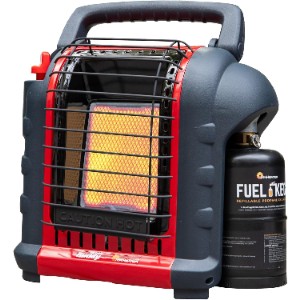
If your garage has no mains electrical supply, or if you need heat output beyond what a standard 13A plug can deliver, the Mr. Heater Portable Buddy is what most garage owners turn to. It produces up to 9,000 BTU/hr (roughly 2.6kW) from propane, includes an integrated oxygen depletion sensor (ODS) that shuts the burner off automatically if oxygen levels drop, and carries CE approval for indoor use. That indoor-safe certification is what sets it apart from the vast majority of propane heaters, which are rated for outdoor use only. In an enclosed garage, that distinction matters enormously.
The Portable Buddy connects to standard disposable 1lb propane cartridges for occasional use, and to larger 7kg or 13kg Calor gas bottles via an optional hose adaptor. Running it on a larger bottle brings down the per-hour fuel cost and means you are not constantly swapping cartridges mid-session. Heat output is adjustable between low (4,000 BTU) and high (9,000 BTU), and there is a built-in tip-over protection that cuts the gas supply if the unit falls over.
In practice, 9,000 BTU heats a well-insulated single-car garage comfortably, and makes a real difference in a larger but less insulated space. It will not replace central heating for a big workshop, but as a portable heat source requiring no power supply and no permanent installation, it is hard to beat. Bear in mind that any gas heater should be used with a window or door open a crack and a carbon monoxide detector fitted in the space. That is not optional advice.
With over 470 ratings and a 4.6-star average, this is the highest-rated heater on this list. It costs more than the electric options, but the propane running cost is competitive with electricity and the heat output is instant with no warm-up delay.
Features
- 9,000 BTU/hr maximum output (approximately 2.6kW)
- Adjustable low (4,000 BTU) and high (9,000 BTU) settings
- Indoor-safe oxygen depletion sensor (ODS)
- Tip-over safety shutoff
- Compatible with 1lb cartridges and larger tanks via adaptor
- CE marked for UK and European use
- Works without any mains power supply
- Indoor-safe ODS certification makes it suitable for enclosed garages
- Instant heat with no warm-up period
- Can connect to large propane tanks for lower running costs
- Ongoing propane fuel cost on top of purchase price
- Ventilation and a CO detector are still required for safe use
3. Draper 2.0kW PTC Portable Electric Space Heater
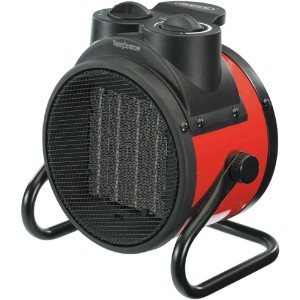
Draper is a well-established UK tool and equipment brand, and this 2kW PTC ceramic heater reflects that heritage: it carries an IP24 splash-proof rating, uses a PTC (positive temperature coefficient) ceramic element that self-regulates and reduces overheating risk, and has a rugged build suited to workshop use. At 2kW, output is lower than the Dimplex above, but the IP24 rating makes it genuinely suitable for damp garages and outbuildings where a standard fan heater would be a risk. Two heat settings (1kW and 2kW) and a thermostat dial keep the controls straightforward.
At £39, it costs about a tenner less than the Dimplex 3KW and gives up 1kW of output in return. For a well-insulated single-car garage or a compact workshop, 2kW is usually enough. For anything larger or colder, the extra kilowatt from the Dimplex is worth the price difference. Where the Draper earns its place is in damp environments: if your garage has water ingress issues or you work with liquids, the IP24 rating is a meaningful safety advantage.
Simple controls, good build quality for the money, and a splash-proof rating make this a solid pick for buyers who want something more rugged than a domestic fan heater without moving to a gas option.
Features
- 2kW PTC ceramic element (two settings: 1kW and 2kW)
- IP24 splash-proof rating for damp environments
- Thermostat control
- Carry handle, under 2kg in weight
- Overheat and tip-over protection
- Indoor and outdoor rated
- IP24 splash resistance makes it genuinely suitable for damp garages
- PTC ceramic element is safer and more energy-stable than wire elements
- Good value at £39 from a trusted UK brand
- 2kW output is modest for larger or poorly insulated garages
- No frost protection mode
- No timer built in
4. Sealey Space Warmer Propane Heater LP14
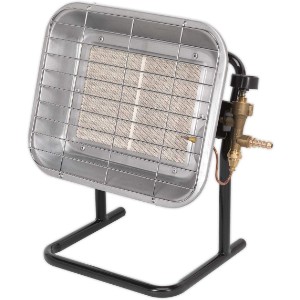
Sealey is another familiar UK tool brand, and the LP14 is their most popular propane space heater. At 15,354 BTU/hr (approximately 4.5kW), it delivers more output than the Mr. Heater Portable Buddy and is better suited to larger or less insulated garages. It comes with an adjustable stand for floor or table positioning, a piezo ignition system, and connects to a standard propane regulator and Calor or similar LPG bottle. If your garage is big, cold, and draughty, this is the kind of output you need to make a real difference.
Unlike the Mr. Heater Buddy, the LP14 does not carry an ODS sensor. This means you need to treat it as a ventilated-use-only heater: garage door partially open, window ajar, CO detector running. In a workshop where the door gets opened and closed regularly during use, that ventilation requirement is not much of a practical hardship. Think of it as a high-output propane heater for semi-open conditions rather than a sealed indoor heater.
At £65.99, it undercuts the Mr. Heater Buddy while delivering roughly double the BTU output. The tradeoff is the absence of ODS and the need to manage ventilation actively. For buyers who need serious heat in a larger space and understand the ventilation requirements, the Sealey LP14 is hard to beat for value.
Features
- 15,354 BTU/hr output (approximately 4.5kW)
- Propane, connects to standard LPG regulator
- Adjustable tilt stand included
- Piezo ignition
- Safety valve on gas connection
- Lightweight and portable
- Higher BTU output than buddy-style heaters, better for large garages
- Strong value from a reputable UK workshop brand
- Stand included for versatile positioning
- No ODS sensor: requires ventilation and a CO detector when in use
- Not for prolonged use in completely sealed spaces
- Ongoing LPG fuel cost
5. Warmlite Infrared Heater with Oscillation WL42013
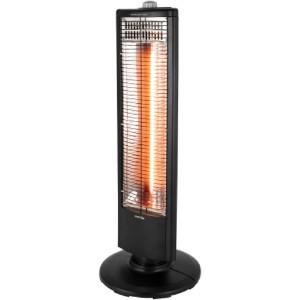
Infrared heaters work differently from fan heaters. Instead of warming the air in the room, they emit infrared radiation that heats objects and surfaces directly, including you, your car, and your workbench. In a draughty garage where warm air escapes quickly through gaps and an open door, this direct heating approach can be more effective than a fan heater struggling to hold air temperature. The Warmlite WL42013 adds a 90-degree oscillation sweep to spread that radiant heat across more of the space, and runs silently with no fan noise at all.
Output is 2kW. The heat feels immediate and directional: stand in front of it and you feel warm even if the air temperature has not risen much. That makes it particularly good for a fixed working position like a workbench or hobby table. Move away from the beam and you lose the benefit quickly, so it suits focused work rather than heating a whole space. If fan noise is a deal-breaker for your working environment, this is the heater to consider.
At £44, the WL42013 is priced between the budget Benross and the Dimplex. The silent operation and direct heating approach justify the slightly higher cost over the Benross if draughts or noise are issues in your garage.
Features
- 2kW infrared heating element
- 90-degree oscillation for wider heat coverage
- Silent operation (no fan)
- Two heat settings
- Overheat and tip-over protection
- Carry handle
- Silent running, no fan noise whatsoever
- Heats people and objects directly, effective in draughty spaces
- Oscillation distributes radiant heat more widely
- Does not raise air temperature as efficiently as a fan heater
- 2kW output limits usefulness in larger garages
6. Mr. Heater Little Buddy MH4B Propane Heater
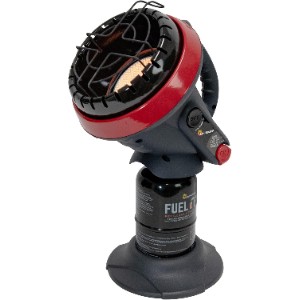
The Little Buddy is the smaller sibling of the Portable Buddy above. It produces 3,800 BTU/hr (approximately 1.1kW) from a standard 1lb propane cartridge and, like its bigger sibling, carries indoor-safe certification with an ODS sensor. At that output level, it is not going to heat a full-sized UK garage in winter. What it will do is take the edge off a small insulated space on a mild day, warm a car interior quickly, or provide reliable heat in a situation where you have no mains power and need something small enough to carry anywhere.
Weighing just 1.4kg with no cable and no installation required, it is the most genuinely portable heater on this list. The 1lb cartridge runs for roughly two hours on high. As a primary garage heater for a typical UK winter, it will disappoint anyone with a standard-sized space. As a supplement, an emergency backup, or a heater for very compact spaces, it earns its place at £84.99. It also doubles as a camping heater, making it multi-purpose in a way none of the other products here can match.
One honest note: the 3,800 BTU rating is for a product sold primarily in the US at a lower price point. UK import pricing means it costs more here relative to what it delivers than the Portable Buddy does. If you specifically need indoor-safe propane heat in a small portable package, it is the right tool. If budget is the priority, the Sealey LP14 delivers more BTUs for less money, albeit with the ventilation requirement.
Features
- 3,800 BTU/hr output (approximately 1.1kW)
- Indoor-safe oxygen depletion sensor (ODS)
- Compatible with 1lb propane cartridges
- Tip-over protection
- 1.4kg weight with no cable
- Foldable carry handle
- Genuinely portable with no cable, works anywhere
- Indoor-safe ODS certification for enclosed use
- Multi-purpose: garage, camping, power cut emergency heat
- 3,800 BTU is too low to heat a typical UK garage in cold weather
- 1lb cartridges are expensive per kWh compared to larger tank options
7. Benross 2000W Industrial Fan Heater
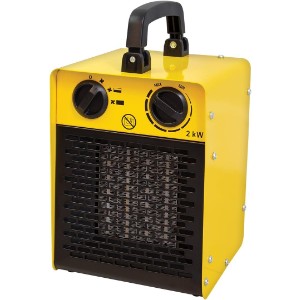
The most straightforward pick on this list: 2kW of electric fan heat in a robust plastic shell for under £33. Adjustable thermostat, two heat modes, cool-blow setting. Nothing clever, which in a garage heater is often a virtue. If you want something cheap, durable, and guaranteed to work without reading a manual, the Benross does the job in a small to medium insulated garage or workshop. Over 400 ratings average 4.3 stars, and the complaints that do appear are mostly about fan noise, which is a fair criticism.
This is not a heater to buy if you use your garage daily for serious work. The build quality reflects the £33 price point, and the fan is notably loud. For occasional use or as a cheap backup when the main heater is out of action, it is worth the money. Step up to the Dimplex or Draper if you want something that feels like it will last a decade rather than a few winters.
Features
- 2kW output (two settings: 1kW and 2kW)
- Adjustable thermostat
- Cool-blow option
- Carry handle
- Overheat protection
- Cheapest electric heater on this list at under £33
- Simple plug-and-use setup with no configuration
- Noticeably loud fan even by fan heater standards
- Economy build quality; not as durable as Dimplex or Draper
- 2kW output limits usefulness in larger garages
8. Dimplex 2FT Tubular Heater
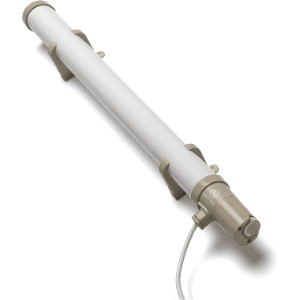
This is not a heater you buy to be comfortable while working in the garage. It is a frost protection device. At 80W, it draws barely more power than a filament light bulb, produces gentle background warmth, and keeps a typical UK garage above freezing throughout the winter. It is designed for permanent wall mounting, runs continuously on a thermostat, and costs around 2p per hour at current electricity rates. That works out to roughly £12-15 over a full October-to-March heating season.
If you store a classic car, have tools or paints that cannot freeze, or want to prevent the damp and condensation cycle that quietly destroys everything stored in an unheated garage over winter, this is the product. It will not make the space comfortable to work in, but it will reliably hold the temperature above 5°C while you are not there. At £27, it is the cheapest heater on this list and has by far the lowest running cost.
Features
- 80W continuous output
- 2ft (600mm) tubular element
- Built-in thermostat
- Wall-mounting brackets included
- Designed for permanent low-level installation
- Running cost of approximately 2p/hour, lowest on this list by far
- Prevents frost damage and condensation without supervision
- 80W output is frost protection only, not comfortable active heating
- Requires semi-permanent wall mounting and an electrical supply to the garage
- Not portable
Garage Heater Buying Guide
Key Takeaways
- Most UK garages with an electrical supply are best served by a 2kW or 3kW electric fan heater. The Dimplex 3KW runs from a standard 13A plug and is sufficient for a well-insulated single-car garage.
- Propane heaters are the answer when mains power is not available or when you need more output than a standard socket can deliver. The Mr. Heater Portable Buddy is the only pick here with indoor-safe ODS certification.
- Always fit a CO detector before running any gas heater in an enclosed space. Even indoor-safe heaters benefit from some ventilation. This is not optional.
- For a large, poorly insulated garage, no portable heater will maintain comfortable temperatures in a UK winter. Improve the insulation first, particularly the door and ceiling.
- A tubular heater is the most cost-effective solution for overnight frost protection: 2p/hour versus 48p/hour for a 2kW fan heater.
- Infrared heaters are more effective than fan heaters in draughty spaces because they heat people and objects directly rather than the air.
What Is a Garage Heater?
A garage heater is any portable or fixed heating device designed for use in garages, outbuildings, and workshops. The category covers a broad range of products, from compact 2kW fan heaters that run from a standard plug to propane space heaters delivering 15,000 BTU/hr or more, to diesel-fired industrial units producing 30kW for large commercial workshops.
What distinguishes a garage heater from an ordinary room heater is typically robustness, heat output flexibility, and fuel variety. Garages are usually uninsulated or under-insulated, draughty, and often without a permanent heating connection. A good garage heater needs to cope with those conditions: it will be knocked around, exposed to damp, and expected to heat a space that loses heat much faster than a well-insulated sitting room.
How Much Heat Does a Garage Need?
The standard rule for electric heating is 1kW per 10 square metres for a reasonably well-insulated space. A typical UK single-car garage (roughly 17-20m²) needs 2-2.5kW to maintain a comfortable working temperature on an average UK winter day. A double-car garage (30-35m²) needs 3-4kW. For poorly insulated garages or very cold days, add 50% to those figures as a safety margin.
For propane heaters, the calculation is the same in different units. One kilowatt is approximately 3,412 BTU/hr. A garage needing 3kW requires around 10,000 BTU/hr. The Mr. Heater Portable Buddy at 9,000 BTU/hr is roughly equivalent to the Dimplex 3KW in heat output terms.
The biggest variable is insulation. An uninsulated concrete block garage with a steel door can lose heat faster than any portable heater can replace it in deep winter. If you use your garage regularly through the colder months, insulating the door and ceiling will do more for your comfort than buying a larger heater.
Electric vs Gas vs Infrared
Electric fan heaters are the default for most UK garages with an electrical supply. They are safe, require no fuel storage, and the maximum available on a standard 13A plug (3kW) is enough for a well-insulated single-car garage. Above 3kW, you need a dedicated circuit from a qualified electrician.
Propane and LPG heaters offer higher output and work without any electrical connection. The downside is ongoing fuel cost, the need to store LPG cylinders, and ventilation requirements. For garages without electricity, or for large spaces where 3kW is not enough, propane is the practical answer. A CO detector is non-negotiable if you run gas heat in an enclosed space.
Infrared heaters heat objects and people directly rather than the air. This makes them effective in draughty spaces where fan heaters struggle to hold temperature, and they run silently. The tradeoff is that moving away from the beam removes the benefit quickly. They suit a fixed working position rather than heating a whole space.
Diesel and paraffin heaters produce very high output (20-30kW) for large commercial workshops and construction sites. They are over-specified and expensive to run for a domestic UK garage.
Benefits of a Dedicated Garage Heater
The most obvious benefit is comfort. A heated garage extends the working season significantly: instead of abandoning projects from October to March, you can work through the winter. For hobbyists, mechanics, woodworkers, and anyone who uses the garage as a secondary workspace, that matters a great deal.
Beyond comfort, background heat prevents damp and condensation. Garages without any heating are prone to condensation on cold metal surfaces, which accelerates rust on vehicles and tools, damages cardboard storage, and creates conditions for mould. A frost-protection heater running in the background significantly extends the life of anything you store in the garage.
Some materials also have minimum temperature requirements for use or storage. Paints, varnishes, adhesives, and wood finishes all have stated minimum application temperatures, typically around 10°C. Maintaining a working temperature in a garage workshop is not just about comfort: it affects the quality of the work itself.
Things to Keep in Mind Before Buying
Your electrical supply. If your garage has a standard ring main socket, a single 13A plug supports a maximum of 3kW. Above that, you need a dedicated circuit. Many garages have only a radial circuit rated below ring main levels. If you are unsure, check with a qualified electrician before buying a high-wattage heater. Overloading an under-rated circuit is a fire risk.
Ventilation for gas heaters. Any propane or LPG heater that burns gas produces carbon monoxide and consumes oxygen. The Mr. Heater Buddy has an ODS that shuts off the burner if oxygen is depleted, but that is an emergency last resort, not a substitute for ventilation. Keep a window or door cracked, fit a carbon monoxide alarm, and check it regularly. The Mr. Heater Little Buddy and Portable Buddy are both certified for indoor use but that certification does not remove the need for ventilation and a CO detector.
Garage size and insulation. Match the heater to the space realistically. A 2kW heater in an uninsulated double garage in January will not create a comfortable working environment. Be honest about your heat loss and either buy accordingly or improve the insulation before settling for a smaller heater.
Portability versus permanence. Portable heaters need to be brought in and set up each time. A wall-mounted tubular heater or a fixed fan heater on a dedicated circuit will always be ready and can run on a timer. If you use the garage daily, a semi-permanent setup is worth the installation effort.
Types of Garage Heater
Electric fan heaters are the most common type for domestic UK garages. A fan blows air over a heating element and warms the space quickly. They are portable, safe, and available from 1kW to 3kW for standard plug use.
Ceramic PTC heaters are a type of electric fan heater using a positive temperature coefficient ceramic element instead of a wire element. PTC elements self-regulate and are safer and more energy-stable, though the practical heating effect is similar.
Infrared heaters produce radiant heat rather than convective heat. They are silent, effective in draughty spaces, and suit directional working heat at a fixed position.
Propane and LPG heaters burn bottled gas to produce heat. They range from compact buddy-style heaters (3,800 BTU) to large stand-mounted units (15,000+ BTU). All require ventilation and a CO detector.
Tubular heaters are low-wattage frost-protection devices (typically 60-160W per foot of tube). They are permanently mounted, always-on, and very cheap to run.
Diesel and paraffin heaters are designed for large commercial spaces and produce 15-30kW of output. They are generally too powerful and expensive to run for a domestic garage.
Case Study: Heating a Workshop Garage on a Limited Budget
Background
A woodworker in South Yorkshire used a detached single-car garage as a workshop throughout the year. The garage was a standard single-skin brick structure with a steel up-and-over door, no insulation in the roof or walls, and a single 13A radial circuit connected from the house. In winter, the space dropped to 2-4°C overnight and took most of a cold morning to warm up even with active heating running from arrival.
Project Overview
The goal was twofold: to make the workshop usable from early morning without a long warm-up period, and to prevent temperatures dropping below 5°C overnight to protect stored timber, paints, and tools. Budget was under £100 for all heating equipment. A dedicated electrical circuit was not available without significant cost, so the solution had to work within a single 13A radial socket.
Implementation
A Dimplex 3KW electric fan heater was positioned on a shelf at head height during active sessions, blowing warm air down into the working area. A Dimplex 2FT tubular heater was wall-mounted on the cold north-facing wall and connected via a mechanical 24-hour plug timer, set to maintain the garage above 7°C overnight. The two units share the single socket using a fused spur, with only one running at a time: the tubular heater for background overnight warmth and the fan heater for active working sessions.
Results
Garage temperature held between 7°C and 10°C overnight throughout the winter months. On arriving at 7am, a 30-minute run of the 3kW fan heater brought the temperature to 16-18°C, which is comfortable for woodworking. Stored timber no longer showed the moisture movement between winter and spring that had been causing joint problems. Total electricity cost over the winter was estimated at £30-38, split roughly 30% tubular heater and 70% fan heater. Both goals were met within the original budget.
Expert Insights From Our Heating Engineers About Garage Heaters
“The question I get most often about garage heating is how many kilowatts are needed. The honest answer is that the heat loss calculation matters far more than the room size alone. A well-insulated 20m² garage with a decent insulated door might be comfortable with 2kW. An uninsulated 15m² garage with a poorly fitting steel door could need 4kW or more to hold temperature during a cold snap. If your garage is uninsulated and you are buying a portable heater expecting it to maintain 18°C in January, you will likely be disappointed unless you also address the building envelope,” explains one of our senior heating engineers with over 19 years of experience across domestic and commercial heating systems in the UK.
“On gas heaters in garages: I am not going to tell people not to use them, because they are often the only practical option when there is no mains power or when the required output exceeds what a standard socket can deliver. What I will say is that a carbon monoxide detector is not optional. It is a £20 piece of equipment. Fit one, check the battery, and replace the unit every 7 years. That applies whether you are using an indoor-safe buddy heater or a larger LPG unit without ODS.”
“The tubular heater is consistently underrated. At around 2p an hour to run, it keeps the garage above freezing and prevents the condensation cycle that destroys tools and stored equipment over winter. I have seen garages where the absence of background heat caused hundreds or thousands of pounds of corrosion damage to stored vehicles and tools over several winters. A £27 tubular heater running from October to March costs roughly £15 in electricity and saves far more than that in avoided damage. It is one of the best-value purchases you can make for a garage.”
Frequently Asked Questions
What is the best garage heater for a UK single-car garage?
The Dimplex 3KW Electric Fan Heater is the best overall choice for a standard UK single-car garage with an electrical supply. It runs from a 13A plug, delivers the maximum output available on household wiring, has frost protection and thermostat control, and costs around £50. If your garage has no mains power, the Mr. Heater Portable Buddy propane heater is the best alternative, with indoor-safe ODS certification and a 4.6-star average from over 470 UK reviews.
Is it safe to use a propane heater in a garage?
Indoor-safe propane heaters like the Mr. Heater Portable Buddy and Little Buddy can be used in enclosed spaces because they include an oxygen depletion sensor (ODS) that shuts off the burner if oxygen levels fall. However, all gas heaters produce carbon monoxide and consume oxygen. Keep a window or door open a crack when running any gas heater in a garage, and fit a working carbon monoxide detector in the space. This applies even to ODS-equipped heaters.
How many kW do I need to heat a garage?
A rough guide is 1kW per 10m² for a reasonably well-insulated garage. A standard UK single-car garage (17-20m²) needs about 2-2.5kW. A double-car garage (30-35m²) needs 3-4kW. For poorly insulated garages, add 50% to these figures. A standard 13A UK plug supports a maximum of 3kW, so anything above that requires a dedicated circuit from a qualified electrician.
Can I use a standard fan heater in a garage?
Yes, a standard electric fan heater works well in a garage with an electrical supply. Look for at least 2kW for a single-car garage. The Dimplex 3KW and Draper 2.0kW are both designed for garage and workshop use and carry appropriate safety certifications. Avoid cheap heaters with exposed wire elements in damp conditions; the Draper’s IP24 rating makes it a better choice where moisture is a concern.
What is the cheapest way to heat a garage?
For active working heat, a 2kW fan heater running at 24p/kWh costs 48p per hour at full power, with the thermostat typically reducing that to 25-35p/hour in a well-insulated space. For frost protection only, a tubular heater at 80W costs around 2p/hour and keeps the garage above freezing for roughly £12-15 over a full October-to-March season. Improving garage insulation, especially the door and ceiling, reduces heating costs more than any heater upgrade.
Do I need a CO detector for a garage heater?
Yes, if you use any gas heater including propane, LPG, paraffin, or diesel. Carbon monoxide is odourless, colourless, and produced by incomplete combustion of any fuel. Even with an ODS sensor, a CO detector is a sensible and important precaution. Combination smoke and CO detectors are available for under £20. Replace the unit rather than just the battery when it reaches the end of its rated life, typically 7-10 years.
How do I prevent my garage from getting damp in winter?
Background heat is the most effective solution. Condensation forms when warm moist air meets a cold surface. If garage surfaces stay cold all winter, everything stored there accumulates condensation repeatedly. A tubular heater running on a thermostat, set to maintain 7-10°C, prevents the temperature swings that cause condensation. It costs very little to run and is far more effective than a dehumidifier alone in most UK garages.
Can I leave a garage heater on overnight?
Electric tubular heaters and thermostatically controlled electric fan heaters with overheat protection can be left on overnight, provided they are positioned away from flammable materials with adequate clearance. Never leave a gas or propane heater running unattended overnight. The risk of CO accumulation and fire from gas heaters makes unattended overnight use unsafe regardless of ODS certification. Use an electric heater on a thermostat for safe overnight warmth.
Summing Up
For the majority of UK garages, the Dimplex 3KW Electric Fan Heater is the right choice: safe, powerful enough for a single-car garage on a standard plug, and available for around £50. Where you need more output or have no mains power, the Mr. Heater Portable Buddy is the best propane option with indoor-safe certification and the strongest review score on this list. The Draper and Benross provide electric alternatives at lower price points, while the Sealey LP14 delivers high-BTU LPG heat for larger spaces.
Add the Dimplex Tubular Heater to any setup where frost protection and condensation control matter. It costs 2p an hour to run and will quietly look after your stored tools, car, and timber while you are not there. Whatever heater you choose, fit a CO detector before running any gas unit in an enclosed space. It costs less than a tank of petrol and could save your life.
Updated