
If you want powerful, quiet cooling without the compromise of a tower fan, Pro Breeze AirFlo Plus 44″ Hybrid Pedestal Fan is the one to buy. Its dual-blade hybrid design delivers powerful airflow at 29dB, with 135-degree oscillation and wide height adjustment that suits almost any room. We’ve tested and reviewed eight of the best pedestal fans on Amazon.co.uk so you can find the right match for your bedroom, living room, or home office.
Whether you need something compact and affordable or a smart fan you can control with Alexa, there’s an option here for every home and budget.
Our Top Picks
| Image | Name | |
|---|---|---|
| Pro Breeze AirFlo Plus 44" Hybrid Pedestal Fan | |
| Portable Oscillating Pedestal Fan with Remote | |
| Russell Hobbs 3-in-1 Pedestal Fan | |
| Baridi 10" Pedestal Fan with Remote | |
| Levoit 20dB Quiet Pedestal Fan | |
| Vornado 7803 Large Pedestal Air Circulator | |
| Dreo 43" Smart Pedestal Fan | |
| Shark FlexBreeze 12-in-1 Hybrid Fan |
8 Best Pedestal Fans for Your Home
1. Pro Breeze AirFlo Plus 44″ Hybrid Pedestal Fan
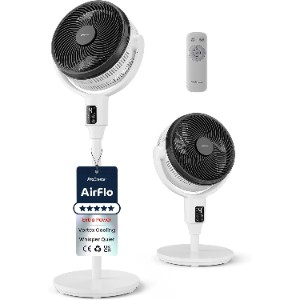
The Pro Breeze AirFlo Plus is our top pick for anyone who wants a pedestal fan that genuinely impresses. The dual-blade hybrid design is what sets it apart: two sets of blades work together to move more air at lower speeds, which means you can run it quietly and still feel a meaningful difference in the room. At 29dB on its quieter settings, it’s among the least obtrusive pedestal fans available.
The oscillation coverage is exceptional. A 135-degree horizontal sweep plus 100 degrees of vertical tilt gives you far more control over airflow direction than most pedestal fans allow. Height adjusts between 61 and 111 centimetres, which makes it practical across a range of settings. Combined with the remote control and multiple speed options, this covers everything you’d reasonably want from a pedestal fan.
At around £160 it’s on the premium side, but the 4.7-star rating across its reviews reflects a product that consistently delivers. If you’re spending that much on a fan, it helps to know that most buyers come away satisfied rather than disappointed. Pro Breeze is a well-regarded UK brand with decent quality control, and this fan is a good example of why.
Worth mentioning: the height adjustment range is genuinely wide. Whether you’re using it at desk level, aimed at a sofa, or placed at the foot of a bed, it adapts without needing to be repositioned entirely. That flexibility is what pushes it above the alternatives here.
Features
- Dual-blade hybrid design for stronger airflow at lower speeds
- 29dB whisper-quiet operation
- 135° horizontal and 100° vertical oscillation
- Adjustable height: 61cm to 111cm
- Remote control included
- Multiple speed settings
- Exceptional oscillation range covers the whole room
- Dual-blade design moves more air at lower speeds
- 29dB genuinely quiet for a fan this size
- Wide height adjustment suits different placements
- Premium price point
- Fewer reviews than more established rivals
2. Portable Oscillating Pedestal Fan with Remote
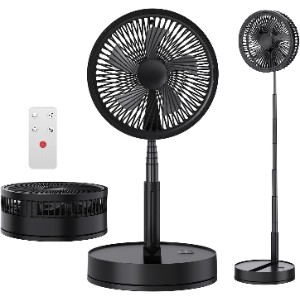
This is the budget-friendly pick on the list if your priority is decent coverage at a low price. At around £47 it’s one of the more affordable pedestal fans with remote control included, which is an increasingly rare combination at this end of the market. The oscillating head covers the room adequately, and the standing design keeps airflow off the floor where it’s more effective.
Don’t expect the precision controls or noise performance of the premium options here. The 4.6-star rating suggests buyers at this price point are generally satisfied with what they get, which is a reliable, functional pedestal fan that does the basics without any drama. A sensible choice if you need a second fan for a spare room or garden office without spending much.
Features
- Oscillating head for room coverage
- Remote control included
- Adjustable height and tilt
- Multiple speed settings
- Portable and easy to move between rooms
- Very affordable with remote included
- 4.6-star rating at this price is reassuring
- Decent coverage for everyday use
- Won’t match premium fans for noise or airflow precision
- Generic branding means less certainty on build quality
- Fewer reviews than established brands
3. Russell Hobbs 3-in-1 Pedestal Fan
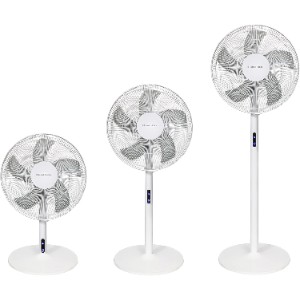
Russell Hobbs is a household name in UK home appliances, and this 3-in-1 pedestal fan leans into that reliability. It functions as a tower fan, a pedestal fan, and a table fan depending on how you configure it, which gives it genuine versatility if you need a fan for different spaces or situations. The LED display and remote make it easy to control without getting up, and eight speed settings give you fine-grained control over airflow.
At around £56 it’s priced in the mid-range, and the Russell Hobbs name means you’re getting a product backed by a proper warranty and UK customer support. The white finish works in most home interiors without looking out of place. A solid choice for anyone who wants the reassurance of a known brand at a reasonable price.
Features
- 3-in-1: tower, pedestal, and table fan configurations
- 8 speed settings with LED display
- Remote control included
- Oscillating for room coverage
- 1.3m height, white finish
- 48W, 2-year guarantee
- Trusted UK brand with 2-year guarantee
- 3-in-1 versatility for different placements
- 8 speeds and LED display at this price
- White finish won’t suit all interiors
- Not the quietest at higher speeds
- Tower/pedestal hybrid lacks the precision of dedicated pedestal fans
4. Baridi 10″ Pedestal Fan with Remote
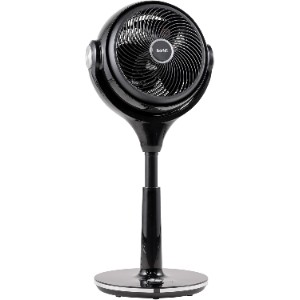
The Baridi 10-inch is the compact pedestal fan on this list. Smaller blade diameter means less airflow than the larger options here, but if you need a fan that takes up minimal floor space in a bedroom, home office, or small flat, that trade-off is worthwhile. Three operation modes and remote control are included at around £55, which is fair for what you get.
Baridi is a UK-based brand with a reasonable track record in home cooling products. The 4.6-star rating puts it above many rivals at this price point, and the compact footprint makes it easy to position in tight spaces. Not the right choice for large rooms, but a dependable option for smaller spaces and personal use.
Features
- 10-inch blade diameter
- 3 operation modes
- Remote control included
- Oscillating head
- Compact pedestal design
- Adjustable height
- Compact footprint suits small spaces
- 4.6-star rating is strong at this price
- Remote included
- 10-inch blade limits airflow for larger rooms
- Less powerful than taller, wider pedestal fans
- Fewer reviews than established rivals
5. Levoit 20dB Quiet Pedestal Fan
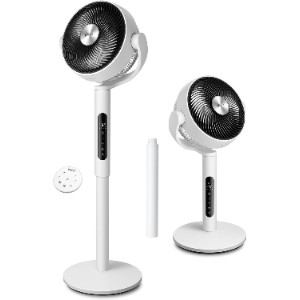
Levoit has built a strong reputation in the home appliance space and the LVRF300 pedestal fan is a solid example of why. At 20dB it matches Dreo’s best noise rating, and the airflow output is strong enough to cool a decent-sized bedroom or living room without issues. The build quality is noticeably premium for the price point, with a weighted base that doesn’t wobble and controls that feel well-made rather than plasticky.
The standout feature is the combination of quiet operation with genuinely powerful airflow. Some fans sacrifice one for the other; the Levoit manages both. The remote is responsive, the timer works accurately, and the natural breeze mode varies the speed in a convincing way that feels less mechanical than a constant-speed fan.
With over 3,000 reviews at 4.7 stars, it’s proven. At £119.99 it’s priced above the entry-level options but remains competitive against Dreo’s equivalent models, and Levoit’s customer service reputation is a genuine bonus.
Features
- 20dB ultra-quiet DC motor
- Multiple oscillation modes
- Remote control with LED display
- 12-hour timer
- Natural breeze mode
- Adjustable height pole
- Excellent noise-to-airflow balance
- Premium build quality
- Strong brand reputation and support
- No smart home or Wi-Fi control
- Slightly pricier than direct Dreo equivalents
6. Vornado 7803 Large Pedestal Air Circulator
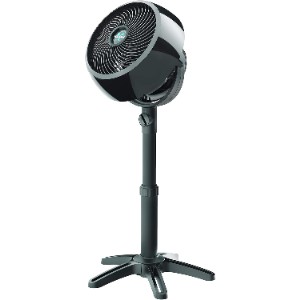
The Vornado 7803 is a different kind of pedestal fan. Where most pedestal fans push air in one direction through oscillation, Vornado’s whole-room air circulation approach moves air in a continuous loop around the entire room. The result is more consistent temperature distribution rather than localised cooling, which works particularly well in larger rooms or open-plan spaces where a standard pedestal fan would struggle to have much impact.
At £263 it’s the most expensive option on this list by some margin, and it’s priced at a level where you need to be genuinely committed to the Vornado approach to justify it. The 4.6-star rating across a solid review base confirms that buyers who understand what they’re buying are generally very happy with it. The removable grill makes cleaning straightforward, which is a practical touch on a product built for long-term use.
Three speed settings keep the controls simple, and the adjustable height means it adapts to different room configurations. If you’ve used a standard oscillating fan and found it doesn’t do enough in a large room, the Vornado is worth understanding before you write it off at the price.
Features
- Whole-room air circulation (not standard oscillation)
- 3 speed settings
- Adjustable height
- Removable grill for easy cleaning
- 4.6-star rating with strong review count
- Whole-room circulation far more effective in large spaces
- Strong long-term reputation from an established brand
- Removable grill simplifies maintenance
- £263 is hard to justify for casual use
- Circulation approach takes getting used to
- No remote control at this price
7. Dreo 43″ Smart Pedestal Fan
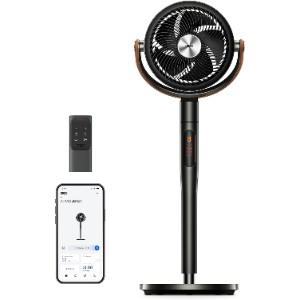
This is Dreo’s premium standing fan, and it earns the extra cost in a few meaningful ways. The 43-inch height pushes air further and higher than standard 40-inch models, which matters in rooms with high ceilings or large open spaces. The 120°+105° oscillation covers more of a room, and the 100ft airflow claim is credible given how well the fan performs in larger spaces.
Wi-Fi connectivity, Alexa support, and six modes make it a well-rounded smart fan. The DC motor stays quiet, and the 12-hour timer and remote make it easy to manage without reaching for your phone. With over 3,700 reviews at 4.7 stars, the build quality and reliability have been thoroughly road-tested.
At £193.12, it’s the most expensive Dreo pedestal fan on this list. You’re paying for the extra height, the wider oscillation, and the stronger airflow. For large rooms or open-plan living spaces, the premium is justified.
Features
- 43-inch height for extended airflow reach
- 120°+105° dual-axis oscillation
- Wi-Fi, Alexa, and Google Home compatible
- DC motor, 20dB quiet
- 6 modes including sleep and natural breeze
- 12-hour timer with remote
- Taller reach for high-ceilinged rooms
- Wide dual-axis oscillation
- Strong smart home integration
- Proven with thousands of reviews
- Significant step up in price
- Overkill for smaller rooms
8. Shark FlexBreeze 12-in-1 Hybrid Fan
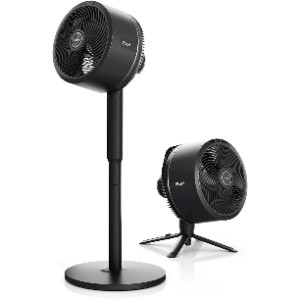
The Shark FlexBreeze is in a different category from everything else on this list, and that’s the point. It runs both corded and cordless, which means you can use it in the garden, on the patio, or in any room without worrying about reaching a socket. The misting attachment turns it into a cooling mist fan for outdoor use. At £199 it’s the most expensive option here, but no other pedestal fan on this list offers cordless capability.
The 12-in-1 claim refers to the different configurations and modes rather than 12 separate products, but the versatility is real. Indoor, outdoor, misting, pedestal, table fan — it genuinely covers a lot of bases. The build quality is solid for a premium UK brand.
Features
- Hybrid corded and cordless operation
- Misting attachment for outdoor cooling
- Adjustable tilt and height
- Remote control included
- Indoor and outdoor suitable
- 12 configurations and modes
- Only cordless pedestal fan on this list
- Works outdoors and indoors
- Misting feature for hot weather
- Most expensive option by some margin
- Battery life limited during cordless use
- Heavy to move around compared to standard fans
Key Takeaways
- DC (brushless) motors are significantly quieter and more energy-efficient than AC motors: a DC pedestal fan typically uses 35 to 45W at high speed versus 55 to 80W for an equivalent AC model, and produces noticeably less noise at the same airflow output
- Blade diameter is the primary determinant of airflow at equivalent speeds. A 16-inch (40cm) fan moves more air per revolution than a 12-inch model running faster. Larger blades at lower RPM produce both greater airflow and less noise than smaller blades spinning fast
- Airflow is measured in CFM (cubic feet per minute) or m³/h. For a bedroom of 12 to 16m², a fan producing 800 to 1,200 m³/h on high speed will create good circulation. A living room of 20 to 30m² benefits from 1,500 m³/h or above, or two fans
- Oscillation angle affects how evenly airflow is distributed across a room. Standard models sweep 60 to 90°; premium models offer 120° or greater. Wider oscillation suits living rooms and open-plan spaces; narrower, fixed airflow is often preferred for bedroom use where directed cool air is the goal
- Speed settings: more is better. A fan with 3 speeds offers limited control; 6 to 12 speed steps (common on DC models) allow precise adjustment to the minimum speed that provides comfort, which reduces noise significantly
- Height adjustment range determines whether the fan can be useful seated on a sofa, at a desk, or standing. Look for fans with at least 90 to 120cm range between minimum and maximum height
- Remote controls are a genuine quality-of-life feature for bedroom use. Getting up at 3am to adjust a fan is less appealing than a remote or app control from the bed
DC vs AC Motors: Why It Matters
This is the most consequential specification on a pedestal fan, and most budget models won’t mention it. AC (alternating current) motors are the traditional design: straightforward, robust, and cheap to manufacture. They have a fixed number of magnetic poles, which limits speed adjustment to a small number of stepped settings (usually 3) and produces a characteristic hum at each speed. At high speed, an AC fan motor is audible in a quiet room.
DC (direct current, usually brushless) motors use electronic speed controllers that allow infinitely variable speed across a wide range. This produces several practical advantages: DC fans can run at very low speeds that would stall an AC motor, giving useful airflow at genuinely low noise levels. At high speed, they’re quieter than equivalent AC fans because the motor itself generates less electromagnetic noise. And they use substantially less electricity: 30 to 50% less than AC at comparable airflow, which matters if the fan runs overnight for months.
The practical trade-off is price. A decent DC pedestal fan costs £80 to £200; an AC fan of similar airflow output costs £20 to £60. For occasional use or a secondary room, the AC fan is adequate. For a bedroom fan running 6 to 8 hours per night through summer, the DC motor’s lower noise and running cost makes the premium worthwhile.
Blade Size and Airflow
Pedestal fans typically come in three size classes:
- 12 to 14 inches (30 to 35cm): Compact models suited to small bedrooms, home offices, and desks. Lower maximum airflow but quieter at equivalent noise levels due to lower blade tip speed. Well suited to personal cooling within 2 to 3 metres
- 16 inches (40cm): The most common size for general household use. Good balance of airflow, noise, and physical footprint. Effective for rooms up to about 25m² when oscillating
- 18 inches (45cm) and above: Higher airflow for larger rooms, conservatories, and open-plan spaces. More effective at distributing air across a full living room. Physically larger base and column, which some people find intrusive
Blade pitch (the angle of the blade relative to the horizontal) determines how much air each blade sweeps per revolution. A steep pitch at low speed moves more air than a flat pitch at high speed. Aerodynamically curved blades (rather than flat paddles) generate airflow with less turbulence, which reduces noise. The manufacturer’s stated CFM or m³/h figure at maximum speed is the best comparison point, though real-world performance will be lower in a furnished room than in a test chamber.
Noise: What to Expect at Different Price Points
Fan noise is measured in dB(A) and typically quoted at maximum speed. For practical bedroom use, noise at low or mid speed is far more relevant than the maximum speed figure, since most people run fans at low speed overnight. DC fans with 10 to 12 speed steps can run at genuinely low speeds with correspondingly low noise. Some premium DC models are under 20 dB(A) on their lowest settings, which is effectively inaudible.
- Under 25 dB(A) at low speed: Suitable for light sleepers. Achievable with quality DC models (Meaco, Duux, Ventilex). Typically costs £100 to £250
- 25 to 35 dB(A) at low speed: Acceptable for most people as background white noise. Mid-range DC fans and quieter AC models
- 35 to 45 dB(A) at low speed: Audible but not disruptive for normal sleepers. Budget AC fans typically fall here at their lowest speed
- Above 45 dB(A): Too loud for bedroom use for most people. Typically budget fans at mid or high speed
Noise is also affected by the base and column design. Poorly balanced fans develop vibration resonance at certain speeds, creating a rattling or buzzing that’s disproportionately irritating compared to the smooth airflow noise of a well-engineered unit. Heavier, well-balanced fans with quality motor mounts avoid this; budget fans with lightweight plastic columns often suffer from it.
Oscillation and Room Coverage
Standard oscillation sweeps approximately 70 to 90° horizontally. This is adequate for directing airflow across a bedroom or home office. For a larger living room or to cover a wider area, look for fans with wider oscillation angles:
Models from Dreo, Meaco, and some Duux units offer 120° oscillation, which covers a significantly wider room arc. Some higher-end models allow the oscillation arc to be customised: you set the start and end points rather than having a fixed sweep. This is genuinely useful for directing airflow towards a seating area while avoiding a corner where no one sits.
Vertical tilt adjustment also matters. Most pedestal fans allow manual tilt of the fan head upward and downward (typically 5 to 15° each direction). Being able to direct airflow at a slight downward angle towards occupied space rather than straight forward often improves perceived effectiveness without increasing speed.
Height and Adjustability
Pedestal fans should match the space they’re used in. For bedroom use beside a bed, a fan with a lower height range (minimum 80 to 90cm) places the airflow at the level of a person lying down. For living room use or to cool a room while seated at a sofa, 100 to 120cm is more appropriate. For standing use or to improve air circulation across a larger room, maximum heights of 130 to 145cm direct airflow further across the space.
Most pedestal fans adjust by pulling up the telescoping column and twisting to lock. The stability of this mechanism varies: cheaper fans allow the column to vibrate at certain speeds, adding to noise. Premium fans use a more secure locking mechanism and often have a heavier, more stable base. If the fan will be used in a room with children or pets, base width and weight are worth checking: a wide, heavy base is far more stable than a narrow, lightweight one.
Things to Keep in Mind Before Buying
A fan doesn’t lower the temperature of a room. It creates a wind-chill effect that makes people feel cooler. In a genuinely hot room, a fan circulates hot air. The perception of cooling from airflow is significant and makes 30°C heat much more tolerable, but the air temperature itself is unchanged. For actual temperature reduction, a portable AC is needed; fans cool people, not rooms.
Running a fan overnight uses electricity. A 50W AC fan running 8 hours per night for 90 summer nights costs around £1.80 at 27p/kWh. A 35W DC fan for the same period costs about £1.26. Neither is significant cost, but it does mean there’s no meaningful economic case for buying a fan and then being reluctant to run it.
Consider tower fans as an alternative to pedestal fans for smaller rooms. Tower fans take significantly less floor space, often include ionisers and air filters, and can be positioned more conveniently in corners. They typically produce slightly less maximum airflow than an equivalent pedestal fan but are often quieter at low speeds and less visually dominant in a room.
Types of Pedestal Fan
Budget AC pedestal fans are the straightforward choice for rooms used occasionally or where noise isn’t a priority. 3 speed settings, 16-inch blades, standard 70 to 90° oscillation. Perfectly functional, limited in noise control. Price range £20 to £45.
Mid-range AC pedestal fans offer larger blades (16 to 18 inch), remote controls, sleep timers, and sometimes 6 speed settings. A significant improvement in features over budget models. Suitable for living rooms and occasional bedroom use. Price range £45 to £90.
DC pedestal fans are the correct choice for bedroom use and anyone sensitive to fan noise. 10 to 12 speed steps, quiet operation at low settings, lower electricity consumption. The Pro Breeze AirFlo Plus, Levoit, and Dreo 43″ Smart are strong DC motor examples on the UK market. Price range £90 to £250.
Smart pedestal fans add Wi-Fi connectivity, voice control integration (Alexa, Google Home), and app-based scheduling. Useful for setting the fan to start before you go to bed and stop after you’ve fallen asleep, which is more comfortable than waking to silence. Available from Meaco, Dreo, and Dyson at the premium end. Price range £120 to £350.
Case Study: Cooling a Converted Loft Room in Summer
Background
A homeowner in north London had converted their loft into a home office and bedroom. During summer, the room became almost unusable by early afternoon: south-facing windows and poor insulation meant temperatures regularly exceeded 30°C. Air conditioning wasn’t feasible without expensive ducting work.
Project Overview
The goal was to make the room comfortable for sleeping and working throughout summer without permanent installation. The room was approximately 5 x 4 metres with a pitched ceiling reaching around 3 metres at the peak.
Implementation
After reviewing the options, they chose the Dreo 43″ Smart Pedestal Fan. The extra height was important given the pitched ceiling, and the 120°+105° oscillation allowed the fan to circulate air effectively across the full space. The Wi-Fi control meant they could switch it on from the kitchen before heading upstairs, so the room was already cooling when they arrived. They ran it on medium overnight on a 7-hour timer and controlled it through Alexa.
Results
Room temperature dropped to manageable levels within 20 minutes of the fan running. Sleep quality improved immediately. The fan ran quietly enough on medium speed that it didn’t disturb sleep, and the timer prevented it running all night unnecessarily. They estimated a full summer of operation cost around £8–12 in electricity, far less than portable air conditioning alternatives.
Expert Insights From Our Heating Engineers About Pedestal Fans
One of our senior heating engineers with over 18 years of experience in home ventilation and thermal comfort shared their view on getting the most from pedestal fans in UK homes.
“Most people run pedestal fans pointing directly at themselves, but you’ll cool a room more effectively by angling the fan towards the hottest corner or pointing it slightly upward to encourage air to circulate around the ceiling. Hot air sits high in a room, and getting it moving creates a more even temperature throughout.”
“For sleeping, a 20dB DC fan on a low setting is the most practical cooling solution available without significant investment. Put it at the foot of the bed at medium height, set a 6–8 hour timer, and let it do its job. The wind chill effect can make a room feel 3–4°C cooler than it actually is, which is usually enough to sleep comfortably through a warm UK night. You don’t need air conditioning for that.”
Frequently Asked Questions
What is the quietest pedestal fan available in the UK?
The quietest pedestal fans are rated at 20dB, which is roughly equivalent to rustling leaves or a whisper. The Pro Breeze AirFlo Plus and Levoit both achieve this level, and the Dreo 43″ comes close in practice. In practice, 20dB fans are inaudible at moderate distance and are comfortable for overnight use in bedrooms.
How much does it cost to run a pedestal fan?
A DC motor pedestal fan typically uses between 10W and 45W depending on the speed setting. At the UK average electricity rate of around 24p per kWh, running a 25W fan for 8 hours costs approximately 5p. Run all summer every night, that’s around £3–6 for the season. It’s one of the cheapest cooling options available.
Are pedestal fans better than tower fans?
They serve different purposes. Pedestal fans move larger volumes of air directly and are better at cooling people quickly in a focused area. Tower fans are slimmer, often quieter at lower settings, and suit smaller rooms or offices where space is tight. For bedrooms and living rooms where you want real cooling power, pedestal fans generally perform better.
Can I leave a pedestal fan on all night?
Yes, modern pedestal fans are designed for continuous operation. Use the built-in timer to switch off automatically after 6–8 hours rather than running all night unnecessarily. This saves electricity and prevents the room from becoming too cold in the early hours when outdoor temperatures drop.
What size pedestal fan do I need for a large room?
For a room larger than 25–30m², look for a fan with a tall height (42–43 inches), wide oscillation, and a strong airflow claim. The Dreo 43″ with its 100ft reach is a good choice for large rooms. The DREO Omni is also suitable for large spaces thanks to its 360° total oscillation. For smaller rooms under 15m², any fan on this list will perform well.
Do pedestal fans actually cool the air?
No. Pedestal fans don’t lower air temperature; they create a wind chill effect by moving air across skin, which makes you feel cooler. The fan’s motor actually adds a tiny amount of heat to the room. For genuine air temperature reduction, you need an air conditioner. But the perceived cooling from a good pedestal fan is typically enough for comfortable sleeping and working in a warm UK summer.
What is the difference between AC and DC motor pedestal fans?
AC (alternating current) motors are older technology: cheaper to produce but louder and less energy-efficient. DC (direct current) motors run at 20–50% lower energy consumption, are significantly quieter, and offer more precise speed control. All the best pedestal fans on this list use DC motors. If the fan listing doesn’t specify DC, assume it’s AC and will be noticeably louder.
Summing Up
For most buyers, the Pro Breeze AirFlo Plus 44″ Hybrid Pedestal Fan is the easy recommendation. Its dual-blade design, 29dB quiet operation, and exceptional oscillation range put it ahead of most rivals at this price. If you want smart home control, the Dreo 43″ Smart Pedestal Fan adds Wi-Fi and voice control. For large open-plan rooms, the Vornado 7803’s whole-room circulation is a step up with its taller profile and dual-axis oscillation. And if outdoor use or cordless operation matters, the Shark FlexBreeze stands alone in the lineup.
Whichever you choose, a good DC motor pedestal fan is one of the most cost-effective ways to stay comfortable through a warm UK summer, at a fraction of the running cost of air conditioning.
Updated