
Our blog is reader-supported. When you buy through links on our site, we may earn an affiliate commission. Thank you for your support!
Portable air conditioners are the practical cooling solution for UK homes that can’t install fixed air conditioning. The Meaco MeacoCool Pro Series 9000 BTU is the best we’ve tested, genuinely quiet, Wi-Fi enabled, and built to a standard that matches the price. But there are good options at every budget, including capable units under £250.
We’ve reviewed the best portable air conditioners available on Amazon UK right now, covering units from budget 5,000 BTU models to powerful 10,000 BTU smart units, so you can find the right fit for your room.
Contents
- 1 Our Top Picks
- 2 6 Best Portable Air Conditioners
- 2.1 1. Meaco MeacoCool Pro Series 9000 BTU Portable Air Conditioner
- 2.2 2. HOMCOM 10,000 BTU 4-in-1 Portable Air Conditioner
- 2.3 3. Pro Breeze 4-in-1 Smart Portable Air Conditioner 9000 BTU
- 2.4 4. Belaco Air Conditioning Unit 9000 BTU
- 2.5 5. DREO 10,000 BTU 3-in-1 Quiet Portable Air Conditioner
- 2.6 6. Igenix IG9904 4-in-1 Portable Air Conditioner 9000 BTU
- 2.7 Key Takeaways
- 2.8 Single-Hose vs Dual-Hose: The Most Important Choice
- 2.9 BTU Sizing: What You Actually Need
- 2.10 Venting and Installation
- 2.11 Condensate Handling
- 2.12 Running Costs
- 2.13 Noise
- 2.14 Things to Keep in Mind Before Buying
- 2.15 Types of Portable Air Conditioner
- 3 Case Study: Cooling a South-Facing Home Office Through a UK Heatwave
- 4 Expert Insights From Our Heating Engineers About Portable Air Conditioners
- 5 Frequently Asked Questions
- 5.1 Do portable air conditioners actually work in the UK?
- 5.2 How much does it cost to run a portable air conditioner in the UK?
- 5.3 Do portable air conditioners need to be vented?
- 5.4 What is the difference between a portable air conditioner and an evaporative cooler?
- 5.5 How long does it take a portable air conditioner to cool a room?
- 5.6 Can I use a portable air conditioner in a rented property?
- 5.7 How often do I need to drain a portable air conditioner?
- 6 Summing Up
Our Top Picks
| Image | Name | |
|---|---|---|
| Meaco MeacoCool Pro Series 9000 BTU Portable Air Conditioner | |
| HOMCOM 10,000 BTU 4-in-1 Portable Air Conditioner | |
| Pro Breeze 4-in-1 Smart Portable Air Conditioner 9000 BTU | |
| Belaco 9000 BTU 4-in-1 Portable Air Conditioner | |
| DREO 10,000 BTU Quiet Portable Air Conditioner | |
| Igenix IG9904 4-in-1 Portable Air Conditioner 9000 BTU |
6 Best Portable Air Conditioners
1. Meaco MeacoCool Pro Series 9000 BTU Portable Air Conditioner
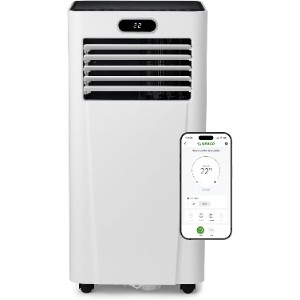
Meaco is the brand that UK heating and cooling professionals consistently reach for when they want a genuinely reliable portable unit. The MeacoCool Pro Series is the evidence behind that reputation. At 9,000 BTU with Wi-Fi connectivity and app control, it offers the combination of output and usability that most UK buyers actually need.
The noise rating is where Meaco separates itself from cheaper alternatives. This unit operates quietly enough to run in a bedroom at night on its lowest setting without disturbing sleep. That’s a real differentiator in this category, many budget portable ACs produce a background drone that becomes noticeable after about 20 minutes.
Wi-Fi control via the Meaco app lets you schedule cooling in advance and monitor the unit remotely. On a hot day, you can switch it on during your commute and arrive to a cool room rather than waiting the 20–30 minutes it takes any portable AC to make a meaningful difference. For a bedroom or a home office that needs reliable cooling, this is the one to buy.
At £389.99 it’s the most expensive unit on this list. But it’s also the one least likely to need replacing in two years, and the one least likely to disrupt your sleep.
Features
- 9,000 BTU cooling output
- Wi-Fi enabled with app control and scheduling
- 4-in-1: cooling, fan, dehumidifier, heating mode
- Quiet operation, suitable for bedroom use
- 24-hour timer with weekly scheduling
- Includes window vent kit
- Best noise rating on this list, genuinely bedroom-suitable
- Wi-Fi and app control for remote scheduling
- Strong Meaco brand reputation for reliability
- 4-in-1 functionality including heating mode
- Most expensive option at £389.99
- Single hose (all portable ACs on this list are single hose)
2. HOMCOM 10,000 BTU 4-in-1 Portable Air Conditioner
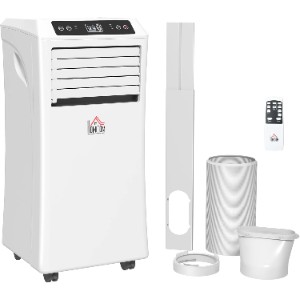
The HOMCOM is the most reviewed unit on this list, with 286 verified ratings at 4.2 stars, the broadest feedback of any model here in the mid-range bracket. That volume of reviews at a consistent rating is a strong confidence signal. It means the experience holds up across different room sizes, installation setups, and user expectations.
At 10,000 BTU it has the highest cooling output on this list, making it better suited to larger rooms than the 9,000 BTU units. A 10,000 BTU unit can typically handle rooms up to approximately 25–30m² in a UK climate, compared to 20–25m² for a 9,000 BTU equivalent. If you’re cooling a living room or a large bedroom, the extra power is worthwhile.
The 4-in-1 functionality covers cooling, fan-only, dehumidification, and heating. The built-in 24-litre daily dehumidification capacity is particularly useful in UK summers when heat often accompanies high humidity. The unit comes with a window vent kit and rolling wheels for easy room-to-room movement.
At £239.99 it represents the best balance of output, reviews, and price on this list.
Features
- 10,000 BTU, highest output on this list
- 4-in-1: cooling, fan, dehumidifier, heating
- 24 litres per day dehumidification capacity
- 24-hour programmable timer
- Rolling wheels for easy movement
- Includes window exhaust vent kit
- Most reviewed mid-range unit on this list
- Highest BTU output, best for larger rooms
- Competitive price at £239.99
- Strong dehumidification capacity
- Larger footprint than some competitors
- No Wi-Fi or smart home integration
3. Pro Breeze 4-in-1 Smart Portable Air Conditioner 9000 BTU
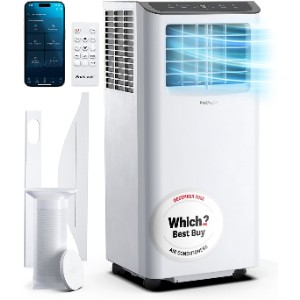
If you want Wi-Fi control at a lower price than the Meaco, the Pro Breeze 9000 BTU Smart is worth considering. Pro Breeze has built a strong reputation for reliable consumer electronics in the UK market, and this unit is one of their most capable offerings, combining app control, a 24-hour timer, and 4-in-1 functionality at a price meaningfully below the Meaco Pro.
The Wi-Fi connectivity works with both the Pro Breeze app and voice assistants including Alexa and Google Home. For households already set up with smart home devices, this integration is genuinely convenient rather than a gimmick. You can add cooling to your morning automation routine or switch the unit off remotely after you’ve left the house.
The trade-off versus the Meaco is noise. At 9,000 BTU the cooling output matches the Meaco Pro, but the operating noise on higher fan settings is more noticeable. For living room or daytime use this isn’t a meaningful disadvantage. For overnight bedroom cooling, some users find it preferable to run at a lower setting.
At £297.49 it sits between the budget units and the Meaco, making it a reasonable middle ground for buyers who want smart features without spending £390.
Features
- 9,000 BTU cooling output
- Wi-Fi enabled, Alexa and Google Home compatible
- 4-in-1: cooling, fan, dehumidifier, heating
- 24-hour programmable timer
- Remote control and app control
- Energy Class A rating
- Wi-Fi and smart home integration at lower price than Meaco
- Alexa and Google Home compatible
- Good UK brand track record
- Energy Class A rating
- Higher noise on upper fan settings than Meaco
- Fewer reviews than HOMCOM
4. Belaco Air Conditioning Unit 9000 BTU
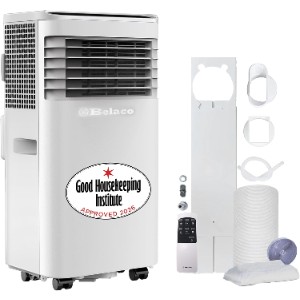
The Belaco is the mid-range value option. At £249.99 with 269 reviews at 4.0 stars, it’s a step below the confidence level of the HOMCOM and Pro Breeze but still a genuinely functional unit for buyers who want air conditioning without spending close to £400.
The 4-in-1 operation covers the same bases as its competitors: cooling, fan, dehumidification, and heating. The installation is standard, a window vent kit routes the exhaust hose, and the unit rolls on castor wheels. Setup typically takes 15–20 minutes without tools.
The 4.0-star rating from 269 reviews isn’t as strong as the top units here, but it’s not poor either. The reviews are reasonably consistent and don’t flag major reliability issues, the lower rating reflects adequate rather than excellent performance, particularly on higher settings where noise and cooling efficiency can be less linear.
For buyers who mainly need occasional cooling during summer heatwaves rather than daily long-season use, the Belaco represents reasonable value.
Features
- 9,000 BTU cooling output
- 4-in-1: cooling, fan, dehumidifier, heating
- Remote control included
- 24-hour programmable timer
- Castor wheels for easy movement
- Window exhaust vent kit included
- Good value at £249.99
- Solid review count for confidence
- Easy setup, 15 to 20 minutes
- 4.0-star rating, lower than top picks
- No smart home or Wi-Fi features
- Higher noise on maximum setting
5. DREO 10,000 BTU 3-in-1 Quiet Portable Air Conditioner
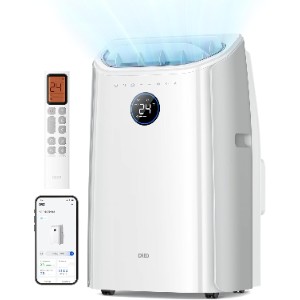
Dreo has been building credibility in the UK fan heater market with products that punch above their price in terms of build quality and quiet operation. The 10,000 BTU portable AC extends that approach to cooling, the headline claim is exceptionally quiet operation, and the 4.4-star rating from 147 buyers supports this.
At 10,000 BTU it matches the HOMCOM for output, making it suitable for larger rooms. The 3-in-1 operation (cooling, fan, dry/dehumidify) is one function fewer than the 4-in-1 units, there’s no heating mode. For most UK buyers who primarily want summer cooling, that omission won’t matter.
The higher price of £499.99 is the main consideration. At this price point you’re paying for Dreo’s quiet operation engineering rather than additional features. If low noise is your priority, particularly for bedroom use, and you’re prepared to spend more for it, this and the Meaco are the two units to compare seriously.
Features
- 10,000 BTU cooling output
- 3-in-1: cooling, fan, dehumidifier (no heating mode)
- Quiet operation, premium noise engineering
- Remote control and timer
- Castor wheels for easy repositioning
- Auto-evaporation, reduces manual draining frequency
- 4.4-star rating, highest on this list
- 10,000 BTU for larger rooms
- Quiet operation, strong point for bedroom use
- Auto-evaporation reduces maintenance
- Most expensive at £499.99
- No heating mode
- Fewer reviews than other top picks
6. Igenix IG9904 4-in-1 Portable Air Conditioner 9000 BTU
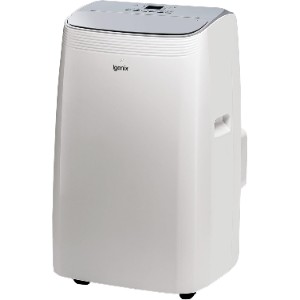
Igenix is an established UK domestic appliance brand with a long track record in the fan, heater, and air conditioning space. The IG9904 is their 9,000 BTU portable air conditioner, and it occupies a sensible position in the market: a recognisable British brand name, standard 4-in-1 functionality, and a price of £289.99 that sits in the middle of this list.
For buyers who specifically want an established brand rather than the newer entrants (Dreo, Belaco), Igenix is a reassuring choice. Their customer service infrastructure is UK-based and their warranty process is generally straightforward. This matters more for a product you might use annually over 5–10 years than for something you might replace within a year.
The unit operates across cooling, fan, dehumidification, and heating modes, the full 4-in-1 feature set. A 24-hour timer lets you schedule operation around your routine. There’s no Wi-Fi connectivity, but the remote control handles all the core functions conveniently.
Features
- 9,000 BTU cooling output
- 4-in-1: cooling, fan, dehumidifier, heating
- 24-hour programmable timer
- Remote control included
- Castor wheels
- UK brand with established warranty support
- Established UK brand with good warranty support
- Full 4-in-1 feature set including heating
- Mid-range price at £289.99
- No smart home or Wi-Fi features
- Slightly higher priced than the HOMCOM for similar output
Key Takeaways
- A portable air conditioner uses a refrigerant cycle to cool air and expels heat via an exhaust hose vented to the outside. Without venting, it cannot cool a room. It simply moves heat around
- Single-hose units draw cool room air to exhaust heat, creating negative pressure that pulls warm outside air back in. Dual-hose units use separate intake and exhaust hoses, eliminating this problem and cooling up to 40% more efficiently in real-world conditions
- BTU output is the headline figure, but the BTU rating on the box reflects ideal lab conditions. In a real room with sun exposure, poor insulation, or high occupancy, effective cooling is often 20 to 30% lower than rated output
- For a standard UK bedroom of 15 to 20m², a 9,000 to 10,000 BTU unit is usually sufficient. Living rooms or rooms with large south-facing windows need 12,000 BTU or more
- Portable ACs work best when the exhaust hose is kept short and straight. Every bend and every extra metre of hose reduces cooling efficiency, so the hose should ideally be no longer than 1.5 metres
- All portable ACs produce condensate water as a by-product of cooling. Some self-evaporate it through the exhaust hose; others collect it in a tank requiring regular emptying. Self-evaporating models are far more practical for continuous use
- Noise levels range from around 45 to 58 dB depending on model and fan speed. The compressor cycles on and off, so noise is not constant, but it is audible in a quiet room, especially at night
Single-Hose vs Dual-Hose: The Most Important Choice
Most portable ACs sold in the UK are single-hose units. They use one exhaust hose to push hot air outside. The problem is that the unit pulls air from inside the room to cool its condenser coils, then expels that air. This creates negative pressure in the room, drawing warm air in through gaps in doors, windows, and walls to replace it. You’re constantly fighting against this warm air infiltration, which is why single-hose units struggle in poorly sealed rooms.
Dual-hose units solve this with a second hose that draws outside air specifically to cool the condenser, then expels it back out. Room air is only used for the evaporator side. There’s no negative pressure effect, so the cooled air you’ve paid to create stays in the room. Independent testing consistently shows dual-hose models outperform single-hose units by 30 to 40% in real-world cooling conditions, even where rated BTU output looks identical on the box.
The trade-off is that dual-hose units are larger, heavier, and cost more. They’re also less common in the UK market. But for a room you’re trying to keep reliably cool through a heatwave, the efficiency difference is significant enough to be worth the premium, particularly in a draughty or older property where air leakage is unavoidable.
BTU Sizing: What You Actually Need
BTU (British Thermal Units per hour) measures cooling output. The figures on the box are generated under controlled laboratory conditions, which rarely match UK rooms in summer. For practical UK use, treat manufacturer BTU ratings as a guide, not a guarantee:
| Room Size | Room Type | Recommended BTU |
|---|---|---|
| Up to 15m² | Small bedroom, home office | 7,000 to 9,000 BTU |
| 15 to 25m² | Standard bedroom, larger office | 9,000 to 12,000 BTU |
| 25 to 35m² | Living room, open-plan space | 12,000 to 14,000 BTU |
| 35m² and above | Large open-plan, conservatory | 14,000 BTU or multiple units |
Add 10 to 20% to these figures if the room is south-facing with large windows, has poor insulation, or is used for cooking or exercise. A conservatory is particularly challenging: it’s essentially a glass box in direct sun, and even a 14,000 BTU unit will struggle to maintain a comfortable temperature on a 30°C day without additional shading on the glass.
One important note: some manufacturers quote BTU figures using the older ASHRAE standard, while others use the newer DOE standard. DOE ratings are more conservative and more realistic. A unit rated at 12,000 BTU (ASHRAE) may be listed as 8,000 BTU (DOE) for the same product. If you’re comparing across brands, check which standard the figure refers to.
Venting and Installation
Every portable AC must be vented to the outside. The exhaust hose typically connects to a window kit, which is a sliding panel that fits in a sash or casement window frame and has a port for the hose. Most units come with a window kit included, but the quality varies considerably. Cheap kits use thin plastic that lets warm air back in around the edges; aftermarket foam tape or draught-proofing strips make a noticeable difference.
Keep the exhaust hose as short and straight as possible. A 1.5-metre straight hose is ideal. Kinking, coiling, or extending the hose increases back pressure on the unit, reduces airflow, and raises exhaust air temperatures. Some manufacturers void warranties if the hose is extended beyond the supplied length. If your window is further from where you want to cool, position the unit closer to the window rather than using a longer hose.
If you can’t vent through a window, through-wall venting is an option but requires a permanent hole. Ceiling venting is used in some commercial setups but is unusual in UK residential settings. Sliding patio doors accept window kits relatively easily; casement windows require a panel cut to size, which some sellers offer as a custom accessory.
Condensate Handling
Cooling air extracts moisture from it. The condensate water that collects must go somewhere. There are three approaches:
Self-evaporating: The unit recycles condensate water through the condenser, evaporating most or all of it through the exhaust hose. On most UK summer days this handles all the water produced, and you’ll never need to empty a tank. On very humid days some water may collect in a reservoir that needs occasional emptying. This is the most practical approach for bedroom or living room use.
Manual drain tank: Condensate collects in an internal tank. When full, the unit shuts off or beeps until you empty it. In humid conditions this can be every 4 to 8 hours. Inconvenient for overnight use unless you’re comfortable with the unit stopping automatically.
Continuous drain: A hose connects to the drain port and runs to a floor drain, bucket, or outside. Eliminates the emptying problem but requires positioning the unit near a suitable drain outlet and on a level surface.
Running Costs
Portable ACs are not cheap to run. Power consumption typically ranges from 700W to 1,400W depending on output and efficiency. At 27p/kWh:
- 700W: 19p per hour. Smaller or more efficient units. Running overnight (8 hours) costs around £1.50
- 1,000W: 27p per hour. Typical for a 9,000 to 10,000 BTU unit. Overnight: around £2.16
- 1,200W: 32p per hour. A 12,000 BTU unit. Overnight: around £2.59
- 1,400W: 38p per hour. Larger or less efficient units. Overnight: around £3.02
EER (Energy Efficiency Ratio) tells you how much cooling you get per watt of electricity. Higher is better. A unit with an EER of 3.0 produces 3 watts of cooling per watt consumed. UK market units typically range from 2.5 to 3.5 EER; dual-hose units tend to score higher in real-world conditions even if the spec sheet shows the same figure, because they don’t suffer the negative pressure losses of single-hose designs.
In practice, units cycle on and off depending on room temperature and thermostat setting. Running costs in a well-sealed room will be significantly lower than continuous full-power consumption.
Noise
Portable ACs are noisier than split air conditioning systems because the compressor is inside the room with you. Typical noise levels range from 45 to 58 dB depending on fan speed and whether the compressor is running. For context, 50 dB is roughly the level of a quiet conversation; 55 dB is more like a busy office. Most people can sleep through 45 to 48 dB with some adjustment; 55 dB and above will disturb light sleepers.
The compressor doesn’t run constantly. It cycles on when the room temperature rises above the set point and off when it reaches target. Cheaper units have less sophisticated thermostats and cycle more frequently, creating more noise variation overnight. Look for units with a dedicated “sleep mode” that reduces fan speed and dims the display.
Things to Keep in Mind Before Buying
Portable ACs are a compromise. They’re less efficient than split systems, harder to live with, and moderately noisy. Their advantage is that they require no permanent installation, no engineer, and no planning permission. You can set one up in 15 minutes and take it to a different room or property as needed.
For a typical UK home where extreme heat is a 2 to 3 week annual event, a portable AC often makes more practical sense than a £1,500 to £2,500 split system installation. But set realistic expectations: a portable unit won’t maintain 21°C on a 35°C day in a poorly insulated Victorian terrace with single glazing. It will make a significant difference to sleeping comfort and concentrated work, but it’s not a replacement for proper building insulation.
Check the window situation before buying. If you have no suitable window for venting, or only tilt-and-turn windows that don’t accept standard kits easily, factor in the additional hassle or cost before committing to a specific model.
Types of Portable Air Conditioner
Single-hose units are the most common type sold in the UK. One exhaust hose runs to a window kit. Affordable and compact, but they create negative pressure that reduces real-world efficiency. Best suited to well-sealed modern rooms where air infiltration is low.
Dual-hose units use two hoses: one to draw outside air for condenser cooling, one to exhaust hot air. No negative pressure effect. Meaningfully more efficient in draughty or older properties. Heavier and less common, but worth seeking out if you’re buying for regular use through UK summers.
Evaporative coolers are often marketed alongside portable ACs but work entirely differently. They cool air by evaporating water, with no refrigerant cycle. They work best in dry climates. In typical UK summer humidity, their cooling effect is modest. Not a substitute for a refrigerant-based unit if you’re dealing with genuine heat discomfort.
Portable AC/heater combos add a heat pump cycle for winter use, reversing the refrigerant flow to heat rather than cool. The heating efficiency is similar to a standard heat pump, making them considerably cheaper to run than electric resistance heaters in winter. A practical choice if you want year-round climate control in a single portable unit.
Case Study: Cooling a South-Facing Home Office Through a UK Heatwave
Background
A freelance designer working from a third-floor flat in London had a south-facing home office of approximately 14m² that became unworkable in summer, regularly reaching 34–36°C by early afternoon during heatwaves. A ceiling fan provided no meaningful relief above 30°C ambient.
Project Overview
The office has a single-pane sash window. The requirement was a portable air conditioner that could be set up without permanent installation, operated quietly enough to use during video calls, and returned to storage when not needed.
Implementation
A Meaco MeacoCool 9000 BTU was installed using the supplied window kit, which fit the bottom portion of the sash window and was secured with the included foam seal. The unit was positioned 30cm from the window to allow adequate clearance for the hose bend. Total setup time was approximately 20 minutes. The unit was connected to the home Wi-Fi network and added to the morning automation routine to begin cooling 30 minutes before work started.
Results
The office reached 22°C within 45 minutes of starting from a peak of 34°C on the hottest days. During the 2023 and 2024 UK heatwaves, the designer worked through periods that would previously have been unmanageable. The unit ran for approximately 6 hours per day during peak summer, at an estimated electricity cost of roughly £1.44 per day. The noise level on the 3 (medium) fan setting was low enough to be inaudible on video calls without the unit being audible in the background.
Expert Insights From Our Heating Engineers About Portable Air Conditioners
One of our senior heating engineers with over 16 years of experience in domestic HVAC systems shared the following.
“The most common mistake I see buyers make with portable air conditioners is underspecifying BTU for their room. People see a 9,000 BTU unit and assume it will cool any domestic room, it will, but it will struggle in a large open-plan space or a poorly insulated room with significant solar gain. Take the room measurement seriously.
The other thing worth saying clearly: those evaporative coolers that look like air conditioners but don’t have an exhaust hose are not air conditioners. They add moisture to the air and rely on evaporation to create a cooling sensation. In a dry climate they can be effective. In a UK summer with 70–80% relative humidity, they make the room feel stickier, not cooler. Make sure whatever you buy has a compressor and an exhaust hose.
On noise: the decibel ratings manufacturers publish are often measured at the quietest fan setting and maximum distance. If you’re sitting 1.5 metres from the unit in a 12m² bedroom at 2am, it will be louder than the spec sheet suggests. Spend the extra money on a quiet unit if you plan overnight use.”
Frequently Asked Questions
Do portable air conditioners actually work in the UK?
Yes. Portable air conditioners use the same refrigeration cycle as fixed split-system AC and genuinely reduce room temperature. A 9,000 BTU unit will cool a standard UK bedroom from 34°C to around 22°C in 30 to 45 minutes. The limitation is that they work best in sealed rooms, leaving windows or doors open allows cool air to escape and warm air to replace it. During a UK heatwave, a properly sized and installed portable AC makes a significant practical difference.
How much does it cost to run a portable air conditioner in the UK?
A typical 9,000 BTU portable AC draws approximately 1 kW of electricity. At the current UK average rate of around 24p per kWh, that’s roughly 24p per hour at full cooling capacity. Running it for 6 hours a day over 30 days costs approximately £43. In practice, the thermostat cycles the compressor on and off to maintain your set temperature, so actual consumption is lower than the maximum draw suggests, typically 60 to 75% of nameplate consumption during a sustained cooling session.
Do portable air conditioners need to be vented?
Yes, all genuine portable air conditioners must be vented through a window or opening to the outside. The unit extracts heat from room air and must expel that heat somewhere. Without venting, the heat would simply be released back into the room and the unit would achieve nothing. Any product described as a portable air conditioner that does not have an exhaust hose is an evaporative cooler, not an air conditioner. Most portable ACs come with a window vent kit for standard casement or sash windows.
What is the difference between a portable air conditioner and an evaporative cooler?
A portable air conditioner uses a refrigerant and compressor to actively remove heat from room air, then expels that heat outside through an exhaust hose. It genuinely reduces room temperature regardless of humidity. An evaporative cooler passes air over water-soaked pads and cools by evaporation, similar to how sweating cools the body. Evaporative coolers only work effectively in low-humidity conditions (typically below 50% relative humidity). In a typical UK summer with 70–80% relative humidity, they add moisture without meaningfully cooling.
How long does it take a portable air conditioner to cool a room?
Typically 30 to 50 minutes to make a meaningful temperature reduction, depending on room size, starting temperature, and insulation quality. A 9,000 BTU unit cooling a 14m² room on a 34°C day will typically bring the temperature down to around 22°C in 40 minutes with windows and doors closed. Larger rooms or higher starting temperatures take proportionally longer. Starting the unit 30 to 45 minutes before you need the room is the most practical approach.
Can I use a portable air conditioner in a rented property?
Yes, in most cases. Portable air conditioners require no permanent installation, the window kit is temporary and reversible, and the unit leaves no marks when removed. Most standard tenancy agreements permit portable appliances of this type. If in doubt, check with your landlord, but this is generally considered normal reasonable use. The position is different from fixed split-system AC, which does require landlord consent due to the wall penetrations involved.
How often do I need to drain a portable air conditioner?
This depends on the unit’s design and your local humidity. Most modern portable ACs use auto-evaporation to recirculate the condensate water through the exhaust, reducing or eliminating the need for manual draining. Some units will still accumulate water in a tank during high-humidity conditions and require periodic emptying, typically every 8 to 12 hours of use during very humid periods. Check whether the unit on your shortlist has auto-evaporation and what the tank capacity is.
Summing Up
For most UK buyers, the Meaco MeacoCool Pro Series 9000 BTU is the portable air conditioner to buy. The combination of reliable brand reputation, genuinely quiet operation, Wi-Fi scheduling, and strong review scores justifies the £389.99 price for anyone who plans to use the unit seriously through the UK summer.
If budget is the primary concern, the HOMCOM 10,000 BTU at £239.99 offers the most cooling power per pound, with the highest review count in the mid-range bracket. For buyers who want smart home integration at a middle price point, the Pro Breeze 9000 BTU Smart at £297.49 is the one to consider.
Avoid anything described as a portable air conditioner that doesn’t have a compressor and an exhaust hose. An evaporative cooler will disappoint in a typical UK summer.
Updated