
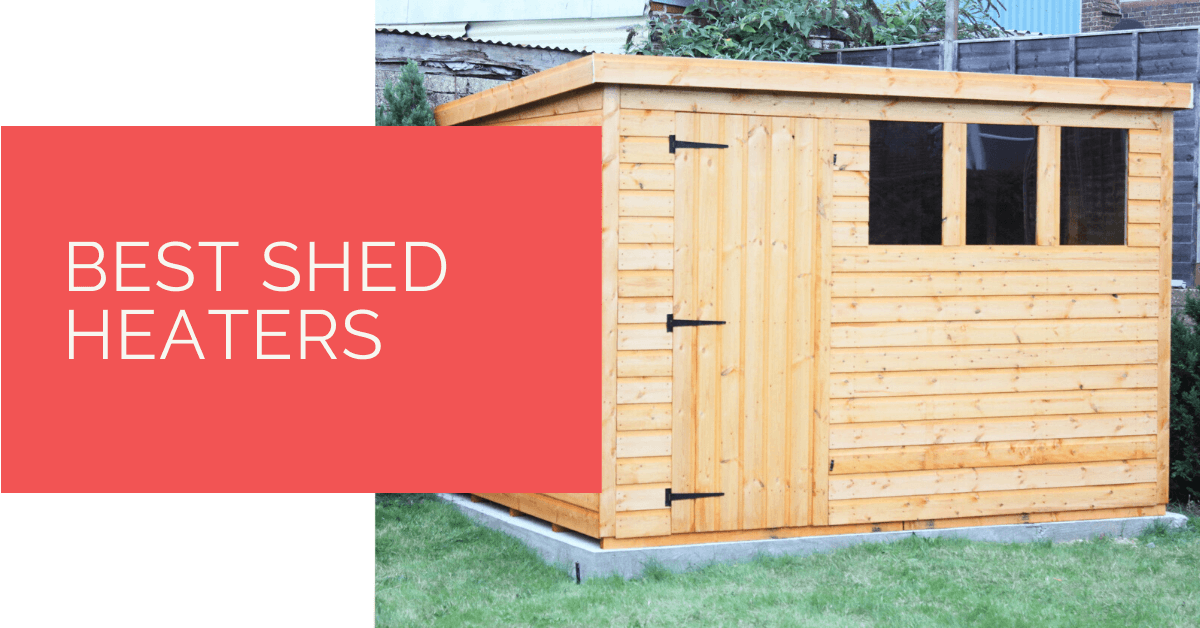
Finding the right shed heater makes the difference between a garden outbuilding you avoid from October to March and one you actually use year-round. The Dimplex ECOT3FT 3FT Tubular Heater is our top pick for most shed owners: it’s purpose-built for outbuildings, safe to leave on overnight, and its built-in thermostat keeps running costs sensible while protecting your tools, paint, and plants from frost damage.
Whether you need gentle background frost protection or serious warmth for a workshop or home office, we’ve tested and reviewed the eight best options currently available on Amazon UK. Read on for our full breakdown.
Our Top Picks
| Image | Name | |
|---|---|---|
| Dimplex ECOT3FT 3FT Tubular Heater | |
| Warmlite Infrared Heater with Oscillation WL42013 | |
| Draper 2.0kW PTC Portable Space Heater | |
| Belaco 2000W Turbo Convector Electric Heater | |
| Dimplex 80W 2FT Tubular Heater | |
| 2KW Electric Convector Radiator Heater | |
| Duronic HV101 2500W Micathermic Panel Heater | |
| TCP Smart Glass Panel Heater 2000W |
The 8 Best Shed Heaters
1. Dimplex ECOT3FT 3FT Tubular Heater
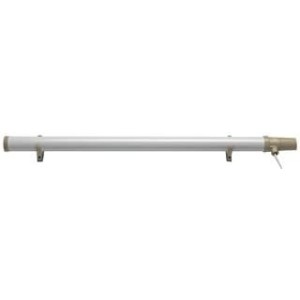
This is the one to buy if you want a proper shed heater rather than a repurposed room heater. The Dimplex ECOT3FT is a 120W tubular heater that runs along the floor or wall of your outbuilding, providing consistent low-level background heat that ticks on and off as needed. It’s specifically designed for sheds, greenhouses, and outbuildings, and it shows.
At 120W continuous, it costs around 3p per hour to run at current UK electricity rates. Most users mount it along the base of the shed wall and leave it on a low thermostat setting throughout winter. The built-in thermostat cuts in when temperatures drop and switches off once the space warms up. You won’t be sitting in shorts, but you will keep your tools rust-free, your paint from freezing, and your bike from seizing up.
The build quality is exactly what you’d expect from Dimplex. Solid metal construction, no moving parts, no fan, no noise. It comes with mounting brackets, so installation is straightforward. The 3FT length means more surface area than the shorter models, which improves heat distribution in wider sheds.
One honest caveat: this won’t heat a shed to working temperature quickly. If you want to step into your workshop and feel warm within ten minutes, you need a fan heater or convector in addition to this. But as a leave-it-on background heater for frost protection and baseline warmth, nothing else on this list beats it for reliability and running cost.
Features
- Output: 120W
- Length: 3ft (approx. 915mm)
- Built-in thermostat for automatic temperature control
- Mounting brackets included
- Designed for outbuildings, sheds, and greenhouses
- No fan, no moving parts, silent operation
- Wall or floor mounting
- Purpose-built for sheds and outbuildings
- Very cheap to run at 120W
- Safe to leave on unattended
- Built-in thermostat included
- Not powerful enough for rapid active heating
- Needs a fused spur rather than a standard plug
2. Warmlite Infrared Heater with Oscillation WL42013
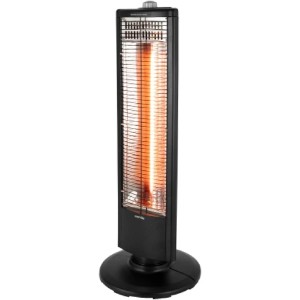
If you spend time actually working in your shed, the Warmlite WL42013 is the one to consider alongside (or instead of) a tubular heater. It’s a 1000W carbon infrared heater that warms objects and people directly rather than heating the air, which makes it genuinely efficient in a draughty outbuilding where warm air escapes through gaps and thin walls.
The oscillation function is what makes this stand out from other infrared heaters at this price. It sweeps left to right through 70 degrees, distributing heat more evenly than a fixed-position model. Set it up facing your workbench and it’ll keep you comfortable without making the whole shed feel like a sauna. The two heat settings (500W and 1000W) give you a sensible low option for milder days.
With over 1,196 reviews at 4.4 stars, the WL42013 has a track record. Most buyers are using it in workshops, garages, and outbuildings exactly as you would. It’s light, easy to position, and the carbon fibre element heats up in seconds rather than the minutes an oil-filled radiator needs.
Features
- Output: 500W and 1000W settings
- 70-degree automatic oscillation
- Carbon fibre infrared heating element
- Overheat protection built in
- Freestanding with carry handle
- Heats in seconds from cold start
- Heats people and objects directly, not just air
- Oscillation gives even heat distribution
- Ideal for draughty or poorly insulated sheds
- Over 1,000 verified reviews
- Only 1000W maximum, won’t heat large sheds alone
- Less effective if you move around the shed frequently
- No thermostat for automatic cut-off
3. Draper 2.0kW PTC Portable Space Heater
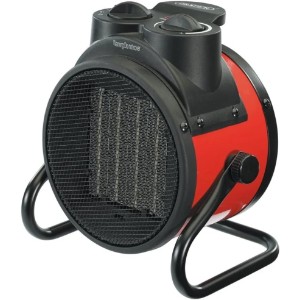
This is the shed heater for people who take their workshop seriously. The Draper 92967 is rated for indoor and outdoor use, built for working environments, and at 2kW with a PTC ceramic element it heats a shed up fast. PTC elements self-regulate temperature, which makes them safer and more efficient than traditional resistive elements — they draw less power as the room warms up.
Draper is a British tools brand that’s been around for over 100 years, so this isn’t a generic import with a random badge on it. The adjustable thermostat lets you dial in your preferred temperature, and the 1.3m cable gives you some flexibility in where you position it. It’s rated for spaces up to around 20 square metres, so it can handle a good-sized shed or workshop.
The 542 five-star reviews are largely from workshop and garage users, which is exactly the audience this is built for. It’s not the cheapest option here, but for a 2kW heater from a reputable brand at £39, it’s well-priced.
Features
- Output: 2kW PTC ceramic element
- Rated for indoor and outdoor use
- Adjustable thermostat
- Fan-assisted for rapid heat distribution
- 1.3m cable length
- Covers spaces up to approximately 20 square metres
- Draper brand with UK tool industry heritage
- Reputable British tools brand
- Rated for outdoor/workshop environments
- PTC element is safer and more efficient
- Heats up quickly for active working sessions
- Fan creates background noise
- Not suitable for permanent frost-protection use
4. Belaco 2000W Turbo Convector Electric Heater
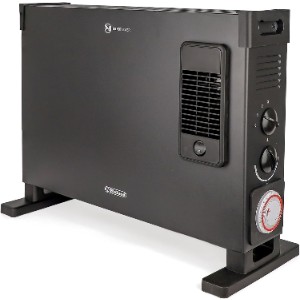
The Belaco ticks the boxes that matter for a shed convector: 2kW output, three heat settings, a 24-hour timer, and fan-assisted circulation to push warm air around the space. It’s heavier and more feature-rich than the Draper, but if you want a timer function to warm the shed up before you arrive, this is the one to pick.
The turbo fan is noticeably effective. Cold air is drawn in at the base and warm air pushed out at the top, which circulates heat faster than a passive convector. In a reasonably well-sealed shed, you’ll feel the difference within five minutes of switching it on. The three settings (750W, 1250W, 2000W) are useful for dialling back output on milder days.
It’s designed for home use rather than industrial environments, so it’s better suited to a garden shed used as a home office or hobby room than a dusty workshop. Keep sawdust and debris away from the intake vents.
Features
- Output: 750W / 1250W / 2000W settings
- 24-hour programmable timer
- Turbo fan for faster heat circulation
- Energy-saving mode
- Overheat protection
- Portable freestanding design
- 24-hour timer to pre-heat the shed
- Three heat settings for flexible output
- Fan circulates heat faster than passive convectors
- Not rated for dusty workshop environments
- Fan noise is noticeable at full power
- Fewer reviews than some rivals
5. Dimplex 80W 2FT Tubular Heater
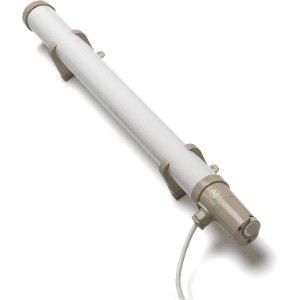
The shorter sibling of the ECOT3FT. At 80W and 2ft long, this is the right choice if your shed is compact, your budget is tight, or you simply need frost protection for a small space like a cold frame, potting shed, or garden storage unit. Over 1,106 Amazon reviewers have given it 4.5 stars, which is remarkable for such an unassuming product.
The principle is identical to the 3FT version: low wattage, continuous heat, built-in thermostat. The 2FT length is easier to fit along a short wall or under a shelf, and at £27 it’s one of the most cost-effective options here. Running cost is around 2p per hour at full power, though with the thermostat cycling, real-world usage tends to be less than that.
Features
- Output: 80W
- Length: 2ft (approx. 610mm)
- Built-in thermostat
- Mounting brackets included
- Designed for outbuildings and sheds
- Wall or floor mounting
- Excellent value at £27
- Compact size suits smaller sheds
- 4.5 stars from over 1,000 reviews
- 80W is only suitable for frost protection, not active heating
- Shorter coverage than the 3FT version
- Requires a fused spur installation
6. 2KW Electric Convector Radiator Heater
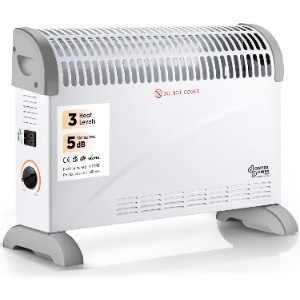
The most budget-friendly active heater on this list at £32.99. This is a passive convector (no fan) that draws cool air in at the base and releases warm air from the top through natural convection. It’s quieter than a fan heater and perfectly adequate for a sealed or reasonably well-insulated shed.
Three power settings (750W, 1250W, 2000W) and an adjustable thermostat give you good control over running costs. It can be wall-mounted or used freestanding, which adds flexibility. The oil-free design means there’s no risk of leaks and it’s lighter than an oil-filled radiator. The reviews note that it heats up faster than oil-filled alternatives while still providing steady, even warmth.
Features
- Output: 750W / 1250W / 2000W
- Passive convection, silent operation
- Adjustable thermostat
- Wall-mountable or freestanding
- Overheat protection
- Carry handles for portability
- Best value active heater on this list
- Silent operation with no fan
- Wall-mount option is great for small sheds
- Slower to heat a space than fan heaters
- Struggles in draughty or uninsulated sheds
- Fewer reviews than the Dimplex tubular models
7. Duronic HV101 2500W Micathermic Panel Heater
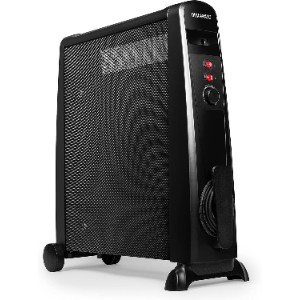
The highest-output heater on this list at 2500W. If you have a large shed, a converted outbuilding, or one with particularly poor insulation, the Duronic HV101 is worth considering. Micathermic panel heaters combine radiant and convection heat, warming up faster than oil-filled radiators while distributing heat more broadly than an infrared heater.
It’s also genuinely lightweight for a 2500W heater, which makes positioning and repositioning it around a larger space much easier than lugging an oil-filled rad. The 805 reviews at 4.4 stars reflect long-term satisfaction from users in exactly this kind of application.
The main reason this doesn’t rank higher despite its power output is the price. At £94.99, it costs more than twice the convector above and over twice the Draper. If you need 2500W and want a reliable heater for a large outbuilding, it earns its cost. For most average sheds, 2kW is plenty.
Features
- Output: 2500W
- Micathermic panel technology (radiant plus convection)
- Adjustable thermostat
- Lightweight despite high output
- Overheat and tip-over protection
- Suitable for large spaces
- Highest output on this list at 2500W
- Micathermic tech combines radiant and convection heat
- Lightweight for its power output
- Strong review track record (805 reviews, 4.4 stars)
- Expensive at £94.99 compared to alternatives
- Overkill for most average-sized garden sheds
8. TCP Smart Glass Panel Heater 2000W
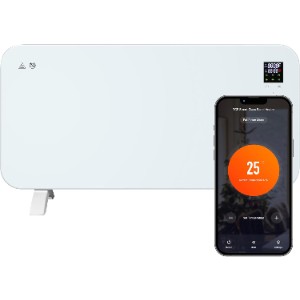
The most divisive pick on this list. If your shed is used as a home office or hobby room, and you want to control it from your phone rather than walking out to switch it on, the TCP Smart is a genuinely useful option. WiFi-connected, works with Alexa, Google Home, and Siri, and you can set schedules via the app so it’s warm by the time you arrive.
The glass panel design looks considerably smarter than a standard white convector. It can be wall-mounted flush against the shed wall or used as a freestanding panel, which gives you installation flexibility. The two heat settings (1000W and 2000W) are straightforward, and the LED display shows the current temperature and settings clearly.
The downsides are real, though. At £89.99, it’s expensive for a 2kW heater when the Draper at £39 does a similar job without the app. And in a shed, smart features matter less than in a house: you’re unlikely to be away long enough to need remote control, and WiFi coverage often doesn’t extend to the bottom of the garden. It earns its place here for the specific use case of a shed-based home office where app control and wall-mounting are genuine priorities.
Features
- Output: 1000W and 2000W settings
- WiFi-connected with TCP Smart app
- Works with Alexa, Google Home, and Siri Shortcuts
- Wall-mounted or freestanding
- Smart scheduling and remote control
- LED display with temperature readout
- Overheat protection
- App control and voice assistant integration
- Smart scheduling to pre-heat the shed
- Stylish glass panel design
- Expensive for what it is at £89.99
- Requires WiFi in the shed
- Smart features are overkill for most shed users
Shed Heater Buying Guide
Key Takeaways
- Tubular heaters are the most efficient choice for permanent frost protection in sheds and outbuildings
- For active working heat, you need at least 1kW, ideally 2kW, depending on shed size and insulation
- Infrared heaters work better than convectors in draughty, poorly insulated sheds
- Running costs depend on output and usage: a 120W tubular heater costs around 3p/hour; a 2kW fan heater costs around 50p/hour
- Safety matters: always use a heater with overheat protection and buy from a brand with proper electrical certifications
- Shed insulation makes a bigger difference than heater choice: even a 2kW heater struggles in an uninsulated timber shed in January
Do You Have Mains Power in Your Shed?
This is the first question to answer before you buy. Tubular heaters and most convectors require a permanent mains connection via a fused spur rather than a standard 13A socket. If your shed only has a standard socket (or an extension lead from the house), stick to heaters that come with a plug.
All the fan heaters, convectors, and infrared heaters on this list use a standard 13A plug. The Dimplex tubular heaters are typically wired directly into a fused spur. If you’re installing one for the first time, factor in the cost of having a qualified electrician wire a spur or run a proper mains circuit to the shed.
Frost Protection vs Active Heating: Two Very Different Needs
A frost protection heater runs continuously at low output to keep the shed above 5°C. This protects tools from rust, prevents paint, adhesives, and other materials from freezing, and keeps any plants you’re overwintering alive. A 80W to 120W tubular heater is perfect for this.
Active heating means raising the shed temperature to a comfortable working level, typically 16 to 20°C, within a reasonable time of arriving. For this you need at least 1kW, ideally 2kW. Many shed owners use both: a tubular heater running constantly for background protection plus a fan heater or infrared they switch on when they’re actually working.
Types of Shed Heater
Tubular heaters are purpose-designed for outbuildings. They run along the wall or floor, draw very little power, and can safely be left on continuously. The Dimplex range is the benchmark.
Convector heaters heat the air through natural convection. Silent, no moving parts, but slower to heat a space than a fan heater. Good for a shed that’s reasonably well insulated.
Fan heaters push air over a heating element, warming the space faster than a passive convector. Noisier, but ideal if you want the shed up to temperature quickly.
Infrared heaters emit radiant heat that warms people and objects directly rather than heating the air. Particularly effective in draughty or uninsulated sheds where warm air escapes quickly.
Micathermic panel heaters combine radiant and convection heat. They heat up faster than oil-filled radiators and more broadly than infrared. Good all-rounder for a larger shed.
How Much Power Do You Need?
As a general rule, allow 100W per square metre for a well-insulated shed and 150W per square metre for an uninsulated one. A typical 2.4m x 1.8m garden shed is around 4.3 square metres, which means 430W for a well-insulated version or 650W for a bare timber one. Most 2kW heaters will comfortably handle sheds up to around 15 square metres.
Bear in mind that shed insulation varies enormously. Single-skin timber sheds lose heat very quickly. Adding a lining of insulation board and a draught-proofing strip around the door can halve your heating requirements and make a dramatic difference to how quickly the space warms up.
Running Costs
At the current UK average electricity tariff of around 25p per kWh:
- 80W tubular heater: approximately 2p per hour
- 120W tubular heater: approximately 3p per hour
- 1kW infrared heater: approximately 25p per hour
- 2kW fan heater: approximately 50p per hour
- 2500W panel heater: approximately 62.5p per hour
If you’re using a 2kW heater for three hours a day, five days a week, that’s £3.75 per week or around £15 per month in winter. A tubular heater running 24 hours a day for a month costs roughly £2.16 at 120W. The difference is significant, which is why many shed owners use both: a tubular heater permanently on a low thermostat, plus an active heater only when they’re in there.
Safety Considerations
Always buy a heater with overheat protection. In a shed with sawdust, wood shavings, or flammable materials, a heater that shuts off automatically if it overheats is not optional. All the products on this list have this feature.
Keep heaters away from flammable materials. Infrared heaters in particular produce intense directional heat that can ignite wood shavings or paper if pointed at them from close range. Fan heaters and convectors generate less directional heat but should still have clearance around them.
If you’re using an extension lead to power the heater, make sure it’s a heavy-duty one rated for the heater’s wattage. A 2kW heater on an under-rated extension lead is a fire risk. Ideally, have a dedicated mains socket installed in the shed by a qualified electrician.
Case Study: Converting a Garden Shed into a Year-Round Workshop
Background
A retired engineer in rural Shropshire wanted to convert his existing 3m x 2.4m garden shed into a usable year-round workshop for woodworking. The shed had a single mains socket wired from the house but no permanent heating. Winter temperatures in the area regularly drop to -5°C overnight, and the shed had no insulation beyond the standard tongue-and-groove cladding.
Project Overview
The goal was to create a workshop that could be used comfortably from October to April without the risk of tools rusting, adhesives freezing, or the space taking 45 minutes to reach a usable temperature. Budget was flexible but the owner didn’t want to spend more than necessary on running costs.
Implementation
Rather than choosing between frost protection and active heating, the owner installed both. A Dimplex ECOT3FT 3FT tubular heater was hardwired to a new fused spur on the shed’s existing mains feed. This runs continuously throughout winter on a low thermostat setting, keeping the shed above 5°C at all times. A Draper 2kW PTC fan heater plugs into the existing socket and is switched on roughly 15 minutes before starting work.
The owner also added 25mm Kingspan insulation board to the interior walls before the second winter, which reduced the warm-up time noticeably and cut the active heater usage in half.
Results
The tubular heater costs around £2 to £3 per month to run through winter. The Draper adds roughly £1.50 to £2 on working days. Tools no longer show rust in spring, and the adhesives and finishes that were previously unusable in January now perform correctly. The owner estimates the two heaters cost less than £8 per month combined through the worst of winter.
Expert Insights From Our Heating Engineers About Shed Heaters
One of our senior heating engineers with over 22 years of experience in domestic and outbuilding heating has this to say about choosing a shed heater:
“The biggest mistake I see is people buying a single heater that’s either too powerful for continuous use or too weak for active warming, and then being frustrated when it doesn’t do both jobs well. A 2kW fan heater left running all winter costs a fortune and wasn’t designed for it. A 120W tubular heater takes two hours to raise the shed temperature from 3°C to 18°C. They’re different tools for different jobs, and the best outcome is usually a combination of both.”
“Insulation is genuinely more important than heater choice. I’ve seen sheds with a 3kW heater running flat-out in January and the owner still can’t get it above 12°C because single-skin timber sheds with gaps around the door lose heat faster than the heater can put it in. Lining the walls with 25mm insulation board, adding a draught seal to the door, and insulating the floor changes everything. After that, even a 1kW heater can keep a modest shed comfortable.”
“On safety: if you’re buying any mains-powered heater for a shed, have the wiring inspected by a qualified electrician if you’re not certain of its condition. Outdoor and garden wiring degrades faster than indoor wiring due to temperature cycling and moisture. A heater plugged into a deteriorating cable is a fire risk, not just an electrical one.”
Frequently Asked Questions
What is the cheapest type of shed heater to run?
Tubular heaters are the cheapest to run for background frost protection. At 80 to 120W, they cost 2 to 3p per hour, or around £2 to £3 per month running continuously. If you need active warming for working in the shed, an infrared heater is the most cost-effective option since it heats people and objects directly rather than the air, which works better in draughty outbuildings.
Can I use a normal room heater in a shed?
Yes, as long as it’s connected to a proper mains supply rather than an extension lead from the house, and kept away from flammable materials. Standard room heaters are not rated for damp or outdoor environments, so avoid using them in sheds that experience condensation or are exposed to rain. Heaters with overheat protection and tip-over switches are safer choices for shed use.
How many watts do I need to heat a shed?
Allow 100W per square metre for a well-insulated shed or 150W per square metre for an uninsulated timber shed. A standard 6x8ft garden shed (roughly 4.5 square metres) needs 450W to 675W for frost protection. For active heating to a comfortable working temperature, double those figures, so a 1000W to 1500W heater minimum for the same size shed.
Is it safe to leave a shed heater on overnight?
Tubular heaters with built-in thermostats are specifically designed to be left on continuously and are the safest option for overnight and unattended use. Fan heaters and infrared heaters should not be left on overnight or unattended. If you need 24-hour frost protection, a tubular heater is the right tool for that job.
Do I need an electrician to install a shed heater?
For heaters that plug into a standard socket, no, as long as the socket is already installed. For tubular heaters that require a fused spur, and for running a new mains circuit to the shed, yes, you should use a qualified electrician. In the UK, running a new outdoor electrical circuit from the house to a shed is notifiable work under Part P of the Building Regulations and must be carried out or inspected by a competent person.
Can a shed heater protect plants from frost?
Yes. A tubular heater running on a low thermostat set to around 5°C will provide adequate frost protection for most tender plants and seedlings. This is one of the most common uses for tubular heaters in garden settings, alongside protecting tools and stored materials from freezing.
What is the best heater for a shed office?
For a shed used as a home office, we’d recommend either the Draper 2kW PTC for straightforward reliable warmth, or the TCP Smart Glass Panel if WiFi connectivity and app-based scheduling are important to you. For longer sessions where you want the shed warm before you arrive, a timer function (built into the Belaco) or smart scheduling (TCP) is worth having. Supplement either with a tubular heater running continuously for background protection.
Summing Up
For most shed owners, the Dimplex ECOT3FT 3FT Tubular Heater is the best starting point. It’s purpose-built for outbuildings, safe to leave running, cheap to operate, and will protect everything in your shed through the coldest months without any ongoing management. If you also want to work in the shed comfortably, add a Draper 2kW PTC or Warmlite Infrared for active sessions.
For a shed-based home office or hobby room, the Belaco’s 24-hour timer or the TCP Smart’s app scheduling takes the friction out of heating. And if you have a large or particularly draughty outbuilding, the Duronic HV101 at 2500W is the only option here that will comfortably handle the job on its own.
Updated