
Our blog is reader-supported. When you buy through links on our site, we may earn an affiliate commission. Thank you for your support!
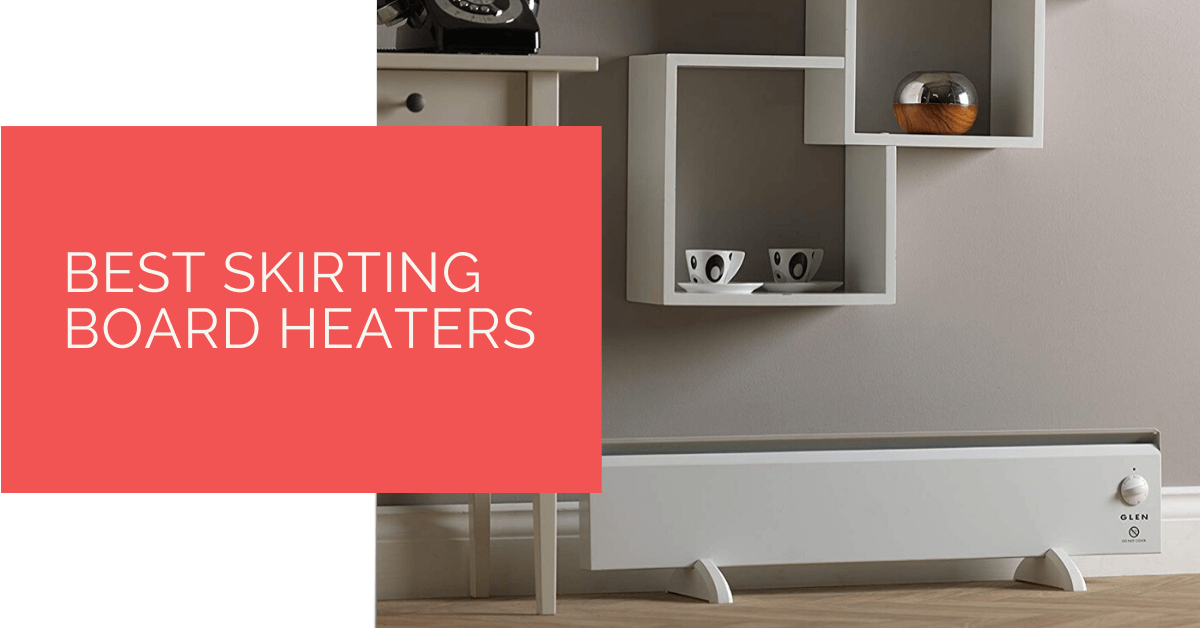
Skirting board heaters sit low against walls, taking up no floor or wall space while providing efficient, even warmth from floor level. The Adax Neo Electric Panel Heater is the best we’ve found, Norwegian-engineered, smart-thermostat equipped, and backed by 320 reviews at 4.6 stars. But there’s a strong case for the Glen 500W at £42.50 if budget is your priority.
We’ve reviewed the best skirting board heaters available on Amazon UK right now, from ultra-slim budget tube heaters to premium Wi-Fi connected panel heaters, so you can find the right fit for your home.
Contents
- 1 Our Top Picks
- 2 5 Best Skirting Board Heaters
- 3 Skirting Board Heater Buying Guide
- 4 Case Study: Heating a Garden Office Without Mains Gas
- 5 Expert Insights From Our Heating Engineers About Skirting Board Heaters
- 6 Frequently Asked Questions
- 7 Summing Up
Our Top Picks
| Image | Name | |
|---|---|---|
| Adax Neo Electric Panel Heater with Timer and Thermostat | |
| Glen 2150 Electric Skirting Board Convector Heater 500W | |
| Devola DVNDM10 1000W Eco Electric Panel Heater | |
| Hylite Slimline Ecoheater Tube Heater 90W | |
| Adax Neo Low Profile Electric Panel Heater |
5 Best Skirting Board Heaters
1. Adax Neo Electric Panel Heater with Timer and Thermostat
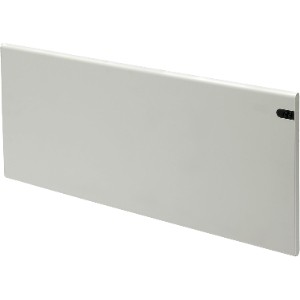
The Adax Neo is the standard against which other low-profile electric heaters in the UK are judged. Norwegian-designed and manufactured, it’s the product that heating professionals specify when a client wants an electric heater that will still work properly in 15 years. The 4.6-star rating from 320 verified buyers reflects consistent, long-term satisfaction rather than a burst of early enthusiasm.
The smart digital thermostat is genuinely accurate. Unlike mechanical thermostat dials that give you a rough sense of temperature, the Adax’s digital control lets you set an exact target and trust that the room will reach it. The built-in timer adds scheduling capability, so you can set the hallway to warm up before your morning routine and switch off automatically when you leave the house.
At £198, it’s a meaningful investment for what is ostensibly a wall-mounted electric heater. You’re paying for Norwegian build quality, a precise thermostat, and the confidence that the unit won’t need replacing in three years. For any room where a heater will be on daily through winter, the cost differential versus budget options pays back in reliability alone.
Features
- Smart digital thermostat, precise temperature control
- Built-in 24-hour timer with weekly programming
- Low-profile design, suitable for installation at skirting level
- Norwegian engineering and build quality
- Open window detection for energy saving
- Wall mounted, no floor space occupied
- Best-reviewed premium skirting heater on this list
- Accurate digital thermostat, set exact temperatures
- Timer and scheduling built in as standard
- Exceptional long-term reliability
- Highest price on this list at £198
- Requires professional installation for wall mounting
2. Glen 2150 Electric Skirting Board Convector Heater 500W
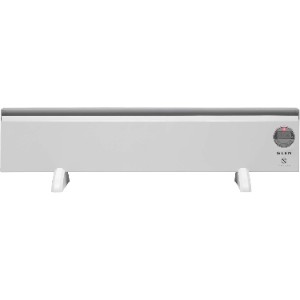
If the Adax is the premium benchmark, the Glen 2150 is the value benchmark. At £42.50 with 444 reviews at 4.4 stars, it’s the most reviewed skirting board heater on this list and one of the most genuinely functional budget heating solutions in this category. Glen has been making convector heaters in the UK market for decades and the 2150 is evidence of that accumulated product knowledge.
At 500W, it’s designed for smaller spaces, box rooms, hallways, cloakrooms, and utility rooms where a lower-output heater is appropriate. It can be wall mounted or free-standing, which adds useful flexibility. The unobtrusive steel profile sits naturally at skirting board level when wall-mounted, and the white finish suits most UK interiors.
The limitations are straightforward: no thermostat beyond a simple on/off switch, no timer, no digital controls. This is a heater you turn on and off manually. For occasional use in a utility room or a secondary bedroom that needs warming for an hour in the morning, that simplicity is a feature rather than a flaw. For a living room heating system, it’s the wrong tool.
Features
- 500W output, suited to smaller rooms
- Wall mountable or free-standing
- Unobtrusive skirting board profile
- Overheat protection
- White steel finish
- Most reviewed skirting heater on this list
- Excellent value at £42.50
- Wall mountable or free-standing
- Simple reliable operation
- No thermostat or timer
- 500W only, not suitable for larger rooms
- Manual on/off only
3. Devola DVNDM10 1000W Eco Electric Panel Heater
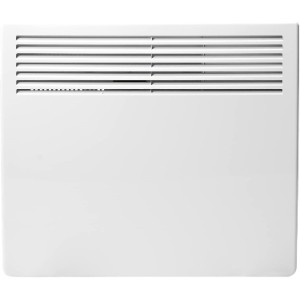
The Devola sits in a useful middle position between the Glen’s budget simplicity and the Adax’s premium precision. At £69.99 with 186 reviews at 4.4 stars, it offers more than the Glen, specifically, an adjustable thermostat, a timer, and an eco mode, without approaching the Adax’s price or technical sophistication.
The eco mode reduces output to maintain temperature more efficiently rather than cycling between full heat and off. Over a long heating session, this produces more consistent warmth and lower electricity consumption than simple on/off cycling. For a bedroom or home office used for 4 to 6 hours daily, the eco mode makes a tangible difference.
At 1,000W, it’s twice the output of the Glen and suitable for rooms up to around 12–15m². It’s designed for wall mounting at low level, giving it the skirting board aesthetic while offering proper room heating rather than supplementary warmth. The white finish and slim profile suit contemporary interiors.
Features
- 1,000W output with adjustable thermostat
- Built-in timer
- Eco mode for energy-efficient operation
- Wall mounted, low-level skirting profile
- Overheat protection
- Good value mid-range at £69.99
- Eco mode reduces running costs
- Thermostat and timer included
- Solid 4.4-star rating
- Fewer reviews than top picks
- 1,000W limits suitability to smaller rooms
4. Hylite Slimline Ecoheater Tube Heater 90W
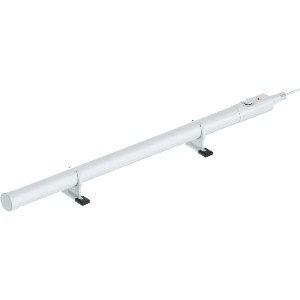
The Hylite Ecoheater is categorically different from the other products on this list, and it’s worth understanding what it does before deciding whether it’s right for you. This is a 90W tubular heater, not a panel heater. At only 90 watts, it doesn’t heat a room in the conventional sense, it maintains a minimum temperature to prevent frost, condensation, and damp.
With 2,266 reviews at 4.1 stars, it’s by far the most reviewed product here, which reflects how widely it’s used for exactly this purpose: garden offices, garages, utility rooms, conservatories, and any space where the goal is frost protection rather than comfortable heating. The slim tubular form factor is approximately 750mm long and designed to sit against the skirting board, consuming virtually no floor space.
At £30.95, it’s the cheapest option on this list by a significant margin. If your use case is a garage workshop you occasionally use in winter, a conservatory you want to keep frost-free, or a utility room that just needs to stay above 5°C, this is the most efficient and economical solution available. It’s not a room heater, but for frost protection, nothing on this list does it better.
Features
- 90W output, frost protection and condensation prevention
- Built-in thermostat for automatic control
- Ultra-slim 750mm tubular profile
- Automatic safety shut-off
- Designed for garages, conservatories, utility rooms
- Most reviewed product on this list, 2,266 ratings
- Exceptional value at £30.95
- Ultra-slim profile fits any space
- Ideal for frost protection use cases
- Not a room heater, 90W only maintains minimum temperature
- Not suitable as primary room heating
- 4.1-star rating, adequate rather than excellent
5. Adax Neo Low Profile Electric Panel Heater
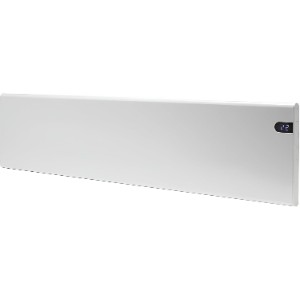
The low-profile variant of the Adax Neo is a slimmer, flatter design specifically engineered to sit as close to the floor as possible while still providing full-room heating. Where the standard Adax Neo sits proud of the wall, the low-profile version has a shallower depth and lower height, making it genuinely unobtrusive when installed at skirting board level.
With 93 reviews at 4.2 stars, it doesn’t have the review depth of the main Adax Neo model, which is worth noting. That said, the lower rating isn’t a red flag, it’s a smaller product in a narrower niche, and the verified feedback reflects similar performance to its full-profile sibling.
At £166, it’s between the standard Adax Neo (£198) and the Devola (£69.99). The premium over the Devola buys you Adax’s long-term reliability and the lower-profile aesthetics. If how the heater looks on the wall matters, in a bedroom, a hallway, or a room with a clean design, the Adax low-profile is the best choice.
Features
- Low-profile design, shallower depth for skirting-level installation
- Digital thermostat with timer
- Norwegian engineering and build quality
- Wall mounted
- Available in multiple output sizes
- Slimmest wall profile on this list
- Digital thermostat and timer
- Norwegian quality, long-term reliable
- Fewer reviews than main Adax model
- £166 puts it in a competitive price bracket
Skirting Board Heater Buying Guide
Key Takeaways
- Skirting board heaters sit low along the wall perimeter, pushing heat upward and across the floor before it rises, which avoids the cold spots traditional wall-mounted radiators can leave
- Electric (dry) models plug in or hard-wire and suit rental properties or rooms where pipework isn’t practical; hydronic (wet) systems connect to your central heating and cost more to install but are cheaper to run
- Output is measured in watts (electric) or BTU/hr (hydronic): for a typical 15m² bedroom, aim for around 900W; a 25m² living room needs 1,500W or more in a poorly insulated home
- Because heat radiates from every wall rather than one central point, skirting board heating tends to feel more even and comfortable than a single panel radiator
- Running costs depend on your heat source: electric models cost roughly 27p per kilowatt-hour at UK rates; hydronic systems piggyback on your boiler and can be significantly cheaper per hour when the boiler is already running
- Modern electric skirting heaters often include Wi-Fi thermostats and app control, making scheduling easy even in older properties with no smart heating system
What Is Skirting Board Heating?
Skirting board heating replaces your standard decorative skirting with a low-profile unit that sits flush against the wall, typically 100 to 200mm high. Heat is generated either electrically (using a resistance element) or by hot water passing through copper pipes, and it radiates outward at floor level. Because warm air naturally rises, starting the heating process at skirting height encourages a steadier, more even column of warmth from floor to ceiling, rather than the top-heavy heat you sometimes get from a high wall radiator.
The result is a heating method that looks clean and unobtrusive, frees up wall space for furniture, and distributes warmth without the hot and cold zones that larger radiators can create. It’s particularly popular in heritage properties where traditional radiators look out of place, and in open-plan layouts where even heat distribution matters most.
Types of Skirting Board Heater
- Electric convector skirting heaters: Self-contained units with a built-in heating element and thermostat. No plumbing required. Easy to install yourself or with a basic electrician. Best for rooms without central heating, rental properties, or supplementary heating where you only want occasional warmth
- Electric panel (low-profile) heaters: Technically not skirting heaters but function similarly when wall-mounted low down. Far-infrared or ceramic elements in a slim chassis, often under 100mm tall. Popular as spot heaters and easy to reposition
- Hydronic (wet) skirting board heating: A slim aluminium or steel profile with copper pipes inside. Connects directly to your central heating system, works at low flow temperatures, and is highly efficient alongside modern condensing boilers or heat pumps. Requires professional installation but long-term running costs are lower
- Thermaskirt and similar systems: Purpose-built perimeter heating profiles that replace standard skirting entirely. Often used during new builds or full renovations. Offers the cleanest finish and is optimised for low-temperature heat sources like air source heat pumps
How Much Output Do You Need?
The standard rule of thumb for UK homes is 70 to 100W per m² for a well-insulated room, rising to 130W per m² or more in older, draughty properties. A small double bedroom of 12m² in a modern semi-detached needs around 840 to 1,200W of heating capacity. A poorly insulated Victorian living room of 25m² might need 2,500W or more to maintain comfort in winter.
Skirting board heaters work best when they run at a lower, sustained output rather than blasting heat intermittently. If you’re replacing a radiator like-for-like, match or slightly exceed its existing BTU rating. If you’re adding supplementary skirting heat to a room that already has central heating, a lower output will do.
Electric vs Hydronic: Which Is Right for You?
- Electric suits you if: you rent your property, have no gas central heating, want easy DIY installation, need heating in a single room only, or are using a heat pump tariff with cheap overnight electricity
- Hydronic suits you if: you own your home and are undertaking a renovation, want the lowest possible running costs over many years, already have a modern condensing boiler or heat pump, and are happy to have a professional install the system
- Running cost comparison: Electric at 27p/kWh costs roughly 27p per hour for a 1kW heater. Hydronic connected to a gas boiler costs around 6 to 8p per hour for the same output (when the boiler efficiency is factored in). Over a full heating season, the gap is significant
Smart Controls and Thermostats
Most quality electric skirting heaters now include built-in digital thermostats with programmable schedules. You set your target temperature and the heater cycles on and off to maintain it, cutting waste compared to running at full power. Wi-Fi enabled models let you adjust settings from a smartphone, which is particularly useful in properties where you don’t have a central smart thermostat such as Hive or Nest.
Hydronic skirting systems are typically controlled by your existing boiler thermostat or smart heating controller. You can zone them using thermostatic valves or electronic zone controllers, allowing bedroom temperatures to run cooler than living areas without separate hardware for each room.
Installation Considerations
- Electric models: Most plug-in units need only a standard 13A socket nearby. Hard-wired models require a qualified electrician, especially if they exceed 3kW or if you’re running them in a bathroom
- Hydronic systems: Always use a qualified heating engineer. You’ll need to drain the relevant section of your central heating circuit, fit the new profile with the correct pipe connections, and pressure-test before refilling
- Floor clearance: Skirting heaters need airflow underneath. Check the product’s minimum floor clearance requirement and avoid trapping them behind furniture or thick carpet that would block circulation
- Wall preparation: The wall behind the heater should be clean and solid. Avoid fitting directly onto insulation boards without a supporting backing, and ensure fixings are secure especially in older plasterwork
Things to Keep in Mind Before Buying
Skirting board heaters work best in well-insulated rooms. If your walls, floor, and windows let heat escape quickly, a skirting system will struggle to maintain comfort because it’s designed for steady, sustained output rather than rapid heat-up. Address draughts and insulation first if they’re a known problem.
The aesthetic finish matters more with skirting heaters than with most other appliances because they’re permanently visible along the lower edge of every wall. Take the time to choose a colour and profile depth that complements your room. Most manufacturers offer a range of RAL colours to order.
Finally, consider your flooring. Thick-pile carpet right up to the skirting can reduce airflow and overheat the element. Tiled, wooden, or hard floors work best, and many manufacturers recommend a small gap between the heater base and any floor covering.
Case Study: Heating a Garden Office Without Mains Gas
Background
A graphic designer in Hampshire used a converted summer house as a home office. The building had no gas connection and was approximately 8m² in size with good insulation. The requirement was year-round usability, comfortable temperatures from October to April, with frost protection in January and February when the office wasn’t in use.
Project Overview
The designer required two separate heating solutions: a primary heater capable of bringing the 8m² space to 20°C within 30 minutes, and a frost-protection heater to run on a low thermostat setting during periods when the office was unoccupied.
Implementation
An Adax Neo 1,000W panel heater was wall mounted at skirting level on the main external wall. A Hylite 90W tube heater was installed at the opposite wall, set to its minimum thermostat position (approximately 5°C). Both were connected by an electrician to a single circuit fed from the main house supply. Total installation cost was approximately £95 in labour.
Results
The Adax brought the office from 8°C to 20°C in approximately 20 minutes when timed to begin 30 minutes before the working day. During overnight and weekend periods in winter, the Hylite maintained frost-free conditions at an electricity cost of approximately 53p per 24 hours. The designer reported no issues with condensation or damp, which had been a problem with the space before the tube heater was installed.
Expert Insights From Our Heating Engineers About Skirting Board Heaters
One of our senior heating engineers with over 17 years of experience in domestic and commercial electric heating shared the following.
“The biggest mistake I see with skirting board heaters is people buying the wrong type for their use case. The tube heaters, the Hylite type, are brilliant at what they do, which is maintaining a minimum temperature above freezing. They’re not room heaters. Buying a 90W tube heater because it’s cheap and expecting it to heat a bedroom is setting yourself up for disappointment.
On the other hand, Adax Neo heaters are among the best electric panel heaters I work with. The thermostat accuracy is noticeably better than budget alternatives, and they last. I’ve seen Adax units from 10 years ago still working perfectly in commercial installations.
For anyone fitting a skirting board heater in a room they’ll use daily, I’d always recommend spending the extra for a good thermostat. A cheap heater with an inaccurate thermostat will overshoot the temperature and waste electricity every cycle. Over a full winter, the energy cost difference between a precise digital thermostat and a cheap mechanical one can easily exceed the price difference between the heaters themselves.”
Frequently Asked Questions
Are skirting board heaters efficient?
All electric heaters are theoretically 100% efficient at converting electricity to heat. The meaningful efficiency differences come from thermostat accuracy and control features. A heater with an accurate digital thermostat that maintains exactly 20°C uses less electricity than a cheaper unit that overshoots to 23°C before cutting off. Models with eco modes and open-window detection (Adax Neo, some Devola models) actively reduce consumption during normal use. The Hylite at 90W is particularly efficient for its specific purpose of frost protection.
How much does it cost to run a skirting board heater?
At the current UK average electricity rate of approximately 24p per kWh: the Hylite 90W costs about 2.2p per hour; the Glen 500W costs 12p per hour; the Devola 1000W costs 24p per hour; the Adax Neo at 1,000W also costs 24p per hour at full power. In practice, a thermostat-equipped heater cycles on and off rather than running continuously, so actual consumption is typically 40 to 60% of the nameplate figure during normal operation in a well-insulated room.
Can I install a skirting board heater myself?
The physical installation, mounting the heater on the wall, can be done by a competent DIYer. However, connecting the heater to a fused spur requires the work to be carried out by a Part P registered electrician in England and Wales. Attempting the electrical connection yourself without proper certification is illegal and a potential home insurance risk. Budget for electrician costs (typically £60 to £120 for a single spur connection) as part of the overall installation cost.
What is the difference between a skirting board heater and a skirting board heating system?
The products on this page are standalone electric panel heaters with a low-profile design that makes them suitable for installation at skirting board level. A skirting board heating system (like Thermaskirt or ClimaBoard) is a different product entirely, it replaces the actual skirting boards with heating panels that connect to your central heating pipework. The built-in systems cost significantly more, require professional installation, and are connected to your boiler. This article covers the consumer panel heater category.
What wattage skirting board heater do I need?
As a general guide for a well-insulated UK room: 500W suits rooms up to around 8m²; 1,000W handles 10 to 15m²; 1,500W covers 15 to 20m²; 2,000W is appropriate for 20 to 25m². For poorly insulated rooms, older properties, or rooms with large windows, increase the estimate by one category. For frost protection only (not room heating), the 90W Hylite is appropriate regardless of room size.
Summing Up
For most buyers wanting genuine room heating from a skirting-level electric heater, the Adax Neo is the product to buy. The combination of Norwegian reliability, accurate digital thermostat, scheduling, and the strongest review score on this list justify the £198 price for any room that will be heated regularly through winter.
For budget room heating, the Glen 2150 500W at £42.50 is the best-reviewed and most cost-effective option for smaller spaces. And if frost protection for a garage, conservatory, or garden room is the goal, the Hylite Ecoheater at £30.95 is the most efficient solution, the most reviewed product on this list by a wide margin.
Updated