

If you want to control your home heating from your phone, set schedules without touching the heater, and get Alexa or Google Home working your radiators on voice command, a smart heater is the obvious upgrade. The Dreo Smart Electric Wall Heater is the standout option: 2000W, whisper-quiet at 28dB, and genuinely useful app control that goes well beyond a basic timer.
Below you’ll find eight of the best smart heaters available on Amazon UK right now, covering everything from wall-mounted glass panels to compact ceramic plug-ins. Each one has been selected for real WiFi functionality, decent build quality, and value that makes sense.
Our Top Picks
| Image | Name | |
|---|---|---|
| Dreo Smart Electric Wall Heater | |
| Ballu 2000W Smart WiFi Panel Heater | |
| MYLEK Glass Panel Heater WiFi 2000W | |
| Devola 1000W Smart Glass Panel Heater | |
| Dreo 1500W Smart Space Heater | |
| Olsen & Smith 1800W Smart Ceramic Heater | |
| Purus 600W WiFi Electric Panel Heater | |
| FLANUR 1500W Smart Portable Heater |
8 Best Smart Heaters
1. Dreo Smart Electric Wall Heater
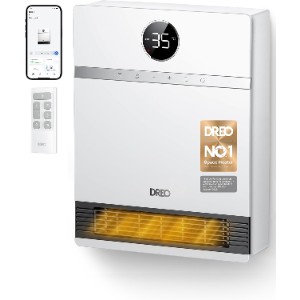
The Dreo Smart Electric Wall Heater is the one to buy if you want quiet, capable, and genuinely smart in a single package. At 28dB it’s barely audible when running, which matters a lot if you’re putting this in a bedroom or study. The 2000W ceramic element warms a room quickly, and the WiFi control via the Dreo app is responsive and well-designed rather than the clunky afterthought you get from cheaper brands.
It mounts flush to the wall or stands freestanding on its included base, so you’re not locked into one position. The thermostat is accurate enough that you’ll actually use it rather than just leaving the heater on full. Alexa and Google Home compatibility works reliably here, not just in theory.
With nearly 3,000 reviews sitting at 4.6 stars, this has genuinely earned its place at the top of the list. The app scheduling is flexible, the safety features are solid, and it doesn’t look out of place in a modern room. If you only buy one smart heater this year, buy this one.
One honest note: the freestanding base is a little flimsy compared to the heater itself. Mount it on the wall if you can. But that’s a minor complaint for a heater that gets almost everything right.
Features
- 2000W ceramic heating element
- 28dB ultra-quiet operation
- WiFi control via Dreo app
- Alexa and Google Home compatible
- Wall-mounted or freestanding
- Adjustable thermostat with scheduling
- Tip-over and overheat protection
- Exceptional 28dB silence makes it bedroom-friendly
- Reliable WiFi with genuinely useful app features
- Dual installation options: wall or freestanding
- Strong real-world review record (2,916 ratings)
- Freestanding base feels less robust than the heater body
- Premium price compared to basic panel heaters
2. Ballu 2000W Smart WiFi Electric Panel Heater
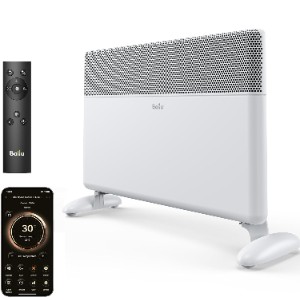
The Ballu is the premium pick here. It combines a full 2000W output with a clean flat-panel design that looks the part in a well-decorated room, and at 4.8 stars it’s the highest-rated heater on this list. Wall-mounted or freestanding, WiFi app controlled, and compatible with Alexa and Google Home.
Where it stands out from other panel heaters is build quality. The housing feels solid, the controls are intuitive, and the app doesn’t fight you every time you try to adjust the schedule. The thermostat maintains temperature precisely rather than cycling in big swings.
Being a newer product it has fewer reviews than the Dreo (48 at time of writing), but the rating is very strong. If aesthetics matter and you want the wall-mounted look without compromising on smarts, this is the one.
Features
- 2000W flat panel design
- WiFi app control
- Alexa and Google Home compatible
- Wall-mounted or freestanding
- Precise thermostat control
- Child lock and safety shutoff
- Highest rating on the list (4.8 stars)
- Premium build quality and clean aesthetics
- Accurate thermostat with reliable app control
- Fewer customer reviews than more established options
- Higher price than comparable wattage rivals
- Less brand recognition in UK
3. Mylek Radiator Glass Panel Heater Black WiFi 2000W
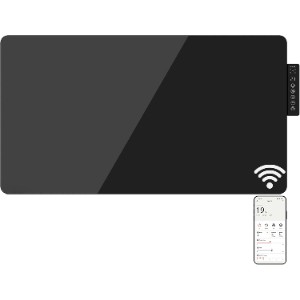
Mylek is one of the better-known UK electric heating brands, and the WiFi glass panel heater is a strong choice for anyone who wants open-window detection as standard. Most smart heaters claim to be efficient but leave you to figure out draughts yourself. The Mylek shuts off automatically if it detects the room temperature dropping suddenly, which is a genuinely useful feature rather than a marketing point.
The black glass panel looks sharp and contrasts well with white walls. At £94.99 for 2000W with WiFi app control, wall-mount capability, and LOT 20 compliance (the energy efficiency standard for heaters sold in the UK), this is well priced for what you get. The 4.7-star rating is encouraging for a newer product.
Features
- 2000W glass panel design
- WiFi app control with open-window detection
- Wall-mounted or freestanding
- LOT 20 compliant
- 7-day scheduling via app
- Black glass finish
- Open-window detection is genuinely useful
- LOT 20 compliant for energy efficiency
- Attractive black glass design
- Relatively low review count as a newer product
- Black glass shows fingerprints and dust
- App can be slower to respond than Dreo
4. Devola 1000W Smart Electric Glass Panel Heater
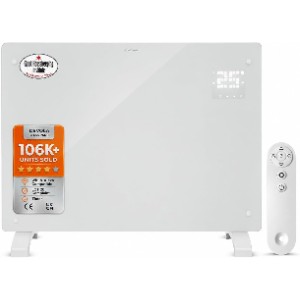
If you’re heating a smaller room or want a supplemental smart heater rather than a primary heat source, Devola’s 1000W glass panel is worth a serious look. Devola is an established UK brand with a reputation for reliable electric heating, and this model backs that up with solid app control, Alexa and Google Home support, LOT 20 compliance, and a clean white glass finish.
Running costs are sensibly low at 1000W: roughly 28p per hour at current electricity rates. The thermostat works well, and 440 reviews at 4.4 stars gives you a reasonable picture of long-term reliability. It’s not the highest-rated product here, but it’s from a brand with proper UK customer service if something does go wrong.
Features
- 1000W smart glass panel
- WiFi control via app
- Alexa and Google Home compatible
- Wall-mounted or freestanding
- LOT 20 compliant
- Timer and scheduling functions
- Established UK brand with local customer support
- Low running costs at 1000W
- LOT 20 compliant energy efficiency
- 1000W may not be enough for larger rooms
- 4.4-star rating is lower than the top picks
- Glass panel can feel cold to the touch initially
5. Dreo 1500W Smart Space Heater
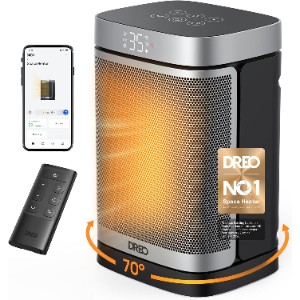
This is the Dreo portable option for anyone who wants smart control without wall-mounting anything. The 1500W output handles rooms up to around 15 square metres, WiFi connects to the Dreo app in the same way as the wall model, and Alexa and Google Home work reliably. Over 1,000 reviews at 4.6 stars is a solid performance indicator.
What makes portable smart heaters like this one useful is flexibility: move it to whatever room needs heating that day and control it from your phone without walking over to it. The scheduling means you can have it warming your home office before you sit down in the morning without touching the heater itself.
Features
- 1500W portable ceramic heater
- WiFi control via Dreo app
- Alexa and Google Home compatible
- 7-day scheduling
- Tip-over and overheat protection
- Quiet operation
- Portable, move it room to room
- 1,015 reviews at 4.6 stars
- Reliable Dreo app ecosystem
- Not wall-mountable
- Takes up floor space
- Not ideal as a sole heat source for larger rooms
6. Olsen & Smith 1800W Smart Ceramic Heater
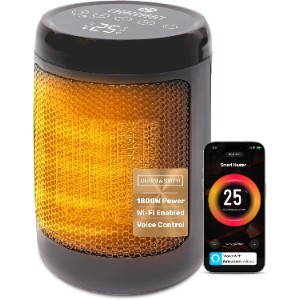
The Olsen & Smith plugs straight into a wall socket and sits on a desk or surface, which makes it the most flexible installation of anything on this list. At £35.99 it’s also the best value for money if you want actual WiFi control rather than just a plug with a timer. Alexa voice control works, 1800W heats a small to medium room quickly, and the ceramic element gets warm fast.
It doesn’t have the build finish of the Dreo or the Ballu, and it looks like a budget heater because it is one. But the smart functions work, and if you need WiFi-controlled heating in a room where aesthetics aren’t the priority, this gets the job done at a very reasonable price.
Features
- 1800W ceramic heating element
- WiFi app and Alexa voice control
- Compact tabletop design
- Plug-in installation
- Thermostat and timer
- Fast heat-up time
- Excellent value at £35.99
- No installation required, plug straight in
- Fast heat-up for spot heating
- Budget build quality
- Compact size, not suited to larger spaces
- Not wall-mountable
7. Purus 600W WiFi Electric Panel Heater
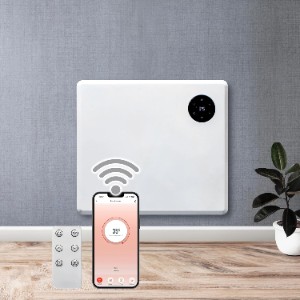
The Purus sits in an interesting position on this list: 600W sounds low, but it’s designed for rooms up to 7.5 square metres (a small bedroom, a hallway, a downstairs loo) where running a 2000W heater would be like using a sledgehammer. At 600W you’re paying around 17p per hour to run rather than 56p, which adds up quickly if the heater is on for several hours a day.
WiFi app control and Alexa/Google Home compatibility are all there. The IP24 rating means it can safely be used in rooms with moisture, which opens it up to bathroom use where the main bathroom radiator might not be smart-controllable. Wall-mounted or freestanding, clean white finish. A niche pick, but the right one for smaller spaces where efficiency matters.
Features
- 600W low-wattage design
- WiFi with Alexa and Google Home
- IP24 moisture resistance
- Wall-mounted or freestanding
- 5 to 35°C thermostat range
- Open-window detection
- Very low running costs at 600W
- IP24 rated for damp/bathroom environments
- Full smart features despite low wattage
- Not powerful enough for larger rooms
- Very few customer reviews so far
- Limited heat output means slower warm-up
8. FLANUR 1500W Smart Portable Electric Heater
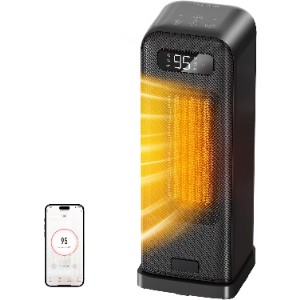
The FLANUR is the budget entry here at around £30. It’s a portable 1500W smart heater with WiFi control, and at 4.4 stars across over 1,000 reviews it’s not just cheap, it’s reasonably well received. If you need smart heating for an occasional-use space like a garage workshop or a spare bedroom, spending £30 rather than £120 makes sense.
Don’t expect the quietness of the Dreo or the build quality of the Ballu. It’s a budget heater and it reads like one up close. But the WiFi works, the app connects, and it heats a room. Sometimes that’s genuinely all you need.
Features
- 1500W portable heater
- WiFi smart control
- App scheduling and thermostat
- Tip-over and overheat protection
- Compact portable design
- Excellent value at around £30
- Good review count (1,033) for confidence
- Budget build quality
- Noisier than premium options
- App less polished than Dreo or Devola
Smart Heater Buying Guide
Key Takeaways
- Smart heaters need a stable 2.4GHz WiFi signal. Most won’t connect to 5GHz networks.
- For rooms under 10 square metres, 1000W to 1500W is usually sufficient. Go 2000W for larger rooms.
- LOT 20 compliance means the heater meets UK energy efficiency standards. Look for it.
- Wall-mounted installation looks better and frees up floor space, but requires drilling and cable management.
- Running costs at current UK electricity rates: 1000W = 28p/hr, 1500W = 42p/hr, 2000W = 56p/hr.
- Open-window detection is a worthwhile feature. It prevents the heater running while a window is open, saving energy automatically.
- IP ratings matter in bathrooms. Look for at least IP24 if the heater will be used in a humid room.
What Is a Smart Heater?
A smart heater is an electric heater with built-in WiFi connectivity that lets you control it remotely via a smartphone app, and often via voice assistants like Amazon Alexa or Google Home. The core appeal is convenience: you can switch the heater on before you get home, set temperature schedules for the week ahead, and check whether it’s running without being in the same room.
Beyond convenience, smart heaters can genuinely reduce running costs if you use the scheduling features properly. The biggest waste in electric heating is leaving heaters on in empty rooms. A smart heater with proper scheduling solves that problem automatically.
How Do Smart Heaters Work?
The heater connects to your home WiFi network during initial setup, typically through the manufacturer’s smartphone app. Once connected, the app communicates with the heater over the internet, so you can control it from anywhere with a phone signal. Voice assistants work through integration with the relevant skill or action (Alexa or Google Home app), which connects to the same cloud system.
The thermostat function works the same as any electric heater: the heating element runs until the room reaches the set temperature, then cycles off and back on to maintain it. The smart layer sits on top, determining when the heater should be active and at what target temperature based on your schedule or manual commands.
Benefits of Using Smart Heaters
Remote control is the obvious benefit, but the scheduling capability is where real money gets saved. Setting a smart heater to run only during hours you’re actually in a room, rather than manually switching it on and forgetting about it, can cut heating costs significantly. Most apps allow 7-day scheduling with different programmes for weekdays and weekends.
Energy monitoring in some models lets you track how much power you’re using over time. Combined with scheduling, this gives you a clearer picture of your heating costs than a standard electric heater ever would. Voice control is a quality-of-life upgrade that sounds gimmicky until you’re in bed and realise you can just tell Alexa to turn the heater off rather than getting up.
Integration with other smart home devices is another advantage as your setup grows. A smart heater can work alongside smart plugs, thermostats, and sensors to create more automated heating routines.
Things to Keep in Mind Before Buying
WiFi compatibility is the first thing to check. The vast majority of smart heaters, including all the ones on this list, require a 2.4GHz WiFi network. If your router broadcasts only on 5GHz, or if it broadcasts both bands under the same name without separating them, you may have connection problems during setup. Check your router settings before buying.
Range matters too. A smart heater in a garage or an outbuilding needs a WiFi signal strong enough to reach it reliably. A dead spot means an unresponsive heater, which rather defeats the point. Consider a WiFi extender if you’re installing away from the router.
The app and cloud dependency is a real consideration. Smart features require the manufacturer’s servers to be running. If the company folds or discontinues the product, cloud features stop working. Established brands like Dreo and Devola reduce this risk compared to no-name imports.
Types of Smart Heaters
Glass panel smart heaters are flat, wall-mounted units that look modern and stay cool to the touch on the front panel. They heat by convection and radiant warmth. Wall-mountable options from Mylek and Devola fall into this category.
Portable ceramic smart heaters (Dreo, Olsen & Smith, FLANUR) are standalone units that plug in and can be moved between rooms. They heat up quickly using a ceramic element with a fan, and are suitable for spot heating.
Smart panel heaters (Ballu, Dreo wall model, Purus) are typically flat aluminium or plastic units that can be wall-mounted or used freestanding. They heat by convection rather than forced air, so they’re quieter than fan-forced models.
Case Study: Heating a Home Office With a Smart Heater
Background
A freelance designer working from a spare bedroom in a 1990s semi-detached in the East Midlands was heating the room with the central heating running for the whole house, even when nobody else was home. The room had a standard radiator on a manual TRV that required physical adjustment.
Project Overview
The goal was to heat the home office only during working hours (9am to 5:30pm, Monday to Friday) without running the central heating for the rest of the house.
Implementation
A 2000W smart wall panel heater was installed in the home office as a supplemental electric heat source. The central heating was set to a lower background temperature during the day, with the smart heater providing top-up heat in the working space only. A 7-day schedule was configured in the app to match working hours, with the heater set to maintain 20°C during those times.
Results
The smart heater cost roughly £1.12 per working day to run at current rates (2000W for approximately four hours at 56p/kWh equivalent cost). The central heating gas bill dropped noticeably in the following quarter due to reduced demand during daytime hours. The scheduling meant the room was warm when work started without any manual intervention, and the Alexa integration allowed quick adjustments on calls when the room temperature needed changing.
Expert Insights From Our Heating Engineers About Smart Heaters
One of our senior heating engineers with over 18 years of experience fitting and advising on electric heating systems offered this perspective: “The biggest mistake people make with smart heaters is assuming the smart features will automatically cut their bills. They won’t, unless you actually programme them properly. A smart heater left running all day on its default settings costs the same as a dumb one.”
“What does save money is using the scheduling aggressively. Set it to turn on 20 minutes before you need warmth, set a target temperature rather than running on maximum, and set it to turn off 30 minutes before you leave a room. That’s where the savings come from. The convenience is great, but the scheduling discipline is what pays for the heater.”
“On WiFi issues: almost every call I get about smart heaters not connecting properly comes down to either a 5GHz-only network or the phone being on 5GHz during setup. Switch your phone to the 2.4GHz band temporarily during the initial pairing process and it usually solves the problem immediately. It’s a one-time fix.”
Frequently Asked Questions
Do smart heaters work without WiFi?
Most smart heaters have manual controls on the unit itself, so they’ll still heat your room without a WiFi connection. You just lose the app control, scheduling, and voice assistant features. If your internet goes down, the heater doesn’t stop working, but any scheduled programmes may not run correctly depending on whether the schedule is stored locally on the device or in the cloud.
Can I use a smart heater in a bathroom?
Only if the heater has an appropriate IP rating. For bathroom use, you need at least IP24, which means protection against water splashing from any direction. The Purus 600W on this list has IP24. Standard smart panel heaters without an IP rating should not be used in bathrooms. Always check the product specification before installing any electrical appliance in a wet room.
How much does it cost to run a smart heater per month?
At around 28p per kWh (typical UK electricity rate in 2026), a 2000W smart heater running for 4 hours a day costs approximately £6.72 per week or around £27 per month. A 1000W heater on the same schedule costs about half that. The key advantage of smart heaters is that proper scheduling can cut actual running hours significantly compared to leaving a manual heater on all day.
Do smart heaters work with Alexa?
Most smart heaters on this list do, yes. You enable the manufacturer’s Alexa skill, link your account, and the heater appears as a device you can control with voice commands. Standard commands include turning on/off, setting temperature, and activating preset modes. Not all skills are equally well implemented. Dreo’s Alexa integration is among the more reliable ones available.
What is LOT 20 compliance?
LOT 20 is the European and UK regulation that sets minimum energy efficiency requirements for local space heaters. Heaters bearing LOT 20 compliance are required to have features like electronic thermostats, 24-hour and 7-day programming, and open-window detection. If you see LOT 20 on a heater spec, it means it meets the current UK energy efficiency standard for electric heaters, which is a useful quality indicator.
Is a 2000W smart heater enough for a living room?
It depends on the room. As a rough guide, a well-insulated room needs around 100W per square metre. So a 2000W heater is designed for rooms up to 20 square metres. A typical UK living room is 18 to 25 square metres, so 2000W is on the lower edge for a larger living room, particularly in an older or poorly insulated house. In those cases, a 2000W smart heater works better as a supplemental heat source alongside central heating rather than as the sole heater.
How do I connect a smart heater to my phone?
Download the manufacturer’s app (Dreo Home, Tuya Smart, or the brand’s own app), create an account, and follow the in-app setup process. During pairing, your phone needs to be connected to your 2.4GHz WiFi network, not 5GHz. Most heaters enter pairing mode by holding a button for a few seconds until an indicator light flashes. The app will then find the device and walk you through the rest. The process usually takes under five minutes once you have the right network selected.
Are smart heaters more energy efficient than regular heaters?
Not inherently. An electric heater converts electricity to heat at close to 100% efficiency regardless of whether it’s smart or not. What makes smart heaters more economical in practice is the scheduling and remote control features, which prevent the heater running in an empty room. A regular heater left on all day uses the same energy as a smart heater left on all day. The efficiency gain comes entirely from how you use it, not from the heating element itself.
Summing Up
The Dreo Smart Electric Wall Heater is the clear standout: 2000W, 28dB quiet, reliable app, and nearly 3,000 reviews backing up those claims. If you want a smart heater that does exactly what it promises without compromise, start there. The Ballu is the premium alternative if aesthetics matter more, and the FLANUR covers the budget end if you just need WiFi heating in an occasional-use space without spending £120.
Whatever you choose, actually use the scheduling. That’s where smart heaters earn their keep.
Updated