
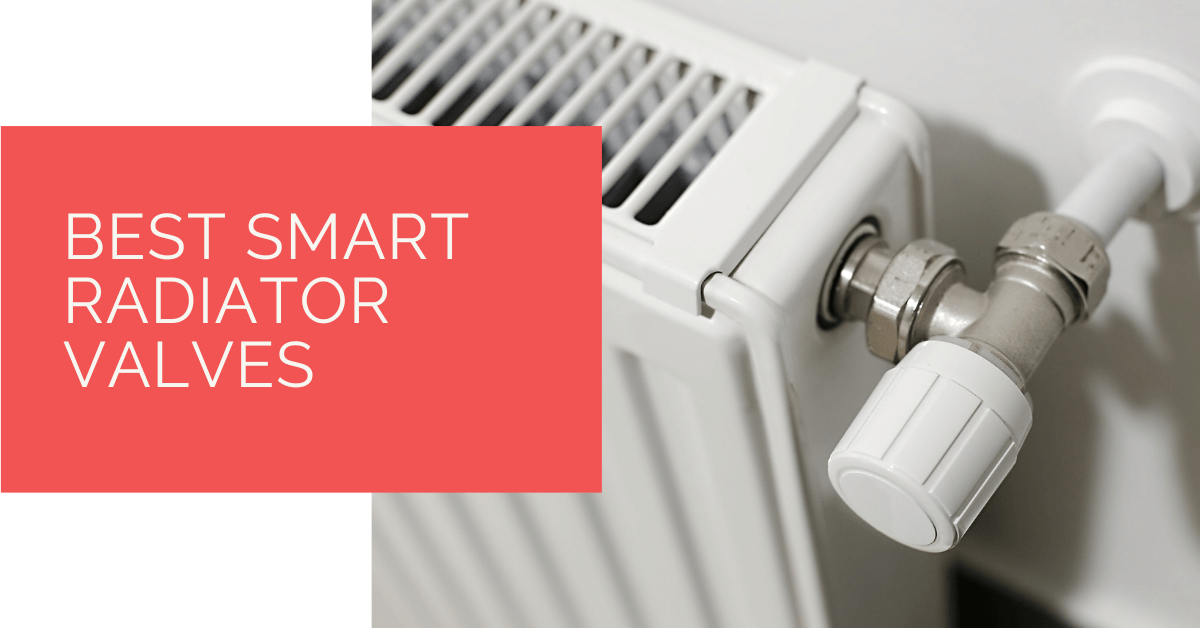
If you want genuine room-by-room control over your heating, a smart radiator valve is the single most cost-effective upgrade you can make. The tado° Smart Radiator Thermostat X is our top pick: it works as a standalone device, supports the latest Matter and Thread standards, and the geofencing feature alone pays for itself in a single winter. But there’s a wide range of options here, from budget Zigbee valves under £30 to full zoning systems with dedicated hubs, and the right choice depends entirely on what smart home platform you’re already using.
We’ve reviewed nine of the best smart radiator valves available on Amazon UK right now, covering every budget and every major connectivity standard.
Our Top Picks
| Image | Name | |
|---|---|---|
| tado° Smart Radiator Thermostat X | |
| Drayton Wiser Smart Radiator Thermostat | |
| Hive Smart Thermostatic Radiator Valve | |
| Eve Thermo (Matter) | |
| tado° Smart Radiator Thermostat X – Starter Kit | |
| Netatmo Smart Radiator Valve | |
| Honeywell Home Evohome HR92 | |
| TP-Link Kasa KE100 Smart Radiator Valve | |
| SONOFF TRVZB Zigbee Smart Radiator Valve |
The 9 Best Smart Radiator Valves
1. tado° Smart Radiator Thermostat X
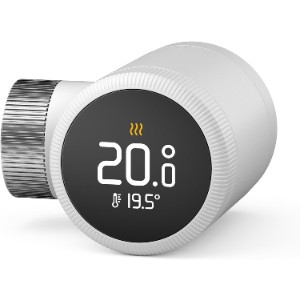
The tado° X is the standout option if you want a modern, future-proof smart TRV without being locked into a proprietary ecosystem. It runs on Thread and supports Matter, which means it works natively with Apple Home, Amazon Alexa, Google Home, and Samsung SmartThings straight out of the box. Unlike older tado° models, the X doesn’t need a separate Internet Bridge for basic functionality – pair it directly with your phone and it works as a standalone unit, though you’ll want the Bridge for remote access and geofencing.
In real-world use the geofencing is the killer feature. The valve detects when everyone has left the house via the tado° app and dials down the heating automatically, then starts warming again before you get home. It’s particularly effective in homes where people have irregular schedules. The temperature accuracy is excellent – typically within ±0.5°C – and the rotary dial makes manual adjustment straightforward without needing your phone.
One thing to be aware of: this is an add-on TRV, not a starter kit. You’ll need at least one other tado° device (or the Bridge X) to enable the full cloud features. If you’re starting from scratch, budget accordingly. For existing tado° users upgrading from V3+ valves, this is a clear step up: faster response, better battery life (around 18 months on two AA batteries), and no bridge dependency for local control.
It’s compatible with the majority of European M30 x 1.5mm valve bodies and comes with adapters for Danfoss and other common fittings. Installation typically takes under five minutes per radiator.
Features
- Thread and Matter compatible – works with all major smart home platforms natively
- Geofencing via tado° app – auto-adjusts when you leave and return home
- Open Window Detection – automatically reduces heat when a window is opened
- Works as standalone unit without Internet Bridge for local control
- Battery life: approximately 18 months on 2 AA batteries
- Temperature range: 5°C–25°C
- Compatible with M30 x 1.5mm valves; includes adapters for Danfoss, Heimeier, and others
- Thread/Matter support means it works with every major platform without extra hubs
- Geofencing is genuinely effective at reducing wasted heating
- No hub dependency for basic operation – simpler setup than older models
- Clean, modern design with intuitive rotary control
- Full cloud features (remote access, scheduling) require the Bridge X add-on
- Premium price compared to budget alternatives
2. Drayton Wiser Smart TRV
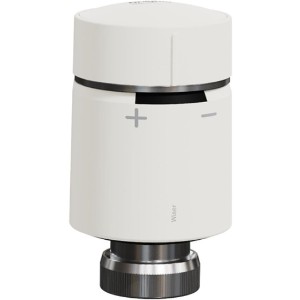
Drayton has been making heating controls in the UK for decades, and the Wiser system is the brand’s serious play at the smart home market. The TRV works best as part of the full Wiser ecosystem (which includes a smart thermostat and hub), but you can buy TRVs individually to extend an existing system. The integration with the Wiser app is polished: scheduling is genuinely granular, energy monitoring shows you exactly which radiators are drawing heat and when, and the Away mode is reliable.
The valve itself is well-built and solid feeling – this is clearly a product designed with the British market in mind, with a setup process that doesn’t require a computer science degree. The Zigbee-based connectivity is rock solid in normal homes, and range issues are rare. Battery life runs to roughly 12–18 months on two AA batteries.
The main limitation is ecosystem lock-in. The Wiser hub is proprietary, and you’ll need one if you want full app control. It doesn’t support Matter or Thread, so if you’re building a platform-agnostic smart home this isn’t the right choice. But if you want a reliable, UK-native system with proper customer support behind it, Wiser is one of the best options available.
Features
- Zigbee connectivity via Wiser Hub (sold separately or as part of starter kit)
- Per-room scheduling in the Wiser app with energy monitoring
- Away mode and holiday mode included
- Open Window Detection
- Compatible with M30 x 1.5mm valve bodies; adapters included
- Battery life: 12–18 months on 2 AA batteries
- Excellent UK-specific app with granular per-room scheduling
- Energy monitoring shows heating usage per radiator
- Reliable Zigbee mesh – rarely drops connection
- Strong UK customer support track record
- Requires Wiser Hub – proprietary ecosystem, no Matter support
- Doesn’t integrate with Apple Home or Google Home natively
- Hub adds to the total cost for new Wiser users
3. Hive Smart Thermostatic Radiator Valve
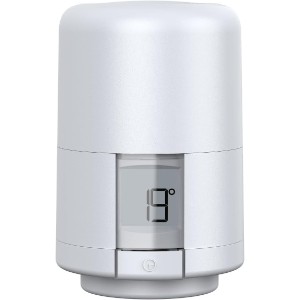
The Hive TRV is the obvious choice if you’re already in the Hive ecosystem – you likely have a Hive Hub at home already, the app is already on your phone, and adding TRVs is a straightforward expansion. The integration is seamless: the same app controls your boiler, your lights, and your radiators, which is a genuine convenience advantage over running multiple apps.
For those without an existing Hive setup, it’s a harder sell. You’ll need the Hive Hub to make it work, and the initial outlay is higher than some rivals. That said, Hive is one of the most widely used smart home systems in the UK, so compatibility and support aren’t concerns. The TRV itself is reliable, the app is user-friendly, and setup is guided well through the Hive app.
Features
- Requires Hive Hub for operation
- Full integration with Hive app – same app as boiler and other Hive devices
- Per-room scheduling and zoning
- Works with Amazon Alexa and Google Assistant
- Battery life: approximately 12 months on 2 AA batteries
- M30 x 1.5mm fitting; adapters included
- Seamless for existing Hive users – no additional hub needed
- Unified app covering boiler, TRVs, and other Hive devices
- Well-supported, widely used UK platform
- Requires Hive Hub – not suitable for non-Hive homes without additional investment
- No Apple Home support
- Battery life shorter than some rivals at around 12 months
4. Eve Thermo (Matter)
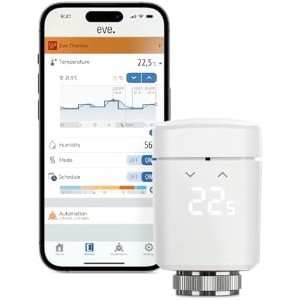
Eve has built a strong reputation among serious smart home users for making devices that actually respect your privacy – all processing happens locally, and there’s no Eve cloud account required. The Matter version of the Eve Thermo is the most interoperable smart TRV on the market: it runs on Thread, works natively with Apple Home, Amazon Alexa, Google Home, and Samsung SmartThings, and pairs in seconds. If you’re an Apple Home user, this is arguably the best TRV available.
The LED display is a nice touch – you can read the current and target temperature at a glance without reaching for your phone. The wheel control is satisfying to use, and the build quality is excellent. Thread means the device communicates directly with your router (via a Thread Border Router, such as an Apple TV 4K or HomePod mini) rather than going through a central hub, which makes for faster response times and greater reliability.
The one thing to be aware of: you do need a Thread Border Router to use all the features. If you don’t already have one, factor that into the budget. For Apple Home users who already have an Apple TV 4K or HomePod mini, this is essentially plug-and-play.
Features
- Thread and Matter – works with Apple Home, Alexa, Google Home, SmartThings
- No Eve account or cloud required – fully local processing
- LED display shows current and target temperature
- Requires Thread Border Router (Apple TV 4K, HomePod mini, etc.)
- Battery life: approximately 18 months on 2 AA batteries
- M30 x 1.5mm; adapters for Danfoss, Heimeier, and other common bodies
- Full Matter/Thread support – genuinely platform-agnostic
- Local processing – no cloud dependency, excellent privacy
- Best Apple Home integration on the market
- LED display is useful for at-a-glance reading
- Requires a Thread Border Router – adds to cost if you don’t have one
- Premium price for what is ultimately a single valve
5. tado° Smart Radiator Thermostat X to Starter Kit with Bridge X
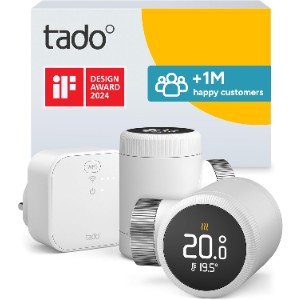
tado° is one of the best-known names in smart heating in the UK, and this Starter Kit is the complete package for getting started with per-room temperature control. The Bridge X handles connectivity, so the TRV communicates reliably without depending on your router being nearby. Setup is straightforward enough for most people to complete without a plumber, and the app is one of the more polished in this category.
Works with Alexa, Siri, and Google Assistant, with geofencing so the system responds when you leave and return home. The auto-balance feature adjusts radiator output to prevent some rooms overheating while others fall short, useful in older properties where radiator sizing isn’t always matched to room size. At 4.2 stars from over 1,100 reviews, it’s a well-validated choice from buyers who’ve lived with it through a heating season.
You’re paying a premium compared to the budget options here, but tado° backs it up with regular app updates and a reasonably active support operation. If you want a starter kit from a brand that’s likely to still be operating in five years, this is the one to consider.
Features
- Includes TRV and Bridge X hub, everything needed to get started
- Compatible with Alexa, Siri, and Google Assistant
- Geofencing: heating adjusts when you leave or arrive home
- Auto-balance prevents hot and cold spots across radiators
- Individual room scheduling via the tado° app
- DIY installation, no plumber required
- Established UK-popular brand with strong track record
- Complete starter kit, hub included, nothing extra to buy
- Geofencing and auto-balance are genuinely useful features
- 4.2 stars across 1,100+ reviews
- Premium price compared to budget TRVs
- Some advanced features require a paid subscription
6. Netatmo Smart Radiator Valve
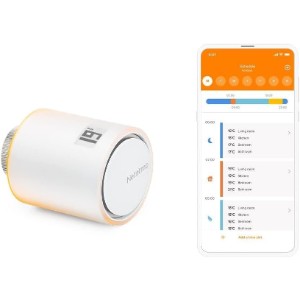
The most divisive pick on this list. Netatmo’s approach is genuinely clever: the system uses a Smart Thermostat as the hub (rather than a separate box), and the TRVs communicate directly with it. The result is a clean, minimalist setup without a hub cluttering up your router cabinet. The design is among the best-looking on the market – if aesthetics matter in your living room, Netatmo stands out.
The energy savings monitoring is a highlight: the app gives you a detailed breakdown of heating usage per room over time, and the auto-adaptation feature learns your home’s thermal characteristics and adjusts schedules accordingly. It also integrates well with Alexa and Google Home.
What holds it back is the price and the ecosystem structure. This TRV is an add-on, meaning you already need the Netatmo Smart Thermostat. If you’re buying into the ecosystem from scratch, the total cost is higher than rivals. Note also that this is an older ASIN and it’s worth checking stock availability before purchasing – Netatmo’s product range has evolved and availability can be patchy.
Features
- Requires Netatmo Smart Thermostat as hub (no separate hub box)
- Energy usage monitoring per room with auto-adaptation learning
- Works with Alexa and Google Home
- Elegantly designed – one of the best-looking TRVs available
- Battery life: approximately 2 years on 2 AA batteries
- M30 x 1.5mm; adapters included for common valve bodies
- No separate hub needed if you have the Netatmo Smart Thermostat
- Excellent energy monitoring and auto-learning features
- Premium design – one of the most attractive options
- Requires Netatmo Smart Thermostat – expensive ecosystem buy-in
- No Apple HomeKit or Matter support
- Stock availability can be inconsistent
7. Honeywell Home Evohome HR92 Wireless Radiator Controller
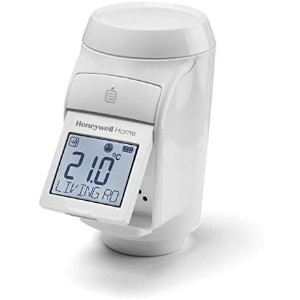
The Honeywell evohome system has been around for over a decade, and the HR92 valve controller remains one of the most technically capable individual zone controllers available. Each HR92 has its own screen and buttons, so manual control doesn’t require a phone at all. The evohome controller (sold separately as the hub) gives you up to 12 independent heating zones, which is substantially more than most competitors offer.
For large homes with complex heating layouts – multiple zones, underfloor heating alongside radiators, guest rooms that are rarely used – evohome is still hard to beat on capability. The scheduling is highly granular, and the system has a long track record of reliability in UK homes.
It’s a product that’s showing its age in terms of app design and ecosystem integration. It doesn’t support Matter, Thread, or most modern smart home platforms natively. The app is functional but dated. This is the right choice for those who prioritise heating control depth over smart home integration, not the other way round.
Features
- Individual screen and buttons on each valve – full manual control without app
- Up to 12 independent heating zones with evohome controller
- Proprietary 868 MHz RF – reliable range throughout a typical UK home
- Works with Alexa (via evohome controller)
- Battery life: approximately 12–18 months on 2 AA batteries
- M30 x 1.5mm; adapters included
- Excellent granular zone control – up to 12 zones
- Individual screen on each valve – no phone needed for manual adjustment
- Long track record of reliability in UK homes
- Dated app design – significantly behind modern rivals in UX
- No Matter, Thread, Apple Home, or Google Home native support
- Expensive ecosystem if starting from scratch
8. TP-Link Kasa KE100 Smart Radiator Valve
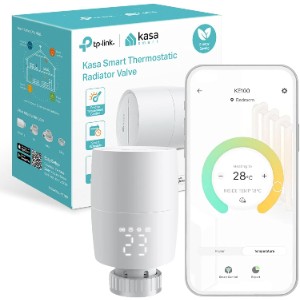
This is the one to buy if you want a reliable, Wi-Fi connected smart TRV at a genuinely affordable price. The KE100 connects directly to your 2.4GHz Wi-Fi network – no hub required – which simplifies setup considerably. It works with Alexa and Google Home, and the Kasa app is well-designed and responsive. TP-Link is a long-established networking brand, and the build quality here is solid for the price.
The direct Wi-Fi approach means the valve draws slightly more power than Zigbee or Thread alternatives, so battery life is shorter – expect around 6–9 months. That’s the trade-off for not needing a hub. If you’re fitting TRVs to two or three radiators in a flat and want a simple setup that works with your existing voice assistant, the KE100 is hard to fault at the price.
Features
- Direct 2.4GHz Wi-Fi – no hub required
- Works with Amazon Alexa and Google Home
- LED display showing current and target temperature
- Kasa app with scheduling and energy tracking
- Battery life: 6–9 months on 2 AA batteries (shorter due to Wi-Fi)
- M30 x 1.5mm with adapters included
- No hub needed – works directly over Wi-Fi
- Very competitive price point for reliable performance
- TP-Link is a trusted brand with long product support
- Shorter battery life due to Wi-Fi (6–9 months)
- No Apple HomeKit support
- Wi-Fi congestion can occasionally affect response time in busy networks
9. SONOFF TRVZB Zigbee Smart Radiator Valve
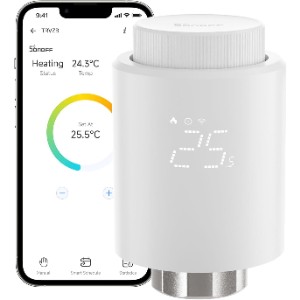
Plug it in, add it to your Zigbee hub, done. The SONOFF TRVZB is the budget pick for technically confident buyers who already run a Zigbee network – whether that’s via Philips Hue, IKEA DIRIGERA, Sonos Era, Home Assistant, or any other Zigbee 3.0 hub. At around £30, you’d struggle to find a more affordable smart TRV that’s genuinely reliable.
It’s not for everyone. SONOFF is a brand that rewards users who are comfortable in the EWELINK app or Home Assistant, and the out-of-box experience isn’t as polished as tado° or Hive. The display is clear and useful, and battery life is excellent – up to two years. For smart home enthusiasts running their own Zigbee mesh, this is excellent value. For someone who just wants something that works without any technical fiddling, look elsewhere on this list.
Features
- Zigbee 3.0 – compatible with any Zigbee 3.0 hub
- Works with Alexa and Google Home via compatible Zigbee hub
- Clear LED display with current and target temperature
- Works with Home Assistant (ZHA and Zigbee2MQTT)
- Battery life: up to 2 years on 2 AA batteries
- M30 x 1.5mm with multiple adapters included
- Exceptional value – hard to beat at this price
- Excellent battery life (up to 2 years)
- Zigbee 3.0 works with most existing Zigbee hubs and Home Assistant
- Requires a separate Zigbee hub – not suitable for those without one
- App and setup less polished than premium brands
- SONOFF is a less well-known brand in UK retail
Smart Radiator Valve Buying Guide
Key Takeaways
- Smart TRVs save most in homes where some rooms are routinely overheated – studies suggest savings of 15–30% on heating bills for typical UK homes.
- Check your connectivity before buying: Matter/Thread valves (tado° X, Eve Thermo) work with any major platform; proprietary-hub valves (Wiser, Hive, evohome) require a matching hub.
- Installation is usually five minutes per radiator – you’re replacing the existing TRV head, not replumbing anything.
- Battery life varies widely: Wi-Fi valves last 6–9 months; Zigbee and Thread valves typically last 12–24 months.
- You don’t need to replace every radiator at once – most systems let you add valves one at a time.
What Is a Smart Radiator Valve?
A smart radiator valve (also called a smart TRV – thermostatic radiator valve) is a device that replaces the manual temperature dial on your radiator. Instead of setting a physical dial and forgetting it, a smart TRV lets you control the temperature of individual rooms via an app, voice assistant, or automated schedule. The valve opens and closes a pin inside the radiator’s valve body to regulate water flow, which in turn controls how much heat the radiator outputs.
Unlike a conventional programmable thermostat – which controls the whole house – smart TRVs give you proper room-by-room zoning. The bedroom can stay at 16°C while the living room runs at 21°C. Rooms you rarely use can be set to frost protection mode and forgotten about.
How Do Smart Radiator Valves Work?
The TRV head screws onto the valve body that’s already fitted to your radiator (usually an M30 x 1.5mm thread, or adaptable to one via an included fitting). Inside the head is a motorised actuator that pushes or releases a pin in the valve body. When the room temperature sensor in the TRV reads below the target temperature, the actuator opens the valve; when it reaches the target, it closes it. This is fundamentally the same mechanism as a standard TRV head, except it’s controlled electronically rather than by a wax or liquid-filled element.
The smart element is the communication layer. Most modern TRVs use Zigbee, Z-Wave, Thread, or Wi-Fi to receive commands and report temperature data back to an app or hub. The better systems also monitor external temperature and adjust schedules automatically, detect when windows are opened (via sudden temperature drops), and use geofencing to reduce heating when the house is empty.
One important point: smart TRVs regulate water flow through individual radiators, but they don’t turn the boiler on or off. For the best results, your boiler should be set to come on when the TRVs are calling for heat. Some systems integrate with smart thermostats to achieve this; others use a relay switch connected to the boiler’s wiring centre.
Connectivity: Which Protocol Is Right for You?
This is the most important decision you’ll make. Smart TRV protocols divide broadly into four categories:
Thread and Matter (tado° X, Eve Thermo): The newest and most interoperable standard. Thread is a low-power mesh network that talks directly to a Thread Border Router (an Apple TV 4K, HomePod mini, or compatible Google Nest device). Matter is the application layer that means every Matter device works with every major platform. If you want future-proofing and platform flexibility, Thread/Matter is the right choice.
Zigbee (Drayton Wiser, SONOFF TRVZB): A low-power mesh protocol that requires a compatible Zigbee hub. The advantage is excellent battery life and reliability; the disadvantage is hub dependency. Zigbee is widely supported – Philips Hue bridges, IKEA DIRIGERA, and Home Assistant all work with Zigbee 3.0 devices.
Proprietary RF (Honeywell evohome, Hive): Each brand uses its own wireless protocol with its own hub. Very reliable in practice, but you’re committed to that brand’s ecosystem. No cross-compatibility.
Wi-Fi (TP-Link KE100): Connects directly to your home router with no hub needed. Simple setup, but draws more power and reduces battery life considerably. Good for small setups where hub cost is a concern.
Hub vs No Hub: What You Actually Need
Whether you need a hub depends on which protocol your chosen TRV uses. Thread/Matter and Wi-Fi devices can work without a dedicated hub (though Thread needs a Border Router, which many Apple and Google devices already serve as). Zigbee and Z-Wave devices need a Zigbee or Z-Wave hub. Proprietary systems need their manufacturer’s hub.
If you’re buying a single TRV to try out, no-hub options (Wi-Fi, or Thread if you already have a Border Router) are simpler. If you’re equipping an entire house, investing in a hub usually makes more sense economically, and hub-based systems generally offer more features and better reliability.
Installation: What to Expect
Fitting a smart TRV is genuinely simple. You’re not doing any plumbing. Most installations follow this sequence: turn off the heating and allow the radiator to cool; use an adjustable spanner to unscrew the existing TRV head (turn anticlockwise); check that the pin in the valve body moves freely; screw the new smart TRV head on (clockwise); tighten with the spanner. Most valves need the pin to be pressed inward before fitting, and the instructions cover this clearly.
The M30 x 1.5mm thread is a near-universal European standard, and all the TRVs in this list include fitting adapters for the main alternative standards (Danfoss, Heimeier, Comap, etc.). It’s worth checking your existing valve body type before ordering – most UK homes built or renovated after 1990 will have M30 x 1.5mm, but older systems may differ.
You do not need to drain the system or call a plumber for a standard TRV swap. If the valve body itself is corroded or seized, that’s a separate job – but the head swap is DIY territory for most homeowners.
Running Costs: Battery Usage and Heating Bill Savings
The TRVs themselves use very little energy – a pair of AA batteries lasting 6–24 months depending on protocol. Wi-Fi models are the heaviest users (6–9 months), Zigbee and Thread models the lightest (12–24 months). At current electricity rates (around 24p/kWh as of May 2026), battery replacement is a negligible cost.
The savings on your heating bill are more significant. Smart TRVs save most in homes where rooms are routinely heated to a higher temperature than needed, or where rooms are heated when unoccupied. In a typical three-bedroom UK semi-detached, reducing bedroom temperatures by 2°C from 20°C to 18°C overnight can cut heating costs for those zones by 12–15%. Studies from tado° and Honeywell suggest whole-home savings of 15–30% for households switching from no thermostatic control to smart TRV zoning. The payback period for a system costing £200–300 is typically one to two winters.
The biggest savings come from:
- Geofencing – heating drops when everyone’s out, rather than following a fixed schedule
- Reducing bedroom temperatures overnight (each 1°C reduction saves roughly 6% on heating that zone)
- Setting unused rooms to frost protection (7°C) rather than the whole-house default
Compatibility: Checking Before You Buy
Three things to verify before purchasing:
Valve body thread. Most UK radiators installed after 1990 have M30 x 1.5mm threads. Danfoss RA-style valve bodies, common in social housing and older private installs, need an RA adapter – check this is included with your chosen TRV. When in doubt, check the markings on your existing TRV head or measure the thread diameter.
Pin direction. Some valve bodies use a normally-open pin (heating flows when unpowered) and some normally-closed. Most smart TRVs are designed for normally-open valve bodies (the most common type in UK homes). If you have normally-closed valve bodies, you’ll need to check compatibility specifically.
Boiler type. If you have a system boiler with a motorised zone valve controlling the heating circuit, smart TRVs will work alongside it. If you have electric storage heaters, smart TRVs don’t apply – those require a different kind of controller.
Smart Radiator Valves vs Standard TRVs
A standard mechanical TRV already gives you some per-room control, and it does it without batteries or apps. So when is the smart upgrade actually worth it? The honest answer is: when your heating behaviour is irregular, when you have rooms that are routinely wasted, or when you travel frequently. If you have a very regular schedule, every room needs the same temperature, and you’re home most of the time, a standard TRV does roughly the same job at a fraction of the cost.
Smart TRVs earn their premium through scheduling flexibility, geofencing, and the app interface that makes fine-tuning easy enough that you actually do it. Standard TRVs get set once and rarely adjusted. The difference in practice is real, but it depends on your habits.
Room-Specific Recommendations
Bedroom: Temperature control here has a direct impact on sleep quality. Most sleep research suggests 16–18°C is optimal. The tado° X and Eve Thermo both support precise scheduling – set the temperature to drop at your usual bedtime and rise before your alarm. Zigbee options (SONOFF TRVZB with a compatible hub) work equally well for this use case at lower cost.
Home office: An occupied room that you want warm during work hours and cooler or off the rest of the time. Any smart TRV will handle this, but the geofencing feature in tado° is particularly useful if your work-from-home schedule is variable. The TP-Link KE100 is a cost-effective option if you just want one room covered.
Spare bedroom / guest room: The clearest win for smart TRVs. Set to frost protection (7°C) when empty, raise to a comfortable 20°C a few hours before guests arrive via the app. A budget option like the SONOFF TRVZB is perfectly adequate here.
Living room: The most-used room typically benefits from the most responsive control. The tado° X or Eve Thermo are worth the premium here – fast response, accurate sensing, and the geofencing feature is most valuable in the room you spend the most time in.
Kitchen: Heat from cooking means the radiator here may barely need to run in winter. A smart TRV set to a lower target temperature (18°C) will avoid the kitchen overheating while cooking – something a mechanical TRV handles less elegantly.
Benefits of Using Smart Radiator Valves
The main benefit is room-by-room temperature control, which a single central thermostat simply can’t provide. But beyond that, smart TRVs offer scheduling at a room level (not just whole-house), automatic adjustments based on occupancy, and energy monitoring that shows you exactly how much each room is costing to heat. The visibility alone – seeing in real time which rooms are calling for heat – tends to change behaviour in ways that reduce energy waste.
For households with varied sleeping patterns, young children, or anyone working from home, the ability to keep frequently used rooms warmer without heating the whole house is a direct comfort and cost improvement. The installation is non-destructive and reversible, which makes it a genuinely low-risk upgrade to try.
Things to Keep in Mind Before Buying
Smart TRVs work best when your boiler knows the radiators are calling for heat. In many setups, the boiler runs on its own schedule regardless of what the TRVs are doing. To get full efficiency, you either need a system where the TRVs can signal the boiler directly, or you need to set the boiler to run during the periods when the TRVs are likely to be active. Check whether your chosen system supports boiler interconnect before purchase.
Also consider the total cost per room. At £50–70 per valve, equipping a five-bedroom house fully represents a significant investment. Start with the rooms where you’ll get the most value – typically bedrooms and rarely-used guest rooms – and add more over time.
Types of Smart Radiator Valves
Add-on TRVs are individual valves that join an existing system or work as standalone units. Most products in this list are add-ons. They’re the right choice for expanding an existing system or for buyers who want to start with one or two valves before committing.
Starter kits include a hub and one or more TRVs in a single package – the Meross MTS150 starter kit is a good example. These are better value for new buyers who need the whole setup in one go.
System controllers like the Honeywell evohome combine a dedicated heating controller (replacing your existing programmer/thermostat) with multiple TRVs for whole-home zoning. These are the most capable option for large homes with complex heating layouts, but require more setup and investment.
Maintenance and Longevity
Smart TRVs are low-maintenance devices. The main routine task is battery replacement – use good-quality alkaline or lithium AAs, and replace both batteries at the same time. Lithium batteries are worth the extra cost in unheated locations like spare bedrooms, where cold temperatures reduce alkaline battery performance.
At the start of each heating season (September/October), run a quick test: turn up the target temperature on each TRV and check that the radiator warms up. If a radiator isn’t responding, the valve body may be stuck – a common problem in summer when the pin hasn’t moved for months. Most smart TRVs have a valve exercise function in the app to prevent this. If the pin is genuinely seized, you may need to replace the valve body (a plumber’s job), but this is relatively uncommon.
Most smart TRV heads will outlast the valve bodies they’re fitted to. Expect a well-made smart TRV to last 5–8 years with normal use.
Common Mistakes
Buying without checking your valve body thread. M30 x 1.5mm is standard but not universal. Danfoss RA-style bodies are common in social housing and some older private properties. If your replacement valve doesn’t include the right adapter, it won’t fit. Measure or photograph your existing TRV head before ordering.
Expecting instant savings without adjusting schedules. A smart TRV out of the box with no schedule configured will behave no differently than a standard TRV set to maximum. The savings come from programming – setting temperatures appropriately for when rooms are occupied and genuinely reducing output when they’re not.
Fitting smart TRVs to every radiator while leaving the boiler on a fixed schedule. If your boiler runs from 6am–9am and 5pm–10pm regardless, smart TRVs have limited impact outside those windows. For best results, combine smart TRVs with a smart thermostat or boiler controller that responds to room demand.
Choosing the wrong ecosystem. The most common regret from smart TRV buyers is discovering their new valve doesn’t work with their existing smart home platform. Check compatibility before purchase, especially if you use Apple Home, which requires HomeKit or Matter support.
When Not to Buy a Smart Radiator Valve
If you have electric storage heaters, smart TRVs don’t apply – storage heaters use a completely different control mechanism (charge controllers and output dampers, not water flow valves). Look at smart storage heater controllers instead.
If you have underfloor heating fed from a manifold, individual TRVs per room still work but the installation is more complex and room-to-room temperature differences are less pronounced in UFH systems. A smart thermostat with zone valves at the manifold is typically a better solution.
If every room in your home needs to be the same temperature and you have a regular, fixed schedule, a standard programmable thermostat covers most of the benefit at a fraction of the cost.
If your valve bodies are corroded, old Danfoss bodies with seized pins, or non-standard fittings, the smart TRV will likely work but you should factor in a plumber’s visit to replace the valve bodies first.
Quick Buyer Checklist
- What thread size is my existing TRV? (M30 x 1.5mm or Danfoss RA?)
- Which smart home platform do I primarily use – Apple Home, Alexa, Google Home, or none?
- Do I already have a compatible hub (Zigbee, Hive, Wiser, etc.)?
- How many radiators do I want to control – is a starter kit or add-on the better value?
- Do I want geofencing, or will scheduled control be enough?
- Do I have a Thread Border Router already (Apple TV 4K, HomePod mini) if considering Thread devices?
- Am I comfortable with a bit of technical setup, or do I need the most plug-and-play option?
Case Study: Smart TRV Upgrade in a Victorian Terrace
Background
A homeowner in south Leeds with a four-bedroom Victorian terrace had been running the heating on a single zone with a standard programmable thermostat. The house has solid walls and original sash windows, making it harder to heat than modern properties. One bedroom was routinely kept at 22°C because the main thermostat was located in the hallway, while the spare bedroom and study were heated to the same level even when unoccupied for weeks at a time.
Project Overview
The goal was to add per-room temperature control without full rewiring or major works. Six smart TRVs were fitted to the main radiators across four bedrooms, the study, and the living room. The kitchen and hallway were left on standard mechanical TRVs.
Implementation
The homeowner chose the Drayton Wiser system (hub plus six TRVs) after confirming the existing M30 x 1.5mm valve bodies were compatible. Installation took around 90 minutes total across all six radiators – about 15 minutes per radiator including app setup. The spare bedroom and study were set to 15°C frost protection during the week and programmed to 20°C only when guests were expected. Bedroom temperatures were reduced from 22°C to 18°C overnight using a scheduled drop at 10pm and a rise at 6:30am.
Results
After one full heating season, the homeowner compared energy usage year-on-year against the previous winter (adjusted for degree-days to account for temperature differences between winters). Heating energy usage dropped by approximately 22%. The biggest single contributor was the spare bedroom and study, which had previously been heated to the whole-house temperature every day. Secondary savings came from the bedroom temperature reduction, which the household found improved sleep quality as a side benefit. The system paid for itself within the first heating season.
Expert Insights From Our Heating Engineers About Smart Radiator Valves
“The question I get asked most often is whether smart TRVs are worth it if you already have a good programmable thermostat. My answer is always the same: a single-zone thermostat controls the boiler based on temperature in one location – usually the hallway or landing. Every room in the house is then over- or under-heated relative to that one reading. In a typical UK home, that means bedrooms running several degrees warmer than necessary while the heating system is active, which is direct wasted money.”
“One of our senior heating engineers with over 20 years of experience in UK domestic installations points out something that many buyers overlook: the positioning of the valve itself matters. Smart TRVs sense temperature at the head of the radiator, which can read higher than the actual room temperature if the valve is in a confined space or behind furniture. If your radiators are behind sofas or inside alcoves, the sensor may call heating off early. Some manufacturers sell a remote temperature sensor to address this – worth considering for awkward radiator positions.”
“For the installation itself, the main thing to check is that the valve body pin moves freely before fitting the smart head. In older properties that have sat unused over summer, the pin can get stuck in the closed position. Give it a firm press with your finger – it should depress 4–5mm and spring back. If it doesn’t move, apply a small amount of penetrating oil and work it loose before fitting the new head. A stuck pin will prevent the radiator from heating regardless of how smart the TRV is.”
Frequently Asked Questions
Do smart radiator valves work with any boiler?
Smart TRVs work with all standard wet central heating systems – combi boilers, system boilers, and heat-only boilers – as they control water flow at the radiator, not the boiler itself. They don’t work with electric storage heaters, electric panel radiators, or underfloor heating (which requires different controls). If you have a heat pump, check manufacturer compatibility first, as heat pump systems typically run at lower flow temperatures and may benefit from valves designed specifically for that operating range.
How much can smart radiator valves actually save on heating bills?
Savings depend heavily on your current habits. For households with no thermostatic control at all, the jump to smart TRVs can be substantial – 20–30% is realistic. For homes already using mechanical TRVs well, the additional saving from going smart is more modest: 10–15% is a reasonable expectation, mostly from geofencing and overnight temperature reductions. At current UK rates of around 24p/kWh, a 20% reduction on a £1,200 annual heating bill saves £240 – enough to pay back a moderate smart TRV system in one to two winters.
Do I need a smart thermostat as well as smart radiator valves?
Not always, but it helps. Smart TRVs control individual radiators; they don’t turn the boiler on or off. If your boiler runs on a fixed schedule, TRVs will only manage temperatures during those windows. A smart thermostat (or a relay that lets the TRV system signal the boiler) unlocks demand-led heating – the boiler only fires when a room is actually calling for heat. The Drayton Wiser and Honeywell evohome systems both support boiler interconnect; tado° requires a separate thermostat device for this.
For a standard M30 x 1.5mm valve body: 5–10 minutes per radiator, including app pairing. No plumbing is required – you’re unscrewing the existing TRV head and screwing on the new one. The only tool you need is an adjustable spanner. For a whole house of eight radiators, allow a couple of hours including app setup and scheduling. The most time-consuming part is usually getting the boiler-to-hub connection working, not the physical fitting.
What happens if the battery dies – does my radiator stop working?
It depends on the valve design. Most smart TRVs default to a fully open position when batteries die, which means the radiator reverts to being always-on (like a radiator with no TRV at all). This is the safer failure mode – you lose smart control but your radiator still provides heat. A few designs default to closed; check this in the product specification if uninterrupted heating in low-battery scenarios is important to you. All the TRVs in this list give app notifications before batteries reach critical levels.
Can I use smart radiator valves in a rented property?
Yes. Smart TRV installation is non-destructive – you’re just replacing the head on an existing valve. No tools go anywhere near the plumbing system and the process is fully reversible. Most landlords have no objection, and the energy savings benefit both tenant (lower bills) and landlord (more attractive property). Check your tenancy agreement, but this falls firmly in the “like-for-like replacement” category in most standard UK tenancy terms.
My radiator has a Danfoss valve body – will smart TRVs fit?
Yes, but you’ll need a Danfoss RA adapter. Danfoss RA-style valve bodies are common in social housing, sheltered accommodation, and some older private properties, and they use a different fitting method to the standard M30 x 1.5mm. All the TRVs reviewed here include Danfoss adapters in the box, or you can buy them separately for a few pounds. The RA adapter simply slips over the valve body before you screw on the TRV head. If you’re unsure which type you have, look at the existing TRV head – Danfoss heads are usually labelled and have a distinctive design.
Which smart TRV is best for Apple HomeKit users?
The Eve Thermo (Matter) is the standout choice for Apple Home users. It runs on Thread, supports Matter natively, and processes everything locally – no Eve cloud account required. If you have an Apple TV 4K or HomePod mini acting as a Thread Border Router (which most Apple Home users do), the Eve Thermo pairs in seconds. The tado° Smart TRV X also supports Matter and works well with Apple Home, with the advantage of built-in geofencing via the tado° app.
Summing Up
The tado° Smart Radiator Thermostat X remains our top pick for most buyers: it’s genuinely platform-agnostic thanks to Thread and Matter support, the geofencing works well in practice, and the build quality justifies the price. For Apple Home users who want local processing and privacy, the Eve Thermo (Matter) is the better choice. On a budget, the TP-Link Kasa KE100 offers reliable Wi-Fi control with no hub needed, and the SONOFF TRVZB is outstanding value for anyone already running a Zigbee network.
The key is matching the TRV to your existing ecosystem – don’t buy an expensive proprietary-hub system if you already have Zigbee infrastructure, and don’t buy a Zigbee valve if you have no hub to connect it to. Get that right and any of the nine options above will meaningfully reduce your heating bills.
Updated