
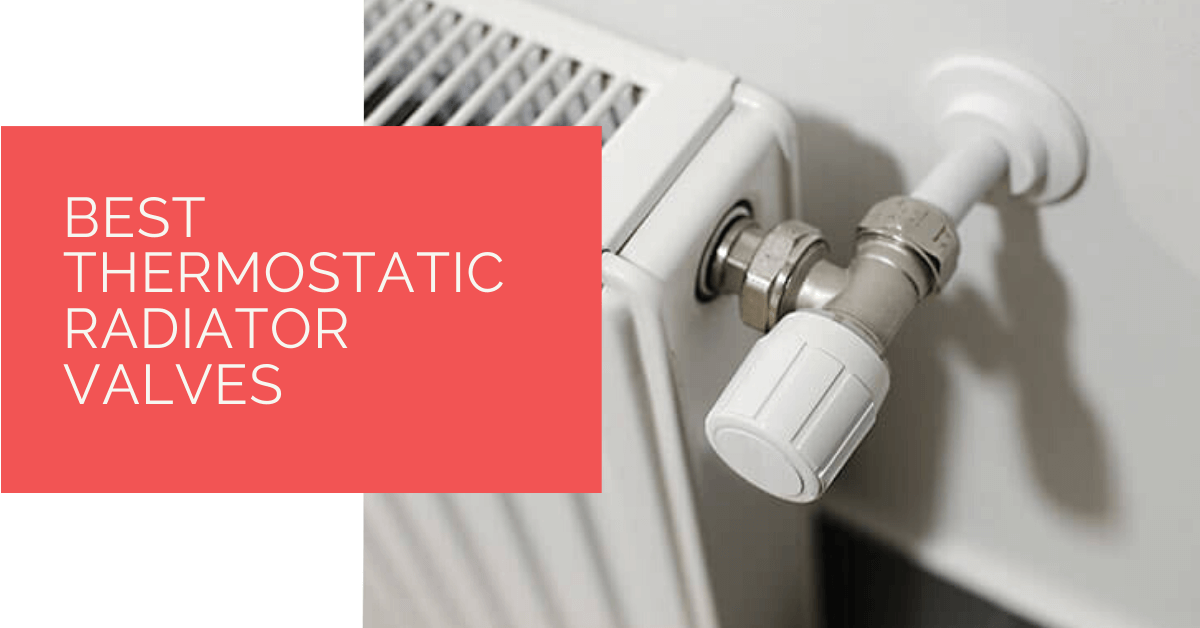
Fitting the right thermostatic radiator valve can make a real difference to your heating bills. Done well, TRVs let you set individual room temperatures so you’re not heating the spare bedroom to the same level as the living room. The trouble is, the market is full of options spanning everything from no-frills £10 valves to slick smart devices that you control from your phone. If you want our top pick for a traditional valve, go with the Drayton TRV4. It’s the most trusted name in the UK, comes with a matching lockshield, and just works. For smart heating control, the TP-Link Kasa KE100 is the one to buy.
We’ve reviewed eight of the best thermostatic radiator valves available on Amazon UK right now, covering budget picks, chrome and anthracite finishes, and app-controlled smart options. Here’s what you need to know.
Our Top Picks
| Image | Name | |
|---|---|---|
| Drayton TRV4 15mm Thermostatic Radiator Valve with Lockshield | |
| TP-Link Kasa Smart Thermostatic Radiator Valve (KE100) | |
| DuraTherm Polished Chrome Thermostatic Radiator Valve Set | |
| ELEGANT Anthracite Angled Thermostatic Radiator Valve Set | |
| Honeywell Home Valencia VTL120 TRV and Lockshield Set | |
| Kartell TRV Thermostatic Radiator Valve | |
| tado° Smart Radiator Thermostat X | |
| Hive Thermostatic Radiator Valve 5-Pack |
8 Best Thermostatic Radiator Valves
1. Drayton TRV4 15mm Thermostatic Radiator Valve with Lockshield
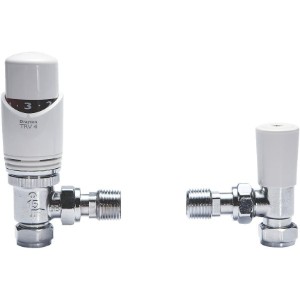
Ask any heating engineer what TRV they’d put on their own radiators and you’ll hear Drayton TRV4 more often than not. This is the industry standard in the UK, widely specified on new boiler installations, and the reason is straightforward: it’s reliable, well-made, and the liquid-filled sensor head responds accurately to room temperature changes rather than just the air immediately around the valve.
The TRV4 is A-rated for energy efficiency, covers temperatures from around 10°C to 27°C across settings 1 to 6, and includes a frost protection position. One thing worth knowing is that it supports reverse flow installation, meaning you can fit it on either the flow or return pipe. That’s handy on older systems where the pipe layout isn’t ideal. This pack includes both the TRV head and a matching lockshield, so you’ve got everything needed.
Construction is solid white plastic over a brass body. It’s not going to win any interior design awards, but it blends in neatly with most radiators and the head screws down securely without wobble. Installation is DIY-friendly, with a standard 15mm connection that fits the vast majority of UK central heating pipework.
Features
- A-rated liquid-filled sensor for accurate temperature regulation
- Settings 1 to 6 with frost protection position
- Reverse flow capable: fits on flow or return pipe
- Double gland seal for water leakage protection
- Includes matching 15mm lockshield valve
- Compatible with most UK radiators on 15mm pipework
- Most trusted TRV brand in the UK, widely used by heating engineers
- Accurate liquid-filled sensor head
- Includes lockshield, so you don’t need to buy anything else
- Works on flow or return pipe
- Plain white finish only in this version
- More expensive than budget alternatives
2. TP-Link Kasa Smart Thermostatic Radiator Valve (KE100)
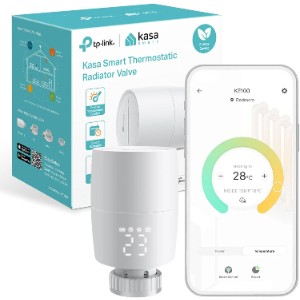
The TP-Link Kasa KE100 is the smart TRV that actually makes sense at this price. At £29.99 it sits well below the tado° and Hive options, yet it delivers proper app control, scheduling, geofencing, and compatibility with Alexa and Google Home. It’s earned nearly 3,000 reviews on Amazon UK, which tells you a lot about how well it’s been received.
What sets it apart from cheaper smart valves is the range of clever extras included without needing paid subscriptions. Geofencing means your heating fires up as you approach home and drops back when you leave. Open window detection (using a compatible Tapo sensor) shuts the valve automatically if a window is opened. You can also group multiple KE100 valves in a large room and control them together. There’s a clear LED display on the unit itself for manual adjustment when you don’t want to reach for your phone.
Installation is tool-free in most cases. The valve comes with multiple adapters to fit Danfoss, Siemens, Honeywell, and most other standard UK radiator valve types. You do need a Kasa hub (sold separately) for full functionality, which is the main caveat. But if you’re already in the Kasa or TP-Link ecosystem, this is the smart TRV to get.
Features
- App control via Kasa app, works with Alexa and Google Home
- Geofencing and smart scheduling built in
- Open window detection (requires Tapo T110 sensor)
- LED display for manual temperature setting
- Group control for rooms with multiple radiators
- Multiple adapters included for most UK valve types
- Nearly 3,000 reviews and outstanding value for a smart TRV
- Geofencing and open window detection included free
- Works with Alexa, Google Home, and Apple HomeKit
- Clear LED display for manual use
- Requires a Kasa hub (sold separately)
- Not a complete valve set: fits over existing valve body
3. DuraTherm Polished Chrome Thermostatic Radiator Valve Set
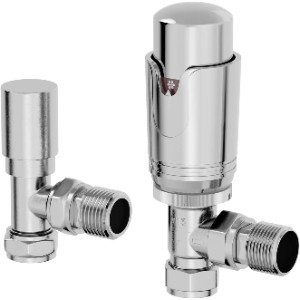
If you’ve got chrome radiators, towel rails, or a bathroom with chrome fittings, fitting a plain white TRV looks like an afterthought. The DuraTherm polished chrome set solves that without stretching to designer prices. Solid brass construction with a multi-layered chrome finish gives it a finish that holds up well to cleaning and doesn’t flake.
It includes both the TRV head and lockshield, and the angled design suits most standard radiator installations. Temperature settings run from frost protection through to a maximum of around 28°C, with variable adjustment between the numbered positions. The valve body allows bi-directional flow, so you don’t need to worry about which side is flow and which is return. At £29.95 with 376 reviews and a solid reputation, it’s the best-value chrome TRV set on Amazon UK right now.
Features
- Solid brass body with polished chrome multi-layer finish
- Bi-directional flow: fits either flow or return pipe
- Includes lockshield valve
- Frost protection setting
- 15mm angled design for most standard radiators
- Variable temperature control with numbered settings
- Polished chrome finish at a very fair price
- Solid brass body, durable finish
- Bi-directional flow for flexible installation
- Chrome finish requires occasional polishing to maintain shine
- Fewer reviews than the biggest brands
- No smart capability
4. ELEGANT Anthracite Angled Thermostatic Radiator Valve Set
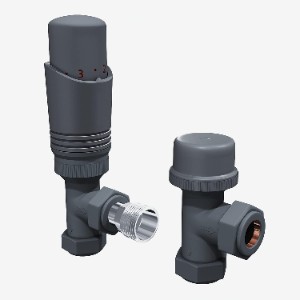
Anthracite grey has become the go-to finish for modern radiators, and this set from ELEGANT matches it well. It’s solid brass with a quality anthracite coating that coordinates with most contemporary anthracite panel radiators. The finish is consistent and doesn’t have the slightly artificial look of some cheaper painted alternatives.
The scale runs from 0 to 5, corresponding to approximately 7°C to 32°C, and includes a frost protection setting. Both horizontal and vertical mounting are supported, which is useful on towel rails or radiators with less conventional pipe entry positions. At £35.99 with over 260 reviews, it sits in the right price bracket for what you’re getting. This is the anthracite TRV set we’d recommend for anyone fitting dark radiators.
Features
- Solid brass with anthracite grey finish
- Scale 0 to 5 (7°C to 32°C) with frost protection position
- Horizontal and vertical mounting supported
- Standard 15mm, 1/2″ BSP connection
- Includes TRV head and lockshield
- Compatible with central heating radiators and towel rails
- Quality anthracite finish that matches modern dark radiators
- Complete set including lockshield
- Horizontal and vertical installation flexibility
- Anthracite finish only, no other colour options in this set
- No smart capability
- Fewer reviews than the top traditional brands
5. Honeywell Home Valencia VTL120 TRV and Lockshield Set
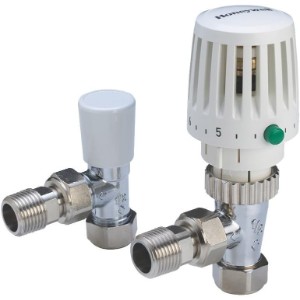
Honeywell is one of the biggest names in heating controls globally, and their Valencia TRV range reflects that pedigree. The VTL120 is a traditional-style valve with a slightly slimmer profile than some competitors. It uses a liquid sensor, which gives it more consistent and longer-lasting performance than older wax-element designs.
The standout practical feature is bi-directional flow: the valve body allows water to flow in either direction, so you don’t need to match flow and return pipes during installation. The head can also be mounted either vertically or horizontally by swapping the tailpiece, which adds further flexibility. There’s also an integrated balancing insert, meaning the system stays balanced even when the radiator is removed for decorating. Not a feature you’d miss until you need it, but useful on older systems.
Features
- Liquid-filled sensor for accurate, consistent temperature control
- Bi-directional valve body: no flow/return matching required
- Head mounts vertically or horizontally
- Integrated balancing insert
- A-rated for energy efficiency
- Includes lockshield valve
- Bi-directional flow makes installation much easier
- Integrated balancing insert for accurate system balancing
- Well-priced for a Honeywell product
- Traditional-only finish, no anthracite or chrome options in this listing
- Fewer reviews than Drayton or Kartell
- No smart functionality
6. Kartell TRV Thermostatic Radiator Valve and Lockshield
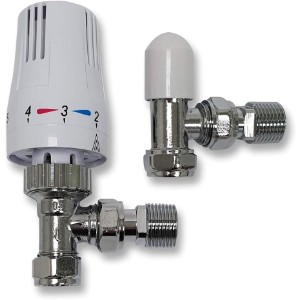
With over 2,500 reviews and a price of under £10, the Kartell TRV is the budget pick that genuinely holds its own. It’s a steel-bodied valve with a white finish, liquid-filled sensor, and an adjustable tailpiece. At this price point you’d expect corners to be cut, but buyer feedback is consistently positive about the build quality relative to what you’re paying.
The 1-year manufacturer guarantee is standard at this price, and the instruction booklet covers installation clearly enough for a competent DIYer. If you’re replacing multiple valves across a house and budget is a primary concern, this is where to start. It won’t match the precision of a Drayton or Honeywell, but it does the job.
Features
- Steel body with white finish and liquid-filled sensor
- Adjustable tailpiece for flexible installation
- 1/2″ x 15mm angled design
- 1-year manufacturer guarantee
- Suitable for most standard central heating radiators
- Excellent value: one of the cheapest TRVs on Amazon UK
- Over 2,500 reviews with consistently positive feedback
- Adjustable tailpiece aids installation
- No lockshield included
- Less precise temperature control than premium options
- White only, no alternative finishes
7. tado° Smart Radiator Thermostat X
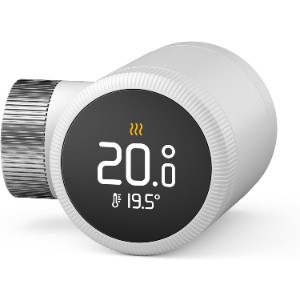
tado° is the German brand that effectively invented the premium smart TRV market, and the X-generation model is their best yet. The headline figure from tado° is an average 22% reduction in energy use, and while individual results will vary, the combination of smart scheduling, geofencing, and room-by-room control makes that figure credible for most homes.
Where the tado° really earns its premium price is in the ecosystem. If you’re using tado° on your boiler as well, the radiator thermostats talk to the central controller and you get true multi-zone heating without overheating. The adapters provided fit almost every radiator valve make and model, and the instruction app walks you through installation step by step. With 725 reviews and strong ratings, it’s the benchmark for smart TRVs in the UK.
Features
- App control with smart scheduling and geofencing
- Compatible with Alexa, Siri, and Google Assistant
- Fits almost all existing radiator valve bodies via included adapters
- Works standalone or integrated with tado° boiler control
- Open window detection, Away mode, and manual override
- Average 22% energy saving (tado° data)
- Premium smart TRV from Europe’s leading smart heating brand
- Geofencing and intelligent scheduling built in
- Integrates with tado° boiler control for full home zoning
- Fits virtually all existing UK radiator valves
- One of the pricier smart TRV options
- Requires Bridge X for full remote access (sold separately)
8. Hive Thermostatic Radiator Valve 5-Pack
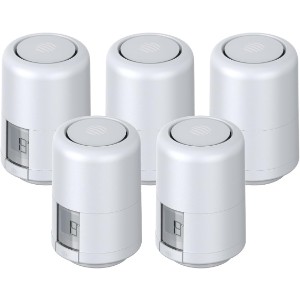
If your home already runs on Hive, this 5-pack is the natural choice for room-by-room smart heating control. The setup is straightforward: unscrew your existing TRV heads and replace them with Hive’s smart heads. No draining the system, no tools beyond a cloth. Within minutes you’ve got five radiators controllable from your phone via the Hive app.
The key selling point over a standard TRV is the degree-level precision. Instead of setting a radiator to position 3 and guessing whether that means 18°C or 21°C, you dial in an exact temperature. You can also set schedules per radiator independently of your main thermostat. The caveat is that you need a Hive Hub for smart control, and these are heads only (not full valve sets), so they need compatible existing valve bodies. Over 2,300 reviews confirm these work reliably for Hive users.
Features
- 5 smart TRV heads for room-by-room heating control
- App control via Hive, with per-room scheduling
- Precise degree-level temperature setting
- Fits most existing 15mm TRV valve bodies
- Works with or without Hive Active Heating subscription
- Over 2,300 Amazon UK reviews
- Best option for existing Hive users: seamless integration
- 5-pack works out well per valve for smart control
- Degree-level precision over temperature
- Easy installation: no draining or plumbing required
- Heads only: needs compatible existing valve bodies
- Requires Hive Hub for smart functionality
- High upfront cost for a 5-pack
Thermostatic Radiator Valve Buying Guide
Key Takeaways
- Thermostatic radiator valves (TRVs) control the flow of hot water through individual radiators based on room temperature, reducing energy waste compared to radiators that run at full flow whenever the boiler is on. Fitting TRVs throughout a home typically reduces heating costs by 15 to 25% compared to running all radiators without thermostatic control
- TRVs do not control the boiler. They control individual radiators. The boiler still needs a separate room thermostat (or programmer) to set the overall heating schedule and target temperature. A TRV on its own cannot turn the boiler on or off
- The numbered scale on a standard TRV (typically 0 to 5) corresponds roughly to temperature settings: 0 = off, 1 = frost protection (approx 7°C), 2 = 12°C, 3 = 16°C, 4 = 20°C, 5 = maximum (around 28°C). In most rooms, a setting of 3 to 4 covers the practical heating range
- Smart TRVs replace the standard head with a motorised, connected unit that allows individual room scheduling, app control, and integration with smart thermostats. They can save a further 12 to 20% on top of standard TRV savings by scheduling rooms individually rather than relying on the whole-house thermostat. Premium smart TRV platforms include Tado, Drayton Wiser, and Hive
- Standard TRVs cost £10 to £30 each and can be fitted without professional help on most radiators. Smart TRVs cost £35 to £80 each and typically require a hub or bridge. Fitting smart TRVs throughout a 3-bedroom home typically costs £250 to £500 in hardware alone
- The boiler or one radiator in the home must always have a non-TRV bypass to prevent pressure build-up. The radiator closest to the boiler, or a dedicated bypass valve in the system, ensures water can circulate even if all TRVs close down. A heating engineer should check your system for an adequate bypass before fitting TRVs throughout
How TRVs Work
A standard TRV contains a wax capsule or liquid-filled bellows inside the valve head. The wax or liquid expands as room temperature rises and contracts as it falls. When the room reaches the set temperature, the expanded element pushes a pin in the valve body, restricting hot water flow to the radiator. As the room cools, the element contracts, the pin retracts, and flow resumes.
This mechanical process has no batteries, no electronics, and no power requirements. A quality TRV will operate reliably for 10 to 15 years in normal conditions. The only common failure is the wax element hardening over time, leaving the valve stuck open or closed. This can happen if the TRV hasn’t been adjusted or cycled for years, particularly in rooms where the radiator is left on the same setting indefinitely.
Liquid-filled TRV heads are more responsive than wax capsule types, reacting faster to temperature changes. This matters in rooms that heat or cool rapidly, or where precise temperature control is important. Drayton and Honeywell liquid-sensor TRVs are the most widely specified in UK new-build and renovations.
Standard TRVs vs Smart TRVs
Standard TRVs are mechanical and respond to the ambient room temperature. They have no scheduling capability: the valve opens when the room is cold (relative to the set point) and closes when it’s warm. If the boiler is running, the radiator will heat the room to the TRV’s set temperature, whether it’s 6am or 6pm.
Smart TRVs add a motorised actuator and wireless connectivity to the standard valve function. This enables individual room scheduling: the bedroom TRV can be programmed to open at 6am on weekdays and stay closed in the afternoon; the living room TRV opens in the evenings only. The result is that each room heats on its own schedule, not just when the whole-house thermostat calls for heat.
Smart TRVs work best as part of a complete smart heating system. Tado’s system includes a smart thermostat plus individual room TRVs, all controlled from a single app. Drayton Wiser similarly combines a smart hub, room thermostats, and smart TRVs. Mixing smart TRVs from one brand with a thermostat from another often results in limited functionality; the systems are designed to work together.
Fitting Direction and Compatibility
TRVs are directional: the valve body has a marked flow direction (an arrow), and it must be installed with flow going the correct way. Most modern UK radiators have angled valve connections on the left side of the bottom of the radiator (when viewed from the front). Standard TRV bodies are available in straight, angled, and corner configurations to suit different pipework arrangements.
Before buying replacement TRVs, check: the existing valve body connection size (15mm is standard in UK homes), whether you’re replacing just the TRV head or the whole valve body, and the pipework orientation (whether pipes come from the floor or wall and at what angle). Most DIY-friendly replacement jobs involve replacing just the TRV head with a compatible one, leaving the existing valve body in place. If the valve body is leaking or corroded, the whole valve needs replacing, which requires draining the relevant circuit.
Lockshield valves are the non-thermostatic return valves on radiators (typically on the right side). These are set once during system balancing and left alone. Do not replace lockshield valves with TRVs; every radiator needs at least one non-adjustable valve to maintain system balance.
Which Rooms Need TRVs?
Current UK Building Regulations (Part L) require TRVs on radiators in all heated rooms, with one exception: the room that contains the main room thermostat. The room with the boiler room thermostat should have either no TRV or a lockshield valve, to act as the system bypass. Fitting a TRV in the thermostat room can create a conflict where the TRV closes the radiator before the room thermostat is satisfied, causing the boiler to hunt.
In practice, rooms where temperature variation matters most benefit most from TRVs: bedrooms (which you may want cooler than living areas), a home office (which you may want warm during work hours but not overnight), and a rarely used spare bedroom. The kitchen often doesn’t need a TRV because it self-heats from cooking activity; a low TRV setting (2 to 3) is usually sufficient.
Things to Keep in Mind Before Buying
Draught from windows or radiator positioning can fool a TRV. A TRV positioned in a cold draught from a nearby window will sense cold air and keep the radiator running even if the room itself is at the set temperature. Remote sensor heads (where the valve body is on the radiator but the sensing head is mounted separately on the wall) solve this problem in awkward installations.
TRVs should not be placed behind curtains or covered by furniture. The sensor needs to breathe room air freely to work accurately. A TRV behind long curtains measures curtain-space temperature, not room temperature, and will overheat the room as a result.
Types of TRV
Standard mechanical TRVs are the practical choice for most UK radiators. Reliable, no power required, 10 to 15-year lifespan. Brands including Drayton TRV4, Honeywell Home VT117, and Danfoss RA2000 are widely specified by UK heating engineers. Price range £10 to £30 per valve.
Liquid-sensor TRV heads offer more precise and responsive control than wax capsule types. A worthwhile upgrade in bedrooms and rooms where precise temperature matters. Compatible with most standard UK valve bodies. Price range £15 to £40 per head.
Smart TRV heads (Tado, Hive, Drayton Wiser, Honeywell Evohome) add individual room scheduling and app control. Most require a compatible hub. Significant additional savings when used as part of a complete smart heating system. Price range £35 to £80 per head, plus hub cost of £50 to £100.
Remote sensor TRVs separate the valve actuator from the temperature sensor, allowing the sensor to be positioned away from the radiator on an adjacent wall. Suited to installations with draughts, enclosed radiator covers, or awkward furniture placement. Price range £25 to £60.
Case Study: Upgrading TRVs in a 1970s Semi-Detached
Background
A family in a 1970s semi-detached in the East Midlands had nine radiators spread across three floors. The house had a modern combi boiler installed two years prior, but the original wax-element TRVs were still in place. Two of them had seized entirely in the open position, meaning those radiators ran at full output regardless of the room temperature setting.
Project Overview
The aim was to replace all nine TRVs with A-rated liquid-sensor valves, fit smart heads in the three main living areas, and leave the remaining six on traditional manual control. The thermostat room (the hallway) would stay on a lockshield as required.
Implementation
A local plumber drained the system and replaced all nine valve bodies in a single day. The smart heads were fitted by the homeowner afterwards as a simple tool-free swap. Scheduling was set up room by room via the app: the living room targeting 20°C from 5 pm to 10 pm, the kitchen 18°C during the day, and the bedrooms dropping to 16°C overnight.
Results
Gas consumption in the first winter after the upgrade dropped by around 18% compared to the previous year. The two seized radiators no longer constantly overheated their rooms, and the living areas held temperature more steadily without the boiler cycling as frequently. The family estimated saving roughly £120 on their annual heating bill.
Expert Insights From Our Heating Engineers About Thermostatic Radiator Valves
One of our senior heating engineers with over 20 years of experience fitting central heating systems across the UK had this to say about TRV selection and installation:
“Most people focus entirely on the head and forget about the valve body. The body is the part that wears out most often and the one that causes leaks. When you’re replacing a TRV, replace the whole thing, not just the head. A cheap valve body with a quality head is a poor combination. The Drayton TRV4 is what I specify for new installations precisely because the body and head are engineered together.”
“The biggest mistake I see on DIY installations is fitting a TRV in the thermostat room. The thermostat is trying to decide whether the boiler should fire, while the TRV is simultaneously throttling back the radiator in that room. They fight each other, the boiler short-cycles, and the efficiency of the whole system drops. Leave the thermostat radiator on a fully open lockshield.”
“Smart TRVs are excellent but they don’t replace a room thermostat. They control radiator output at room level, but your boiler still needs a signal to fire. Make sure your thermostat is set a degree or two above your coldest TRV setting so the system has reason to run. If your thermostat is set to 18°C and your TRVs are all set to 21°C, nothing works properly.”
Frequently Asked Questions
Do I need a plumber to fit a thermostatic radiator valve?
For replacing the valve body (the brass part connecting to the pipe), yes, you’ll need someone confident with plumbing who can drain down the system. This doesn’t have to be a Gas Safe engineer. Smart TRV heads, however, simply screw onto an existing valve body with no tools and no draining, so homeowners can fit those themselves in minutes.
What setting should I leave my TRVs on?
Most people find settings 2 to 3 work well for bedrooms and less-used rooms (around 16 to 18°C), with 3 to 4 for living areas (around 18 to 21°C). Bathrooms often suit a slightly higher setting. Experiment over a week or two to find what each room needs, bearing in mind that rooms with south-facing windows will gain solar heat and may need a lower setting than north-facing rooms.
Can I fit TRVs on all radiators?
Almost all of them, but not the one in the room where your main room thermostat is located. That radiator should remain on a fully open lockshield. Fitting a TRV in the thermostat room means the two controls compete with each other, which causes the boiler to cycle poorly and reduces efficiency.
What size TRV do I need?
Most UK central heating systems use 15mm copper pipe, so a 15mm TRV is correct for the vast majority of homes. Older properties built before the 1970s may have 8mm or 10mm microbore systems. If you’re unsure, measure the pipe diameter at the radiator connection before ordering.
How much can TRVs save on heating bills?
Estimates from the Energy Saving Trust suggest fitting TRVs on all radiators could save £50 to £150 per year in an average UK home, depending on existing controls and how well the system is set up. Smart TRVs with proper scheduling and geofencing can push savings higher, with tado° claiming an average 22% reduction in heating energy for users with their full system installed.
My TRV seems to be stuck. What should I do?
A stuck TRV pin is one of the most common radiator faults, especially after a long summer when the heating hasn’t been used. Remove the TRV head and look for the pin protruding from the top of the valve body. Try pressing it down gently with a finger or cloth and releasing it a few times. If it’s corroded in place, a small pair of pliers and some penetrating oil can free it. If it won’t move at all after this, the valve body needs replacing.
Do smart TRVs work without a smart thermostat?
Yes, smart TRVs work independently of your main thermostat. They control the individual radiator rather than the boiler. However, for best efficiency you want your room thermostat set slightly higher than your warmest TRV setting, so the boiler has cause to fire when needed. If you have a traditional timer thermostat, you’ll still get the benefit of per-room temperature control, just without the app scheduling and geofencing on your boiler side.
Summing Up
For a reliable, no-nonsense traditional TRV, the Drayton TRV4 is the one to buy. It’s the standard choice of UK heating engineers for a reason, and comes with everything you need including the lockshield. For smart heating control at a sensible price, the TP-Link Kasa KE100 offers more features than anything else at its price point, with geofencing and open window detection included free. If you’re already in the Hive ecosystem, the 5-pack heads make multi-room control easy. And for those with anthracite or chrome radiators, the ELEGANT and DuraTherm sets give you a finish that actually matches.
Updated