
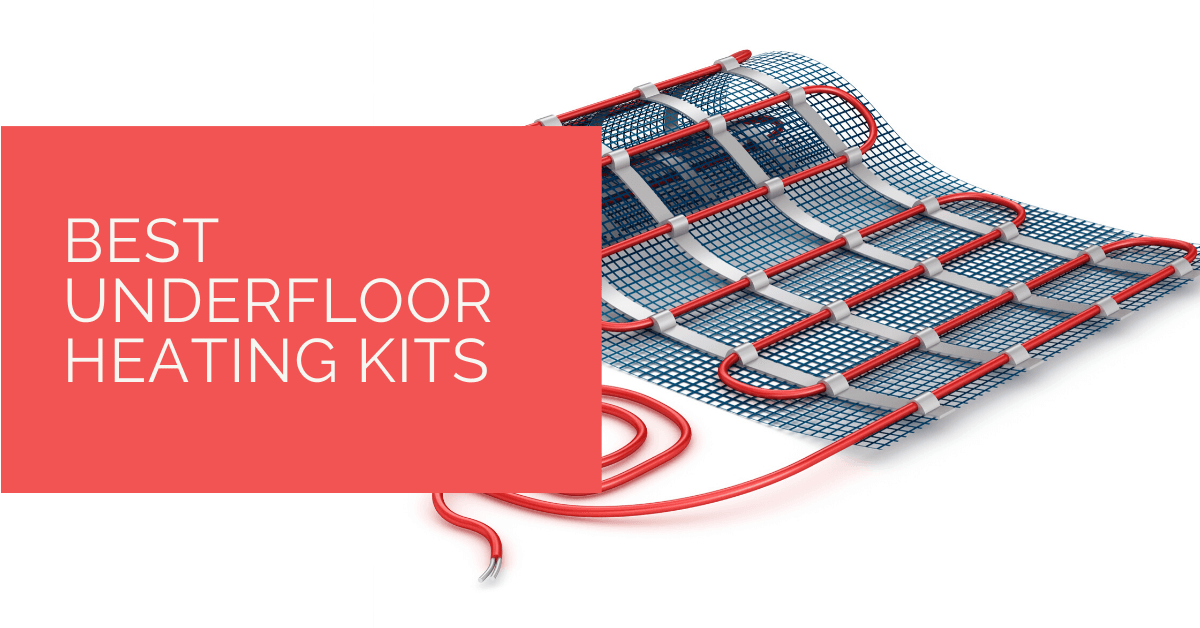
If you’re looking to add genuine warmth underfoot without the bulk of radiators, an electric underfloor heating kit is the cleanest solution going. Our top pick is the Nassboards Premium Pro 200W Mat Kit, which combines straightforward DIY installation with a reliable self-adhesive mat and a touchscreen thermostat included in the box. It’s the kit we’d reach for first in a bathroom, en-suite, or kitchen.
Below you’ll find eight of the best electric underfloor heating kits on the market right now, covering everything from budget mat-only options to Wi-Fi-enabled smart bundles. After the reviews, our buying guide covers mat vs loose cable, floor compatibility, running costs, and everything else you need to get the installation right first time.
Our Top Picks
| Image | Name | |
|---|---|---|
| Nassboards Premium Pro Electric Underfloor Heating Mat Kit 200W/m² — 1.5m² | |
| Warmup StickyMat 150W SPM-5 Electric Underfloor Heating Mat | |
| Nassboards Pro Elite Loose Cable Underfloor Heating System 200W/m² | |
| BodenWärme Electric Underfloor Heating Mat Kit 200W/m² with Wi-Fi Thermostat | |
| HEATIT Warmmat Electric Underfloor Heating Mat 150W/m² | |
| Heat Up Electric Underfloor Heating Sticky Mat 150W/m² | |
| Adept Electric Underfloor Heating Mat Kit 140W/m² — Laminate & Wood | |
| HEATIT Warmmat Electric Underfloor Heating Kit 200W/m² — 4m² with ET-81 Thermostat |
8 Best Underfloor Heating Kits
1. Nassboards Premium Pro Electric Underfloor Heating Mat Kit 200W/m² — 1.5m²
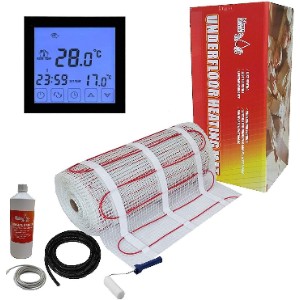
The Nassboards Premium Pro has built up the strongest review count in this category for good reason. Over 230 buyers have rated it at 4.5 stars, and the consistent feedback is that the self-adhesive mat lays flat without fuss, the cable stays exactly where you put it, and the included black touchscreen thermostat looks genuinely smart on a tiled wall. For a 1.5m² kit, it’s an ideal size for a downstairs cloakroom, an en-suite, or the section of a larger bathroom that actually sees foot traffic.
The mat runs at 200W/m², which puts it at the higher output end for electric underfloor heating. In practice, that means faster warm-up times and better performance in rooms where the heating isn’t running continuously, like a bathroom you use for 20 minutes in the morning. Pair it with the included thermostat’s scheduling function and you’re typically looking at 15–20 minutes of pre-heating to get the floor to a comfortable temperature from cold.
Installation is as DIY-friendly as this category gets. You unroll the mat, press it to the subfloor with the self-adhesive backing, run the cold-lead through the wall to your thermostat position, and embed the floor temperature sensor. The wiring itself needs to connect to a fused spur, which most DIYers will want a Part P-qualified electrician to sign off. But the mat-laying part is entirely manageable as a weekend job.
You’ll want to check coverage before ordering. The 1.5m² size is designed for the free floor area (i.e., the area without fixed furniture on it). If your room is larger, Nassboards offers other sizes at different ASINs, but this entry-level kit represents the best value per square metre in the range and is the one most buyers actually need.
Features
- 200W/m² output for faster warm-up times
- Self-adhesive mesh mat — no clips or staples needed
- Covers 1.5m² of free floor area
- Includes black touchscreen thermostat with scheduling
- Suitable for use under ceramic tiles, porcelain, and stone
- 230V operation, compatible with standard UK wiring
- Over 230 verified Amazon reviews at 4.5 stars
- Best-reviewed kit in the category — over 230 ratings with consistent positive feedback
- Touchscreen thermostat included in the box at this price
- 200W/m² output heats up quickly from cold
- Self-adhesive mat makes DIY installation straightforward
- 1.5m² coverage suits small rooms only — larger rooms need a higher size variant
- Thermostat wiring still requires a qualified electrician to connect to the fused spur
2. Warmup StickyMat 150W SPM-5 Electric Underfloor Heating Mat
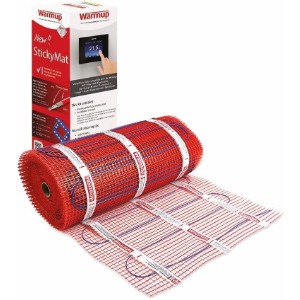
Warmup is one of the most established names in underfloor heating in the UK. They’ve been manufacturing UFH systems since 1994, their products carry full UK and EU certifications, and their technical support is a cut above most competitors in this space. The StickyMat SPM-5 is their entry-level electric mat system, sold as a mat-only product (thermostat purchased separately), and it runs at 150W/m² — the standard output for tile and stone applications.
At £236.08, the Warmup StickyMat is significantly more expensive than the other 150W options on this list. You’re paying for brand assurance, a 25-year company track record, and the knowledge that the product has been independently tested and certified. If you’re tiling an expensive bathroom or fitting underfloor heating under natural stone, that premium is worth it. For a quick laminate bedroom job, probably not.
The mat itself uses a self-adhesive backing for straightforward installation, and the heating cable is pre-spaced at 8cm intervals for optimal heat distribution. Unlike some budget alternatives, the cable construction is robust enough to handle the weight of the tile adhesive and grout bed without shifting. Warmup sells a compatible touchscreen thermostat (the 4iE) separately, which adds Wi-Fi control and an energy monitor if you want to track running costs.
Features
- 150W/m² output — UK standard for tiled floor applications
- Self-adhesive backing with pre-spaced 8cm cable intervals
- Mat only — thermostat sold separately
- Compatible with Warmup’s 4iE Wi-Fi thermostat
- UK and EU certified; 25+ years of Warmup manufacturing
- Suitable for tile, stone, and porcelain
- Warmup is the most trusted name in UK electric underfloor heating
- Full certification and long-established product range
- Excellent technical support and installation resources
- Mat sold without thermostat — adds significant extra cost
- Premium price versus comparable 150W mats
- 150W/m² means slower warm-up than 200W alternatives
3. Nassboards Pro Elite Loose Cable Underfloor Heating System 200W/m²
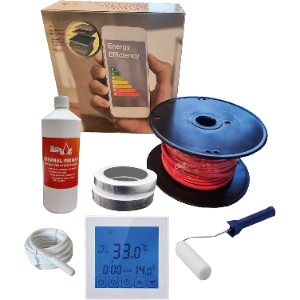
Mat-based systems are great for rectangular rooms, but the moment you have an L-shaped bathroom, alcoves, or floor area that wraps around a freestanding bath, you need a loose cable system. The Nassboards Pro Elite uses a twin conductor loose cable that you fix to the subfloor using the provided fixing rails, spacing it yourself at whatever interval gives you the coverage you need. It takes more planning than unrolling a mat, but it gives you complete control over the layout.
The 200W/m² output matches the top pick, and the cable quality is rated at 4.7 stars from early buyers. At £85.85, it’s the right choice for irregular-shaped rooms or any project where a pre-formed mat simply won’t fit without creating cold spots or overlapping cable runs. You’ll need to calculate your spacing before installation — Nassboards provides guidance, but a simple formula is: divide the cable length (in metres) by your floor area to get your spacing in centimetres.
This is not the option for first-timers who want the quickest possible installation. But for anyone tackling a room that doesn’t fit neatly into standard mat sizes, the loose cable approach is significantly more professional than forcing a mat into an awkward shape.
Features
- Twin conductor loose heating cable, 200W/m²
- Includes fixing rails for cable spacing during installation
- Flexible layout — suits L-shaped rooms and irregular floor plans
- 230V, UK standard operation
- Compatible with any standard electric UFH thermostat
- 4.7 stars from verified buyers
- Works in any room shape — no wasted coverage or cold spots
- 200W/m² output for fast response
- More professional installation result in complex rooms
- Takes longer to lay than a self-adhesive mat
- Requires cable spacing calculations before starting
- Thermostat not included
4. BodenWärme 200W Electric Underfloor Heating Mat with Wi-Fi Thermostat
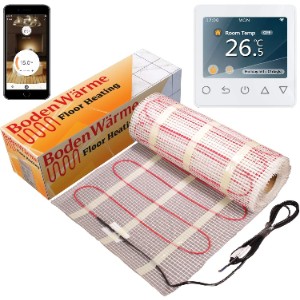
Most underfloor heating kits are sold either as mat-only or as with a basic dial or touchscreen thermostat. BodenWärme’s bundle goes a step further by including a Wi-Fi connected thermostat that you can control via a smartphone app. If you’re renovating a bathroom and want to come back to a warm floor after a winter commute, this is the kit that makes that genuinely easy.
The 200W/m² mat is self-adhesive and straightforward to lay, and the Wi-Fi thermostat connects to your home network without needing a hub or bridge. You set schedules from the app, check the current floor temperature remotely, and adjust on the fly. At £190.79, it’s a premium bundle, but you’re buying the mat and a Wi-Fi thermostat in one box rather than purchasing them separately. BodenWärme has 21 reviews sitting at 4.5 stars, which is a solid track record for a specialist product in this category.
One thing worth noting: if you’re integrating this with a broader smart home system, check app compatibility before buying. The BodenWärme app is standalone rather than working through Google Home or Alexa, so it’s best suited to buyers who just want simple remote control from their phone rather than deep smart home integration.
Features
- 200W/m² self-adhesive heating mat
- Wi-Fi connected thermostat included — smartphone control via app
- Schedule heating remotely from anywhere
- No hub or bridge required — connects directly to home Wi-Fi
- Suitable for tile and stone floors
- 4.5 stars from verified buyers
- Wi-Fi thermostat included — no need to buy separately
- Remote scheduling from anywhere via app
- 200W/m² gives good warm-up performance
- App is standalone — doesn’t integrate with Google Home or Alexa
- Premium price over non-smart bundles
5. HEATIT Warmmat 150W Electric Underfloor Heating Mat
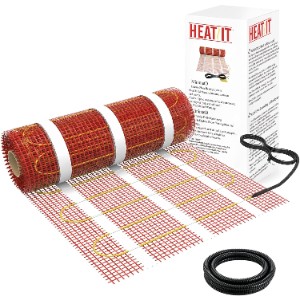
At £48.99, the HEATIT Warmmat is the most affordable entry point on this list. Don’t let the price put you off — it’s rated 4.7 stars from 28 buyers, which is the highest average rating in this entire roundup. The 150W/m² mat is sold without a thermostat, but that makes it useful if you’re replacing an existing mat on a thermostat you already have, or if you want to choose your own thermostat model independently. The HEATIT build quality is a step up from the very cheapest mats on the market: the cable is pre-spaced on a mesh at consistent intervals and the construction feels solid in use.
The main limitation is what 150W/m² means in practice. It’s sufficient for the standard UK application of tile and stone floors in rooms that are well-insulated, but warm-up times will be noticeably longer than a 200W/m² system. If you’re heating a cold bathroom from scratch on a winter morning, expect 25–35 minutes rather than 15–20. For rooms that run on a schedule and stay at a maintained temperature through the day, the difference is largely irrelevant.
Features
- 150W/m² output — standard UK specification for tile floors
- Pre-spaced heating cable on mesh mat
- Sold without thermostat — choose your own
- 230V, compatible with all standard UK thermostats
- Suitable for tile, porcelain, and stone
- 4.7 stars — highest average rating on this list
- Most affordable mat on this list at £48.99
- Highest star rating of any product here — 4.7 stars from 28 buyers
- Flexible — use with any thermostat you choose
- No thermostat included — extra purchase required
- 150W/m² means slower warm-up than 200W alternatives
- Not suitable for laminate or engineered wood floors
6. Heat Up Electric Sticky Mat 150W Underfloor Heating Kit
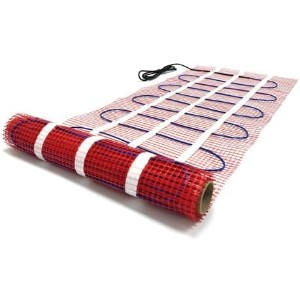
The Heat Up sticky mat comes in at £59.95 and holds a 4.6-star average across 11 reviews. It’s a newer listing with fewer reviews than the HEATIT above, but the feedback is strong, with buyers noting the self-adhesive mat lays easily and the build quality is better than the price suggests. This is a sensible budget choice if the HEATIT is out of stock or if you specifically want a self-adhesive mat rather than a mesh-only design.
Like the HEATIT Warmmat, this runs at 150W/m² and is designed for tile, stone, and porcelain applications. It’s not suitable for floating floors. It comes without a thermostat, so budget for one on top. For a cloakroom or small bathroom on a tight budget, this does the job well.
Features
- 150W/m² self-adhesive mat
- Suitable for tile, stone, and porcelain floors
- Easy DIY installation — peel and stick design
- 230V standard UK supply
- Thermostat not included
- 4.6 stars from verified buyers
- Self-adhesive design — easier to lay than mesh-only mats
- Strong early review average at 4.6 stars
- Good value at £59.95
- Fewer reviews than more established options
- No thermostat included
- Not suitable for laminate or floating floors
7. Adept Electric Underfloor Heating Mat 140W — for Laminate and Engineered Wood
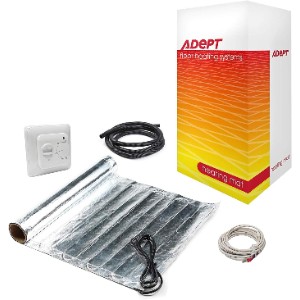
If you’re fitting underfloor heating under laminate, engineered wood, or luxury vinyl tile, this is the product to look at. Most mats on this list are rated for tile and stone only. The Adept 140W mat is specifically designed for floating floors, with a lower 140W/m² output that keeps surface temperatures within the safe range for wood-based and vinyl floor coverings — typically a maximum floor temperature of 27°C.
The kit includes a white dial thermostat, which is a simple and reliable choice for a room where you just want a set temperature without the complexity of scheduling. At £54.99 with an 18-strong review base sitting at 4.8 stars, this is the best-reviewed per-star product on the list, and the floor-type compatibility fills a genuine gap that the other mats don’t address. If your bathroom or bedroom has engineered oak or LVT rather than porcelain tile, this is the one to buy.
Installation follows the same general approach — lay the mat over a suitable insulation board, run the cold tail to the thermostat position, and tile or lay your floor finish on top. For laminate or engineered wood, you place the mat loose (without adhesive to the subfloor), then float your floor covering directly over it. The Adept can also be used under tile if needed, making it a flexible choice for mixed-floor rooms.
Features
- 140W/m² output — rated safe for laminate, engineered wood, and LVT
- Suitable for floating floor installation (no adhesive to subfloor required)
- Includes white dial thermostat
- Also suitable for use under ceramic tile
- Available in multiple size options
- 4.8 stars — highest-rated product on this list
- Only kit here rated for laminate, engineered wood, and vinyl
- 4.8 stars — top-rated product on this list
- Includes thermostat at an affordable price
- Available in multiple sizes
- 140W/m² output is lower — works best in well-insulated rooms
- Dial thermostat lacks scheduling or smart features
8. HEATIT Warmmat 200W/m² 4m² Underfloor Heating Kit with ET-81 Thermostat
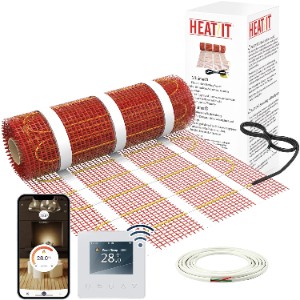
For medium-sized bathrooms and open-plan kitchens where you need more than 2m² of coverage, this HEATIT kit steps things up. The 4m² mat runs at 200W/m² (800W total), and it comes bundled with HEATIT’s ET-81 digital thermostat — a clean, functional controller with floor and air temperature sensing, a programmable weekly schedule, and a clear display. At £129.99 for a complete kit covering 4m², the price per square metre is reasonable, and 29 reviews at 4.3 stars suggests consistent real-world performance.
The mat uses fluoropolymer insulation, one of the more durable options in this category, and the construction is rated for wet applications (bathrooms with a screed base, not just dry-set tiles). The mesh design allows the cable to be cut and turned to fill irregular sections of floor, though as with all heating cables, you cannot cut the heating element itself — anly the mesh support. This is distinctly different from the budget HEATIT 150W option (#5), which is a smaller mat without a thermostat, making this a step-up choice for anyone needing proper room coverage with controls included.
Features
- 200W/m² output, 4m² total coverage (800W total)
- Includes ET-81 digital thermostat with programmable schedule
- Fluoropolymer insulated heating cable — durable and moisture resistant
- 0.5m width × 8m length mat with cuttable mesh
- Suitable for ceramic tile, stone, and wet applications
- 4.3 stars from 29 verified buyers
- 4m² coverage — genuinely useful for medium-sized rooms
- ET-81 thermostat included with weekly scheduling
- 200W/m² for good warm-up performance
- More expensive per m² than smaller kits
- Not suitable for laminate or floating floors
Electric Underfloor Heating Buying Guide
Key Takeaways
- Electric UFH is best suited as a supplementary heat source rather than a primary heating system in most UK homes.
- Mat systems suit rectangular rooms; loose cable suits irregular shapes and larger areas.
- 150W/m² is the standard output for tile and stone; 200W/m² heats up faster; 140W/m² or lower is needed for laminate and wood.
- Running costs typically range from 3p to 7p per hour for a standard bathroom mat, depending on energy tariff and usage.
- Installation must comply with Part P of the Building Regulations — final connection by a qualified electrician or self-certified DIYer is required.
- Always use an insulation board under the mat. Heating a concrete subfloor directly wastes up to 50% of the energy downwards.
- Never overlap the heating cable, and never cut the element — only the mesh or fixing rails.
What Is Electric Underfloor Heating?
Electric underfloor heating (sometimes abbreviated to UFH or electric UFH) uses a network of resistance heating cables embedded in or under the floor to warm the surface from below. The heat radiates upward from the floor, warming the room evenly from ground level rather than creating a hot spot near a radiator. In practice, this means the room feels comfortable at a lower air temperature — typically 18–19°C instead of the 21–22°C you might need with a conventional radiator.
Electric UFH is distinct from water-based (hydronic) underfloor heating, which circulates warm water through pipes embedded in a screed floor. Electric systems are far simpler and cheaper to retrofit into existing bathrooms, kitchens, and bedrooms because they don’t require a wet screed installation or connection to the boiler circuit. Most electric UFH kits are installed by the homeowner in a day, with only the final electrical connection needing a qualified electrician.
How Does Electric Underfloor Heating Work?
The heating element is a twin-conductor cable with a core resistance that converts electrical current into heat. In a mat system, this cable is pre-attached to a fibreglass mesh at a set spacing — typically 8–10cm — and rolled into a mat you can unroll and lay on the subfloor before tiling or floating the floor covering on top. In a loose cable system, you fix the cable yourself using mounting rails or staples, giving you full control over the spacing and layout.
A floor temperature sensor is buried in the floor finish (for tile systems, between the mat and the tile adhesive) and connected to the thermostat. The thermostat monitors the floor temperature and cuts power once the set point is reached, cycling on and off to maintain a consistent warmth. On a timer or smart schedule, this means the floor is only actively heating during the periods when the room is in use — the key to keeping running costs reasonable.
Mat vs Loose Cable vs Heating Film: Which Type Do You Need?
Mat systems are the right choice for most standard bathroom and kitchen installations. The cable is pre-spaced and attached to a mesh, so installation is fast — you simply unroll, cut the mesh (not the cable) to shape, and lay it before tiling. Self-adhesive mats stick directly to the subfloor or insulation board. These work perfectly in square and rectangular rooms where a pre-formed mat can cover the floor without gaps or wasted runs.
Loose cable systems are the professional choice for irregular-shaped rooms, L-shaped bathrooms, or large areas where multiple mat sizes would create awkward joins. You fix the cable to the subfloor using mounting rails at whatever spacing your coverage calculation requires. The installation takes longer, but the result is a perfectly uniform heat distribution with no cold spots. For anything bigger than a standard 3m × 2m bathroom or with an awkward floor plan, loose cable is worth the extra effort.
Heating film is a completely different technology — thin carbon-film strips that are designed specifically for floating floors like laminate, LVT, and engineered wood. Unlike a cable mat (which can damage the flooring above if the temperature gets too high), heating film runs at low surface temperatures safe for wood-based products. You lay the film on top of the existing subfloor before floating your new floor over it, with no adhesive or tile adhesive involved. If you want underfloor heating under a laminate floor and want the simplest possible installation, a low-wattage mat (like the Adept above) or a heating film system is the answer.
150W/m² or 200W/m²: Does the Output Wattage Actually Matter?
Yes, but not in the way most people think. The output wattage determines two things: how quickly the floor heats up from cold, and the maximum floor temperature the system can achieve.
150W/m² is the traditional UK standard for bathroom and kitchen tile installations. It provides adequate warmth for a pre-scheduled floor that maintains temperature through the morning routine, and it’s the recommended output for most domestic applications. 200W/m² systems heat up faster — typically 15–20 minutes versus 25–35 minutes for a 150W system from cold — and are useful in rooms that heat on demand rather than running on a continuous schedule.
The important constraint is floor type. Laminate, engineered wood, and LVT have a maximum surface temperature limit set by the flooring manufacturer (usually 27°C), which means you cannot use a high-wattage cable that would exceed this limit if the thermostat failed. Mats rated at 140W/m² or lower, or dedicated heating films, are designed to stay within these limits even at full power. For tile and stone, 150W or 200W are both fine — choose 200W if fast warm-up is a priority, 150W if running cost efficiency is more important.
Floor Compatibility Guide
Not every mat works under every floor covering. Getting this wrong can void your flooring warranty or damage the mat. Here’s the quick reference:
Ceramic tile, porcelain, and natural stone: Compatible with all standard 150W/m² and 200W/m² electric mat systems. This is the most common application and where electric UFH performs best. The tile or stone stores heat well and radiates it evenly after the mat switches off.
Engineered wood and hardwood: Must be installed with a low-wattage mat (typically 100–140W/m²) or a dedicated heating film. The maximum floor surface temperature for most engineered wood is 27°C. Always check the flooring manufacturer’s specification. Solid hardwood flooring is not recommended for UFH as the movement caused by heating and cooling can cause boards to split or cup over time.
Laminate flooring: Use a low-wattage mat or heating film designed for floating floors. Many laminate manufacturers specify a maximum underfloor temperature — check before buying. Install an insulation board with a low tog rating (0.5 or below) to allow heat to transfer upward rather than insulating it away from the room.
Luxury vinyl tile (LVT) and vinyl plank: Most LVT products are compatible with electric UFH up to 27°C. Check the manufacturer’s spec. Use a low-tog insulation board under the mat and a low-wattage mat or film system on top.
Carpet: Not recommended for electric UFH. Carpet acts as an insulator and the total tog rating (carpet plus underlay) is usually too high to allow effective heat transfer. If you must fit UFH under carpet, use a very thin, low-tog carpet and underlay and accept reduced performance.
Benefits of Underfloor Heating Over Radiators
The main practical advantage is comfort. A heated floor warms the room from the ground up, which matches how the human body retains and loses heat. Your feet are warm, the lower air temperature in the room is comfortable, and you don’t have the hot-wall/cold-corner effect that radiators create. In bathrooms especially, a warm floor transforms the experience — stepping out of a shower or bath onto a cold tile is one of the most unpleasant sensations in a UK winter morning.
The hidden benefit is space. A standard bathroom radiator takes up wall space, generates a hot spot immediately adjacent to it, and creates difficult decisions about towel rail placement. Electric UFH eliminates this entirely — you get the full wall area back, and the heating is invisible. In smaller bathrooms where every centimetre of wall space matters for cabinetry and mirrors, this is a real practical win.
Running costs are the one area where electric UFH needs honest treatment. Electricity costs roughly three times as much per kWh as gas in the UK. Electric UFH in a well-insulated bathroom running for 1 hour per day might cost £15–25 per year at current rates. In a kitchen running 3–4 hours daily, that figure rises significantly. Electric UFH works best as a supplementary comfort heat source for rooms used for short periods, not as the primary heat source for an entire house.
Running Costs: What Will It Actually Cost?
Running cost depends on three things: the output of the mat, the hours of use, and your electricity tariff. A useful starting point: the average UK electricity rate is around 24p/kWh (as of early 2026), though this varies by tariff and supplier.
A 150W/m² mat covering 2m² (300W total output) running for 1 hour uses 0.3kWh — roughly 7p. Run it for 2 hours in the morning every day and you’re looking at £5–6 per month. A 200W/m² mat over the same 2m² (400W) costs about 10p per hour under the same conditions — so roughly £6–8 per month for 2 hours daily. Over a full heating season (October to April), a standard bathroom UFH installation typically adds £20–45 to the electricity bill, depending on usage.
The single biggest lever on running costs is the thermostat setup. A floor on a sensible schedule (heating to temperature 30 minutes before use, off the rest of the time) costs a fraction of a floor left on a continuous low setting. Every kit on this list includes or is compatible with a programmable thermostat — use the scheduling function.
UK Building Regulations and Compliance
Electric underfloor heating in the UK falls under Part P of the Building Regulations (Electrical Safety in Dwellings). In practice, this means the installation must either be carried out by a registered competent person (an electrician registered with NICEIC, NAPIT, or a similar scheme) or be notified to your local authority building control department for inspection.
Most homeowners handle the mat-laying themselves — this is the non-notifiable part of the installation. The cable connects to a fused spur (typically a 5A or 16A fused connection unit, depending on the mat output), which then connects to your consumer unit. This electrical work is the Part P-notifiable element. A qualified electrician can do this in an hour or two and will issue a Minor Works certificate confirming the installation complies with BS 7671 (the IET Wiring Regulations).
In bathrooms, the thermostat position also matters. BS 7671 divides bathrooms into zones based on proximity to water sources. Zone 1 (above the bath or shower tray up to 2.25m) and Zone 2 (up to 0.6m outside Zone 1) have restrictions on what electrical equipment can be installed. A thermostat with a suitable IP rating (IPX4 minimum in Zone 2) can be placed on the bathroom wall. A standard thermostat should be positioned outside the bathroom entirely — typically on the other side of the wall.
Things to Keep in Mind Before Buying
Always insulate underneath the mat. Without insulation, a significant proportion of the heat from the mat goes downward into the subfloor rather than upward into the room. A 6mm or 10mm insulation board under the mat reduces this heat loss by 40–60%. Boards are available at builders’ merchants for £15–25 per sheet and make a meaningful difference to both performance and running costs.
Never overlap the heating cable and never cut the cable element. Both will cause a hotspot that will burn out the mat — usually within the first few weeks of operation. You can cut the mesh of a mat system to help it navigate around obstacles, but the cable itself must remain as a single unbroken run.
Measure your free floor area, not the total floor area. Free floor area is the area the mat actually heats — the section of the floor not permanently covered by furniture, the bath base, toilet pedestals, or kitchen units. This is typically 50–70% of the total room area. Size your kit to the free floor area, not the room dimensions.
Budget for the thermostat if the kit doesn’t include one. A basic programmable thermostat costs £20–40. A touchscreen thermostat is £40–80. A Wi-Fi-enabled smart thermostat is £80–120. The thermostat controls when the mat runs and has a bigger impact on running costs than any other variable.
DIY Installation vs Hiring an Electrician
The mat-laying element of electric UFH installation is well within the capability of a confident DIYer. You’re essentially unrolling a mat, sticking it to an insulation board, and embedding a sensor cable — no specialist skills required. Warmup and Nassboards both publish detailed installation guides and videos that walk through the process step by step.
The electrical connection is a different matter. Connecting the cold tail of the mat to a fused spur and the spur to the consumer unit is notifiable work under Part P. Options: hire an electrician to do just this part (typically £80–150 for a straightforward spur connection), ask a friend or family member who is a registered electrician, or if you are yourself registered under a competent person scheme, self-certify the work. Attempting the electrical connection without Part P compliance leaves your installation uninsured and can invalidate your home insurance in the event of an electrical fault.
Common Installation Mistakes to Avoid
Skipping the insulation board. This is the most common and most costly mistake. The mat warms the subfloor rather than the room, running costs are higher, and the floor takes much longer to reach temperature.
Incorrect sensor placement. The floor temperature sensor should be positioned between two heating cable runs, not directly on top of the cable. If the sensor reads the cable temperature instead of the floor temperature, the thermostat will cut out too early and the floor will be unevenly heated.
Not leaving a conduit for the sensor. The floor sensor needs to be replaceable without lifting the floor. Run it inside a piece of conduit (a length of plastic pipe) that you embed with the mat so the sensor can be withdrawn and replaced if it fails. This takes five minutes during installation and saves an enormous amount of trouble later.
Buying the wrong size. Buying a mat for the total room area rather than the free floor area means you’ll either need to cut the mat (which damages the cable) or leave gaps in the coverage. Measure carefully before ordering.
Tiling too soon. Wait for the adhesive to fully cure before switching the mat on for the first time — typically 24–28 days for standard tile adhesive. Switching the heating on while the adhesive is still curing can cause cracking or adhesive failure.
Case Study: Electric Underfloor Heating in a Victorian Terrace Bathroom
Background
A couple renovating the first-floor bathroom of a Victorian terraced house in Leeds wanted to add underfloor heating as part of a full retile. The room was 3.5m × 2.2m, with a freestanding bath taking up one corner and a WC with a pedestal basin on the opposite wall. Free floor area for heating: approximately 4.5m². The existing floor was original floorboards, which needed to be covered before the mat could be laid.
Project Overview
The homeowner chose a 200W/m² mat system to maximise warm-up speed (the bathroom was cold and north-facing), along with a touchscreen programmable thermostat. An insulation board was laid over the original floorboards to create a flat, insulated base before the mat was installed. The total material cost including mat, insulation board, tile adhesive, and thermostat came to around £280.
Implementation
The insulation board was cut and laid in sections, taped at the joints, and levelled. The mat was unrolled and positioned to cover the free floor area, with the mesh cut (not the cable) to navigate around the WC pedestal. The floor sensor was inserted into a conduit and positioned between two cable runs. The cold tail was run through the partition wall to the thermostat position in Zone 2. A local electrician connected the fused spur to the consumer unit and issued the completion certificate — the work took less than two hours.
Results
The floor reaches a comfortable temperature in around 18 minutes on a cold January morning when scheduled to start 20 minutes before the alarm. Monthly electricity cost is estimated at £8–10 during winter months, based on 1.5 hours of heating per day. The homeowners noted that the temperature of the room felt perceptibly warmer than before despite keeping the towel rail at a lower setting, consistent with the radiant heat-from-below effect that underfloor heating is known for.
Expert Insights From Our Heating Engineers About Electric Underfloor Heating
One of our senior heating engineers with over 18 years of experience installing and commissioning both wet and electric underfloor heating systems offers this practical advice for homeowners considering an electric kit installation.
“The number one thing I see go wrong is people skipping the insulation layer. They think because the mat is going under the tiles it’ll heat upward naturally — and it will, but a lot of the energy goes straight into the screed or floorboards first. Put a 6mm PIR-backed board down before the mat and you’ll notice the difference in warm-up time immediately. It’s cheap, it’s easy, and it makes the difference between a system that feels responsive and one that feels sluggish.”
“The other thing worth knowing is that the thermostat matters more than the mat in most cases. I’ve seen expensive mats underperform because they’re on a basic thermostat with no scheduling, and budget mats work brilliantly because they’re on a well-programmed controller that learns the room. Spend the money on a good thermostat — ideally one with a floor sensor and an air sensor and set it up properly when it’s installed. That’s what will keep running costs down over the years.”
“On the question of 150W versus 200W: for a bathroom that runs on a morning schedule, 200W is noticeably better. It hits temperature faster, which means you can shorten the pre-heat window and reduce running time. For a kitchen that runs more continuously through the day, 150W is fine. For laminate floors, the choice is made for you — keep it at 140W or below and check the flooring manufacturer’s specification before you order the mat.”
Frequently Asked Questions
Can I install electric underfloor heating myself?
The mat-laying part, yes — most homeowners can do this without any specialist skills. Unrolling the mat, cutting the mesh to shape, and embedding the floor sensor are all DIY-friendly tasks. The electrical connection (connecting the mat to a fused spur and the consumer unit) is notifiable work under Part P of the Building Regulations in England and Wales. You either need a registered competent electrician to complete this part, or you need to notify your local authority building control. Attempting the connection without compliance leaves you uninsured.
How much does electric underfloor heating cost to run?
For a standard 2m² bathroom mat (300–400W `epending on output rating), running costs are roughly 7–10p per hour at current UK electricity rates. A bathroom scheduled for 2 hours of active heating per morning costs approximately £5–8 per month during the heating season. Over a full winter (October to April), most bathroom UFH installations add between £20 and £45 to household electricity bills. The thermostat scheduling has a bigger impact on running costs than any other factor.
What’s the difference between 150W/m² and 200W/m² underfloor heating?
The main practical difference is warm-up speed. A 200W/m² mat heats to a comfortable floor temperature in roughly 15–20 minutes from cold; a 150W/m² mat typically takes 25–35 minutes. For bathrooms where the heating runs on a schedule and needs to respond quickly, 200W/m² is preferable. For rooms that maintain a background temperature continuously, 150W/m² is more than adequate. Both are suitable for tile and stone floors; for laminate and wood, use 140W/m² or lower.
Can electric underfloor heating be used under laminate flooring?
Yes, but you need a mat specifically rated for use under laminate — typically 140W/m² or below. Most standard tile mats run too hot for wood-based floor coverings and can cause laminate to buckle, warp, or void its warranty. The Adept 140W mat on this list is designed specifically for laminate and engineered wood. Always check both the mat’s maximum surface temperature and your flooring manufacturer’s specification before buying.
Do I need planning permission or building regulations approval for electric underfloor heating?
You don’t need planning permission for electric UFH in most domestic situations. You do need to comply with Part P of the Building Regulations (Electrical Safety in Dwellings), which governs the electrical connection — not the mat-laying itself. In practice, this means having the fused spur and consumer unit work done or inspected by a registered competent electrician who can issue the appropriate certification. Some local authorities may also require a building notice for work in certain locations.
How long do electric underfloor heating mats last?
Most manufacturers specify a design life of 25+ years for the heating element itself. The thermostat is more likely to need replacing before the mat does — thermostats typically last 10–15 years before the display or electronics start to fail. The most common cause of early mat failure is damage during installation: a nail or screw through the cable, overlapping runs, or switching the heating on before the tile adhesive has fully cured. Install carefully and the mat should outlast the rest of the bathroom renovation.
Is a thermostat included with underfloor heating kits?
It depends on the kit. Several products on this list include a thermostat — the Nassboards top pick comes with a touchscreen thermostat, the BodenWärme includes a Wi-Fi thermostat, the Adept includes a dial thermostat, and the HEATIT 4m² kit includes an ET-81 digital controller. Others (the HEATIT 150W Warmmat, Heat Up sticky mat, and Warmup StickyMat) are mat-only, with the thermostat sold separately. Check the product listing carefully and budget £20–120 for a thermostat if it’s not included, depending on how basic or smart you want the controls to be.
Can electric underfloor heating replace a radiator?
In most UK homes, no —”not as a sole heat source. Electric UFH is excellent as a comfort heat source in bathrooms and kitchens, and as a supplement to the main heating system. As a primary heat source, its running costs (electricity at roughly 3× the cost of gas) make it expensive to run for extended periods in larger rooms. The exception is well-insulated modern homes with a low heat demand per square metre, where a properly sized system can provide meaningful heat output without excessive running costs.
Summing Up
For most homeowners fitting electric underfloor heating in a bathroom or kitchen, the Nassboards Premium Pro 200W 1.5m² kit is the standout choice. It has the strongest review base in the category, includes a quality touchscreen thermostat, and the 200W/m² output means genuinely fast warm-up times. If you need coverage for a larger or irregularly shaped room, the Nassboards Pro Elite loose cable system is the professional-grade alternative, and the HEATIT 4m² kit with ET-81 thermostat handles medium-sized bathrooms at a fair all-in price.
For laminate or engineered wood floors, the Adept 140W mat is the one to buy — it’s the only kit here specifically rated for floating floor installation and it’s the highest-rated product on this list by average star score. Whatever you choose, don’t skip the insulation board, size the mat to your free floor area rather than the total room, and get the electrical connection certified under Part P. Done right, an electric underfloor heating kit is one of the most satisfying bathroom upgrades you can make.
Updated