
Air filters are easy to underestimate because they sit quietly in an appliance, duct, purifier or ventilation unit. Yet the filter is often the part that decides whether the system actually removes dust, pollen, fine particles and odours effectively, or simply moves air around the room.
This guide explains the main filter types, what MERV ratings and microns mean, how HEPA differs from other filters, and what to check before buying replacement filters. It is written for normal UK homes, so it also covers running costs, replacement intervals, mould limitations and when an air purifier is not the complete answer.
Key Takeaways
- Filter type matters, but it must be matched to the appliance and room.
- MERV ratings compare how well HVAC-style filters capture particles from 0.3 to 10 microns.
- HEPA filters are different from MERV-rated filters and are common in portable air purifiers.
- Activated carbon helps with some odours and gases, but it does not replace a particle filter.
- Filters need replacing. A clogged filter can reduce airflow and make performance worse.

What Air Filters Actually Do
An air filter captures particles as air passes through a material, mesh, pleated sheet or cartridge. The principle is simple, but performance varies enormously. A coarse pre-filter may catch hair and visible dust, while a high-efficiency particle filter can capture much smaller particles such as pollen, fine dust and some smoke particles.
The important distinction is between particle filtration and gas or odour control. A HEPA-style particle filter is useful for dust, pollen and many airborne particles, but it will not remove every smell or chemical vapour. Activated carbon can help with some odours and volatile compounds, but it becomes saturated and needs replacement.
If your main issue is damp or mould, filtration is only part of the conversation. Our damp prevention guide explains why moisture control and ventilation usually matter more than trying to filter mould spores after the problem has developed.
MERV Ratings Explained
MERV stands for Minimum Efficiency Reporting Value. It is mostly used for HVAC and furnace-style filters rather than standalone air purifier marketing. The US EPA explains that MERV ratings compare a filter’s ability to capture particles between 0.3 and 10 microns. A higher rating generally captures smaller particles more effectively, but it can also restrict airflow if the system is not designed for it.
| MERV Range | Typical Use | What to Know |
|---|---|---|
| MERV 1 to 4 | Basic dust protection | Catches larger particles but offers limited fine-particle filtration. |
| MERV 5 to 8 | Better domestic dust control | Often used where airflow must stay easy and pressure drop is a concern. |
| MERV 9 to 12 | Improved particle capture | May help with finer dust and pollen where the system can handle it. |
| MERV 13 to 16 | Higher-efficiency HVAC filtration | Can capture smaller particles but may need professional checking for compatibility. |
| HEPA | Portable purifiers and specialist filtration | Not part of the MERV scale, but a different high-efficiency standard. |
What Is a Micron?
A micron is one millionth of a metre. It is used in air filtration because many airborne particles are far too small to judge by sight. Pollen, dust mite waste, smoke particles and mould spores can all sit in different size ranges, which is why a filter that catches visible dust may still miss finer particles.
The micron figure is not the whole story. Airflow, filter seal, fan speed, room size and how long the purifier runs all affect real-world performance. A good filter inside a badly sealed appliance can leak air around the edge and perform worse than the specification suggests.
HEPA, Carbon, UV and Ionic Filters Compared
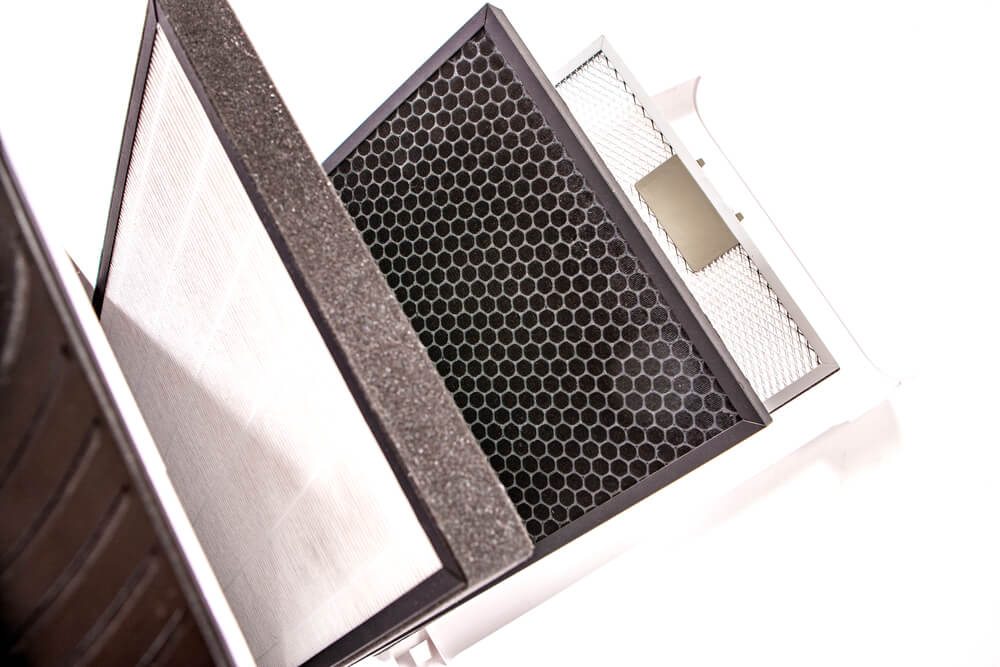
| Filter Type | Best For | Limitations |
|---|---|---|
| Pre-filter | Hair, lint and larger dust | Needs cleaning and does not handle fine particles alone. |
| HEPA filter | Fine particles, pollen and many allergens | Needs replacement and does not remove gases by itself. |
| Activated carbon | Some smells and gases | Can saturate quickly and is usually paired with a particle filter. |
| UV | Microbial control inside some units | Does not remove dust or particles from the air stream. |
| Ionic filter | Some particle charging and collection | Check ozone claims carefully and avoid over-relying on marketing. |
If you are choosing between appliances, our air purifier versus air conditioner guide explains why cleaning air and cooling air are separate jobs. For product-style decisions, the filter specification should be considered alongside CADR, noise and replacement-filter cost.
CADR, Room Size and Replacement Costs
CADR, or Clean Air Delivery Rate, tells you how quickly a purifier can deliver filtered air for particular particles. It is not the same as filter quality. A strong filter with a weak fan may clean the room slowly, while a high airflow appliance with poor filtration may move air without solving the problem.
| Room Situation | What to Prioritise | Common Mistake |
|---|---|---|
| Bedroom allergies | Quiet mode, HEPA filter, affordable replacements | Buying a loud purifier that is never used overnight. |
| Open-plan living room | Higher CADR and good airflow path | Choosing a small bedroom unit for a large space. |
| Odours from cooking or pets | Meaningful activated carbon capacity | Expecting a thin carbon sheet to remove heavy smells. |
| Dusty home | Pre-filter access and regular cleaning | Letting the pre-filter clog and reduce airflow. |
| Mould concern | Moisture control first, filtration second | Treating filtration as a cure for damp. |
Replacement filters can be a hidden cost. Before buying any purifier or HVAC filter, check availability, price and recommended replacement frequency. A cheaper unit with expensive filters can cost more over two years than a better appliance with reasonably priced cartridges.

Case Study: Choosing Filters for a Dusty Family Home
A family in a semi-detached home found that dust built up quickly in bedrooms and that one child’s hay fever symptoms were worse during spring. They first bought a small purifier based on price, but it was too noisy at night and the filter replacements were expensive.
They reassessed the problem room by room. Bedrooms needed quiet operation and reliable HEPA filtration. The kitchen needed better extraction rather than an air purifier. A hallway unit made little difference because doors were usually closed and airflow did not reach the rooms that mattered.
The family chose a purifier sized for the main bedroom, cleaned the pre-filter regularly and set calendar reminders for filter replacement. They also improved cleaning routines and ventilation, because filtration alone was not going to remove settled dust or moisture sources.
The result was a more realistic setup. The purifier helped where it was used consistently, but the family stopped expecting one appliance to solve every air-quality issue in the house.
They also stopped moving the purifier from room to room every few hours. Keeping it in the bedroom, where symptoms were worst, gave more consistent results than chasing every possible air-quality concern around the house.
They also checked replacement filter prices before buying a second unit. That changed the final choice, because one purifier looked cheaper upfront but would have cost considerably more to maintain over the first two years.
The final setup was not the most powerful purifier they considered. It was the one they could run quietly in the right room for long enough to matter.
Expert Insights from Our Heating and Air Quality Engineers About Air Filters
One of our senior heating engineers with over 18 years of experience says: “A filter is only useful if air actually passes through it. People often buy a higher-efficiency filter but forget to check airflow, filter fit and replacement intervals.”
For homes with allergies, pets or persistent dust, the best approach is usually layered: source control, cleaning, ventilation and appropriately sized filtration. Air filters can help, but they should not be sold as a cure for damp, poor extraction or badly maintained ventilation systems.
How to Choose the Right Filter for Your Home
Start with the problem you are trying to solve. If the issue is hay fever, dust or pet dander, a good particle filter and enough airflow are the priorities. If the issue is odour, carbon capacity matters more. If the issue is mould, the first question is why moisture is present, because no filter will stop mould growing on a cold, damp wall.
Next, check compatibility. In an HVAC system, a filter that is too restrictive can reduce airflow and place extra strain on the fan. In a portable purifier, a replacement cartridge that does not seal properly can allow air to bypass the filter. That is why genuine or correctly specified replacement filters are usually safer than buying the cheapest cartridge that appears to fit.
Noise should also influence the decision. A purifier that is only effective on its loudest setting may look good on paper but fail in a bedroom because nobody wants to sleep beside it. In bedrooms, a lower noise setting with enough CADR for the room is often more useful than a high headline airflow figure that is never used.
Common Air Filter Mistakes
| Mistake | Why It Causes Problems | Better Approach |
|---|---|---|
| Buying only by HEPA label | The appliance may be too small or too noisy for the room. | Check CADR, room size and replacement cost. |
| Ignoring pre-filters | Hair and lint can clog the main filter faster. | Clean washable pre-filters regularly. |
| Expecting carbon to last forever | Carbon becomes saturated and stops adsorbing effectively. | Replace carbon filters as recommended. |
| Using high-MERV filters in any system | Airflow may fall if the fan cannot cope. | Check compatibility before upgrading. |
| Treating filters as mould treatment | Mould returns if moisture remains. | Fix damp, ventilation and cold surfaces first. |
Think of filtration as maintenance as much as purchase. The first week with a new purifier is rarely the problem. The question is whether the filter will still be changed six months later, whether the pre-filter is accessible and whether the unit is placed where air can circulate.
Maintenance Schedule for Home Air Filters
A filter schedule should be based on use, not only on the calendar. A purifier running every night in a bedroom will load up faster than one used occasionally in a spare room. Homes with pets, open fires, nearby roads, renovation dust or heavy pollen exposure may also need more frequent cleaning and replacement.
| Task | Typical Frequency | Why It Matters |
|---|---|---|
| Check pre-filter | Every 2 to 4 weeks | Hair and lint can block airflow quickly. |
| Vacuum washable pre-filter | Monthly or as needed | Keeps the main filter from clogging early. |
| Inspect HEPA or main filter | Every 3 to 6 months | Look for dust loading, odour and reduced airflow. |
| Replace carbon filter | When odours return or per guidance | Carbon can saturate before it looks dirty. |
| Clean appliance exterior and inlets | Monthly | Blocked grilles reduce circulation. |
Do not wash a disposable HEPA filter unless the manufacturer specifically says it is washable. Water can damage the filter media and reduce performance. If a filter smells musty, is visibly loaded or causes the unit to become noisier, replacement is often the safer choice.
Choosing Filter Performance by Problem
The right air filter depends on the problem you are trying to solve. For visible dust and general household particles, a good quality pleated filter changed on schedule can make a noticeable difference without putting too much strain on the system. For pollen, pet dander and finer particles, HEPA-level filtration is more useful, but only if the appliance has enough airflow for the room and the filter is sealed properly.
Odours and gases are different. A particle filter will not do much for cooking smells, smoke odour or volatile organic compounds unless it also includes enough activated carbon. Even then, carbon has a working life. If odours return quickly, the filter may be saturated rather than faulty.
Be careful with filters that promise everything at once. The best choice is usually the one that matches the room, the contaminant and the airflow available. An over-restrictive filter in the wrong appliance can reduce performance, increase noise and make the unit less pleasant to use every day.
Filter Claims to Treat Carefully
Some filter marketing focuses on laboratory capture rates, but the real-world result depends on how much air actually passes through the filter. A filter material can be excellent while the appliance around it is underpowered, poorly sealed or too noisy to run for long periods. That is why CADR, room size guidance and replacement filter availability matter as much as the headline filtration claim.
Also think about the ongoing cost. A cheaper appliance that needs frequent proprietary filters may cost more over two years than a slightly dearer model with longer-lasting replacements. For allergy sufferers, it is often better to buy a purifier that can run quietly for long periods than one with an impressive maximum setting that nobody wants to hear overnight.
Frequently Asked Questions
Is a Higher MERV Rating Always Better?
Not always. A higher MERV rating can capture smaller particles, but it may also restrict airflow if the system is not designed for it. In HVAC systems, the best filter is the highest practical rating the fan and filter slot can handle without causing performance problems.
Is HEPA Better Than MERV?
HEPA and MERV are not directly the same scale. HEPA is a high-efficiency particle filtration standard commonly used in portable air purifiers, while MERV is used for HVAC-style filters. HEPA can be excellent for fine particles, but the appliance still needs enough airflow for the room.
What Micron Size Should I Care About?
It depends on the issue. Pollen, dust, smoke and mould spores vary in size, and real-world capture depends on filter quality, seal and airflow. Micron ratings are useful, but they should be read with CADR, room size and replacement guidance rather than in isolation.
Can Air Filters Remove Mould?
They can capture some airborne spores, but they do not remove the moisture source that allows mould to grow. If mould is visible or returning, fix damp, ventilation and cold-surface problems first. A purifier may support air quality, but it is not the main treatment.
How Often Should Filters Be Replaced?
Follow the manufacturer’s guidance, but adjust for real use. Homes with pets, smoke, heavy dust or long purifier run times may need more frequent replacement. A clogged filter can reduce airflow, increase noise and make the appliance less useful.
Do Carbon Filters Remove All Smells?
No. Activated carbon can help with some odours and gases, but capacity matters. Thin carbon layers may have limited effect on strong or persistent smells. If the source is cooking, damp, smoke or a leak, removing or controlling the source is still the priority.
Can a Better Filter Make Airflow Worse?
Yes. A denser filter can restrict airflow if the appliance or HVAC system is not designed for it. That can increase noise, reduce heating or cooling performance and make the unit work harder. Always check the manufacturer guidance before moving to a higher-grade filter, especially in ducted systems.
Summing Up
Air filters are useful when they are matched to the problem, the appliance and the room. Look beyond simple claims such as “HEPA” or “high efficiency” and check airflow, room size, replacement cost and what the filter is actually designed to capture.
For most homes, the best results come from combining sensible ventilation, source control and correctly sized filtration. A filter can improve air quality, but it works best as part of a wider plan rather than a magic fix.
Updated