
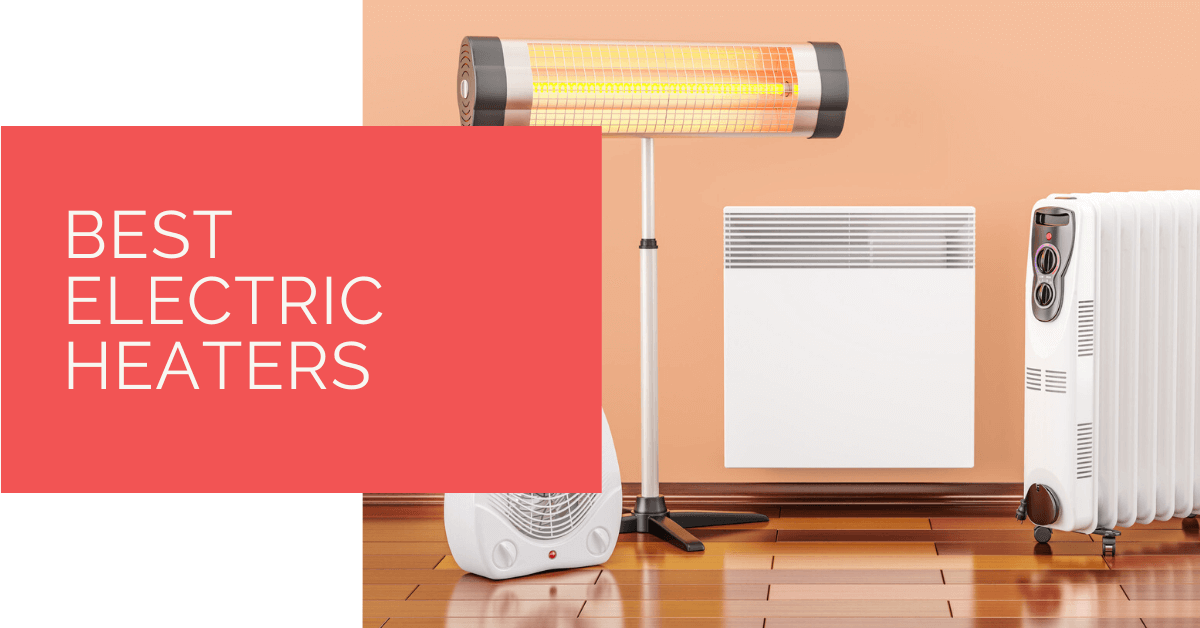
For most UK homes, the Dreo 1500W Electric Heater is the one to buy. It costs less than £35, has over 10,000 Amazon reviews at 4.6 stars, heats a room quickly, and runs efficiently enough to use daily without guilt. Simple, compact, and proven at scale.
That said, the right electric heater depends on how you plan to use it. A portable fan heater is very different from an oil-filled radiator or a wall-mounted smart unit. We’ve reviewed eight of the best electric heaters currently available on Amazon.co.uk, covering every main type and a range of budgets from under £30 to £130.
Contents
- 1 Our Top Picks
- 2 8 Best Electric Heaters
- 2.1 1. Pro Breeze 2000W Mini Ceramic Fan Heater
- 2.2 2. Dreo 1500W Electric Heater
- 2.3 3. HOMCOM 1500W Oil Filled Radiator
- 2.4 4. Duronic HV220 Oil Free Convection Heater
- 2.5 5. PELONIS 2000W Silent Electric Heater
- 2.6 6. Dreo 25 Inch Tower Heater with 70° Oscillation
- 2.7 7. Dreo Smart Electric Wall Heater
- 2.8 8. De’Longhi Dragon 4 TRD40820T Oil Filled Radiator
- 2.9 Key Takeaways
- 2.10 How to Choose the Right Type of Electric Heater
- 2.11 Wattage and Room Sizing
- 2.12 Running Costs: What to Expect
- 2.13 Lot 20 Regulations: What They Mean for Buyers
- 2.14 Safety Features Worth Checking
- 2.15 Things to Keep in Mind Before Buying
- 2.16 Types of Electric Heater
- 3 Electric Heater Buying Guide
- 4 Case Study: Heating a Victorian Terrace on a Budget
- 5 Expert Insights From Our Heating Engineers About Electric Heaters
- 6 Frequently Asked Questions
- 6.1 Are electric heaters expensive to run?
- 6.2 What type of electric heater is cheapest to run?
- 6.3 Is it safe to leave an electric heater on overnight?
- 6.4 What wattage do I need for my room?
- 6.5 What is the difference between a fan heater and an oil-filled radiator?
- 6.6 Can I use an electric heater as my main source of heating?
- 6.7 Do electric heaters dry out the air?
- 6.8 Are smart electric heaters worth the extra cost?
- 7 Summing Up
Our Top Picks
| Image | Name | |
|---|---|---|
| Pro Breeze 2000W Mini Ceramic Fan Heater | |
| Dreo 1500W Electric Heater | |
| HOMCOM 1500W Oil Filled Radiator | |
| Duronic HV220 Oil Free Convection Heater | |
| PELONIS 2000W Silent Electric Heater | |
| Dreo 25 Inch Tower Heater | |
| Dreo Smart Electric Wall Heater | |
| De'Longhi Dragon 4 Oil Filled Radiator |
8 Best Electric Heaters
1. Pro Breeze 2000W Mini Ceramic Fan Heater
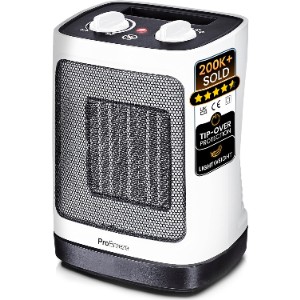
Plug it in, point it at yourself, done. The Pro Breeze Mini is about as straightforward as electric heaters get, and for many people that’s exactly what they want. At 2000W it heats a small room or workspace quickly, the two heat settings give you some control, and the built-in thermostat cuts in once the target temperature is reached. Over 7,200 Amazon reviews at 4.5 stars suggests it does what it says reliably.
The size is genuinely compact. It sits comfortably on a desk or bedside table without taking over the space, and the cool-touch housing means it’s safer around kids than older bar heaters. There’s an overheat cut-off as well. At under £30 it’s one of the cheapest ways to get instant heat into a cold room, though it’s not designed for all-day background heating.
Features
- Power: 2000W
- 2 heat settings plus cool fan mode
- Built-in adjustable thermostat
- Overheat and tip-over protection
- Compact desktop design
- Cool-touch housing
- 7,200+ reviews at 4.5 stars, thoroughly proven at this price
- Compact enough for a desk, bedside table, or shelf
- Heats a small room almost instantly
- Not suitable as a primary heater for larger rooms
- Fan noise audible, not ideal for sleeping next to
- No smart or app connectivity
2. Dreo 1500W Electric Heater
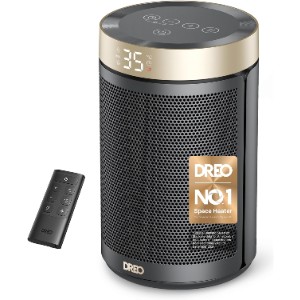
This is the one we’d recommend to most people. The Dreo 1500W is the best-selling electric heater on Amazon UK for good reason: 10,800 reviews at 4.6 stars, a compact form that fits anywhere, and genuine energy efficiency at 1500W rather than the 2000W that cheaper fan heaters default to. That 25% reduction in draw adds up over a winter of daily use.
The PTC ceramic heating element warms up within seconds and maintains a consistent output. There’s a thermostat to avoid the unit running flat out unnecessarily, a tip-over cut-off, and an overheat shut-off. The noise level is low enough for background office use, though you’ll notice it in a quiet room at night.
At £33.99 it sits just above the budget tier but feels meaningfully better built than the cheapest options. If you want one heater that works well almost anywhere in the home, this is the straightforward answer. The review count alone should tell you all you need to know about its track record.
Features
- Power: 1500W
- PTC ceramic heating element
- Adjustable thermostat
- Tip-over and overheat protection
- Quiet fan operation
- Compact upright design
- 10,800+ reviews at 4.6 stars: exceptional track record
- 1500W draw is more economical than 2000W alternatives
- Quick-heat PTC ceramic element
- Compact enough for any room without dominating the space
- Fan noise means it’s not the best choice for very light sleepers
- No smart features or app connectivity
3. HOMCOM 1500W Oil Filled Radiator
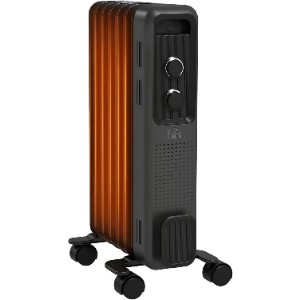
If you want heat that stays in the room after the heater switches off, an oil-filled radiator is where to look. The HOMCOM 1500W is the budget entry point for this type: three heat settings, a 24-hour programmable timer, and an adjustable thermostat that lets you set a target temperature and leave it running without babysitting. At £44.99 it’s the cheapest way into oil-filled radiator territory with a reasonable review base.
It’s also completely silent. No fan, no moving parts, just radiant heat that warms the air gently without blasting it around the room. That makes it a better overnight choice than any fan heater for sensitive sleepers. The four wheels make it easy to move between rooms.
Features
- Power: 1500W
- 3 heat settings
- 24-hour programmable timer
- Adjustable thermostat
- Silent operation (no fan)
- 4 castors for easy movement
- Overheat protection
- Completely silent: no fan noise at any setting
- Retains heat even when cycling off, reducing run time
- Budget price for oil-filled radiator category
- Takes longer to heat up than fan heaters
- Fewer reviews than the Dreo and Pro Breeze alternatives
- Heavier and less portable than compact fan heaters
4. Duronic HV220 Oil Free Convection Heater
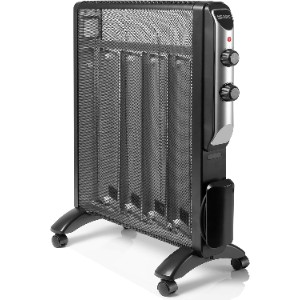
The Duronic HV220 occupies an interesting middle ground: it’s a panel-style convection heater that heats silently like an oil-filled radiator but warms up significantly faster because it uses a heated element rather than oil. It covers up to 20m², draws 2000W at maximum, and has a digital thermostat with seven temperature presets. At £69.99 it sits above the budget options but below the premium smart heaters.
The slim panel design means it stands upright without taking much floor space, or can be wall-mounted using the optional bracket. This versatility makes it useful in rooms where floor space is tight. With 560+ Amazon reviews at 4.5 stars it has a solid track record, and Duronic is a UK brand with reliable customer support.
Features
- Power: 2000W
- Oil-free convection heating
- Digital thermostat with 7 temperature presets
- Coverage: up to 20m²
- Freestanding or wall-mountable
- Silent operation
- 24-hour timer
- Silent like an oil-filled radiator, but heats faster
- Can be wall-mounted to save floor space
- 560+ reviews at 4.5 stars, proven reliability
- Pricier than fan heaters with similar wattage
- 20m² coverage limits it to medium rooms
- Less well-known brand than De’Longhi or Dreo
5. PELONIS 2000W Silent Electric Heater
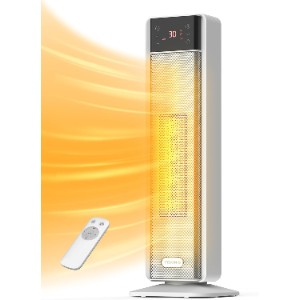
The PELONIS positions itself as a quiet step up from basic fan heaters, and at £76.99 it’s priced accordingly. The headline claim is a low noise level on its quieter setting, which makes it more viable for bedroom use than most fan heaters. It runs at 2000W on high and has a thermostat mode that cycles the element on and off to hold a set temperature. The 4.6 star rating from nearly 200 reviews is strong for a relatively newer listing.
It’s worth considering if your main complaint with cheaper fan heaters is the noise. You still get fast heat delivery (much faster than oil-filled), but with a noticeably lower audible output. There’s also a timer function and remote control, which aren’t standard features at this price point.
Features
- Power: 2000W
- Low-noise ceramic heating
- Adjustable thermostat
- Remote control included
- Timer function
- Overheat and tip-over protection
- Quieter than most fan heaters at equivalent wattage
- Remote control is a convenient bonus
- Strong 4.6 stars from an emerging review base
- Fewer reviews than the top Dreo models
- Not as proven long-term as established brands
- Higher price than the Dreo 1500W for similar functionality
6. Dreo 25 Inch Tower Heater with 70° Oscillation
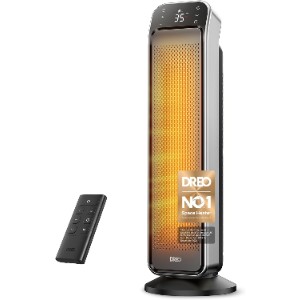
Ask someone what they want from a living room heater and you usually get the same answer: something that heats the whole room, not just the corner it’s sitting in. The Dreo tower heater’s 70° oscillation is designed for exactly that. It sweeps heat across a wide arc as it runs, which means better distribution in open-plan spaces or larger rooms than a fixed-position fan heater can manage. With 7,500 Amazon reviews at 4.5 stars, it’s one of the most reviewed tower heaters in this category.
At 1500W it’s efficient for its size, and the tall column design means it circulates air at a level that actually reaches seated adults rather than just heating the floor. There’s a thermostat, multiple heat settings, and a sleep mode that dials back the output and dims the display for overnight use. At £88.78 it’s a genuine upgrade over compact fan heaters for anyone with a living room or open-plan space to heat.
The main limitation is that it’s a floor-standing unit with a defined footprint. If you’re short on floor space, the wall-mounted Dreo smart heater below might be a better fit.
Features
- Power: 1500W
- 70° horizontal oscillation
- Height: 25 inches (64cm)
- Multiple heat settings and thermostat
- Sleep mode with dimmed display
- Tip-over and overheat protection
- 7,500+ reviews at 4.5 stars: outstanding track record
- 70° oscillation distributes heat across larger spaces
- Taller design circulates warm air at seated height
- Sleep mode makes it usable overnight
- Requires floor space; not suitable for desk or shelf use
- Fan noise still audible at higher settings
7. Dreo Smart Electric Wall Heater
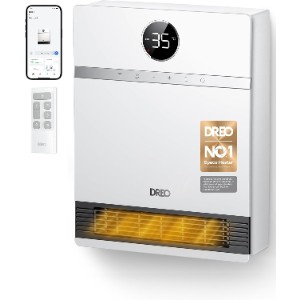
The most divisive pick on this list, and deservedly so. At £89.99 the Dreo Smart Wall Heater asks you to commit to a fixed installation rather than a portable unit, which isn’t for everyone. But what you get in return is wall-mounted heating that takes zero floor space, operates at just 28dB (genuinely near-silent by any measure), and connects to the Dreo app for remote control and scheduling. With 2,600 Amazon reviews at 4.6 stars it has earned that price tag.
The smart features are genuinely useful here rather than marketing additions. You can set heating schedules tied to your routine, check the room temperature remotely, and control it via voice if you have Alexa or Google Home. The ceramic heating element heats up quickly despite the silent operation, and the flat panel design means it blends into a wall rather than sitting in front of it.
It’s the right choice for anyone who wants a permanent heating solution in a bedroom, study, or bathroom where floor space and noise are at a premium. Installation requires screwing a bracket to the wall, which is straightforward but does rule it out for renters without landlord permission.
Features
- Power: 2000W
- Noise level: 28 dB
- Wall-mounted installation
- Dreo app control (iOS and Android)
- Alexa and Google Home compatible
- Ceramic heating element
- Weekly scheduling function
- 28 dB operation: one of the quietest electric heaters available
- Wall-mounted design takes zero floor space
- Full app, Alexa, and Google Home control with scheduling
- 2,600+ reviews at 4.6 stars, strongly proven
- Requires wall installation, not suitable for renters
- Higher price than portable alternatives
8. De’Longhi Dragon 4 TRD40820T Oil Filled Radiator
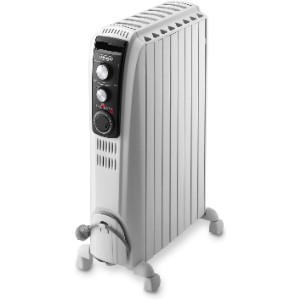
De’Longhi has been making oil-filled radiators longer than most of its competitors have existed, and the Dragon 4 is the model that has accumulated the most trust. At £129.00 it’s the most expensive option on this list, but 1,900 Amazon reviews at 4.6 stars across a product that has been available for years tells you this isn’t a flash-in-the-pan purchase. The Dragon 4’s heating elements are positioned at the base of each fin rather than the top, which De’Longhi calls Dragon Technology: it heats the oil faster and more evenly than traditional top-element designs.
The 2000W output covers rooms up to 20m² comfortably, and the thermostat is precise enough to hold a set temperature without constant cycling. Three heat settings, a 24-hour timer, and a frost protection mode (which kicks in at around 5°C to prevent pipes freezing) round out the feature set. Like all oil-filled radiators it’s silent, and the heat retained in the oil continues radiating even after the element cycles off.
If you want the best oil-filled radiator you can buy from Amazon without worrying about whether it will still work in five years, this is the answer. The brand reputation and review track record justify the premium.
Features
- Power: 2000W
- Dragon Technology base-positioned heating elements
- Coverage: up to 20m²
- 3 heat settings plus thermostat
- 24-hour timer
- Frost protection mode (activates at approx. 5°C)
- Silent operation
- 4 castors for easy movement
- De’Longhi’s proven Dragon Technology heats oil faster and more evenly
- 1,900+ reviews at 4.6 stars over multiple years: genuine long-term reliability
- Frost protection mode is useful in conservatories and utility rooms
- Completely silent operation
- Most expensive option on this list
- Slower to heat up than fan or ceramic heaters
Key Takeaways
- Electric heaters convert 100% of electricity into heat, so efficiency differences between models come down to control quality, not heating technology. A cheap thermostat wastes far more energy than a slightly higher wattage unit with accurate control
- Oil-filled radiators are the best choice for rooms you heat for hours at a time: they retain warmth after switching off and create a stable, even heat. Fan heaters are better for quick bursts in rooms you use briefly
- Infrared heaters heat people and objects directly rather than the air, making them effective in draughty or poorly insulated spaces where convected air escapes quickly
- Since January 2018, all electric heaters sold in the UK must meet Lot 20 regulations, which require an accurate thermostat, a 24-hour timer, and open window detection. Any current model without these features is non-compliant
- Running costs scale directly with wattage and usage. A 2kW heater running 4 hours a day costs roughly £2.16 per day at 27p/kWh. Thermostat control reduces actual consumption by 30 to 50% depending on room conditions
- For bedroom or sleeping area use, fan heaters are the worst choice: they’re noisy, cycle off immediately, and create temperature swings. Panel heaters or oil-filled radiators are far better
How to Choose the Right Type of Electric Heater
The single most important buying decision is heater type, not brand or wattage. Each type heats differently and suits different rooms and usage patterns. Getting this wrong means buying a heater that costs more to run, warms unevenly, or simply doesn’t suit the space.
| Type | Warm-Up Time | Heat Retention | Noise | Best For |
|---|---|---|---|---|
| Fan heater | 30 seconds | None | Audible fan | Quick heat in rooms used briefly |
| Convector heater | 3 to 5 minutes | Minimal | Silent | Background heat in occasional-use rooms |
| Panel heater | 5 to 10 minutes | Low | Silent | Regular-use rooms with smart control |
| Oil-filled radiator | 10 to 15 minutes | 30 to 40 minutes | Silent | Rooms used for hours, bedrooms |
| Infrared heater | Instant | None | Silent | Draughty spaces, targeted warmth |
Wattage and Room Sizing
A useful starting rule: allow 100W per square metre of floor area for a standard-height, reasonably insulated room. A bedroom of 12m² needs around 1,200W; a living room of 20m² needs 2,000W. These are guidelines rather than exact figures because room shape, window area, insulation, and ceiling height all affect how much heat escapes.
If the room is poorly insulated, draughty, or north-facing with large windows, add 25 to 30% to the estimated output. If it’s south-facing, well-insulated, or an interior room with no external walls, you may need less. A heater that’s too small will run continuously at full power and still leave the room cold. One that’s too large will short-cycle, switching on and off repeatedly, which wears out the thermostat and wastes energy on overcooling cycles.
Most electric heaters max out at 2,000W on a standard UK 13A socket. If you need more than 2,000W for a large room, you’re better off with two separate heaters in different positions than one oversized unit in a corner.
Running Costs: What to Expect
All electric heaters convert electricity to heat at 100% efficiency: there’s no combustion loss. Running costs therefore depend purely on wattage, hours of use, and how effectively the thermostat limits actual draw. At 27p/kWh:
- 500W: 14p per hour. Typical for a small oil-filled radiator on low setting, or a ceramic panel on minimum
- 1,000W: 27p per hour. A mid-range convector or oil radiator on medium. Running 4 hours costs about £1.08
- 1,500W: 41p per hour. Common for fan heaters and panel heaters at mid-setting
- 2,000W: 54p per hour. Full-power operation. Running 4 hours costs £2.16
The key word here is “actual draw”. A 2,000W heater with a well-calibrated thermostat in a 15m² room might only run at full power for 20 minutes per hour once the room is up to temperature, cutting actual consumption by 60% versus an unregulated heater. This is why thermostat accuracy matters more than headline wattage when comparing running costs.
Lot 20 Regulations: What They Mean for Buyers
Since January 2018, UK regulations (implementing EU Lot 20 ErP standards) require all new electric heaters to include three core features: an accurate electronic thermostat (to within 1°C), a 24-hour programmable timer, and open window detection that cuts heating if it senses a sudden temperature drop suggesting a window has been opened. Any heater currently sold in the UK should have all three; if a listing doesn’t mention them, ask the seller.
In practice, this means modern electric heaters are meaningfully more efficient than models from before 2018, even if the wattage rating looks the same. The key benefit is that scheduled heating: warming a room 30 minutes before you need it, then switching off automatically. This is now built into every heater rather than being a premium feature.
Safety Features Worth Checking
Tip-over protection cuts power if the heater falls over, which is essential for fan heaters and portable oil radiators that sit on the floor. Overheat protection does the same if the heater’s casing reaches a dangerous temperature due to restricted airflow. Both are standard on well-made models but worth confirming on cheaper units. For rooms with children or pets, look for cool-touch casings, which prevent burns on contact. Infrared heaters and some panel heaters radiate heat without hot surfaces; fan heaters typically do not.
IP ratings matter if you’re using an electric heater in a bathroom, conservatory, or kitchen with steam and moisture. IP24 provides splash protection and is the minimum for conservatories; IP44 or higher is required for bathroom zones near showers. A heater without an IP rating should not be used in moisture-prone areas.
Things to Keep in Mind Before Buying
Don’t heat rooms you’re not using. An electric heater running in an empty room is pure waste. If you find yourself heating multiple rooms simultaneously, a central heating system (even a basic oil-filled radiator strategy) is cheaper than running several electric heaters at once. Electric heating is economical for supplementary warmth in one or two rooms, not as a whole-house solution.
Consider how long you actually need heat in each room. Fan heaters make sense if you need warmth for 30 minutes. For a full evening in a sitting room, an oil-filled radiator will be more comfortable and quieter. For a room you use five days a week throughout winter, a wall-mounted panel heater on a schedule will almost always be cheaper to run than a portable heater without scheduling.
Types of Electric Heater
Fan heaters blow air over a heated element and deliver fast, direct warmth within seconds. They’re cheap to buy, compact, and effective for quick heating of small spaces. Drawbacks: audible fan noise, no heat retention after switching off, and ongoing dust and allergen circulation. Best for: home offices, hallways, brief sessions in rooms you use intermittently.
Convector heaters heat air by natural convection over an element with no fan. They’re silent, affordable, and heat up a room in minutes. Less effective in draughty rooms where the warm air escapes quickly. Best for: living rooms with moderate insulation and occasional daily use.
Panel heaters are slimmer, wall-mountable, and typically include smart controls, timers, and precise thermostats. They’re the modern replacement for storage heaters in many homes, offering programmable schedules at a reasonable cost. Best for: bedrooms, home offices, and rooms used on a regular weekly schedule.
Oil-filled radiators heat thermal oil in sealed fins which then radiates warmth steadily into the room. They take longer to reach full warmth but sustain it long after switching off, which smooths out temperature swings overnight. Silent operation makes them ideal for bedrooms. Best for: bedrooms, living rooms used for extended sessions, or anywhere you want even heat without fan noise.
Infrared heaters emit far-infrared radiation that warms objects and people directly, without first heating the air. Effective in poorly insulated or draughty spaces because escaping air doesn’t waste the heating effect. Typically mounted on walls or ceilings. Best for: workshops, garages, conservatories, and targeted zone heating.
Electric Heater Buying Guide
Key Takeaways
- All electric heaters convert electricity to heat at 100% efficiency — a 2kW fan heater and a 2kW oil-filled radiator cost exactly the same to run at full output (54p per hour at 27p/kWh). The difference is how quickly they heat the room, how long they retain warmth after switching off, and how suitable they are for different use cases
- Lot 20 compliance is essential for any electric heater used as a primary heat source. Compliant models include a digital thermostat, a 24/7 programmable timer, and energy-saving features such as open window detection. Non-compliant budget models cost more to run over a winter than the upfront saving justifies
- Wattage sizing: 100W per m² for well-insulated rooms at average ceiling height. A 15m² bedroom needs 1,500W; a 20m² living room needs 2,000W. Add 20 to 30% for older poorly insulated properties
- Fan heaters heat fastest but are noisiest and suit short-burst use. Oil-filled radiators heat slowly but retain warmth longest. Infrared heaters warm people directly without heating the air first, making them efficient in draughty or high-ceilinged spaces. Panel heaters are the best all-rounder for permanent room heating
- Running costs at 27p/kWh: 2kW at full output = 54p/hour. With a good thermostat cycling to maintain temperature, effective running costs drop to 15 to 25p per hour in a typical well-insulated UK room
Choosing the Right Type of Electric Heater
The electric heater market covers half a dozen distinct technologies. The choice depends on three questions: how quickly do you need the room warm, how long will you be in the room, and does background noise matter?
For rapid heat on demand (getting dressed in a cold bedroom, warming a home office before starting work), a fan heater is the right tool. It blows warm air directly, raises temperature fast, and is inexpensive to buy. For a living room you want warm all evening, a panel heater or oil-filled radiator with a good thermostat maintains temperature more efficiently and more quietly. For spaces with high ceilings, draughts, or frequent door opening (conservatories, workshops, garages), infrared heaters warm the occupants directly regardless of air temperature and outperform convection heating in these settings.
Types of Electric Heater Compared
| Type | Warm-Up Speed | Heat Retention | Noise | Best For |
|---|---|---|---|---|
| Fan heater | Fast (2–5 min) | None | Audible | Rapid spot heating |
| Convector heater | Medium (10–15 min) | Some | Silent | Sustained room heating |
| Oil-filled radiator | Slow (20–30 min) | High (30–40 min) | Silent | Long sessions, overnight |
| Panel heater | Medium (5–10 min) | Moderate | Silent | Primary room heating |
| Infrared panel | Fast (1–3 min) | None | Silent | High ceilings, draughts |
| Storage heater | Overnight charge | All day | Silent | Economy 7/10 tariffs |
Lot 20 Compliance and Energy Efficiency
Lot 20 is UK regulations requiring all electric heaters to meet minimum energy efficiency standards. Compliant models must include a precision digital thermostat (accurate to 1°C), a 24/7 programmable timer, and at least one additional energy-saving feature. Open window detection (the heater switches off when a sudden temperature drop indicates a window has been opened) is the most useful additional feature.
The practical impact of these features is significant. A heater with a precise thermostat cycling to maintain 20°C will use roughly half the electricity of the same heater running at constant full output. For a heater used daily through a UK winter, the annual saving easily exceeds £50. Budget heaters sold without Lot 20 certification look cheaper upfront but cost more to run. Check for Lot 20 compliance in the product listing before buying.
Wattage and Running Costs
Every electric heater converts electricity to heat at 100% efficiency. A 1kW heater running for one hour costs 27p at current rates. A 2kW heater running for one hour costs 54p. The type of heater makes no difference to this calculation — what differs is the thermostat’s ability to cycle the heater to use less electricity while maintaining comfort.
| Room Size | Recommended Wattage | Full Output Cost/hr | Thermostat Cycling Cost/hr |
|---|---|---|---|
| 10m² (bedroom) | 1,000W | 27p | 10–15p |
| 15m² (large bedroom) | 1,500W | 41p | 15–22p |
| 20m² (living room) | 2,000W | 54p | 20–30p |
| 25m² (large room) | 2,500W | 68p | 25–38p |
Running costs assume 27p/kWh. Cycling cost assumes a thermostat operating the element at 50 to 65% duty cycle in a well-insulated UK room.
Safety Features to Look For
Tip-over protection is a legal requirement for portable electric heaters in the UK — it cuts power immediately if the unit is knocked over. Overheat cutoff shuts the heater down if the element exceeds a safe temperature, which can happen if the heater is covered, placed too close to furniture, or if the fan motor fails. Both features are standard on all quality models.
Cool-touch casings matter if children or pets are in the home. Fan heaters and infrared heaters can have surfaces hot enough to cause burns on contact. Oil-filled radiators, panel heaters, and most modern convectors run warm but not dangerously hot on the outer casing.
Things to Keep in Mind Before Buying
Don’t use a standard domestic heater in a bathroom. Bathrooms require IP-rated heaters certified for the specific zone. Zone 2 (within 0.6m of a shower or bath) requires IP24 minimum; Zone 1 (directly above a bath or shower to 2.25m) requires IP45. Most domestic heaters carry no IP rating and must be installed outside bathroom zones entirely.
For properties without gas central heating (many flats, new builds, rural properties), electric panel heaters with smart thermostats are an effective whole-home heating solution. Smart models allow individual room scheduling, reduce waste from heating unoccupied rooms, and integrate with voice assistants and apps.
Case Study: Heating a Victorian Terrace on a Budget
Background
A family in a Victorian terrace in Leeds had been relying solely on gas central heating but found the boiler was struggling to heat the back extension, a conversion with poor insulation and single-glazed windows. Heating bills were high and the back rooms were still cold. Rather than upgrade the boiler, they decided to supplement with electric heaters in the rooms that needed it most.
Project Overview
The goal was to make the rear kitchen-diner and one upstairs bedroom comfortable through winter without dramatically increasing energy bills. Budget was around £200 total. They needed two heaters: one for background warmth in the extension and one for the bedroom that a light sleeper used.
Implementation
A De’Longhi Dragon 4 was placed in the kitchen-diner extension, running on a timer to come on an hour before the family used the room in the evenings and switching off at 10pm. In the bedroom, a Dreo Smart Wall Heater was installed, scheduled via the app to run at low setting from 10pm to midnight and switch off, giving the room enough residual warmth without running all night.
Results
The extension was noticeably warmer within a week, and the family found themselves using it as a living space rather than avoiding it. The bedroom occupant reported better sleep with a warm room that didn’t have fan noise running overnight. Monthly energy cost for both heaters in active use came to approximately £28 at typical usage patterns, well within the budget for the improvement in comfort delivered.
Expert Insights From Our Heating Engineers About Electric Heaters
One of our senior heating engineers with over 22 years of experience in domestic heating systems offers this perspective on getting the most from electric heaters without wasting money on running costs.
“The most common mistake I see is people buying a heater without a thermostat, or buying one with a thermostat they never set properly. A thermostat is what makes an electric heater economical. Without it, the thing runs continuously at full wattage. With it set correctly, it cycles on and off to hold your target temperature and you might be running at 30-40% of maximum draw on an average evening. That difference in run time is where the real savings are. Always set the thermostat to the lowest temperature you find comfortable, not the highest.”
“On type: if you’re heating a room for a few hours in the evening, a fan heater is fine. If you’re trying to maintain background warmth in a room over a full day or overnight, an oil-filled radiator is more appropriate. The reason is thermal mass. Oil stores heat and releases it gradually, so the element doesn’t need to run continuously to keep the room at temperature. A fan heater has no thermal mass at all, so it either runs or it doesn’t. For a bedroom, I always recommend oil-filled or a near-silent panel heater over a fan heater.”
“One thing people don’t factor in is placement. Electric heaters should be positioned where the heated air can circulate freely. Don’t put a heater behind furniture or in a corner where the output is blocked. For oil-filled radiators, central floor placement with clearance on all sides is ideal. For tower heaters with oscillation, place them so the sweep arc covers the seating area. That positioning makes a real difference to how efficiently the room warms up.”
Frequently Asked Questions
Are electric heaters expensive to run?
It depends on the wattage and how long you run them. At the current UK average electricity rate of around 24p/kWh, a 1500W heater costs about 36p per hour at full output. With a thermostat cycling it on and off, real-world costs are typically 40-60% of the theoretical maximum. For occasional use or supplemental heating of single rooms, electric heaters are often cheaper than running whole-house central heating just to warm one space.
What type of electric heater is cheapest to run?
All electric heaters convert electricity to heat at 100% efficiency, so the running cost is entirely determined by wattage and run time, not heater type. A 1000W heater will always cost less to run than a 2000W heater running for the same period. Oil-filled radiators can appear cheaper to run because their thermal mass means the element cycles off more often, but the underlying physics are the same. The cheapest to run is whichever heater uses the lowest wattage necessary to heat your specific room.
Is it safe to leave an electric heater on overnight?
Modern electric heaters with overheat protection and tip-over cut-offs are significantly safer than older designs, but it’s still recommended to use a thermostat and not leave any heater running unattended near flammable materials. Oil-filled radiators with thermostats are considered the safest type for overnight use because they have no exposed elements and no fan to pull dust across hot surfaces. Always follow the manufacturer’s guidance and never use a heater that has any visible damage to the cable or housing.
What wattage do I need for my room?
A rough guide is 100W per square metre for a well-insulated modern room. So a 12m² bedroom needs around 1200W, a 20m² living room around 2000W. Older properties with poor insulation, draughty windows, or high ceilings need more. If in doubt, size up: running a larger heater with the thermostat set to cycle off is more efficient than running a smaller one continuously at full output trying to keep up.
What is the difference between a fan heater and an oil-filled radiator?
Fan heaters blow air over a heated element for fast heat delivery but cool down almost instantly when switched off, and they make noise. Oil-filled radiators heat thermal oil that then radiates warmth silently; they take longer to reach operating temperature but retain heat for a period after the element cycles off, making them more suitable for sustained background heating. Fan heaters are better for quick warming; oil-filled radiators are better for quiet, prolonged use.
Can I use an electric heater as my main source of heating?
Yes, but you need to factor in the running costs. Electricity costs roughly three to four times more per kWh than gas in the UK, so replacing gas central heating entirely with electric heaters would significantly increase energy bills for most households. Electric heaters are most economical when used to heat specific rooms on demand rather than as whole-house heating. Properties without gas connections, or those using renewable electricity tariffs, may find the economics more favourable.
Do electric heaters dry out the air?
Fan heaters can make air feel drier because they heat it rapidly and circulate it, which increases the evaporation rate of any moisture present. They don’t actually remove moisture from the air, but the effect can feel similar. Oil-filled radiators and convection panel heaters are gentler in this regard. If dry air is a concern, a small humidifier used alongside a fan heater addresses the issue directly.
Are smart electric heaters worth the extra cost?
If you’ll actually use the scheduling feature, yes. The ability to programme a heater to come on 30 minutes before you arrive home and switch off when you leave means you’re never heating an empty room. Over a winter, that reduction in wasted run time can offset the higher purchase price. If you want a simple heater you’ll just switch on and off manually, the smart premium isn’t necessary.
Summing Up
For most UK homes, the Dreo 1500W Electric Heater is the best starting point. It’s compact, efficient, backed by over 10,000 reviews, and costs under £35. If you need something quieter for a bedroom, step up to the De’Longhi Dragon 4 oil-filled radiator or the HOMCOM as a budget alternative. If you want to heat a larger room efficiently, the Dreo tower heater’s 70° oscillation makes it the standout choice. And if floor space and noise are your main concerns, the Dreo Smart Wall Heater at 28dB is in a class of its own.
The right heater depends on the room, your tolerance for fan noise, and how long you plan to run it. Use the buying guide above to match the type to your needs, and always factor in running costs alongside the purchase price when making your decision.
Updated