
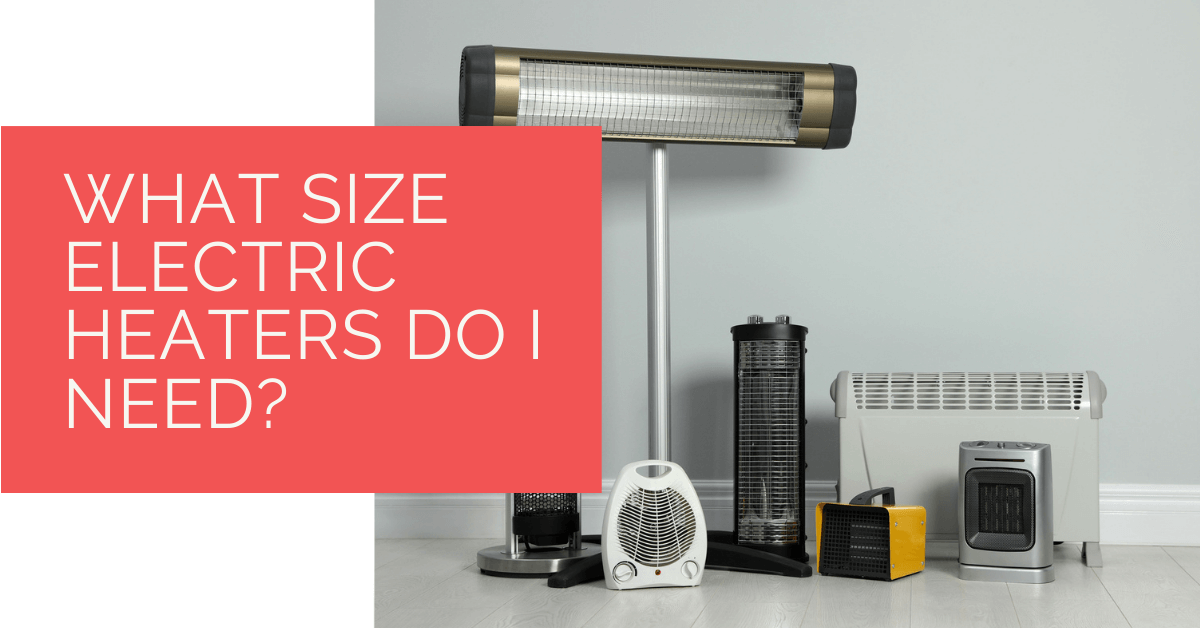
Electric heater sizing is usually expressed in watts or kilowatts. As a rough starting point, many average UK rooms need around 100 watts per square metre, but that figure changes quickly with insulation, ceiling height, glazing, draughts and how warm you want the room to feel.
The goal is not to buy the biggest heater. It is to match output to the room and the way the heater will be used: quick top-up warmth, steady background heat, a home office, a bedroom or a poorly insulated space.
Contents
Key Takeaways
- A common starting point is around 100W per square metre for average rooms.
- Poor insulation, high ceilings and large windows increase the required output.
- Portable heaters are usually best for short targeted use.
- A 2 kW heater is the practical maximum for many plug-in domestic heaters.
- For primary heating, a proper heat-loss calculation is better than a simple rule.
The Basic Electric Heater Sizing Rule
For a normally insulated room with average ceiling height, start with around 100 watts per square metre. A 10 m² room might need about 1,000W. A 15 m² room might need about 1,500W. A 20 m² room may need around 2,000W.
This is a rule of thumb, not a guarantee. A draughty room with single glazing may need more, while a well-insulated room used occasionally may need less.
Electric Heater Size Chart
| Room Size | Approx Heater Output | Typical Use |
|---|---|---|
| 5 m² | 500W | Small box room or under-desk top-up |
| 10 m² | 1,000W | Small bedroom or office |
| 15 m² | 1,500W | Medium bedroom or study |
| 20 m² | 2,000W | Living room or larger bedroom |
| 25 m² plus | 2,500W plus or multiple heaters | May need fixed heating design |
Adjust For Heat Loss
Add allowance for high ceilings, single glazing, external walls, draughts, poor insulation and rooms above garages. Reduce expectations if the room is open-plan or doors are left open because the heater will be trying to warm a larger air volume.
If the room is always cold, check whether the issue is heater size or heat loss. Our guide on ways to warm up a room covers draughts, radiators and insulation.
Heater Type Changes How Warm It Feels
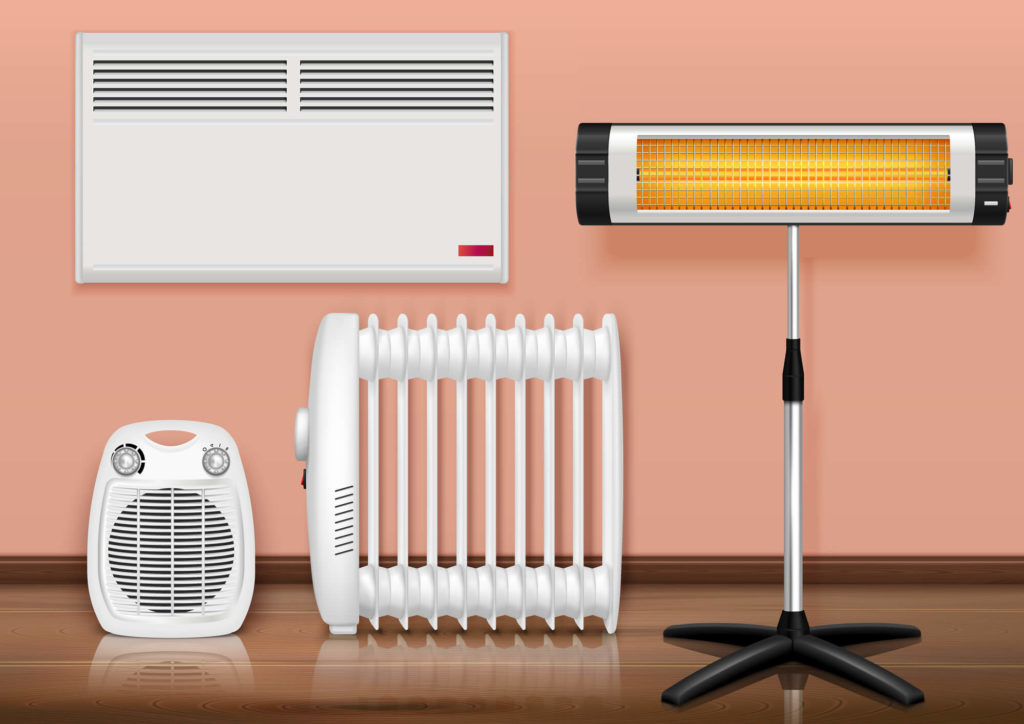
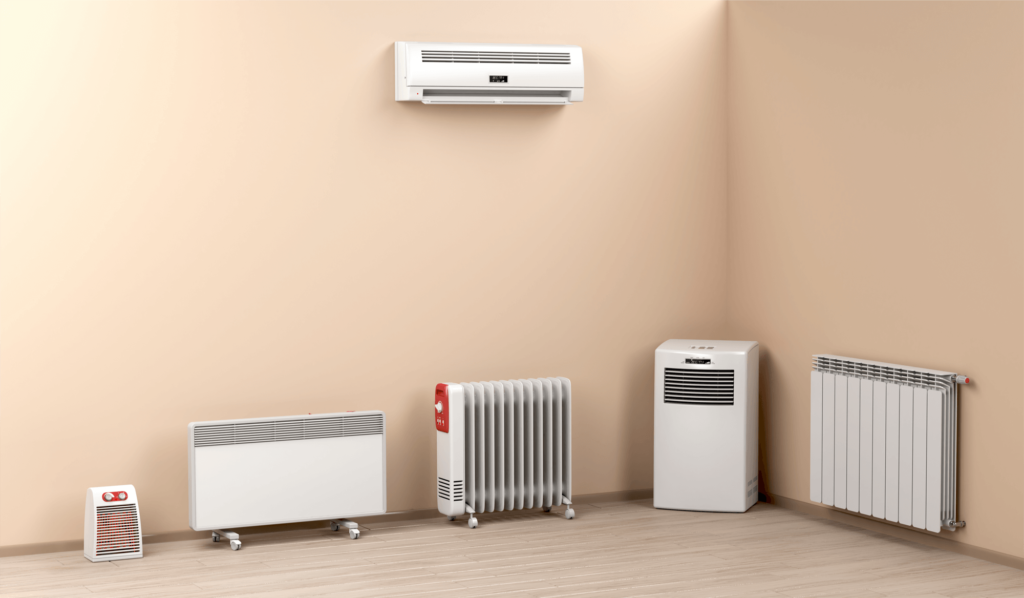
A fan heater gives fast warmth but cools quickly when switched off. An oil-filled radiator is slower but steadier. A convector warms air quietly. Infrared heaters warm people and surfaces directly, which can be useful in draughty or open spaces.
All direct electric heaters are close to 100 percent efficient at turning electricity into heat at the point of use. The real difference is how effectively that heat reaches the person or room. For product context, see our guide to electric heaters.
Worked Examples
Small Home Office
A 9 m² room may need around 900W as a baseline. If it is well insulated and used for short periods, a 1 kW heater may be enough. If it has a cold external wall and draughty window, 1.5 kW may be more realistic.
Medium Bedroom
A 14 m² bedroom may need around 1.4 kW. A 1.5 kW oil-filled radiator or convector may suit steady evening use, while a fan heater may suit short bursts but feel less comfortable overnight.
Large Living Room
A 24 m² living room may need more than one plug-in heater or a fixed heating solution. A single 2 kW portable heater may improve a seating area but struggle to heat the whole room evenly.
Running Cost And Safety
Electric heater running cost is wattage multiplied by time and tariff. A 2 kW heater uses 2 kWh per hour at full output. Thermostats and timers reduce run time, but they do not change the maximum draw when the heater is on.
Keep portable heaters away from curtains, bedding and furniture, do not cover them and avoid poor-quality extension leads. For cost detail, our guide to electric heater running costs explains the calculation.
When A Heater Cannot Solve The Problem
If a correctly sized electric heater still struggles, the issue may be heat loss rather than heater output. Large windows, uninsulated floors, open staircases, draughty doors and high ceilings can lose heat faster than a portable heater can comfortably replace it.
In that situation, adding more wattage may only raise running costs. Improve draught-proofing, close doors, use curtains, check insulation and consider whether fixed heating would distribute heat better. For open-plan rooms, two smaller heaters positioned sensibly can sometimes feel better than one heater trying to warm the entire space from a corner.
Safety also limits sizing. Many domestic plug-in heaters top out around 2 kW to 2.5 kW because they draw a high current. If a room genuinely needs more than that regularly, it is usually time to look at fixed heating design rather than daisy-chaining portable appliances.
Adjustment Factors Competitors Usually Include
The 100W per square metre rule is useful only for an average room. For a more realistic estimate, adjust the baseline before buying. Add roughly 10 to 20 percent for high ceilings, large windows, rooms with two or more external walls, or a room above a garage. Add 20 to 30 percent if the room is noticeably draughty or poorly insulated. Reduce expectations only where the room is small, internal, well insulated and used for short periods.
| Room Condition | Adjustment To Baseline | Why It Matters |
|---|---|---|
| Average insulated room | Use baseline | 100W/m² is a reasonable starting point |
| High ceiling | Add 10 to 20% | More air volume needs heating |
| Large windows or external walls | Add 10 to 25% | More heat is lost through cold surfaces |
| Draughty or poorly insulated room | Add 20 to 30% or fix heat loss first | The room may lose heat faster than a portable heater can replace it |
| Top-up heating only | May use less than calculated | The main heating is already doing part of the work |
Watts, Kilowatts And BTU Conversions
Electric heaters are normally sold in watts or kilowatts. One kilowatt is 1,000 watts. If a guide or calculator uses BTU, 1 watt is approximately 3.41 BTU per hour. That means a 1.5 kW heater is about 5,100 BTU/h, and a 2 kW heater is about 6,800 BTU/h.
Do not let conversions make the decision look more precise than it is. Heat loss is still the real issue. A calculated 1.8 kW requirement does not mean a 1.8 kW heater will perform well in a room with a door left open to a cold hallway.
More Worked Examples
Box bedroom, 7 m²: baseline output is about 700W. A 750W to 1 kW heater may be enough if the room is insulated and the door is closed. If the room has a cold external wall and single glazing, a 1 kW model is more realistic.
Home office, 11 m²: baseline output is about 1,100W. Because desk work is sedentary, comfort may require a 1.2 to 1.5 kW heater, or a smaller targeted heater close to the desk if the room already has background heat.
Open-plan kitchen living area, 28 m²: baseline output is about 2.8 kW, which is beyond many single plug-in heaters. In this case, one portable heater is unlikely to heat the whole space evenly. Fixed heating, zoning or multiple properly placed heaters may be needed.
Placement Changes The Result
Competitor guides often focus on wattage, but position matters too. A heater tucked behind furniture or placed in a corner can create a warm pocket while the room remains cold. Keep airflow clear, avoid blocking intakes and outlets, and place convection or fan heaters where warm air can circulate.
In bathrooms, use only heaters designed and installed for bathroom zones. For portable heaters, Electrical Safety First advises care with extension leads and high-load appliances. A correctly sized heater is still unsafe if it is placed near bedding, curtains, towels or wet areas.
Expert Insights From Our Heating Engineers
Our engineers use simple wattage rules only as a starting point. The proper question is heat loss: how quickly does the room lose heat through walls, windows, floors, ceiling and draughts? Two rooms of the same size can need very different heater outputs.
They also warn that plug-in heaters are often used to compensate for heating-system faults. If one room needs a 2 kW heater every evening while the rest of the house has central heating, check radiator output, balance, insulation and draughts before accepting the running cost as normal.
Frequently Asked Questions
How Many Watts Do I Need To Heat A Room?
A common starting point is around 100 watts per square metre for an average room. A 10 m² room may need about 1,000W and a 20 m² room about 2,000W. Adjust for insulation, draughts, ceiling height and glazing.
Is A 2 kW Heater Enough For A Living Room?
A 2 kW heater may be enough for a small or medium living room with reasonable insulation, but it may struggle in a large, draughty or open-plan space. It can still work well as targeted heat near a seating area.
Can An Electric Heater Be Too Powerful?
Yes. An oversized heater can make a small room uncomfortable, cycle on and off frequently or encourage wasteful use. Most thermostatic heaters can control temperature, but matching output to the room is still better for comfort and running cost.
What Size Electric Heater Do I Need For A Bedroom?
Many small to medium bedrooms need between 1 kW and 1.5 kW as a rough guide, depending on room size and insulation. For overnight use, choose a stable heater with thermostat and safety features rather than relying only on maximum output.
Do Infrared Heaters Need The Same Wattage?
Not always. Infrared heaters warm people and surfaces directly, so they can feel effective at lower wattage in targeted areas. They are less suitable if you need to raise the air temperature evenly throughout a whole enclosed room.
Should I Use An Electric Heater As Main Heating?
Electric heaters can be main heating in some small or well-insulated spaces, but running costs can be high if used for long periods. For regular whole-room heating, consider insulation, fixed controls, radiator sizing or other heating options before relying on portable units.
Summing Up
To size an electric heater, start with around 100W per square metre, then adjust for insulation, glazing, draughts, ceiling height and use pattern. A simple chart helps, but real comfort depends on heat loss, heater type, placement, controls and running time.
Updated